Fingerprint and Biomarker Analysis: Raising the Value of Agricultural and Community Products
Fingerprint and Biomarker Development Service by TIBD
Fingerprint and Biomarker Development Service by TIBD
Description
In today’s competitive markets, differentiation is a key task for agricultural and community products. Government agencies, local communities and entrepreneurs all want to add value to their products and make them stand out as trustworthy, not only through basic quality but through a distinctive identity that can be proven in concrete terms.
One increasingly popular approach is to use a “Fingerprint” (a scientific signature or specific code) and “Biomarkers” (biological marker compounds) to analyse and confirm a product’s distinctive characteristics in depth. This gives consumers and stakeholders greater confidence that the product is genuinely different and linked to its geography or production culture, which may relate to a Geographical Indication (GI) or other standards in the future.
It should be stressed, however, that “measuring biomarkers or building a fingerprint” is not a mandatory requirement for every GI registration. Producers can often apply for a GI based on the product’s history, local culture, or physical and sensory characteristics. Still, scientific evidence that “may” confirm distinctive characteristics can greatly add credibility and value to a product.
In this article, TIBD Co., Ltd., as an innovation and business development consultant, introduces how Fingerprint/Biomarker analysis can be used as a tool to raise the profile of agricultural and community products. We explain the basics, benefits and potential of this approach, together with how TIBD can support different sectors in reaching their goals.
Fingerprint and Biomarker: Meaning and Benefits
Definition of “Fingerprint”
In the context of agricultural or community products, a “Fingerprint” is a scientific signature or specific code derived from a product’s chemical compounds, microorganisms, physical characteristics or composition ratios. It may help indicate the product’s origin and distinguish products from different geographies or varieties. The approach usually relies on laboratory analysis such as spectroscopy and chromatography, together with data analysis using bioinformatics.
Definition of “Biomarker”
A “Biomarker” is a compound or set of compounds (such as proteins, enzymes, organic compounds or phenolic molecules) found in plants or animals and linked to specific product characteristics, such as taste, aroma, colour, antioxidant activity or health-related properties. Measuring biomarkers can therefore indicate the quality and uniqueness of a community product.
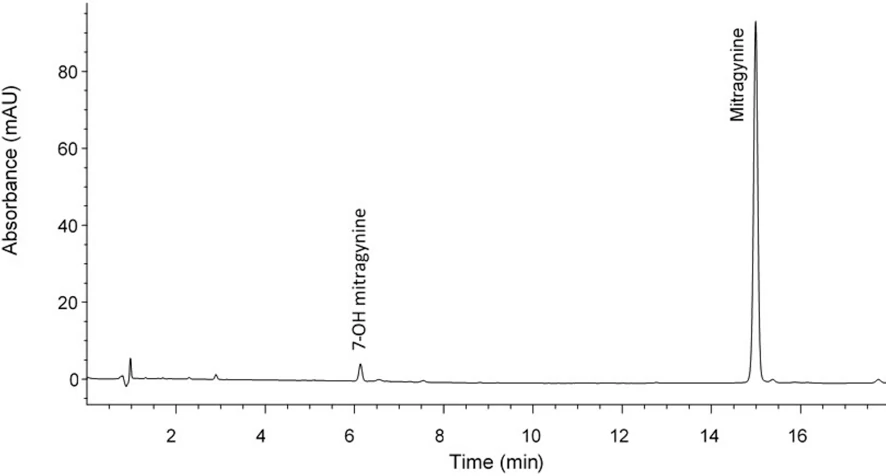
Example of a Mitragynine analysis report using HPLC. The figure shows the chromatogram of Mitragynine.
Benefits of Fingerprints/Biomarkers for Agricultural and Community Products
- Proof of authenticity: helps prevent counterfeiting or misuse of a product’s name by showing the specific code of genuine products from the local source.
- Greater credibility in international markets: today’s consumers value scientific data. Biomarker test results make a product more credible and support a higher price.
- Continuous research and development: once producers know which components or production steps affect the biomarkers, they can improve varieties or processes for consistently better quality.
- May support GI or other certifications: not a mandatory condition, but an option that adds weight to quality and characteristic evidence when applying for certification.
Contact TIBD Co., Ltd. through any channel. Our team is ready to listen and recommend suitable R&D approaches so your agricultural or community products can truly stand out.
How Fingerprints/Biomarkers Relate to GI Registration
What is a GI (Geographical Indication)?
Under Thailand’s Geographical Indication Protection Act B.E. 2546 (2003), a geographical indication is a symbol, name or sign that identifies the geographical origin of a product and tells consumers that products from that origin have particular quality, reputation or characteristics due to the geography and traditional production methods.
Is biomarker measurement required for GI registration?
- Measurement is not always required. Many GI applications focus on history, culture, traditional production methods, climate and sensory evaluation (taste, aroma, colour) without in-depth compound analysis.
- However, scientific data can serve as supporting evidence. Producers or agencies that want stronger proof can use Fingerprint/Biomarker analysis to demonstrate chemical or biological quality and identity, for example the key aroma compound of fragrant rice or phenolic compounds in coffee.
Benefits of using biomarkers to support GI documents
- Stand out from competitors: when products from several areas have similar names, a “chemical fingerprint” can make yours more distinctive.
- Prepare for international markets: biomarker data may be required in some countries with strict food regulations, or used as additional reference documents for export.

TIBD Services: End-to-End Fingerprint/Biomarker Development
Why choose TIBD
TIBD Co., Ltd. combines scientific expertise with marketing and innovation. Our team has experience in R&D, laboratory analysis, branding and business development, so we can provide complete consulting and a true one-stop service.
Core scope of services
- Product assessment: understand the needs of the producer or agency and the purpose of establishing the product’s scientific identity.
- Research planning and design: the TIBD team defines suitable analytical methods, such as aroma compound measurement, microbial profiling or antioxidant detection.
- Sampling and laboratory testing: we work with accredited partner laboratories equipped with modern analytical instruments.
- Results and recommendations: we interpret the findings in an easy-to-understand format and highlight the product’s strengths and areas for improvement, for use in both quality and marketing.
- Product development and branding: TIBD also offers brand identity design, storytelling and strategic marketing.
Benefits for Government Agencies and Communities
Government agencies
- Build a scientific database of local products: create a database of biomarkers or fingerprints for key products in each province to promote the community economy.
- Support GI or other certifications: when communities apply for a GI or international quality standards, agencies have scientific data ready to support them.
Communities and farmer groups
- Improve product quality: knowing which components drive quality and identity allows targeted improvements in cultivation, harvesting or processing.
- Expand market opportunities: presenting a scientific “signature” attracts consumers looking for distinctive products and may support higher prices.
Entrepreneurs (SMEs, startups and processing plants)
- Differentiate in highly competitive markets, especially for agricultural and processed products where consumers care about quality and origin.
- Prepare for export: many markets require in-depth test results or international standards. Fingerprint/Biomarker data makes trade negotiations easier.
Applying Fingerprints/Biomarkers in Agriculture and Communities
Thai Hom Mali rice
Thai Hom Mali rice is world-famous for its aroma and taste. One biomarker for its fragrance is 2-acetyl-1-pyrroline (2AP), which may be used to confirm the identity of Hom Mali rice from specific areas, for example by profiling 2AP in growing areas with different soil and climate. Clear 2AP criteria could help communities or agencies communicate that “genuine Hom Mali rice from this area has 2AP levels higher than or within the range of…”.
Note: If this data is used in GI documents, it may need to be combined with historical, cultural and sensory evaluation data, and measurement is not required in every case. It depends on the applicant’s strategy.


Highland coffee
Coffee from the mountains of northern Thailand, such as Doi Chang and Doi Tung, has a distinctive taste. Measuring phenolic compounds or antioxidants such as chlorogenic acid may help confirm standards and flavour profile differences. Studying the microorganisms in the soil or in the coffee fermentation stage may also provide a microbiological “fingerprint”.
Fermented drinks and processed fruit products
For these products, unique local microbial strains may play an important role in aroma and flavour, for example in fermented drinks, pickled fruit, fruit wine, cider or traditional fermented vinegar. Communities can study and isolate microorganisms found in their area to build a microbiological fingerprint that no other source shares. This data makes the brand story more interesting and credible.
Observation: All of these examples are approaches that producers or agencies may choose to use. They do not mean that every GI registration actually measures these compounds.

Working with TIBD
- Initial contact: share product details, objectives and budget. TIBD will first assess feasibility.
- R&D strategy: our team designs research and biomarker/fingerprint analysis methods suited to the product type and growing area.
- Sampling and laboratory testing: using standard analytical instruments such as HPLC, GC-MS or other biological assays as needed.
- Interpretation and marketing communication: we summarise the insights in an easy-to-understand format and recommend how to communicate them to consumers.
Building Branding and Corporate Identity
Once fingerprint/biomarker data is available, the story about the product’s distinctive character and geography becomes more credible because it is backed by science. TIBD can help producers turn this data into a clear, distinctive brand identity, for example:
- Storytelling about key molecules, such as “Our Hom Mali rice stands out with 2AP levels that may be … times higher than average, giving it a unique fragrance.”
- Value-based marketing: show that the product is made with environmentally friendly processes or reflects local wisdom.
- Packaging design that expresses identity: create a logo or symbol related to the compound or microorganism that is the product’s “signature”.
- Support for international markets: scientific data behind the brand builds international confidence and increases export opportunities.
Turning Agricultural and Community Products into Sustainable Businesses with Science
Fingerprints and biomarkers are scientific tools that “may” help agricultural and community products gain clearer value and differentiation. Although GI registration and branding do not require every product to measure compounds, producers or agencies that want to strongly emphasise quality and authenticity can use biomarker/fingerprint studies as solid evidence.
If you are interested in TIBD services
Want advice on Branding or Corporate Identity
Want to expand into the market with a market feasibility study

Apply for Fingerprint and Biomarker Development Service by TIBD
If you have any questions or would like to receive a free consultation regarding Fingerprint and Biomarker Development Service by TIBD, or if you would like to visit us in person in Bangkok, Thailand, you are warmly welcomed and feel free to contact us via the contact form below.