Plasma Innovation Wins TECH PLANTER Thailand 2026
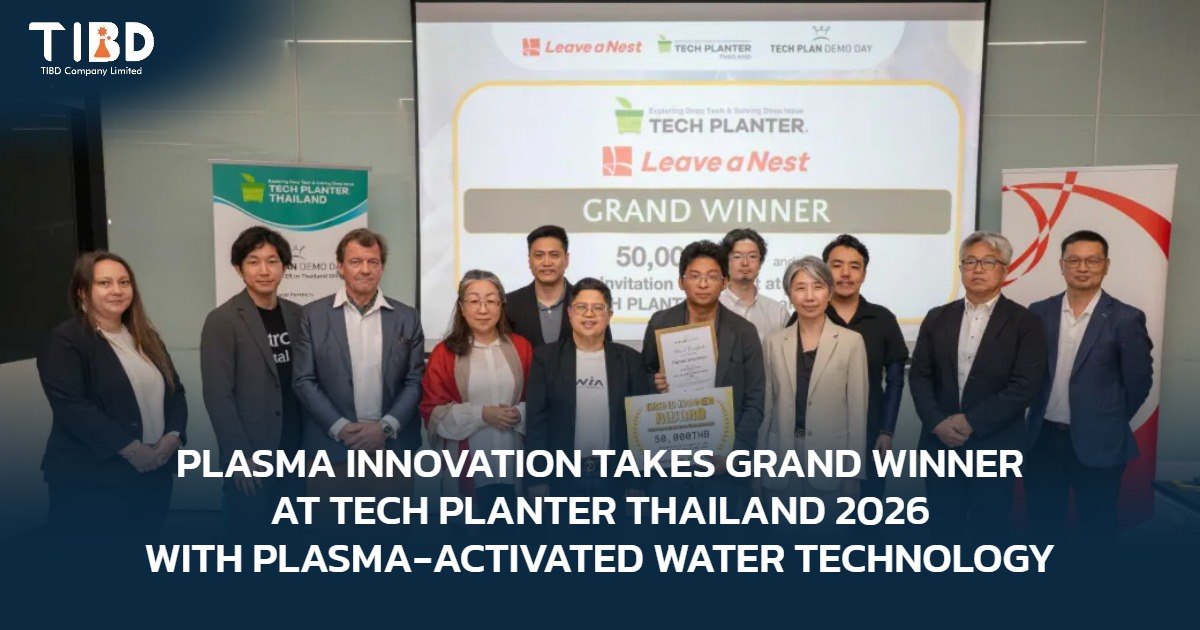
Plasma-activated liquid technology takes first place from 46 teams nationwide, earning a place at the Asia final — and a closer look at what plasma-activated water is, where it can be used, and why the result matters to Thai industry.
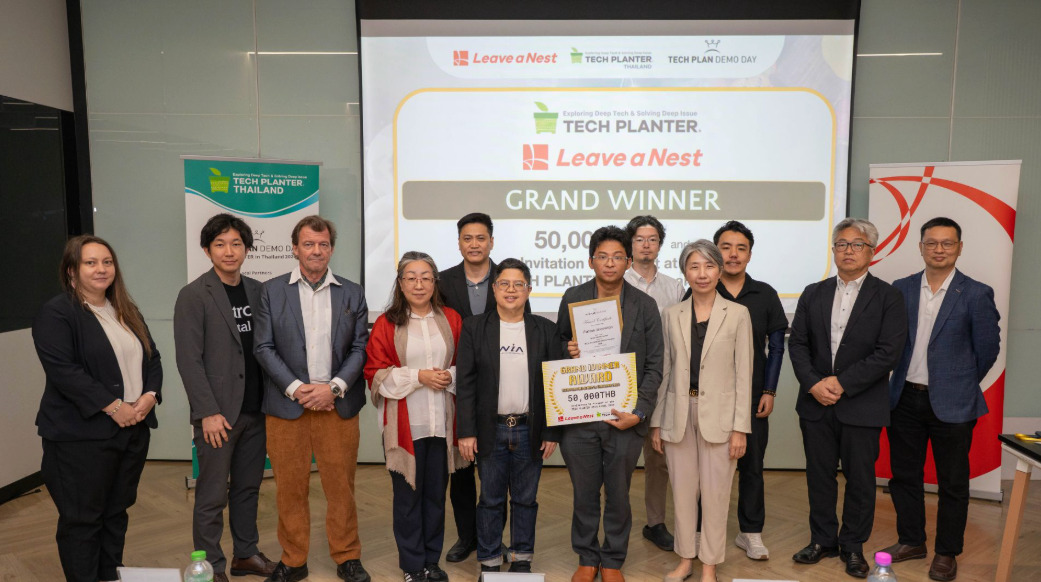
On 18 July 2026, at the Chaloem Rajakumari 60 Building, Chulalongkorn University, the Plasma Innovation team won the Grand Winner award at TECH PLANTER Thailand 2026 Demo Day, organised by Leave a Nest Singapore. TIBD Co., Ltd. extends its congratulations to the team on this achievement. The award-winning work is a plasma-activated liquid (PAL) technology for reducing microbial contamination and for processing that uses fewer chemicals.
TECH PLANTER: A Platform for Taking Deep-Technology Research into Real Use
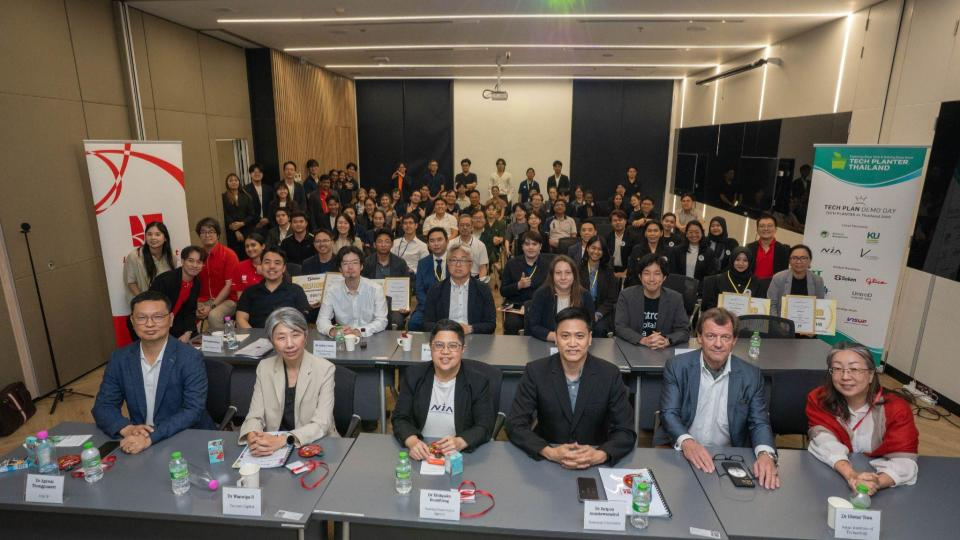
TECH PLANTER is a platform for teams taking deep-technology research into real use, run by Leave a Nest, a Japanese organisation that works between research and industry across several countries in Asia. It differs from an ordinary business plan competition in that it weights the depth of the technology and the realistic prospect of using it, rather than how interesting the idea sounds.
Thailand’s 2026 round drew 46 entries, narrowed to 9 teams in the final, alongside 6 Lightning Talk teams and 14 poster presentations. As Grand Winner, the Plasma Innovation team received the Grand Winner award of TECH PLANTER Thailand 2026, a prize of 50,000 THB, and a place at TECH PLANTER Asia Final 2026.
The team went on to present at TECH PLANTER Asia Final 2026, held on 27 August 2026 at MRANTI Innovation Park, Kuala Lumpur, Malaysia, as one of 14 finalist teams from across Southeast Asia and Japan.
The official announcement gave the judges’ reasoning as follows:
“The technology offers an innovative solution for food safety, agriculture, and healthcare by utilizing plasma-activated liquids to reduce microbial contamination while minimizing chemical usage, demonstrating strong commercialization potential and significant societal impact.”
— Official announcement, TECH PLANTER by Leave a Nest
Three things stand out in that assessment. The technology is placed across food safety, agriculture and health care rather than inside a single sector; the reduction in chemical use is counted as part of the value rather than a side effect; and the commercial path is weighed alongside the science, which is the criterion that separates this stage from a research competition.
What Plasma-Activated Water Is
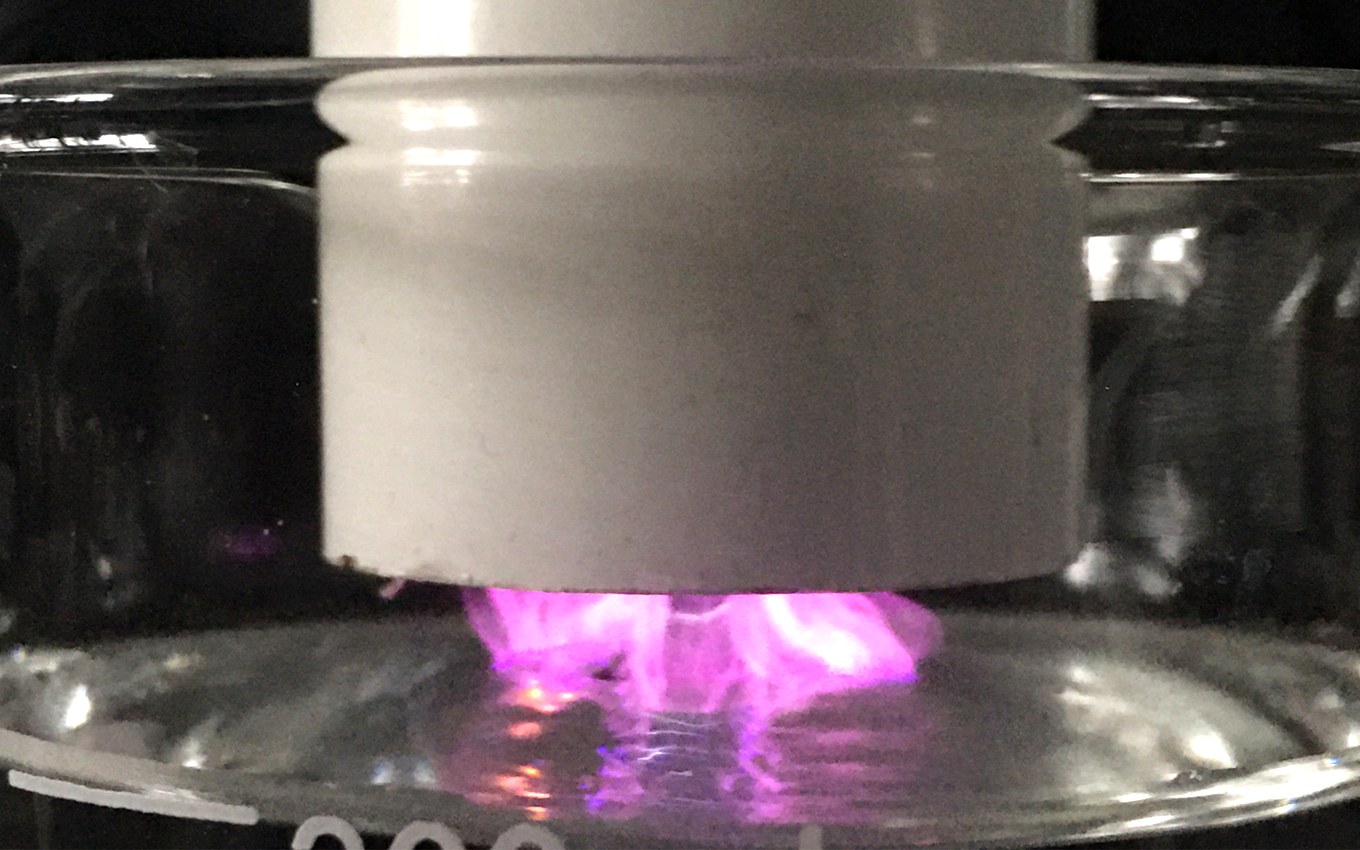
Plasma-activated water (PAW) is water that has been in contact with cold plasma until reactive oxygen and nitrogen species dissolve into it, turning ordinary water into a liquid with activity against microorganisms, without a disinfectant chemical being added from outside. When the starting liquid is something other than plain water, an organic acid solution for instance, the group is called plasma-activated liquids (PAL), which are more stable and allow finer control of their properties.
Production starts by generating cold plasma in air at atmospheric pressure, then bringing that plasma into contact with the water surface. The species formed dissolve in and change the water’s properties: its pH, its oxidation-reduction potential, and its surface tension.
The key properties of plasma-activated water follow from this mechanism. It is active against microorganisms without a disinfectant chemical added from outside, and its strength is controlled by adjusting the time and the energy used to generate it. The species formed have a limited lifetime, so the window of use has to be designed for. And because it is made from water and electricity, there is no hazardous chemical to transport or store.
Where Plasma-Activated Water Is Used
Washing fresh produce and extending shelf life. Washing fresh produce with plasma-activated water is one of the best-supported groups of work in the research, because it answers two things at once: it reduces microorganisms on the surface, and it reduces reliance on chemicals in the washing step, which bears directly on both safety and the cost of handling wastewater.
Seed and cultivation. Plasma-activated water is used to soak seed, both to reduce seed-borne organisms and to stimulate germination. The nitrogen species formed in the water are also of interest as a source of nitrogen for plants, a research direction drawing attention in several countries.
Production processes in the factory. On a production line, plasma-activated water is treated as an option for cleaning steps that previously required a chemical. Its strength is that it is made on site from water and electricity, which reduces the burden of storing and disposing of chemicals.
Putting it to work in any given industry still requires conditions designed and tested case by case, together with the requirements of the relevant regulatory authorities.
Behind the Work
This work builds on cold plasma research by Assoc. Prof. Dr. Siwapon Srisonphan, Department of Electrical Engineering, Faculty of Engineering, Kasetsart University. Assoc. Prof. Dr. Siwapon holds a PhD in electrical and computer engineering from the University of Pittsburgh and a master’s degree from the University of Texas at Austin on a Ministry of Science and Technology scholarship. He has around 21 publications in first-quartile journals, covering both nanoelectronics and the application of plasma in agriculture and biology.
What makes this group of technologies interesting industrially is that it does not need the expensive vacuum systems the semiconductor industry uses, which lowers the cost of entry considerably, and it can be designed to work alongside an existing production line.
In an earlier interview, Assoc. Prof. Dr. Siwapon described the question he set himself on returning from his studies in the United States (translated from Thai):
“How do we make plasma technology easy to get hold of, and easy to use?”
— Assoc. Prof. Dr. Siwapon Srisonphan
This award is one sign that the question is starting to have an answer that can be put to practical use.
Other Teams Awarded This Year
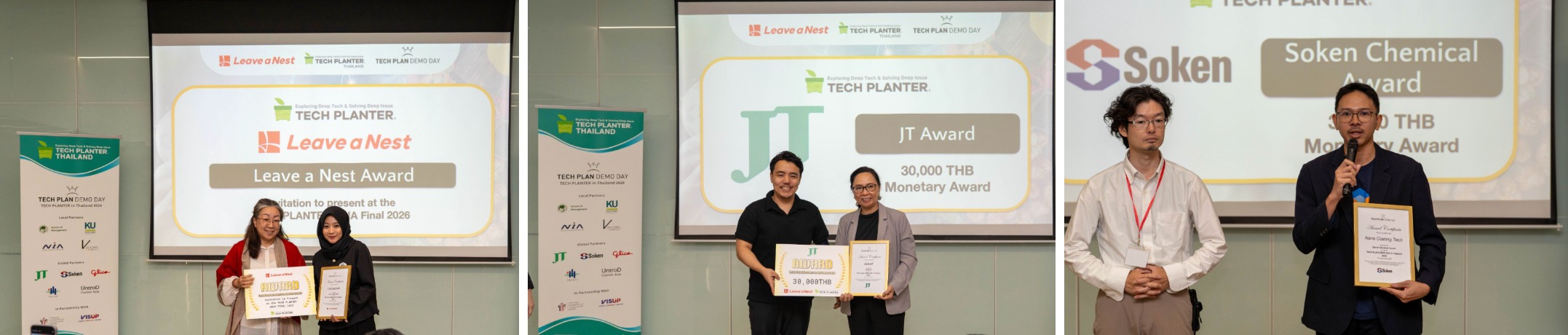
Alongside the Grand Winner, TECH PLANTER Thailand 2026 gave three further awards.
| Award | Team | What they receive |
|---|---|---|
| Grand Winner | Plasma Innovation Co., Ltd. | 50,000 THB and a place at TECH PLANTER Asia Final 2026 |
| Leave a Nest Award | GlycoSphere | A place at TECH PLANTER Asia Final 2026 |
| JT Award | Hillkoff Co., Ltd. | 30,000 THB |
| Soken Chemical Award | Nano Coating Tech Co., Ltd. | 30,000 THB |
How Plasma-Activated Water Compares with Other Ways of Reducing Microorganisms
The first question an operator asks is where it is better than what is already in use. The table below shows what each method trades against what, not which method is best, because the answer depends on the process in each plant.
| Method | Chemical added | Heat used | Limits to manage |
|---|---|---|---|
| Heat or blanching | No | Yes | The quality, colour and texture of fresh produce change. |
| Disinfectant chemicals | Yes | No | Residues and wastewater have to be managed, with a continuing chemical cost. |
| UV light | No | No | Works only on surfaces the light reaches; shaded areas are not treated. |
| Plasma-activated water (PAW) | No | No | Activity falls with time, so the point of use has to be placed close to the point of generation. |
Practical Considerations for Industrial Use
Compared with chlorinated water, which requires a chemical to be added and leaves residues to manage, plasma-activated water generates its activity from water and air using electricity, and the species formed decay over time. The two are therefore handled in quite different ways; each has its own advantages and limits, and the choice has to suit the process.
The species that carry the activity have a limited lifetime and decline over time. How long plasma-activated water remains usable in practice depends on the conditions of generation and storage, so it has to be set from test results for each system rather than from a single figure that holds everywhere. For the same reason, the workable arrangement is mostly generation at the point of use, with a generator installed in the production line, rather than buying it by the tank and storing it. The size of the system depends on how much water that process uses per day.
Reducing microorganisms on the surface of produce slows spoilage, so the technology does bear on shelf life. How many days it extends, however, depends on the type of produce, the conditions used, and temperature control afterwards, so it has to be tested on the actual produce before any number is stated. For operators, the starting point is to define the problem precisely — where in the process the contamination occurs and what the chemical cost is — then to assess whether this group of technologies suits the problem, before designing a small test to prove the result.
Why This Award Matters to Thai Industry
Thailand has a reasonable body of cold plasma research, in universities and in state research bodies. What has been missing is the crossing from research into real use on a production line. That gap does not come from weak science. It comes from scale-up, from designing conditions that fit a real process, and from finding a business partner whose problem actually matches — a different set of skills from getting the research to work.
A Thai plasma project being chosen as Grand Winner on a platform that weights commercial potential is therefore a signal that this group of work has reached the point where regional judges can see a route to market.
What Comes Next
This award is not a finish line. It is a signal that Thai cold plasma research has reached the point where a route to market is visible. The next problem is scaling production and matching the technology to real problems in industry — the stage a great deal of research never reaches, and the stage in which TIBD works.
TIBD works alongside researchers and technology owners so that research carries on from the laboratory through to a real production line. The company’s first step with any operator is to assess together whether the problem genuinely suits the technology, and if it does not, to say so at the outset — building a foundation for long-term collaboration between Thai research, technology owners and industry.
Interested in Applying Cold Plasma or Plasma-Activated Water with TIBD?
Operators interested in using cold plasma or plasma-activated water in their own process or product can discuss initial feasibility with the TIBD team, even at a stage where no data is yet available, via LINE Official Account @tibdglobal or the contact form at tibdglobal.com/contact. More information is available on the Cold Plasma and cold plasma services pages.
Related reading: Plasma-activated water as a source of plant nutrients · Extending the shelf life of fresh produce with cold plasma · What is cold plasma — an interview with Assoc. Prof. Dr. Siwapon Srisonphan
Sources: Competition results are taken from the official announcement by TECH PLANTER by Leave a Nest, published 22 July 2026. Asia Final details are taken from the TECH PLANTER Asia Final 2026 report, published 28 August 2026. Event photographs courtesy of TECH PLANTER by Leave a Nest. Researcher background from the Faculty of Engineering, Kasetsart University website and the researcher’s CV. Technical descriptions compiled from interviews and the research team’s technical documents.