Bromelain Buying Guide: Why GDU Matters More Than Percentage and Price per Kilogram
Written by the TIBD Co., Ltd. consulting team
Pineapple is one of Thailand’s major economic crops. According to the Thai Government Public Relations Department, the 2023 harvest was forecast at about 1.65 million tonnes, with roughly 72% going to processing plants for export [1]. Thailand is also the world’s largest exporter of canned pineapple, with about 32% of the global market [1].
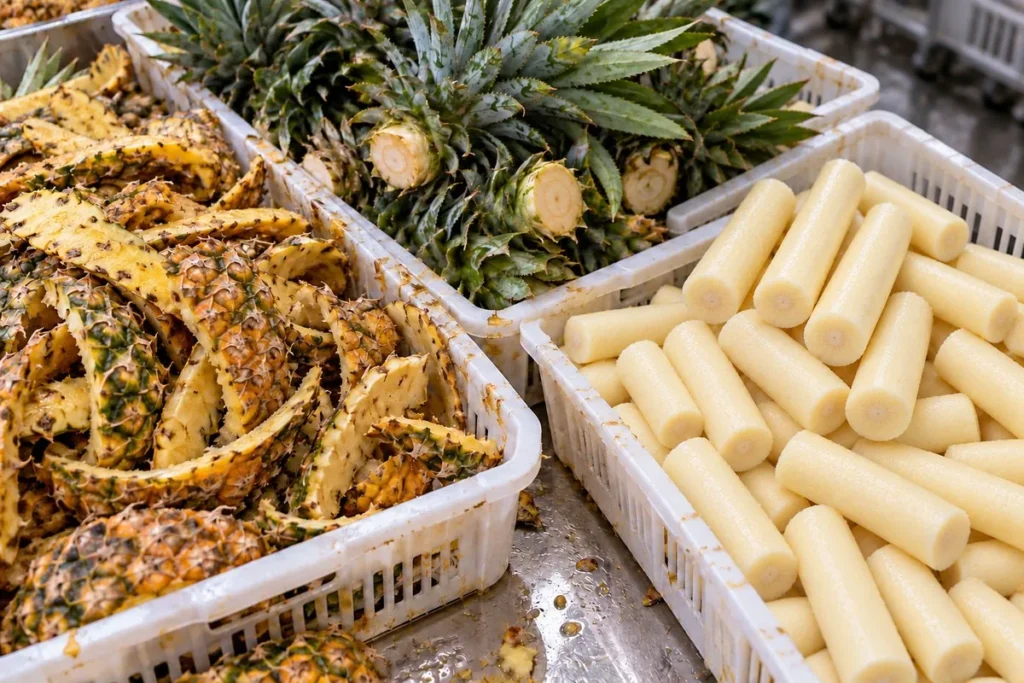
Where there is large-scale processing, there are large volumes of by-products. Peel, core, stem and crown are all sources of bromelain, a protein-digesting enzyme used in food, dietary supplements and cosmetics.
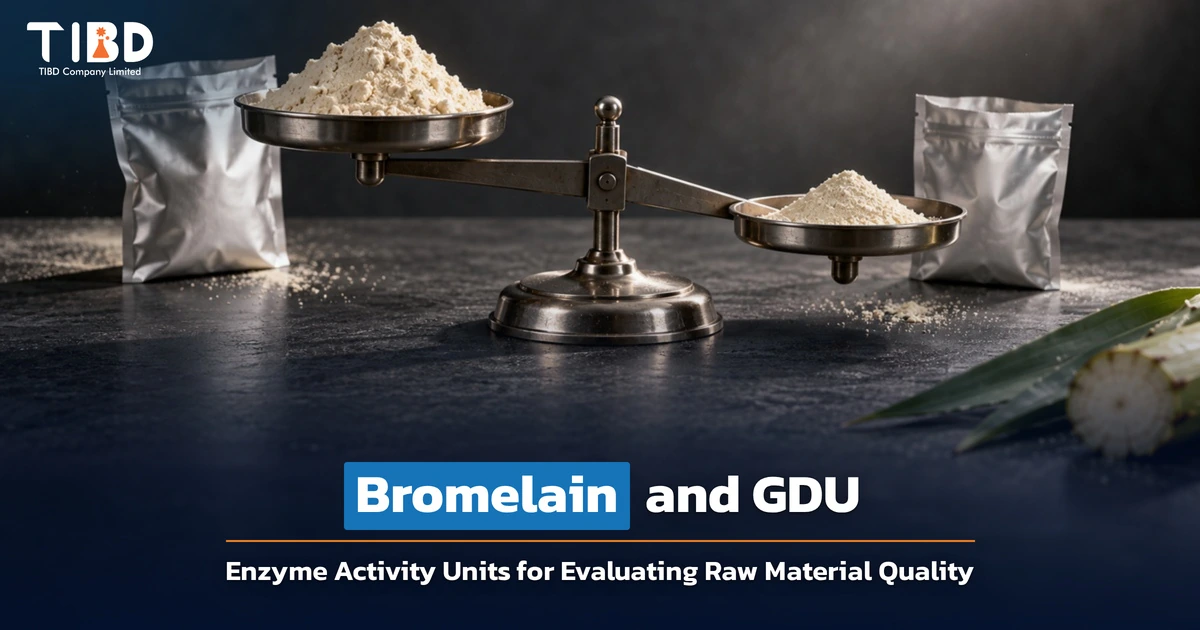
In practice, however, many brand owners still buy bromelain powder the same way they buy plant extracts: by comparing the “percentage” and the “price per kilogram”. Yet the figure that best describes the value of an enzyme is its enzyme activity unit, such as GDU.
This article explains what GDU is, why two bags of powder that look the same can differ several-fold in value, which production factors destroy enzyme activity, and how purchasing and R&D teams should read a specification and COA before buying.
Thai Pineapple By-products: A High-Value Enzyme Source
A Thai study of by-products from the Nang Lae and Phu Lae pineapple cultivars reported the following share of by-products by weight [2]:
- Peel: 29–42%
- Core: 9–10%
- Stem: 2–5%
- Crown: 2–4%
Crude extracts from every part showed proteolytic activity, and the crown extract gave the highest proteolytic activity and protein content in that study [2]. This shows that bromelain is not found only in the stem. By-products that were once a disposal burden can become value-added raw materials when the extraction process is designed properly.
In industry, bromelain is usually grouped into two main types by source:
- Stem bromelain (EC 3.4.22.32), the form referenced in the US FDA regulation [4]
- Fruit bromelain (EC 3.4.22.33), found in the fruit flesh and related parts
The two types differ slightly in structure and substrate specificity, so the source (stem, fruit or which by-product) should always be stated in the specification when buying raw material.
What Is Bromelain, and Why Its Value Lies in “Working Ability”
Bromelain is a group of protease enzymes of the cysteine protease type, named after the thiol group of the amino acid cysteine in the active site [3]. In practice, the “bromelain” sold commercially is an enzyme complex made up of several endopeptidases together with other enzymes and carbohydrate compounds [3].
The main function of bromelain is to cleave the peptide bonds of proteins. In the United States, bromelain is affirmed as GRAS (Generally Recognized as Safe) for use as a proteolytic enzyme in food under 21 CFR 184.1024 [4].
The key point is that an enzyme is a protein that works only while it keeps its three-dimensional structure. If that structure is denatured, the powder weighs the same, but its ability to digest protein falls or disappears. This is why “weight” or “percentage” alone cannot describe the value of an enzyme.
Enzyme Activity Units: What GDU Is and How It Differs from Other Units
What is GDU (Gelatin Digesting Unit)?
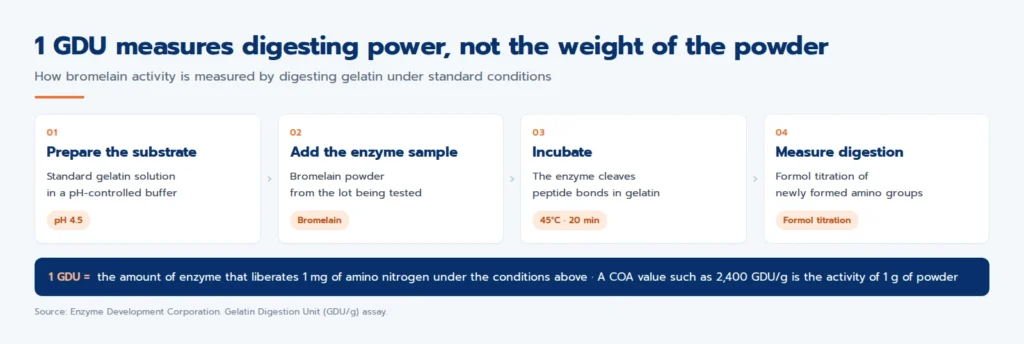
GDU is a unit that measures an enzyme’s ability to digest gelatin under standard conditions. The analytical method used by enzyme manufacturers defines it as follows [5]:
1 GDU is the amount of enzyme that liberates 1 milligram of amino nitrogen from a standard gelatin solution at pH 4.5 and 45°C in 20 minutes
The assay uses formol titration to measure the new amino groups released by digestion [5]. Values on documents are usually reported as GDU/g, the activity per gram of powder.
Other units you may see in supplier documents
| Unit | Full name | Measured by | Notes |
|---|---|---|---|
| GDU/g | Gelatin Digesting Units | Gelatin digestion | Common for supplement-grade raw materials |
| MCU/g | Milk Clotting Units | Milk clotting | Used by some manufacturers |
| FCC PU/g | Papain Units per the Food Chemicals Codex | Protein digestion by the FCC method | Figures run into millions or tens of millions |
| U/g or CDU/g | Manufacturer-defined units | Often casein as the substrate | Always check the analytical method |
Note that these units cannot be converted precisely, because each enzyme cleaves peptide bonds at different sites and each substrate responds differently [6]. Some suppliers give approximate equivalents, for example bromelain at 2,000 GDU/g is roughly equal to 30,000,000 FCC PU/g [6], but such equivalents should be used for estimates only.
Recommendation: When comparing raw materials from several suppliers, specify one unit and one analytical method in the specification, or send every supplier’s sample to the same laboratory for analysis by the same method, such as the protease enzyme activity analysis service from VISBIO. The result may be reported in the laboratory’s own unit rather than GDU, but when every sample is tested the same way, the comparison is fair.
An Example: Two Bags of Powder That Look the Same but Differ in Value
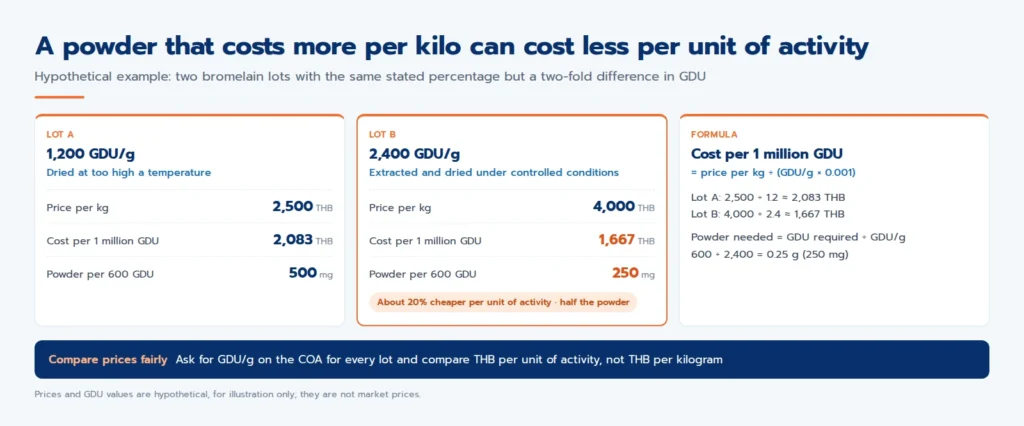
Suppose a brand receives quotations for two lots of bromelain powder with the same stated percentage and appearance. Lot A was dried at too high a temperature, so part of the enzyme was denatured. Lot B was extracted and dried under well-controlled conditions.
(The figures below are hypothetical for illustration; they are not market prices or reference activity values.)
| Item | Lot A | Lot B |
|---|---|---|
| Enzyme activity | 1,200 GDU/g | 2,400 GDU/g |
| Price per kilogram (hypothetical) | 2,500 THB | 4,000 THB |
| Total activity per kilogram | 1.2 million GDU | 2.4 million GDU |
| Cost per 1 million GDU | about 2,083 THB | about 1,667 THB |
| Powder needed for a formula calling for 600 GDU per serving | 500 mg | 250 mg |
Although Lot B costs more per kilogram, on a cost per unit of activity basis it is about 20% cheaper, and only half as much powder is needed to deliver the same activity.
The knock-on effects for product development are:
- Smaller capsules or tablets, leaving room for other actives in the formula
- Lower packaging and processing-aid costs, because less powder is used per serving
- Labels and documents that match reality, when the activity stated is the value actually measured for each lot
A formula you can use straight away:
Cost per 1 million GDU = price per kilogram ÷ (GDU/g × 1,000 ÷ 1,000,000)
Factors That Reduce Bromelain Activity
1. Heat: the variable that can destroy the enzyme permanently
A Thai study of fruit bromelain from the Pattavia (Smooth Cayenne) pineapple found that [7]:
- At 40°C, activity did not decrease over 60 minutes
- At 50°C, about 83% of activity remained after 60 minutes
- At 80°C, the enzyme was almost completely denatured within 8 minutes
A 2026 review reaches the same conclusion: bromelain is fairly stable when heated up to about 60°C and is strongly inhibited above 65°C [3]. Every heated step, from extraction and concentration to drying and downstream production, therefore needs clearly defined temperatures and times.
2. Drying method: freeze drying vs spray drying
A study comparing the drying of partially purified bromelain reported [8]:
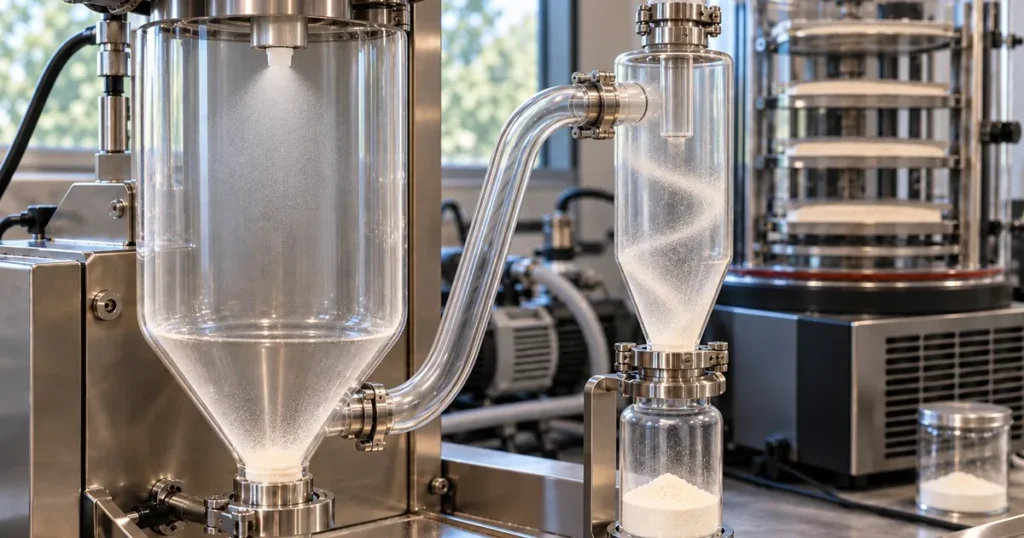
- Spray drying at an outlet temperature of 40–50°C gave a yield of about 50–70%
- Freeze drying gave a yield of about 96%
Freeze drying preserves activity better because water sublimes at low temperature, but it costs far more in energy and cycle time.
However, spray drying does not always mean lower quality. The outcome depends on control of the inlet and outlet air temperatures, the time particles are exposed to heat, and the use of a carrier or stabiliser such as maltodextrin. So the question to ask a supplier is not just “which drying method do you use”, but “what activity is measured after drying, and how long does it last?”
3. pH during extraction and in the formula
Crude bromelain extracts from Thai pineapple by-products kept more than 80% relative activity across pH 3–9, with an optimum temperature of about 50–60°C [2]. Above pH 10, however, the enzyme loses activity irreversibly [3]. Controlling the pH of the extraction buffer and of the final product formula is therefore as important as controlling temperature.
4. Moisture and storage
Enzyme activity in dry powder can still fall during storage, especially when the powder absorbs moisture or is stored somewhere hot. The literature reports that bromelain remains stable for long periods at −20°C [3], and cosmetic research recommends low-temperature storage, such as 4°C, to preserve activity [9].
In real trade, the specification should state the storage conditions and a shelf life backed by stability data, not a generic shelf-life figure with no supporting data. This data comes from a stability test and shelf-life study in which enzyme activity is re-measured at set intervals.
How to Read a Bromelain Powder Specification and COA Before You Buy
Before placing an order, purchasing, QC and R&D teams should check the documents against the following list:
- Activity with its unit, for example GDU/g, not just “Bromelain 90%” or “Purity 100%”
- The analytical method used, including the reference method, pH, temperature and substrate
- The specification range, for example not less than 2,400 GDU/g, rather than a single unqualified figure
- Lot-specific results on the COA that match the lot number actually delivered and show a clear analysis date
- The enzyme source: stem, fruit or which by-product, with the scientific name Ananas comosus
- Carrier or diluent: type and proportion, because it affects the activity per gram
- Moisture (moisture content or loss on drying), which is linked to stability during storage
- Safety quality: microbiology, heavy metals and residues according to the requirements of the target market
- Storage conditions and shelf life, supported by stability data on enzyme activity
Further recommendation: For the first lot received, send a sample to an independent laboratory to re-test the activity, to confirm that the COA value matches the real material and to set a baseline for monitoring later lots.
For enzymes used in food production, Thailand’s Ministry of Public Health Notification No. 443 (2023) requires enzyme activity to be not less than 85% of the declared activity [10]. Activity figures in documents must therefore be values that can actually be measured, not marketing numbers.
Design Your Own Production Process So It Does Not Destroy What You Bought
Buying high-activity bromelain powder is only half the job. The other half is designing the brand’s own production process so that activity is not lost before the product reaches the consumer.
Dietary supplements
- Hard capsules or tablets: avoid steps with high heat or long heat exposure
- Moisture in the formula: choose low-moisture excipients and control humidity in the production room
- Packaging: use moisture-barrier packaging and consider adding a desiccant
- Activity overage: set it from real stability data for the formula, not an estimate
- Stability monitoring: measure the GDU of the finished product at defined intervals
Skincare
In cosmetics, bromelain is used for enzymatic exfoliation, breaking down the keratin protein bonds of dead cells in the outer skin layer [9]. A cosmetic review reports a working pH range of about 5.5–8.0 and an optimum temperature of about 50°C, and notes that keeping the enzyme active in a formula depends on a balanced choice of stabilisers [9].
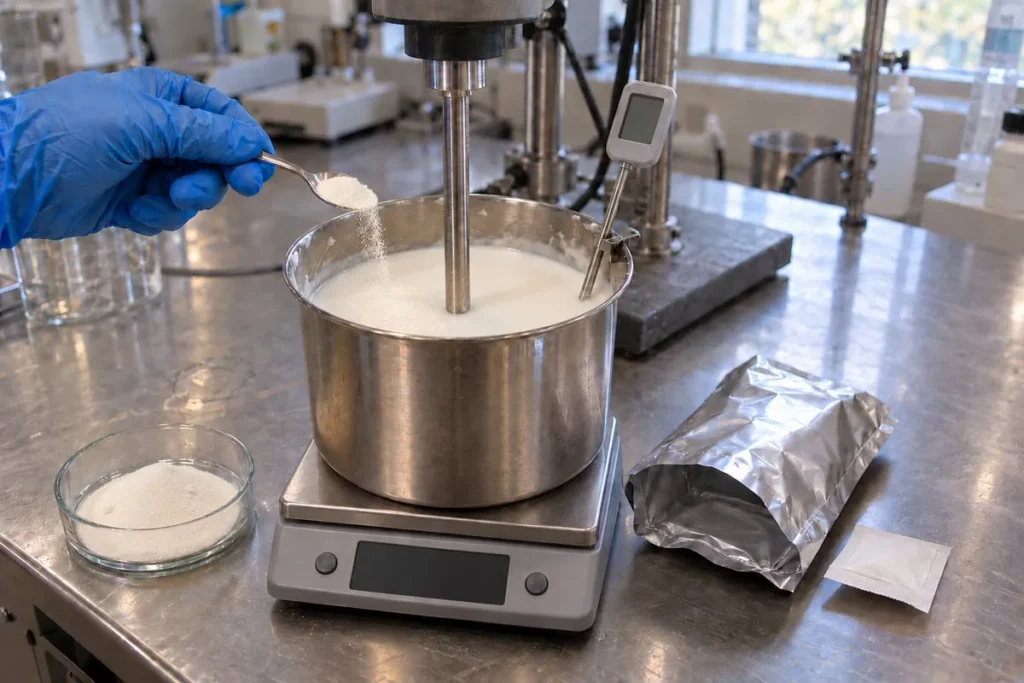
- Add the enzyme in the cool-down phase, not during a heated step
- Check compatibility with other ingredients, such as surfactants, preservatives and the pH of the formula
- Consider the product format: powders or anhydrous products reduce stability problems in water
- Test stability and skin safety before launch, because proteolytic enzymes may irritate some users
Regulatory and communication cautions
- Use as an enzyme in food production must comply with Thailand’s Ministry of Public Health Notification No. 443 (2023) on enzymes used in food production. Its annex lists both stem bromelain (EC 3.4.22.32) and fruit bromelain (EC 3.4.22.33) from the stem or fruit of pineapple (Ananas comosus) or red pineapple (Ananas bracteatus), for use in foods with protein raw materials, such as meat products, cereal products, protein hydrolysates and beer, at levels according to GMP [10]
- Dietary supplements and cosmetics must not be promoted with claims to treat, relieve or cure disease, and advertising must follow what the Thai FDA permits
- Export: check the requirements of each destination market, because the status of bromelain and the permitted claims differ between countries
Read more: Deep Tech for Food Supplement and Cosmetic Product Development | Active Ingredient Testing and Analysis Services
The Role of TIBD in Developing Bromelain Products
TIBD provides end-to-end consulting and innovation development for health and beauty products, from upstream to downstream. For bromelain, the team can help brands with:
- Setting raw material specifications with a clear activity value, analytical method and acceptance range
- Evaluating supplier documents: reading COAs, comparing cost per unit of activity and planning verification of the first lot
- Designing extraction and drying processes with the Extraction Factory, choosing between freeze drying and spray drying to balance retained activity against cost
- Developing finished-product formulas for both supplements and skincare, with attention to enzyme stability throughout the product’s shelf life
- Regulatory readiness: checking label and advertising wording against Thai FDA requirements
TIBD also carries out research and development on Bromelain Extract from pineapple, focused on developing forms of bromelain with better enzyme stability, together with research institutes in Thailand and abroad. Interested brands can build on this research instead of starting development from zero. See the other actives TIBD develops at Active Ingredient Innovation for Supplements and Cosmetics.
For brands that need a ready-to-use raw material, ZUBB Biotech, TIBD’s raw material partner, offers PuriBrome purified bromelain, developed with the Kasetsart Agricultural and Agro-Industrial Product Improvement Institute (KAPI), Kasetsart University, with a stated activity of up to about 2,400 GDU/g.
TIBD’s Recommendations for Brands Using Bromelain
- Change how you compare prices, from THB per kilogram to THB per unit of activity (for example THB per 1 million GDU)
- Use the same unit and analytical method when comparing several suppliers
- Request a lot-specific COA every time, and verify the first lot with an independent laboratory
- Ask about the production process, especially temperatures during extraction and drying, not just the name of the method
- Design your own formula and process to control temperature, moisture and pH throughout production
- Communicate within the law: avoid therapeutic claims and review wording before publishing
GDU Is the Common Language Between Producers and Brand Owners
Bromelain from Thai pineapple is a good example of turning processing by-products into a high-value raw material. But that value is real only if the enzyme still works, from the extraction plant all the way to the consumer.
When brands start trading on activity, such as GDU/g, instead of percentage and weight, price comparisons become fairer, quality control becomes more consistent, and product development rests on figures that can be verified.
For businesses that want to develop bromelain products, whether supplements or skincare, or that need a raw material with a clearly stated GDU value from the extraction stage onwards, click to contact the TIBD consulting team to discuss the right approach for your brand.
References
- Thailand Public Relations Department. Thailand drives to retain its status as the world’s largest canned pineapple exporter [Internet]. Bangkok: PRD; 2023 Apr 15 [cited 2026 Sep 29]. Available from: https://thailand.prd.go.th/en/content/category/detail/id/48/iid/174194
- Ketnawa S, Chaiwut P, Rawdkuen S. Pineapple wastes: a potential source for bromelain extraction. Food Bioprod Process. 2012;90(3):385-91. doi:10.1016/j.fbp.2011.12.006. Available from: https://doi.org/10.1016/j.fbp.2011.12.006
- Sanlier N, Irmak E, Ankarali E. Potential health benefits of bromelain: a critical review of the current literature. Front Nutr. 2026;13:1744666. doi:10.3389/fnut.2026.1744666. Available from: https://doi.org/10.3389/fnut.2026.1744666
- Bromelain. 21 C.F.R. Sect. 184.1024 [Internet]. Washington (DC): U.S. Government Publishing Office; [cited 2026 Sep 29]. Available from: https://www.ecfr.gov/current/title-21/chapter-I/subchapter-B/part-184/subpart-B/section-184.1024
- Enzyme Development Corporation. Gelatin Digestion Unit (GDU/g) assay [Internet]. New York: EDC; [cited 2026 Sep 29]. Available from: https://www.enzymedevelopment.com/wp-content/uploads/2011/10/ASSAY-Gelatin-Digestion-Unit-GDU-UNCONTROLLED.pdf
- NOW Foods. Bromelain FAQs [Internet]. Bloomingdale (IL): NOW Foods; [cited 2026 Sep 29]. Available from: https://www.nowfoods.com/healthy-living/FAQs/bromelain-faqs
- Jutamongkon R, Charoenrein S. Effect of temperature on the stability of fruit bromelain from Smooth Cayenne pineapple. Kasetsart J (Nat Sci). 2010;44(5):943-8. Available from: https://li01.tci-thaijo.org/index.php/anres/article/view/245008
- Devakate RV, Patil VV, Waje SS, Thorat BN. Purification and drying of bromelain. Sep Purif Technol. 2009;64(3):259-64. doi:10.1016/j.seppur.2008.09.012. Available from: https://doi.org/10.1016/j.seppur.2008.09.012
- Venetikidou M, Lykartsi E, Adamantidi T, Prokopiou V, Ofrydopoulou A, Letsiou S, et al. Proteolytic enzyme activities of bromelain, ficin, and papain from fruit by-products and potential applications in sustainable and functional cosmetics for skincare. Appl Sci. 2025;15(5):2637. doi:10.3390/app15052637. Available from: https://doi.org/10.3390/app15052637
- Ministry of Public Health (Thailand). Notification of the Ministry of Public Health (No. 443) B.E. 2566 (2023) Re: Enzymes Used in Food Production [Internet]. Nonthaburi: Food and Drug Administration; 2023 [cited 2026 Sep 30]. Available from: https://food.fda.moph.go.th/food-law/announ-moph-443