Description

Body oils (Body Oil, Facial Oil, Hair Oil) and Essential Oils are a cosmetic category with specific stability challenges, as most oils are susceptible to oxidation reactions that cause rancidity, color changes, and potentially the formation of degradation products that are unsafe for skin contact.

The primary stability challenges for oils in the tropical-humid climate of ASEAN Zone IVb stem from degradation driven by oxygen, light, and heat, all of which accelerate the process. Oils with a high unsaturated fatty acid content, such as Rice Bran Oil, Camellia Oil, and Rosehip Oil, carry the highest risk. Essential oils face an additional challenge in the form of volatile compound evaporation.

TIBD’s service is specifically designed for body oils and essential oils, covering measurement of Peroxide Value (PV), Acid Value (AV), Oxidative Stability Index (OSI), volatile compound analysis by GC-MS, and sensory evaluation, conducted under ASEAN Zone IVb conditions in collaboration with VISBIO as an Independent Quality Assurance Verifier (IQAV).

Body Oils and Essential Oils in the Thai Cosmetics Market

Oil-based products in the Thai cosmetics market span several subcategories. Facial oils using Rosehip Oil, Jojoba Oil, and Squalane. Body oils using Coconut Oil, Sesame Oil, and Argan Oil. Hair oils using Coconut Oil, Argan Oil, and Camellia Oil. Essential oils derived from fragrant plants such as Lavender, Rosemary, Tea Tree, and Lemongrass.

The growing consumer preference for Natural and Organic products has driven sustained growth in natural oil formulations. Consumers increasingly prioritize minimally processed ingredients and formulas free from synthetic preservatives. The challenge is that these products often lack a sufficient antioxidant system and require packaging that provides enhanced protection against light and oxygen.

Stability testing for skin oils and essential oils

Oxidation Reactions and Oil Degradation

Oil degradation occurs through a chain reaction of lipid oxidation that proceeds in three stages.

The initiation stage occurs when oxygen comes into contact with the double bonds in unsaturated fatty acids, generating free radicals. This stage is accelerated by light, elevated temperatures, and heavy metals such as iron and copper, which may be introduced as contaminants during manufacturing.

The propagation stage involves free radicals reacting with neighboring molecules to produce hydroperoxides, the primary oxidation products measurable by Peroxide Value (PV). This is the stage at which PV begins to rise rapidly.

The termination stage occurs when hydroperoxides break down into secondary oxidation products, including aldehydes, ketones, and acids, which produce the rancid odor perceived immediately by consumers.

In addition to oxidation, oils can also degrade through hydrolysis, accelerated by moisture and heat, which causes the Acid Value (AV) to rise. In essential oils, evaporation of volatile compounds is a separate and additional degradation pathway.

Two key factors accelerate oxidative breakdown. The first is heavy metals, particularly iron and copper, which may be introduced from processing equipment or packaging materials and act as catalysts for oxidation. Using chelating agents such as EDTA or Citric Acid helps bind these metals and slow degradation. The second is the quality of the starting oil: cold-pressed oils tend to have a lower initial PV than solvent-extracted oils, but may contain fewer natural antioxidants.

Testing Parameters: PV, AV, OSI, Volatile

TIBD’s protocol covers parameters specific to oils.

Peroxide Value (PV) is measured by Iodometric Titration per ISO 3960, expressed as mEq O2/kg. The accepted limit for both food-grade and cosmetic oils is not more than 10 mEq/kg throughout the shelf life. Values above 10 mEq/kg indicate that the oil has begun to turn rancid.

Acid Value (AV) is measured by Potentiometric Titration per ISO 660, expressed as mg KOH/g, and indicates the quantity of free fatty acids (FFA). The accepted limit is no more than a 20% increase above the initial baseline value.

Oxidative Stability Index (OSI) is measured using a Rancimat or Oxipres instrument per EN 14112, which heats the sample at 110°C while passing purified air through it and records the Induction Time, representing the oil’s capacity to resist oxidation. A higher OSI value indicates a more stable oil.

Volatile Content, for essential oils, is measured by Headspace GC-MS (HS-GC-MS), tracking key marker compounds such as Linalool in Lavender, 1,8-Cineole in Eucalyptus, and Limonene in Citrus oils.

Appearance, color, odor, and texture are assessed by visual inspection and a trained sensory evaluation panel.

Anisidine Value (AnV) serves as a supplementary tool for assessing secondary oxidation products, measured spectrophotometrically per ISO 6885. The Total Oxidation Value (TOTOX), calculated as 2×PV + AnV, provides an overall oxidation status indicator.

Volatile Analysis and Odor Evaluation

Essential oils and oils containing volatile compounds require detailed analysis of both volatiles and fragrance character.

Volatile compound analysis uses Headspace GC-MS (HS-GC-MS), which captures molecules in the headspace above the product without the need for solvent extraction. The result is a chromatographic profile showing the relative quantity of each volatile compound, compared across sampling timepoints. A reduction of more than 15% in a key marker compound indicates significant evaporation.

Odor evaluation is conducted by a trained sensory panel, with each evaluator scoring the sample on Strength, Quality, and Off-note dimensions against a reference sample.

Analysis of oxidation-derived degradation products, including aldehydes and ketones associated with rancid odors, is performed by GC-MS. The appearance of any new compound not present at T0 is treated as an early warning indicator.

Testing Conditions and Sampling Schedule

The protocol follows ICH Q1A(R2) conditions for ASEAN Zone IVb, with adjustments specific to oils.

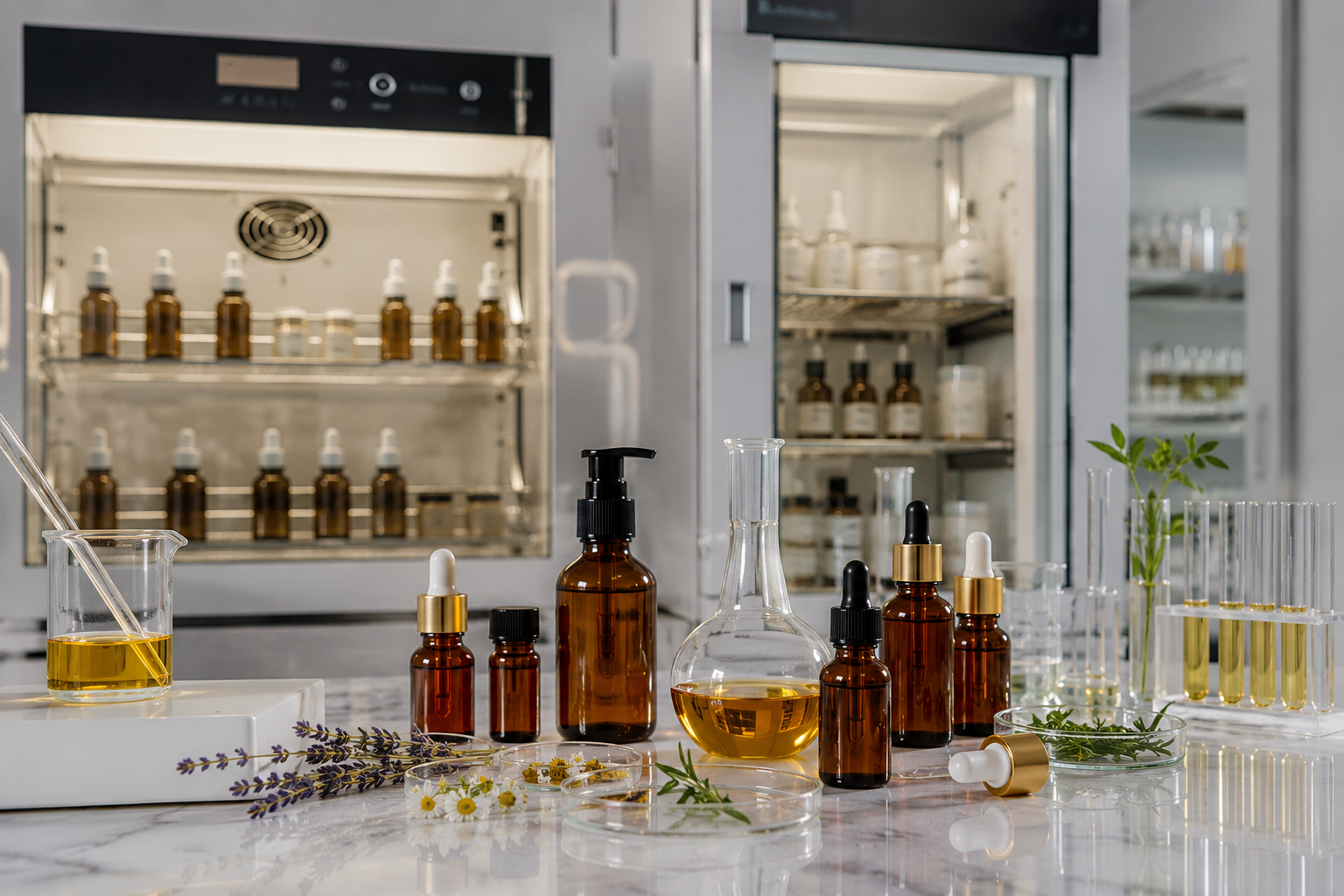
Long-term Stability is conducted at 30°C / 75% RH for a minimum of 12 months. Accelerated Stability is conducted at 40°C / 75% RH for 6 months. For highly oxidation-prone oils, a 50°C condition may be added for further accelerated assessment.

Standard sampling timepoints for long-term testing are months 0, 3, 6, 9, 12, 18, and 24. For accelerated testing, sampling occurs at months 0, 1, 2, 3, and 6. For oxidation-prone oils, monthly sampling during the first six months is recommended.

A special photostability protocol per ICH Q1B applies to photosensitive oils such as Rosehip Oil and Jojoba Oil, including a comparative assessment of degradation in transparent versus amber packaging.

Registration and Export

Body oils and essential oils classified as cosmetics must be submitted via Cosmetic Notification with the Thai FDA and comply with the ASEAN Cosmetic Directive across ASEAN member states.

The Product Information File (PIF) must include stability data covering PV, AV, OSI, volatile compound content, and odor evaluation. For export to the European Union and United States markets, additional data on Heavy Metals and Pesticide Residues are required.

Antioxidant System Selection and Degradation Prevention

Several antioxidant systems are used in cosmetic oils. Tocopherol (Vitamin E) is the most widely used natural antioxidant, functioning by scavenging free radicals and interrupting the oxidation chain. It is typically used at concentrations of 0.05 to 0.5% depending on the oil type. Rosemary Extract provides effective antioxidant protection with a characteristic scent that may complement or interfere with the product’s fragrance profile. Ascorbyl Palmitate, a fat-soluble form of Vitamin C, works synergistically with Tocopherol.

Synthetic antioxidants such as BHT (Butylated Hydroxytoluene), BHA (Butylated Hydroxyanisole), and TBHQ (Tert-Butylhydroquinone) offer high efficacy at a lower cost but may not align with the Clean Beauty expectations of today’s consumers.

Packaging design for oil protection is an equally important consideration. Amber or green glass bottles provide good light blocking. Aluminum packaging provides complete protection against both light and oxygen. Airless Pump systems minimize air contact with the product after opening and help extend in-use shelf life. Selecting appropriate packaging works as a critical complement to the antioxidant system in maintaining oil quality throughout shelf life.

Applications of Natural Oils in Cosmetic Products

The market for cosmetics using natural oils as primary ingredients continues to grow, particularly within the Clean Beauty and Natural Skincare categories. Oils commonly used in premium products include Rosehip Oil, which is rich in Vitamin A and essential fatty acids; Camellia Oil, which closely resembles the skin’s natural sebum; Jojoba Oil, which is a wax ester and inherently more stable against oxidation than triglyceride-based oils; and Squalane, which has been hydrogenated to provide excellent resistance to oxidative degradation.

Developing products with natural oils requires careful consideration of each oil’s fatty acid profile. Oils with a high Polyunsaturated Fatty Acid (PUFA) content, such as Rosehip Oil and Evening Primrose Oil, carry a higher oxidative risk and require both a well-designed antioxidant system and packaging with excellent oxygen-barrier properties. Shelf life assessment at defined sampling timepoints is a prerequisite for market launch of these formulations.

The Role of VISBIO as an IQAV

VISBIO, acting as an Independent Quality Assurance Verifier (IQAV), performs PV, AV, and OSI measurements, volatile compound analysis by GC-MS, and sensory evaluation. All analytical methods are validated in accordance with ICH Q2(R1), supported by full traceability documentation at every stage, and conducted under ISO/IEC 17025 best-practice standards.

TIBD Team Expertise

The oil stability testing service is conducted in collaboration with Dr. Wuttipong Phanitsetsakorn, Advisor and Co-founder, with expertise in commercial technology management for the health and beauty industry, and Ms. Manjamon Utomo, Senior Product Formulator with experience in body oil formulation development and antioxidant system selection. The team includes specialists in Lipid Chemistry and Essential Oil Science.

Is your oil product ready for Cosmetic Notification? Contact TIBD to receive a customized protocol design for your product. Contact TIBD

References

Apply for Stability Testing Service for Body Oils and Essential Oils (Oil Stability)

If you have any questions or would like to receive a free consultation regarding Stability Testing Service for Body Oils and Essential Oils (Oil Stability), or if you would like to visit us in person in Bangkok, Thailand, you are warmly welcomed and feel free to contact us via the contact form below.

  • This field is for validation purposes and should be left unchanged.