Description

Sunscreen and SPF-rated foundation products (Sun Protection Factor: SPF and Protection Grade of UVA: PA) are among the cosmetic categories requiring the most rigorous stability testing, because they must demonstrate the stability of the UV Filter system, emulsion system stability, colour stability in pigmented products, and preservative system stability, throughout shelf life under the hot and humid conditions of Thailand and the ASEAN region.

Manufacturers and brand owners of sunscreen products face specific challenges that differ from general cosmetics. Organic UV Filters such as Avobenzone, Octinoxate, and Oxybenzone tend to degrade on exposure to light, high temperatures, and unsuitable pH values. Inorganic UV Filters such as Zinc Oxide and Titanium Dioxide, while having higher chemical stability, present challenges in long-term particle dispersion and agglomeration.

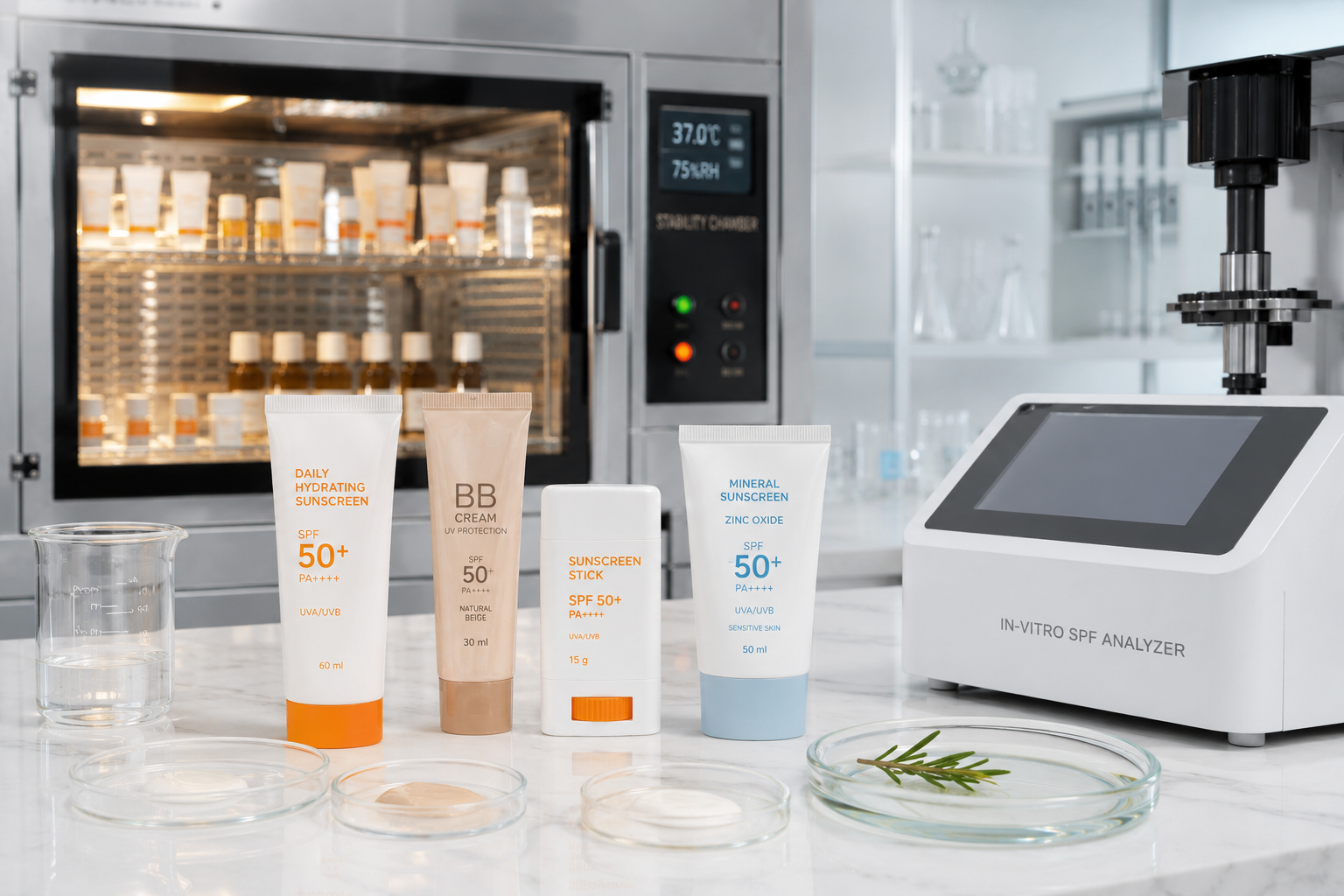
TIBD’s service is designed specifically for sunscreen products of all types, covering SPF Retention and PA Stability testing by In-vitro methods per ISO 24443 and ISO 24444, Photostability testing per ICH Q1B, UV Filter Assay analysis by High Performance Liquid Chromatography (HPLC), and physical and microbiological assessment of the emulsion system, in partnership with VISBIO as an Independent Quality Assurance Verifier (IQAV) using Validated Methods per ICH Q2(R1).
What is Sunscreen Stability Testing and Why is Specialized Testing Required?

Sunscreen Stability Testing is a study that monitors changes in UV protection values (SPF and PA), UV Filter content, emulsion system stability, and physical characteristics of the product throughout shelf life, to confirm that the product continues to provide UV protection as stated on the label.

Sunscreen products require specialized testing for three reasons that differ from general cosmetics. The first is that UV Filter compounds themselves are sensitive to light and temperature. Avobenzone, the most widely used UVA filter in global products, can degrade within 30 to 60 minutes of sun exposure without a Photostabilizer such as Octocrylene. Stability testing must therefore cover both normal storage conditions and light-exposed conditions.

The second reason is that SPF/PA values depend on the distribution of UV Filter compounds in a thin film on the skin. When the emulsion system separates or changes viscosity over time, the distribution changes and SPF values may decrease even if the UV Filter quantity remains constant.

The third reason is legal and commercial risk. Sunscreen products claiming an SPF value on the label must have supporting evidence that the value remains stable throughout the stated shelf life. Declaring an SPF value without stability evidence creates both legal and brand reputation risk in the event that consumers sustain sun damage because the product does not provide effective protection.

Sunscreen stability testing: SPF retention, UV filter assay and photostability

Differences between Organic UV Filters and Inorganic UV Filters

Sunscreen products in the market contain two primary groups of UV Filters with different chemical properties and stability challenges.

  • Organic UV Filters function by absorbing UV radiation and converting it to heat energy. Commonly used filters in the ASEAN market include Avobenzone (Butyl Methoxydibenzoylmethane) for UVA, Octinoxate (Ethylhexyl Methoxycinnamate) for UVB, Oxybenzone (Benzophenone-3), Octocrylene, Tinosorb S, and Tinosorb M. These compounds offer high efficacy and produce lightweight, easy-to-apply products, but present stability challenges against light and heat, require Photostabilizers, and face restrictions in certain markets: the European Union restricts Avobenzone concentrations, and Hawaii prohibits Oxybenzone and Octinoxate.
  • Inorganic UV Filters, also called Mineral Filters or Physical Filters, function by reflecting and scattering UV radiation. The compounds used are Zinc Oxide (ZnO) and Titanium Dioxide (TiO2), both in regular particle size and in nanoparticle form (Nano-ZnO, Nano-TiO2). This group has high chemical stability, is reef-safe, and is not prohibited in any market, but presents challenges in long-term dispersion stability and skin feel that may be thick and white.

Modern sunscreen products commonly use a Hybrid System that combines both organic and inorganic compounds to achieve high SPF values while reducing the disadvantages of each group. Stability testing for hybrid systems must analyze each compound separately and evaluate interactions between compounds.

Sunscreen-Specific Testing Parameters: SPF, PA, UV Filter Assay

TIBD’s sunscreen stability testing covers parameters designed specifically for products containing UV Filters, covering efficacy, compound content, and physical characteristics.

  • SPF Retention is the primary parameter, tested by In-vitro method per ISO 24443 using Spectrophotometry to measure SPF from light absorbance. Testing is conducted at various Pull Points throughout the study. An SPF decrease of more than 10 to 15% from the initial value is considered a significant change and may require label revision.
  • PA Stability per ISO 24443 is used for UVA protection assessment. The PA value is expressed as PA levels from one plus to four plus based on the UVA Protection Factor ratio. A decrease in PA level indicates degradation of UVA filter compounds, particularly Avobenzone.
  • UV Filter Assay is analyzed by High Performance Liquid Chromatography (HPLC) using a Reverse Phase Column and UV Detector at the specific wavelength of each compound. UV Filter content must not fall below 90% of the initial value (Not Less Than 90%) to be considered as passing the criterion.
  • pH for products containing Avobenzone must remain within the pH 5 to 8 range and must be stable throughout testing. Changes in pH can rapidly accelerate the degradation of organic UV Filter compounds.

Viscosity for sunscreen creams and lotions should remain within plus or minus 10% of the initial value, as it affects product distribution on the skin. Phase Separation is assessed by Visual Inspection and Centrifuge Test. Any phase separation renders the product unusable and requires immediate recall.

Photostability Testing per ICH Q1B

Photostability testing is a specific requirement for sunscreen products, since the products are used in light conditions and must have evidence that UV Filters retain efficacy after prolonged light exposure.

Testing per ICH Q1B requires samples to receive at least 1.2 million Lux-hours of visible light and at least 200 Wh/m² of UVA energy in a controlled light chamber using D65 lamps or equivalent. Assessment is conducted both on products in normal packaging and on open samples, to separate the effect of packaging from the effect of the formula.

After light exposure, samples are analyzed for SPF values, UV Filter content, colour changes (Color Stability), and formation of degradation products. Products passing Photostability testing must retain at least 80 to 90% of their initial SPF value and must not produce potentially irritating degradation compounds.

For products using Avobenzone, TIBD recommends additional Avobenzone-specific stability testing by analyzing content before and after light exposure, along with degradation product profile analysis by Liquid Chromatography Mass Spectrometry (LC-MS), to confirm that the Photostabilization system functions effectively.

Sunscreen stability testing: SPF retention, UV filter assay and photostability

Testing Conditions for ASEAN Zone IVb

Thailand and the ASEAN region fall within the ASEAN Zone IVb climatic zone, a hot and humid zone. The testing conditions TIBD uses reflect the real environment in which products will be used and stored.

  • Long-term Stability testing uses 30°C / 75% RH conditions for a minimum of 12 months, simulating storage conditions in shops, in vehicles during the day where temperatures may reach 50°C, and in consumer bags during daily product use.
  • Accelerated Stability testing uses 40°C / 75% RH conditions for 6 months. The more severe conditions accelerate UV Filter degradation, supporting preliminary shelf life prediction and formula screening.
  • Cycling testing between 4°C and 45°C is an additional consideration for sunscreen products that may be stored under changing temperature conditions during transport and consumer storage. This test helps detect emulsion separation and degradation issues that may not occur under constant storage conditions.

Legal Requirements and Thai FDA Cosmetic Registration

Submitting a Cosmetic Notification to the Thai FDA for sunscreen products requires particularly complete data, as these are products with a health claim in UV protection.

The Thai FDA expects stability data supporting the SPF/PA values stated on the label, covering Accelerated data for 6 months, Long-term data for at least 6 to 12 months, Photostability testing data per ICH Q1B, Microbial Limit Test data per ISO 17516, and Preservative Efficacy Test (PET) data per ISO 11930 for water-containing products.

Sunscreen products without complete stability data risk document rejection, Notification suspension, and in serious cases product recall if consumers sustain sun damage because the product does not provide effective protection.

Exporting Sunscreen Products to International Markets

Exporting sunscreen products to foreign markets involves diverse requirements by market.

  • In the ASEAN market under the ASEAN Cosmetic Directive, stability data tested in Thailand under Zone IVb conditions can be used to submit Notifications with Indonesia’s BPOM, Malaysia’s NPRA, Singapore’s HSA, Vietnam’s DAV, and the Philippines FDA.
  • In the European Union market, sunscreen products are regulated under Cosmetic Regulation (EC) No 1223/2009, which requires a Cosmetic Product Safety Report (CPSR) with Photostability and SPF Stability data assessed by a certified Safety Assessor.
  • In the United States market, sunscreen products are classified as Over-The-Counter (OTC) Drugs under FDA regulations, must comply with the OTC Sunscreen Monograph, and must have stability data meeting USP standards.
  • In the Japanese market under the Pharmaceutical and Medical Device Act (PMD Act), sunscreen products claiming SPF/PA values must have stability data from 3 production batches and test results conducted in JIS-accredited laboratories.

VISBIO’s Role as an Independent Quality Assurance Verifier (IQAV)

The credibility of a sunscreen stability testing report depends on the independence of the analyst. VISBIO, acting as an Independent Quality Assurance Verifier (IQAV), conducts In-vitro SPF/PA assessment, UV Filter Assay by HPLC, Photostability testing, and Microbial Limit Testing on samples collected at TIBD’s Pull Points, using Validated Methods per ICH Q2(R1) with full traceability documentation at every step and operations conducted under ISO/IEC 17025 standards.

For sunscreen products intended for export, having an independent third-party IQAV makes the SPF/PA and Photostability data credible in markets with stringent regulatory authorities such as the European Union and Japan.

TIBD Team Expertise

The Sunscreen Stability Testing service is conducted in partnership with Dr. Wuttipong Panitsettakorn, Advisor and Co-Founder, who specializes in commercial technology management for the health and beauty industry, and Ms. Mandhamon Uttamo, Advanced Formulator, with experience in developing sunscreen formulas using organic, mineral, and hybrid systems, including Photostabilizer selection. Our team includes researchers specializing in Photoprotection Chemistry, In-vitro SPF Methods, and Cosmetic Microbiology, and a network of researchers covering In-vivo SPF assessment, UV Filter analysis by LC-MS, and Photostability testing per ICH Q1B.

Is your sunscreen product ready to confirm the SPF/PA values stated on the label and ready to submit a Cosmetic Notification? If you need stability data based on ICH Q1A(R2), ICH Q1B (Photostability), ISO 24443 (In-vitro UVA), ISO 24444 (In-vitro SPF), ISO 11930 (PET), and ISO 17516 (Microbial Limits) for sunscreen products in any form, contact TIBD for a customized protocol designed for your product.

References

Apply for Sunscreen Stability Testing Service: SPF Retention, UV Filter Assay and Photostability

If you have any questions or would like to receive a free consultation regarding Sunscreen Stability Testing Service: SPF Retention, UV Filter Assay and Photostability, or if you would like to visit us in person in Bangkok, Thailand, you are warmly welcomed and feel free to contact us via the contact form below.

  • This field is for validation purposes and should be left unchanged.