

Cold plasma in agriculture / Article 05
Plasma-activated water as a source of plant nutrients: how far does nitrogen fixation from air actually go?
PAW as an alternative nitrogen source — the principle, where the research stands, the conditions that make it worth doing or not, and why TIBD still keeps this at research stage.
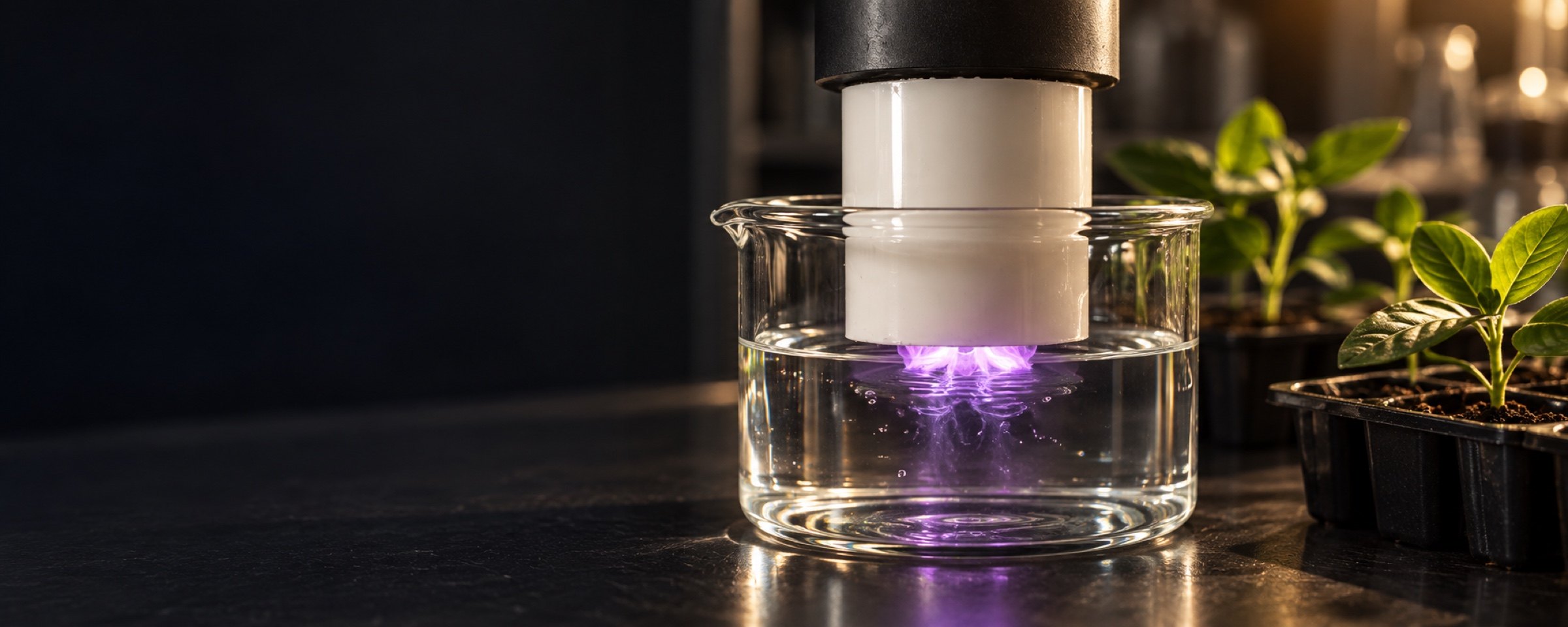
Plasma-activated water, or PAW, (PAW) is water energised by cold plasma until it holds nitrogen compounds in a dissolved form that plant roots can take up. It is made from air, water and electricity alone, with no ammonia as a feedstock.
The question companies ask immediately is whether it can replace urea. The straight answer is that at the point the research has reached today, it cannot, not at production scale , and this article explains exactly where it gets stuck.
The reason to keep watching it is that the cost structure of nitrogen fertiliser is shifting, and PAW is one of very few routes that produces nitrogen on site without importing it.
01Why nitrogen became such a large problem
Farming worldwide depends on synthetic nitrogen fertiliser made through the Haber-Bosch process, to the point where natural gas prices and international politics feed straight through into the cost of producing food.
On the carbon side, the International Energy Agency reports that the ammonia industry, the main feedstock for nitrogen fertiliser, accounts for roughly 1.3 per cent of global greenhouse gas emissions, and that producing one tonne of ammonia takes on the order of 30 to 35 gigajoules of energy and emits around 1.8 tonnes of carbon dioxide.
Thailand imports urea and other nitrogen fertilisers at the level of several million tonnes a year. World market price swings between 2021 and 2023 fed clearly into Thai farmers' costs. At the same time, bio-circular-green economy policy is pushing the search for nitrogen sources that can be produced domestically with a lower carbon footprint.
Another pressure is arriving in the form of the European Union's carbon border adjustment mechanism, which will add cost to agricultural products grown with high-carbon fertiliser when they are exported into European markets. Premium agricultural exporters are therefore beginning to look for alternatives whose carbon reduction they can demonstrate.
02How plasma-activated water is made
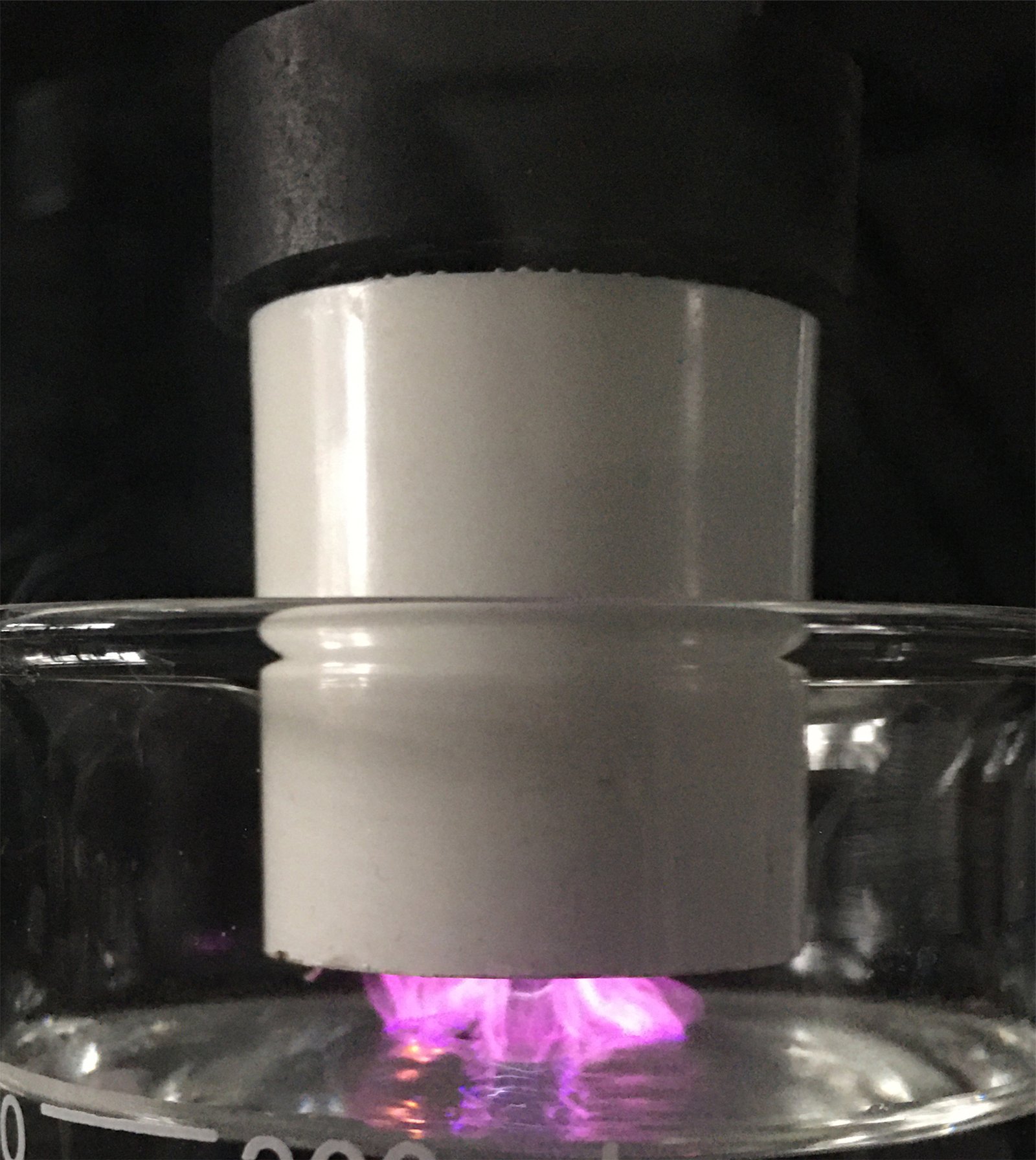
When cold plasma meets the water surface, or is struck directly at the gas-liquid interface, nitrogen and oxygen from the air are broken apart and recombine in the water as nitrate held in solution, together with hydrogen peroxide and other reactive species.
Nitrate is the form of nitrogen a plant root takes up directly. That is the chemical reason PAW is treated as a possible nitrogen source.
What has to be understood clearly is that PAW is not a concentrated fertiliser. The nitrogen concentration coming out of a laboratory-scale plasma system is significantly lower than commercial urea. Delivering an equivalent amount of nitrogen per hectare therefore takes either a great deal of water or a production system larger than anything currently in place.
The other limitation is stability. The active species in PAW change over time and with storage conditions, so moving it through a conventional fertiliser distribution chain is not yet a workable format. By its nature PAW suits generation at the point of use rather than buying and storing it.
03Where the research stands
| Study | Journal | What it reports |
|---|---|---|
| Tephiruk et al. (2025) | Journal of Environmental Chemical Engineering | A gliding arc plasma system performing two functions at once: reducing carbon dioxide and generating plasma-activated water in a single system. |
| Tephiruk et al. (2023) | IEEE Access | Plasma at the gas-liquid interface from discharge in water, for seed treatment. |
| Suwannarat et al. (2024) | ACS Applied Bio Materials | Using plasma in liquid together with plasma-activated water to reduce Xanthomonas campestris on brassica seed. |
| Misra, Schlüter and Cullen (eds., 2016) | Academic Press | An engineering framework for plasma-activated water systems at research and small application scale. |
The most interesting idea in this group is the dual-function system, taking an industrial carbon dioxide stream as feedstock while producing plasma-activated water. If that can be made to work at sufficient scale, it changes the whole cost equation.
The other point the research agrees on is that PAW does more than one job. As well as being a nitrogen source, it reduces the microorganisms carried on plant material at the same time, which is not something conventional fertiliser does.
What is missing is multi-season field trials against urea under Thai growing conditions, which takes time and has no shortcut.
04Why TIBD has not announced this as a commercial service
Four things not yet cleared
- The nitrogen concentration achievable with systems at current scale is still far below commercial fertiliser. Using it at an equivalent level needs a larger system, which is still at design and test stage.
- The stability of the active species changes with time and storage conditions, and still has to be tested specifically for real use.
- The effect on yield and quality for each crop under Thai growing conditions has to go through multi-season field trials against a control group.
- Registering it as a fertiliser under the Fertiliser Act B.E. 2518 means building a new regulatory path, because it is a category with no specific framework in the country yet.
Announcing a percentage of urea replacement before those four are cleared would be a promise the evidence cannot yet support, which is a risk neither side should take on.
05Who fits as a research partner in this
The profile that matches a research-stage programme
- Fertiliser companies with in-house R&D looking for new products in biological inputs or specialty fertiliser.
- Large agricultural companies with their own research farms wanting to test lower-carbon options.
- Agencies working under bio-circular-green economy policy looking for technology for low-carbon value chains.
- University and research institute groups working on plasma for agriculture.
- Premium agricultural exporters preparing for carbon border measures in their destination markets.
Who does not fit: anyone wanting to buy PAW as a ready-to-use fertiliser for this season, because that is not where the technology can deliver.
06How the research project runs
It starts with analysing the source water to be used in production: pH, conductivity, baseline ion concentrations and microbiological quality, along with chemical composition measured before and after the plasma process, because different water gives different results.
Next comes a preliminary efficacy study, both laboratory chemical analysis and pot trials with the target crop, to build a data set before any decision to scale. What comes out of it is not a guarantee of yield increase or of a urea replacement rate in the field.
Where the results support it, a plasma-activated water generator is then designed around the flow rate and conditions the partner needs, with operating procedures and team training.
Verification is carried out by VISBIO as the independent tester, covering chemical analysis of the plasma-activated water, how the activity holds over time, and plant growth trials against a control group.
07In summary: four points before deciding
Four things to remember before deciding
- Plasma-activated water is made when nitrogen and oxygen from the air are broken apart and recombine in water as dissolved nitrate.
- The gliding arc system the research team has developed does two jobs at once: reducing carbon dioxide and generating plasma-activated water in one system.
- The nitrogen concentration achievable at current scale is still far below commercial fertiliser, which is why TIBD has not announced this as a commercial service.
- Different source water gives different results, so every project starts by analysing the water first.
08Frequently asked questions
Can plasma-activated water replace urea outright?
Not at real production scale. The nitrogen concentration achievable with current systems is still far below commercial fertiliser. What is realistic in the near term is supplementary use within an irrigation system that already exists, rather than full replacement.
How long can plasma-activated water be kept?
The activity falls off over time, and how fast depends on temperature, container and light, so the usable life has to be set from each system's own test results rather than a general number. In practice the workable pattern is to produce it and use it on site.
Can we produce it ourselves on the farm?
In principle yes, because the inputs are air, water and electricity. But sizing a system to deliver enough for a real area is an engineering problem that has to be designed case by case. It is not something bought off the shelf and installed.
Can it be used in organic farming?
Since nothing synthetic is added to the system, in principle it aligns with organic practice. But because there is no specific registration framework in the country yet, using it in a system that has to maintain a certificate should always be discussed with the certifying body first.
09Talk through your problem with the TIBD team
If you are in fertiliser or agricultural inputs and the nitrogen-from-air route interests you, this remains joint research, not a product ready to deliver.
TIBD works alongside researchers and technology owners so that research carries on from the laboratory through to a real production line. The first thing we do is assess together whether your problem genuinely suits this technology. If it does not, we will say so at the start.
Message us on LINE @tibdglobal or use the contact form at tibdglobal.com/contact and tell us about the problem in your process.
Read next
- Plasma Innovation takes Grand Winner at TECH PLANTER 2026A regional award, won with plasma-activated water technology
- Cold plasma and rice seedWhy a plasma-treated seed takes up water faster, and how far the research goes
- Plasma and fermentationUsing controlled stress to push microorganisms into producing active compounds
← Back to Cold Plasma · Cold plasma services · Talk to the team
Sources Tephiruk et al. (2025) Journal of Environmental Chemical Engineering, vol. 13, article 117567 · Tephiruk et al. (2023) IEEE Access DOI: 10.1109/ACCESS.2023.3329811 · Suwannarat et al. (2024) ACS Applied Bio Materials · Misra, Schlüter and Cullen (eds., 2016) Cold Plasma in Food and Agriculture, Academic Press · International Energy Agency (2021) Ammonia Technology Roadmap · FAO World Fertilizer Trends and Outlook to 2026 · Fertiliser Act B.E. 2518, administered by the Department of Agriculture · Cold plasma research in Thailand by Assoc. Prof. Dr. Siwapon Srisonphan Kasetsart University
About TIBD TIBD Company Limited works alongside researchers and technology owners so that research carries on from the laboratory into real industrial use, from feasibility assessment and test design to prototyping and scale-up of production, with VISBIO, an affiliated company, acting as the independent verifier. The office is at the Kasetsart Agricultural and Agro-Industrial Product Improvement Institute, Kasetsart University, Bangkhen.