

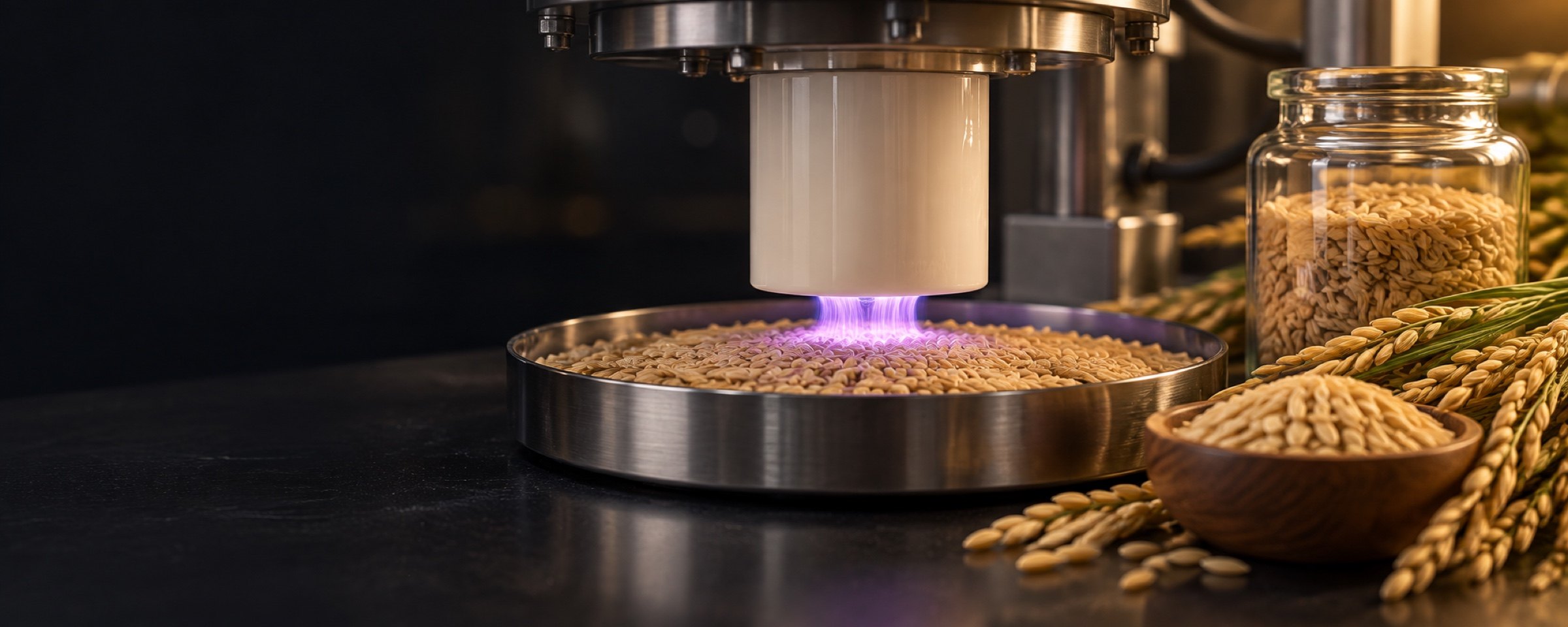
Cold plasma seed priming: what it is, how it works, how far the research goes, and where a seed company should start.
Cold plasma seed treatment for rice means exposing seed to plasma struck in ordinary air at close to room temperature, to change the seed surface so it takes up water better and to reduce the microorganisms carried on the hull, with no chemical coating, no heat and no residue left on the seed.
What interests a seed company is not the germination percentage alone but the evenness of germination, because seedlings that come up at different times leave a field at different ages, which affects water management, fertiliser timing and harvest.
This article explains the mechanism, sets out what the research actually reports, states the limits worth knowing before deciding, and describes a sensible testing sequence for a seed producer.
Where the quality problem in rice seed sits
In the rice production chain, the quality of the starting seed sets the yield at the end. Four problems come up repeatedly in the Thai seed industry.
Four problems rice seed producers meet routinely
- Germination below the certification threshold, which keeps that lot out of the premium market.
- Uneven germination, leaving seedlings of different ages in the field and making the whole field harder to manage.
- Seed-borne fungi such as Aspergillus and Fusarium, which can produce toxins during storage.
- Seed-borne blight pathogens that then spread in the field.
The conventional answers are chemical coating and heat treatment, and each has its own limits. A chemical coating leaves a residue that has to be declared in export documentation. Heat treatment risks seed viability if the temperature is not tightly controlled.
Regulatory pressure keeps rising. The European Union withdrew approval for Thiram in 2018 and formally banned Mancozeb from January 2022 after ECHA classified it as a reproductive hazard, while the default maximum residue level for substances with no specific limit is set at 0.01 mg/kg under Regulation (EC) No 396/2005, and Japan’s Positive List System uses the same 0.01 ppm threshold.
What cold plasma does to the seed surface
The shortest answer is that it turns the seed surface from hydrophobic into hydrophilic.
A rice hull is naturally a fairly water-repellent surface, so a droplet landing on it beads up rather than spreading and soaking in. When the seed meets cold plasma, the chemically active species in the plasma react with the seed surface at the nanometre scale, lowering the contact angle of the droplet. Water spreads flat and soaks in faster.
That is why water uptake speeds up, and water uptake is the first step of germination. Make the first step faster and more uniform across a whole lot, and the germination that follows is more uniform too.
At the same time those active species break down the cell structure of microorganisms sitting on the seed surface, so one step does two jobs: it conditions the surface and reduces the microbial load.
What has to be understood clearly: plasma works at the surface. It does not go in and change the genetics of the seed, and the species it creates are short-lived, decaying back into ordinary air once they have reacted.
How far the research goes
The work that started this line in Thailand is Khamsen et al. (2016), published in ACS Applied Materials & Interfaces, reporting that rice seed treated with hybrid atmospheric-pressure cold plasma germinated faster and took up water better, with final germination rising from around 90 per cent to around 98 per cent.
Follow-up work from the same team confirmed the result at larger scale and explained the mechanism in more detail.
| Study | Journal | What it reports |
|---|---|---|
| Khamsen et al. (2016) | ACS Applied Materials & Interfaces | Rice seed treated with hybrid cold plasma germinated faster and took up water better, with final germination rising from around 90% to around 98%. |
| Rongsangchaicharean et al. (2022) | Plasma Chemistry and Plasma Processing | Both DBD and large-scale streamer corona systems produced higher seed vigour values than the control group. |
| Rongsangchaicharean et al. (2022) | Journal of Physics D: Applied Physics | Explains the effect of DBD on water uptake dynamics and the hygroscopic properties of rice seed. |
| Jang et al. (2023) | Applied Biological Chemistry | Rice seed treated with non-thermal plasma took up phosphorus better, showed higher chlorophyll and soluble protein, and developed better as seedlings under low temperature. |
| Suwannarat et al. (2025) | Results in Engineering | Non-thermal plasma significantly reduced fungal contamination on seed within minutes, without the seed losing its ability to germinate. |
One observation matters: the Jang et al. (2023) result indicates the mechanism does not stop at the seed surface but carries into the physiology of the seedling after germination, which remains open for further research.
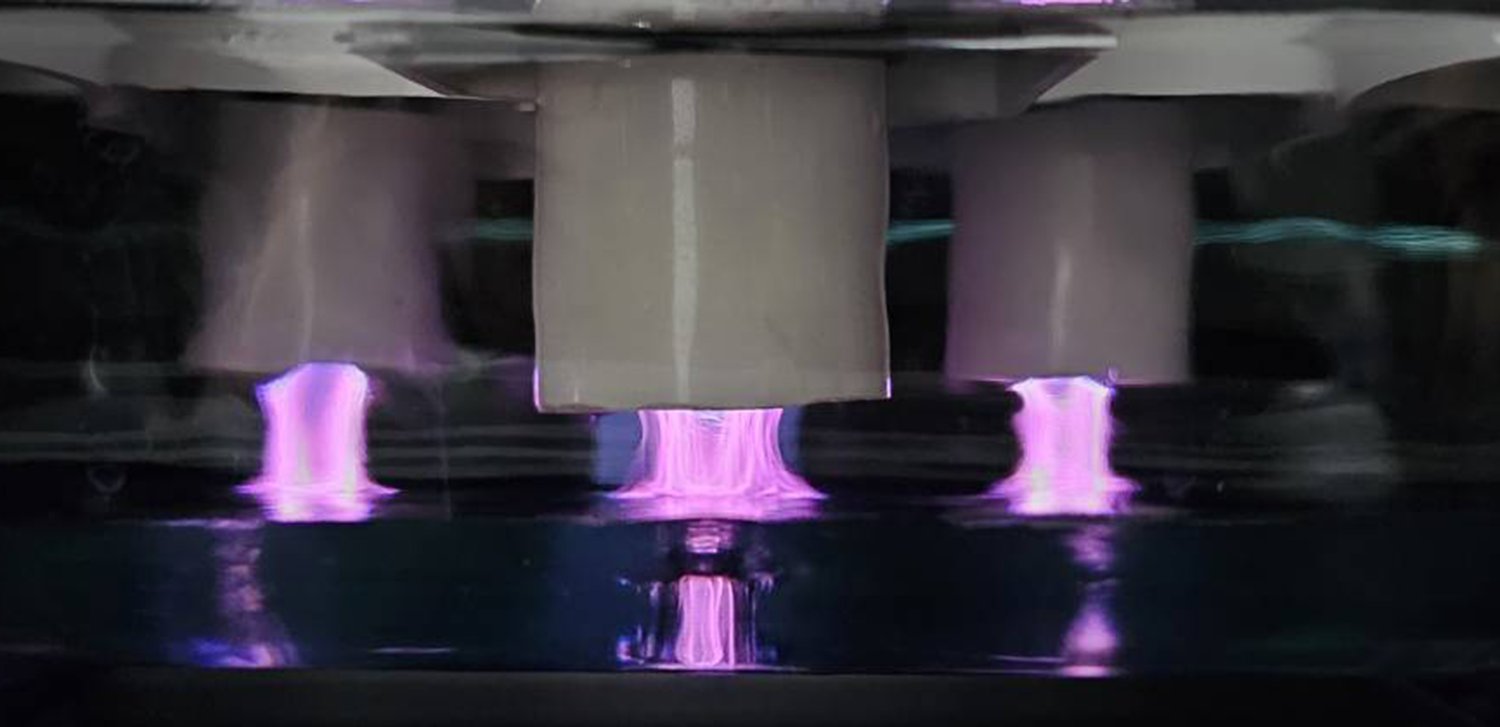
Several plasma heads running together above seed
How it compares with chemical coating
The two approaches solve different problems and trade different things. This table lays out the decision points.
| Point | Chemical coating | Cold plasma |
|---|---|---|
| Residue on the seed | Present, and has to be declared and managed against the destination market’s limits. | Adds nothing new to the seed. |
| Ongoing cost | A chemical cost on every lot. | Mainly electricity and equipment maintenance. |
| Organic certification | Restricted under several standards frameworks. | Sits in the physical-methods group, which most certifiers accept, though it has to be confirmed case by case. |
| Effect on germination | Mainly disease protection. It does not speed up water uptake. | Conditions the surface for faster water uptake and reduces surface microorganisms at the same time. |
| Operator safety | Chemical exposure and hazardous storage have to be managed. | No chemicals in the process. |
| What still has to be proven | A long accumulated data record. | Conditions have to be found by testing for each variety and each lot. |
The last row is the point to be clear about. Cold plasma is not a set-once technology that works across every variety, every moisture level and every lot. Conditions that suit one variety may not be the best conditions for another.
Who should be interested
This kind of work suits producers where the value added by seed quality is clearly higher than the cost of the treatment step.
Who benefits most clearly
- Commercial rice seed companies building a premium seed line.
- Agricultural cooperatives and farmer groups under contract to produce organic rice for export.
- Mills with contract farming networks wanting to control quality from the start of the chain.
- Producers of geographical indication rice who have to protect the identity of the variety.
- Agencies running rice seed centres that want to raise the standard of the seed they distribute.
How to start testing without wasting money
The sensible order is to test small and then scale, not to buy first and look for conditions afterwards.
The first step is measuring the baseline on a real lot: seed moisture, baseline germination percentage and starting microbial load. With no baseline, a post-treatment result has nothing to be compared against.
The second step is a preliminary efficacy test at small batch scale, using seed from the producer’s own real lot rather than a sample from elsewhere. What comes out of this step is not a guaranteed germination increase. It is the information needed to decide whether to continue or stop.
The third step is designing the process and the equipment around the real throughput of the line, with operating procedures and training for the team who will run it.
The final step is verification by a tester separate from the technology developer. In TIBD’s case that is VISBIO, an affiliated company acting as the independent verifier, covering germination rate, seed vigour index, mean germination time and microbial reduction. Separating the roles this way gives the customer’s procurement and audit teams documentation they can stand behind.
For registration and trade, the standard that seed buyers recognise internationally is the guidance of the International Seed Testing Association (ISTA), which sets the methods for testing germination, purity and seed health.
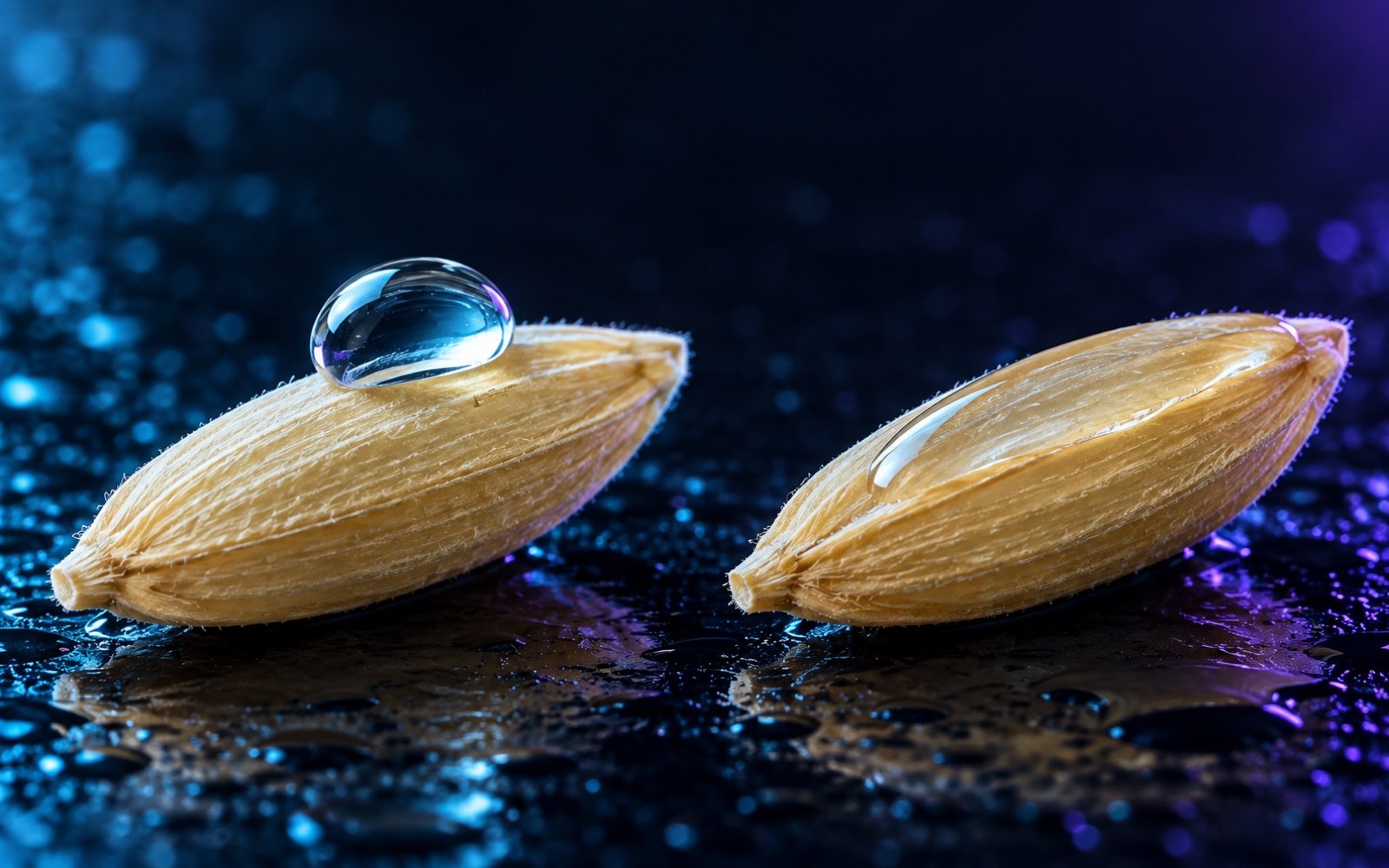
On an untreated rice seed the droplet beads up; on a treated seed it spreads flat
In summary: four points before deciding
Four things to remember before deciding
- Cold plasma turns the rice seed surface from hydrophobic to hydrophilic, so the seed takes up water faster and germinates more evenly.
- The work that started this line in Thailand is Khamsen et al. (2016), published in ACS Applied Materials & Interfaces.
- Unlike chemical coating it adds nothing to the seed, in exchange for having to find the conditions that fit your own variety and lot.
- It pays when the value added by seed quality is clearly above the cost of treatment, and it has to be tested small first, not bought first.
Frequently asked questions
Does cold plasma damage the seed?
Under properly designed conditions the seed is not heated and retains its viability. The research cited above reports seed germinating normally after treatment. That said, too much energy or too long an exposure can reduce germination, which is why suitable conditions have to be found by testing.
Does treated seed store as long as untreated seed?
Making the surface more hydrophilic also means the seed picks up moisture from the air more readily. Storage after treatment therefore has to control humidity and packaging appropriately. The real storage life has to be set from each system’s own test results, not from a general number.
Can it be used for organic rice?
Cold plasma falls into the physical treatment group, which most organic standards frameworks accept, but final confirmation rests with the body that holds each producer’s certificate, so it should be discussed with the certifier before it goes into a real production line.
What does it cost to invest?
The investment figure depends on the volume of seed to be treated per hour, the shape of the existing line, and the constraints of the site. It is therefore a figure developed together after preliminary testing, not a standard price announced in advance.
What is the difference between cold plasma rice seed priming and seed treatment?
In English-language literature, seed priming usually means conditioning the seed to be ready to germinate, while seed treatment usually means managing the microorganisms carried on the seed. Cold plasma does both in a single step, which is why the literature uses the two terms interchangeably.
Talk through your problem with the TIBD team
If you have a rice seed lot and want to know how much cold plasma can help, what we want to see first is the baseline figures for that real lot.
TIBD works alongside researchers and technology owners so that research carries on from the laboratory through to a real production line. The first thing we do is assess together whether your problem genuinely suits this technology. If it does not, we will say so at the start.
Message us on LINE @tibdglobal or use the contact form at tibdglobal.com/contact and tell us about the problem in your process.

Read next
- Cold plasma and vegetable seed Reducing seed-borne microorganisms without a chemical coating
- Extending the shelf life of fresh produce with cold plasma Reducing post-harvest microorganisms without adding a residue
- What cold plasma is — an interview with Assoc. Prof. Dr. Siwapon Srisonphan Explained without a single equation, and the one question he has carried for over ten years
← Back to Cold Plasma · Cold plasma services · Talk to the team
Sources
Khamsen et al. (2016) ACS Applied Materials & Interfaces DOI: 10.1021/acsami.6b04555 · Rongsangchaicharean et al. (2022) Plasma Chemistry and Plasma Processing, and Journal of Physics D: Applied Physics · Jang et al. (2023) Applied Biological Chemistry DOI: 10.1186/s13765-023-00852-9 · Suwannarat et al. (2025) Results in Engineering · Regulatory framework: Regulation (EC) No 396/2005, ECHA classification (Mancozeb), Positive List System of the Ministry of Health, Labour and Welfare, Japan, International Rules for Seed Testing (ISTA) · Cold plasma research in Thailand by Assoc. Prof. Dr. Siwapon Srisonphan Department of Electrical Engineering, Kasetsart University
About TIBD
TIBD Company Limited works alongside researchers and technology owners so that research carries on from the laboratory into real industrial use, from feasibility assessment and test design to prototyping and scale-up of production, with VISBIO, an affiliated company, acting as the independent verifier. The office is at the Kasetsart Agricultural and Agro-Industrial Product Improvement Institute, Kasetsart University, Bangkhen.