

Cold plasma and cosmetics / Article 09
Plasma-activated water actives for skincare: what the research says, and where the line sits
For brands competing on evidence rather than on an ingredient name — the reported mechanisms, the concentration range to watch, and the difference between research data and a label claim.
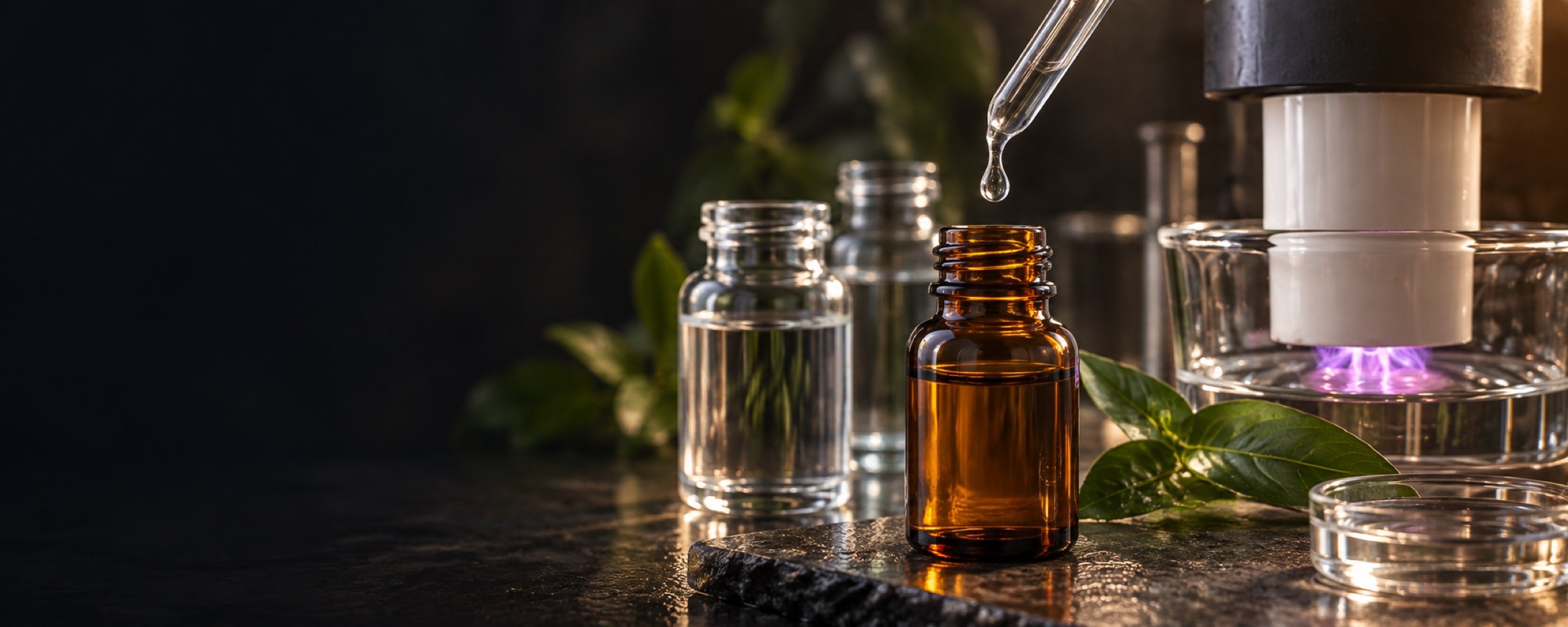
Using plasma-activated water as a skincare active means working with a liquid energised by cold plasma that carries chemically active species at a concentration you can design. Research reports that this group of species affects skin cells in several ways, both stimulating and inhibiting, depending on the concentration used.
That last sentence is the heart of the whole subject. These species do not have one effect. They have a range of effects. Low concentrations may stimulate; higher concentrations may be toxic. Finding the usable window is the main work of a project, not a footnote to it.
This article summarises what the research reports, states what cannot yet be proven, and explains the line between research data and what may be written on a label.
01Why brands want actives backed by evidence
The highest value-added layer in the beauty supply chain is not the formulation, it is the active. Formulations are copied quickly; an active with its own body of evidence is much harder to copy.
Competition has therefore moved from saying what is in the product to showing what evidence stands behind it. A brand that can demonstrate a mechanism at a measurable level, with endpoint data verified by an independent body, holds the upper layer of the chain for longer.
At the same time, pressure on conventional preservatives opens space for substances that do two jobs: acting on the skin and helping to limit microbial growth in the formulation, which is a property plasma-activated water has by its nature.
02What mechanisms the research reports
| Study | Journal | What it reports |
|---|---|---|
| Bourke et al. (2018) | Plasma Processes and Polymers | The role of species formed at the gas-liquid interface in wound healing, through stimulating fibroblasts and keratinocytes to produce growth factors and cytokines associated with tissue repair. |
| Privat-Maldonado et al. (2018) | Free Radical Biology and Medicine | Quantitative toxicity data for hydrogen peroxide in a three-dimensional skin model, giving a frame for which concentration range is safe and where toxicity begins. |
| Bekeschus et al. (2020) | Scientific Reports | The antimicrobial activity of plasma-activated water is driven by two groups of components acting independently of each other. |
| Kamgang-Youbi et al. (2012) | Physics of Plasmas | The acidic properties of plasma-activated water, adjustable through the composition of the source water and the plasma parameters, so it can be designed to sit in a range suitable for use on skin. |
| Bourke et al. (2017) | Journal of Applied Microbiology | A mechanistic review of how cold plasma acts on microorganisms under a range of conditions. |
The Privat-Maldonado paper is the one a formulator should read most closely, because it does not say the substance is good. It says where too much begins to be a problem, which is data you can actually set project limits with.
03The concentration window is the whole subject
The active species in plasma-activated water behave very differently depending on concentration. At low levels they are a signal the cell responds to. At high levels they destroy cells, which is the same property that makes them antimicrobial.
That means one and the same substance can be both the active and the thing to watch, depending on the concentration used and how long the skin is in contact with it.
In practice, establishing the usable window takes three layers: chemical analysis of the plasma-activated water produced, then testing in cultured skin cells, then a three-dimensional skin model, before human volunteer testing is even considered.
The other limitation to plan for from the start is stability. The activity of these species falls off with time and storage conditions. Product design therefore has to answer whether a consumer opening the bottle in month six receives the same thing that was tested.
04The endpoints used as proof
Descriptive claims alone no longer carry a premium market. What carries is endpoints measured at cell level, molecular level, or gene expression level.
Endpoints used in this kind of project
- Free radical scavenging capacity, measured with several standard methods in combination.
- Cell viability, to confirm the concentration used is not toxic to skin cells.
- Cytokine profile associated with inflammation, to see whether the substance leans towards stimulating or towards reducing inflammation.
- Skin barrier function in a skin model, for products claiming barrier repair.
- Skin microbiome balance, measured by sequencing, for microbiome-positioned products.
Verification of these endpoints is carried out by VISBIO as the independent tester. Separating the technology developer from the verifier means the documentation can be used with a brand's regulatory team and its distribution channels.

05The line between research data and a label claim
This is where projects of this kind most often go wrong. Research data from cells in a dish is not evidence that can be used to claim an effect on human skin.
Evidence has layers. A cell result says a mechanism is possible. A skin model result says the mechanism still works in a more complex structure. Only a human volunteer study speaks to what happens to an actual user.
Label copy therefore has to match the layer of evidence that actually exists, and match the framework of the regulator in each destination market. A claim beyond the evidence is a legal risk that is not worth the additional sales.
In Thailand, the Cosmetics Act B.E. 2558 and Thai FDA regulations require a new substance to be notified together with safety data. In the European Union, Regulation (EC) No 1223/2009 requires a safety report for every product and maintains a separate list of permitted preservatives, which means positioning this substance as a preservative and positioning it as an active follow two different documentation routes.
06Skin is not a flat surface, and that affects measurement
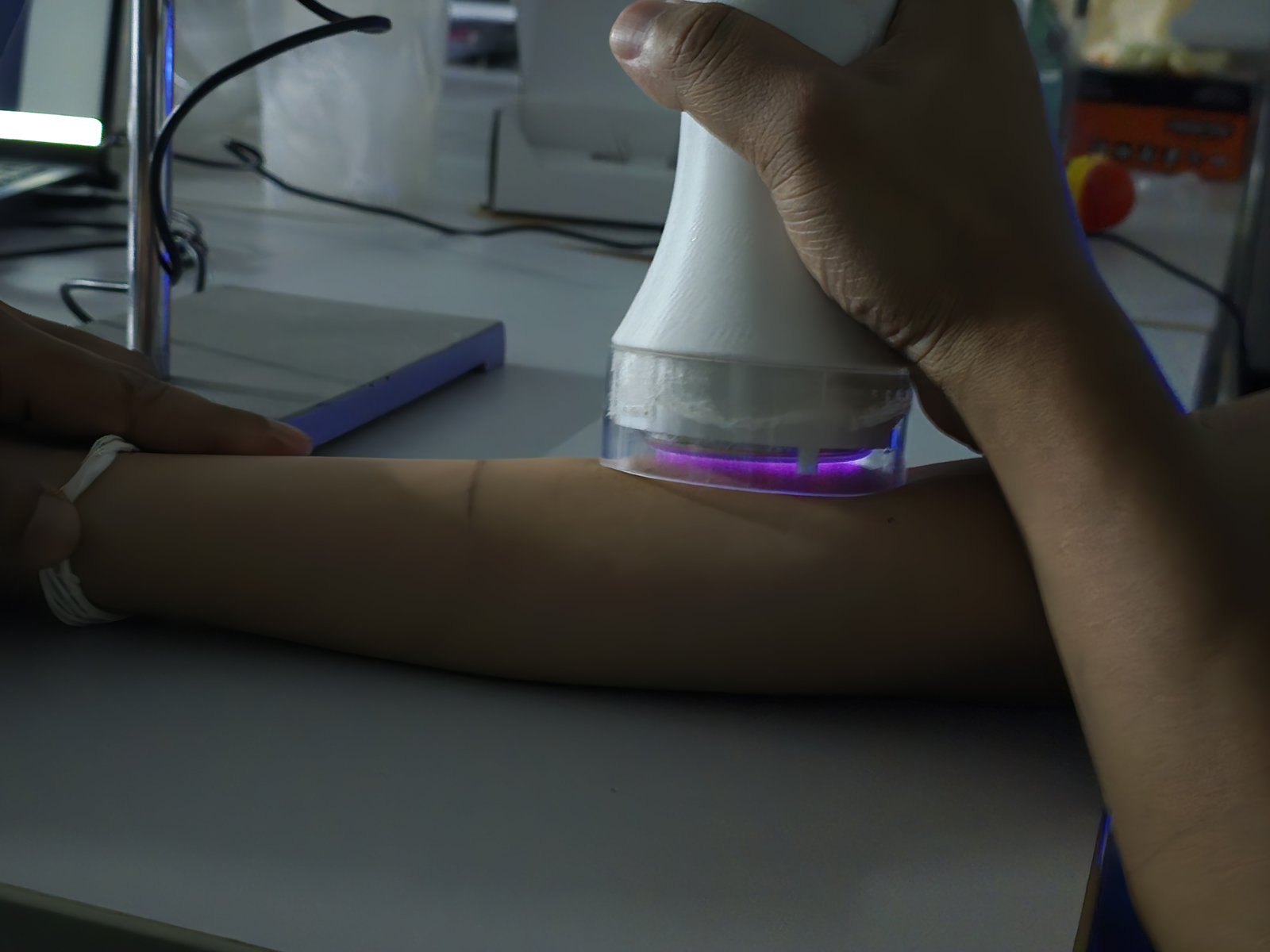
Two foundational papers by Assoc. Prof. Dr. Siwapon Srisonphan explain directly relevant mechanisms. The first, in ACS Applied Materials & Interfaces in 2018, deals with tuning surface wettability using cold plasma. The second, in Plasma Chemistry and Plasma Processing in 2020, deals with the way the electric field intensifies by itself on curved biological surfaces while shadowed regions form in the concavities.
That is the same physics as on skin, which has curves, furrows and pores. The dose the skin actually receives is not the same at every point, which is why a result from a culture dish cannot stand in for a result on real skin.
07How the project runs
The first step is a literature review and analysis of the source water to be used: pH, conductivity, baseline ion concentrations and microbiological quality, with composition measured before and after the plasma process.
The second step is a preliminary study, both chemical analysis and testing in keratinocytes and fibroblasts, under conditions drawn from the literature. The aim of this step is to find the concentration range that is both safe and promising, before committing to the more expensive stages.
The third step is testing in a three-dimensional skin model, and where the results support it, a human volunteer study under dermatological supervision, which requires ethics committee approval first.
What each step produces is not a guarantee of the claim a partner will use on their formulation. It is the body of evidence used to decide which stage to go to next, and what can be written on the label.
08In summary: four points before deciding
Four things to remember before deciding
- The highest value-added layer in the beauty chain is not the formulation, it is the active, because formulations are copied far more quickly.
- The concentration window is the whole subject. At low levels the active species are a signal the cell responds to; at high levels they destroy cells.
- Research data from cells in a dish is not evidence for a claim on human skin. This is where projects of this kind most often go wrong.
- What carries is endpoints measured at cell, molecular or gene expression level, not descriptive claims alone.
09Frequently asked questions
Is plasma-activated water an active or a preservative?
It can be either, depending on how its position in the formulation is designed. But the two positions follow different documentation routes and different registration requirements, so it has to be decided at the start of the project, not at notification.
Why not just buy plasma-activated water as a raw material?
Because the activity falls off over time. Buying it in and storing it gives you something different from what was tested. The workable pattern is generation in the manufacturer's own line, which changes the shape of the project entirely, from buying a raw material to investing in a system.
How long until there is enough data to write a label?
It depends what you want to write. A claim based on a cell-level mechanism takes far less time than a claim based on an effect on human skin. Setting the target claim at the start is what determines both the budget and the timeline of the project.
Can it be used for sensitive skin?
That is a question to be answered with data, not with reasoning. Testing in a sensitive-skin group has to be designed separately, and should be in the plan from the start if the product intends to speak to that group.
10Talk through your problem with the TIBD team
If you are building your brand's own active and want a body of evidence a competitor cannot copy, start with what you want to claim on the label, then work backwards to design the testing.
TIBD works alongside researchers and technology owners so that research carries on from the laboratory through to a real production line. The first thing we do is assess together whether your problem genuinely suits this technology. If it does not, we will say so at the start.
Message us on LINE @tibdglobal or use the contact form at tibdglobal.com/contact and tell us about the problem in your process.
Read next
- Cosmetics that want to cut back on preservativesWhere plasma-activated water sits in a formulation
- Cold plasma devices for skinThe line between a cosmetic and a medical device
- Plasma and fermentationUsing controlled stress to push microorganisms into producing active compounds
← Back to Cold Plasma · Cold plasma services · Talk to the team
Sources Srisonphan, Ruangwong and Thammaniphit (2020) Plasma Chemistry and Plasma Processing 40, 1253–1265 · Srisonphan (2018) ACS Applied Materials & Interfaces 10 (13), 11297–11304 · Bourke et al. (2018) Plasma Processes and Polymers DOI: 10.1002/ppap.201700151 · Privat-Maldonado et al. (2018) Free Radical Biology and Medicine · Bekeschus et al. (2020) Scientific Reports · Kamgang-Youbi et al. (2012) Physics of Plasmas · Bourke et al. (2017) Journal of Applied Microbiology · Regulatory framework: Thailand Cosmetics Act B.E. 2558, Regulation (EC) No 1223/2009, ISO 17516:2014, ISO 22716:2007, ISO 11930:2019, USP 51 · Cold plasma research in Thailand by Assoc. Prof. Dr. Siwapon Srisonphan Kasetsart University
About TIBD TIBD Company Limited works alongside researchers and technology owners so that research carries on from the laboratory into real industrial use, from feasibility assessment and test design to prototyping and scale-up of production, with VISBIO, an affiliated company, acting as the independent verifier. The office is at the Kasetsart Agricultural and Agro-Industrial Product Improvement Institute, Kasetsart University, Bangkhen.