Description

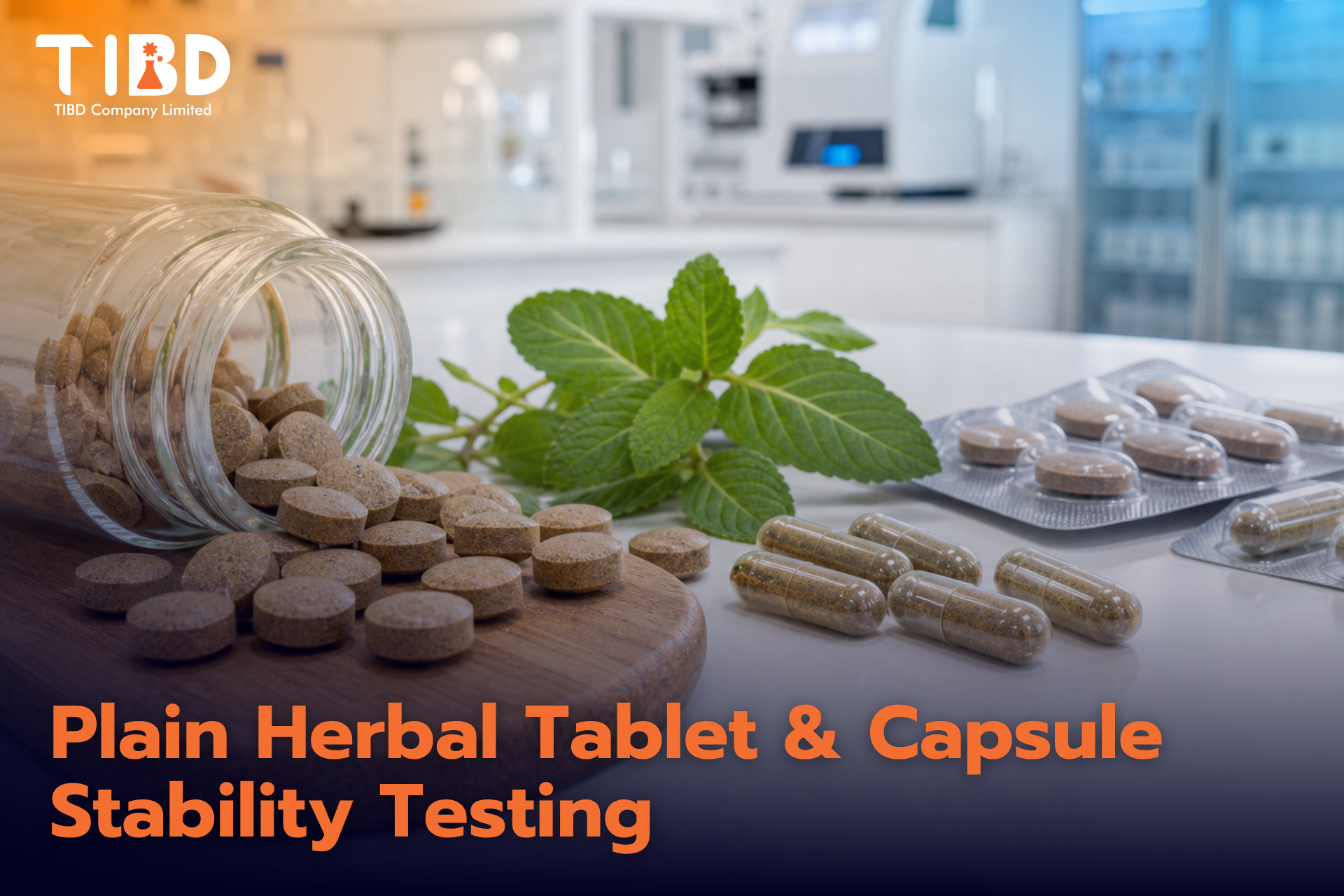
Plain herbal tablets and capsules are among the most widely registered dosage forms under the Thai Herbal Product Act B.E. 2562 (2019). A Plain Tablet is an uncoated compressed tablet consisting of powdered herbal extract, binder, disintegrant, and lubricant, with no polymer coating over the tablet surface. Hard Gelatin Capsules and HPMC Capsules contain powdered herbal extract or granules in a two-piece shell. Both formats are produced at scale in Thailand and exported throughout the ASEAN region, and both present specific challenges in the hot and humid environment of ASEAN Zone IVb, including Hardness reduction, Disintegration Time change, Dissolution failure, Marker Compound degradation, and moisture-driven microbial growth.

TIBD’s service is designed specifically for Plain Herbal Tablets and Capsules, covering Hardness, Disintegration Time, Friability, Dissolution, Moisture Content, Water Activity, Weight Variation, Content Uniformity, Color assessment by CIE Lab* Colorimeter, Marker Compound Assay by High Performance Liquid Chromatography (HPLC), TLC Fingerprinting, Heavy Metal by ICP-MS, Pesticide Residue by LC-MS/MS, and Aflatoxin under ASEAN Zone IVb conditions per ICH Q1A(R2), in partnership with VISBIO as an Independent Quality Assurance Verifier (IQAV) using Validated Methods per ICH Q2(R1).
Herbal Tablet and Capsule Product Types in the Thai and ASEAN Market

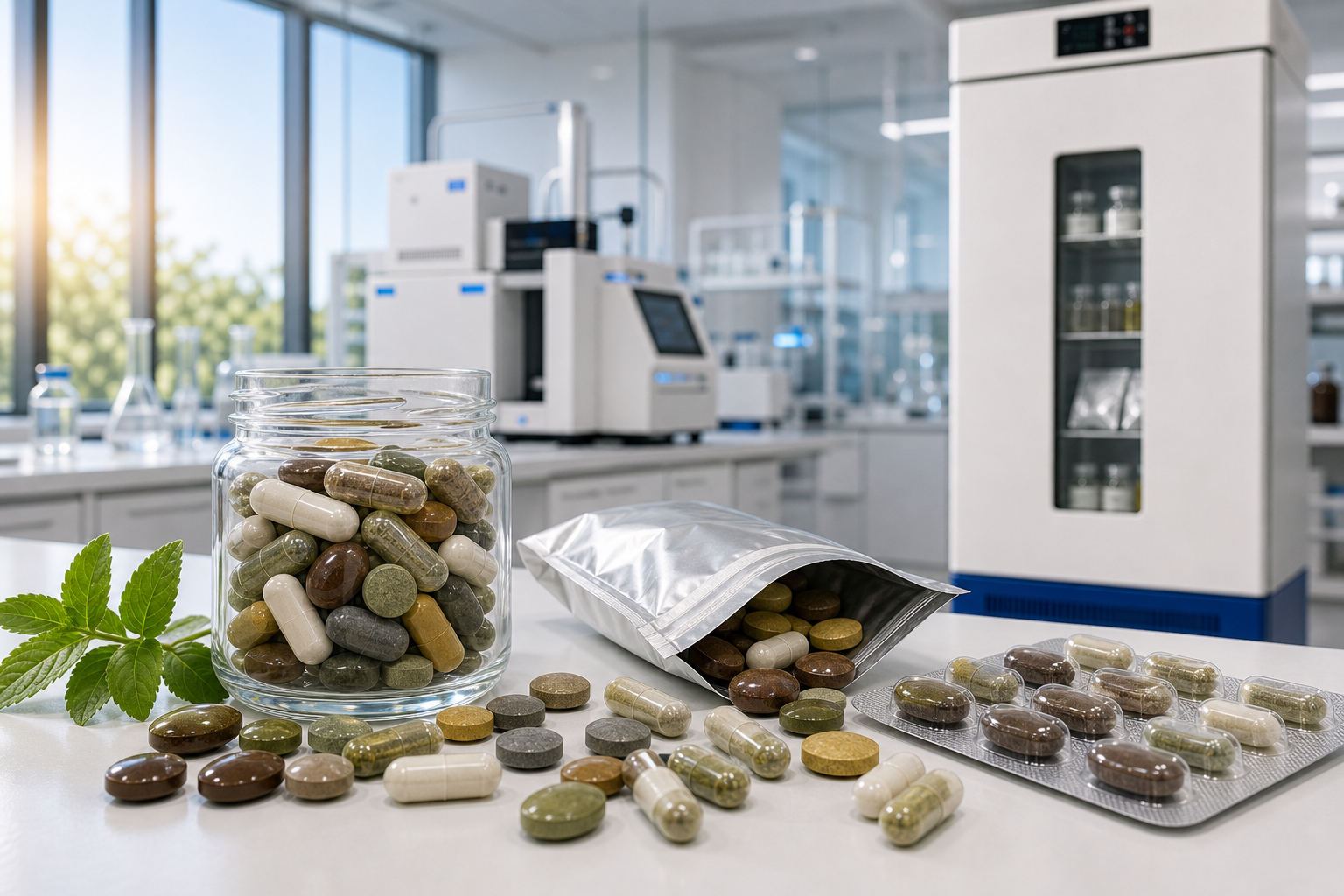
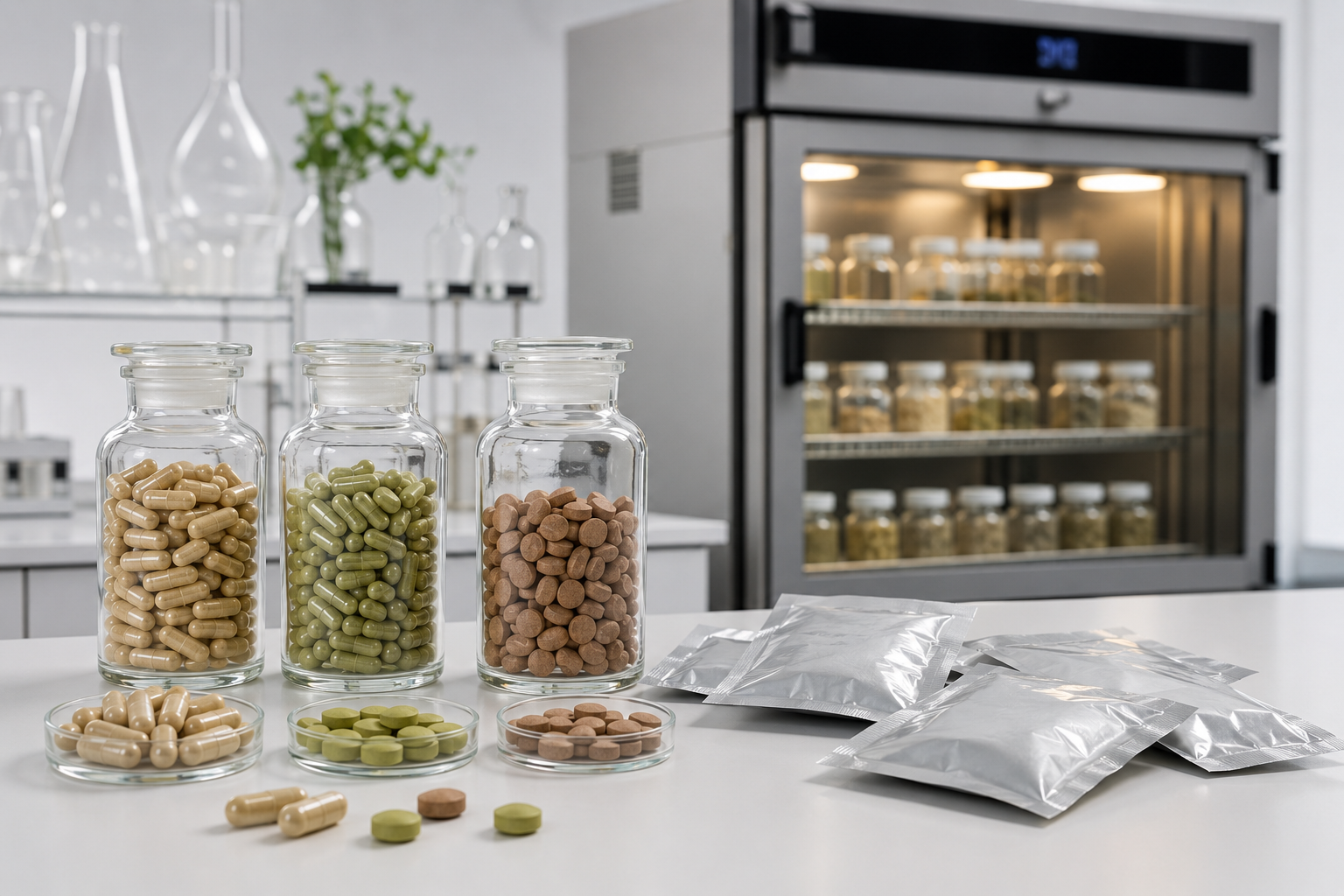
Eight product types covering the main Plain Tablet and Capsule formats are commercially produced in Thailand and the ASEAN region.

  1. Plain Herbal Tablets with Standardized Extract are produced by direct compression or wet granulation of a spray-dried or freeze-dried herbal extract with Microcrystalline Cellulose, Lactose, or Mannitol as diluent, Polyvinylpyrrolidone (PVP) or HPMC as binder, and Sodium Starch Glycolate or Croscarmellose Sodium as disintegrant. These tablets carry quantitative Marker Compound claims on the label and are the most common format for regulated herbal products in the Thai market.
  2. Plain Herbal Tablets with Popular Thai Herbs cover high-volume products including Andrographis paniculata (Fah Talai Jone), Centella asiatica (Bua Bok), Curcuma longa (Khamin Chan), Zingiber officinale (King), Phyllanthus amarus (Look Tai Bai), and Morinda citrifolia (Yo), produced in tablet format with both extract and whole herb powder formulations.
  3. Hard Gelatin Capsules consist of a two-piece gelatin shell filled with powdered herbal extract or granule mixture. Gelatin is the most widely used capsule shell material, but is sensitive to moisture-driven cross-linking in tropical climates, which causes capsule shell failure detected by Disintegration Time greater than twice the initial value and by Two-Tier Dissolution testing per USP Apparatus 1 in pepsin medium.
  4. HPMC Capsules (Hydroxypropyl Methylcellulose Capsules) are vegetarian capsule shells suitable for consumers avoiding animal-derived products and for hygroscopic fill materials. HPMC capsule shells are more resistant to cross-linking than gelatin shells, but require monitoring for brittleness at low humidity and for softening and deformation at high temperature and humidity.
  5. Compressed Capsules are produced by filling granules into soft gelatin capsule shells and compressing the filled capsule into a tablet form. This format combines the protection of an outer capsule shell with the mechanical strength of a tablet.
  6. Bilayer Tablets consist of two distinct compressed layers within a single tablet, allowing combination of two herbal actives with different compressibility characteristics or different Release Profiles. Bilayer Tablet stability testing requires assessment of layer separation and Hardness at the bilayer interface.
  7. Sustained-Release Tablets use a hydrophilic or hydrophobic matrix (HPMC, Ethylcellulose, or Carnauba Wax) to control the Release Rate of the herbal active over an extended time. Stability testing requires Dissolution profiling at multiple time points to confirm that the Release Profile is maintained throughout the shelf life.
  8. Multivitamin Herbal Tablets combine standardized herbal extracts with vitamins and minerals in a single tablet. This format requires individual Marker Compound and vitamin/mineral stability monitoring throughout the study, as each active has different thermal and hydrolytic degradation kinetics.
Stability testing for plain herbal tablets and capsules

Specific Stability Challenges of Plain Tablets and Capsules in Tropical Climates

Seven stability challenges specific to Plain Tablets and Capsules must be addressed in a protocol designed for ASEAN Zone IVb conditions.

  1. The first challenge is moisture absorption increasing Disintegration Time and reducing Hardness. Plain Tablets absorb moisture from humid storage conditions, causing binder softening and prolonged Disintegration Time. A change of more than 30% from the initial Disintegration Time is considered significant per ICH Q1A(R2) and indicates a formulation issue requiring investigation.
  2. The second challenge is Dissolution failure due to moisture-induced compaction. Moisture absorption by the tablet matrix can reduce porosity and increase resistance to dissolution medium penetration, causing the product to fail the Q not less than 75% Dissolution acceptance criterion before the end of the declared shelf life.
  3. The third challenge is Gelatin cross-linking in Hard Gelatin Capsules. Aldehydes formed from lipid oxidation in the fill material react with Amino Groups in the gelatin shell to form cross-links, causing the shell to become insoluble. This is detected by Disintegration Time exceeding twice the initial value and confirmed by Two-Tier Dissolution testing in pepsin medium per USP Apparatus 1 and by FTIR spectroscopy.
  4. The fourth challenge is Marker Compound degradation. Andrographolide, Curcuminoids, Asiaticoside, and other Marker Compounds degrade under thermal, hydrolytic, and oxidative conditions, with degradation rates accelerated by moisture and elevated temperature. Stability Indicating HPLC methods are required to resolve the parent compound from its degradation products.
  5. The fifth challenge is microbial contamination, particularly Total Yeast and Mold Count exceedance. Herbal tablets and capsules with Moisture Content above 6% or Water Activity above 0.6 are at risk of exceeding the microbial limit specifications under tropical storage conditions.
  6. The sixth challenge is color change from oxidation of natural pigments in the herbal extract, assessed quantitatively by CIE Lab* Colorimetry. A color difference (Delta E) of more than 3 units is typically considered visually significant.
  7. The seventh challenge is Release Profile change in Sustained-Release Tablets. Moisture absorption by the hydrophilic matrix polymer causes swelling and changes in the Release Rate, which may result in either faster release (dose dumping) or slower release (inadequate bioavailability) than specified.

Testing Parameters: Hardness, Disintegration, Dissolution, Moisture Content

TIBD’s stability testing protocol for Plain Herbal Tablets and Capsules covers the full set of physical and chemical parameters.

  1. Hardness is measured using a Hardness Tester per Ph.Eur. 2.9.8. The acceptance criterion for Plain Tablets is typically 50 to 150 N depending on tablet size and formulation. Hardness below the lower acceptance limit indicates risk of breakage during distribution; hardness above the upper limit may increase Disintegration Time.
  2. Disintegration Time is measured by Disintegration Tester per Ph.Eur. 2.9.1 in water at 37°C. The acceptance criterion is Not More Than 15 minutes for Plain Tablets and Not More Than 30 minutes for Hard Gelatin and HPMC Capsules. For Enteric-Coated variants, a two-stage method tests resistance to 0.1 M HCl before testing disintegration in phosphate buffer pH 6.8.
  3. Dissolution is measured per Ph.Eur. 2.9.3 using USP Apparatus 1 (Basket) or Apparatus 2 (Paddle) in appropriate simulated gastrointestinal fluids. The acceptance criterion is Q not less than 75% within 30 to 45 minutes for Immediate Release tablets and capsules. For products showing Gelatin cross-linking, Two-Tier Dissolution per USP Apparatus 1 with pepsin medium is used to confirm whether the dissolution failure is caused by cross-linking or by a formulation issue.
  4. Friability is measured per Ph.Eur. 2.9.7 using 6.5 g of tablets. The acceptance criterion is Not More Than 1% weight loss. Friability monitoring at each Pull Point detects progressive tablet weakening from binder degradation during storage.
  5. Moisture Content is measured by Karl Fischer Titration or Loss on Drying. The acceptance criterion is 3 to 5% for Plain Tablets and 3 to 7% for Hard Gelatin and HPMC Capsules. The wider acceptance range for capsules reflects the inherent moisture content of the gelatin or HPMC shell material.
  6. Water Activity (aw) is measured by Water Activity Meter. The acceptance criterion is Not More Than 0.6 to inhibit microbial growth. Water Activity is the most reliable predictor of microbial stability and is more informative than Moisture Content alone for tablets and capsules containing highly hygroscopic excipients.
  7. Thickness and Diameter are measured by Micrometer at each Pull Point to confirm dimensional consistency and to detect tablet swelling or deformation.
  8. Color assessment uses a CIE Lab* Colorimeter to quantify color change in tablets and capsule shells. A Delta E of more than 3 units from the initial measurement is considered a significant change requiring investigation.
  9. Weight Variation and Content Uniformity are confirmed per Ph.Eur. 2.9.5 and 2.9.6 at the initial time point and at each significant stability Pull Point.

Marker Compound Analysis: Ten Methods Plus TLC Fingerprinting

TIBD and VISBIO apply compound-specific HPLC methods validated as Stability Indicating methods, capable of resolving the parent compound from its degradation products.

  • Andrographolide: Analyzed by HPLC with UV detection at 225 nm using a method that resolves Andrographolide from Dehydroandrographolide. Primary Marker Compound for Andrographis paniculata (Fah Talai Jone) tablets, the most widely registered herbal tablet product in Thailand.
  • Curcuminoids (Curcumin, Demethoxycurcumin, Bisdemethoxycurcumin): Analyzed by HPLC with UV detection at 425 nm, resolving all three curcuminoid compounds. Primary Marker Compound for Curcuma longa (Khamin Chan) tablets.
  • Asiaticoside: Analyzed by HPLC with ELSD or UV detection at 200 nm. Primary Marker Compound for Centella asiatica (Bua Bok) tablets and capsules.
  • Withanolide: Analyzed by HPLC with UV detection at 220 nm for ashwagandha (Withania somnifera) tablets and capsules.
  • Berberine: Analyzed by HPLC with UV detection at 280 nm for tablets containing Coptis chinensis or Berberis vulgaris extracts.
  • Plumbagin: Analyzed by HPLC with UV detection at 268 nm for tablets containing Plumbago rosea (Jed Mu Pleng).
  • 6-Gingerol: Analyzed by HPLC with UV detection at 280 nm for ginger (Zingiber officinale) tablets and capsules.
  • Glycyrrhizin: Analyzed by HPLC with UV detection at 254 nm for tablets containing Glycyrrhiza glabra (licorice) extract.
  • Ginsenoside: Analyzed by HPLC with ELSD or UV detection at 203 nm for Korean ginseng (Panax ginseng) tablets and capsules. The method resolves major ginsenosides Rb1, Rb2, Rc, Rd, Re, Rf, Rg1, and Rg2 individually.
  • HPTLC (High Performance Thin Layer Chromatography) with Densitometry: Applied for identity confirmation and purity assessment of herbal tablets and capsules per THP 2021 monograph requirements. HPTLC provides a fingerprint chromatogram that confirms the correct botanical source and the absence of adulterants. The Densitometer provides quantitative measurement of Rf values and band intensity for each spot in the fingerprint.
  • Marker Compound content must be maintained at Not Less Than 90% of the initial labeled value throughout the declared shelf life.
  • Heavy Metal Testing per ICH Q3D by ICP-MS: Lead not more than 10 mg/kg, Arsenic not more than 5 mg/kg, Cadmium not more than 0.3 mg/kg, Mercury not more than 0.5 mg/kg. Heavy metals can accumulate in the tablet or capsule throughout the shelf life if the raw material specification is not adequately controlled, and are required for Thai FDA registration.
  • Pesticide Residue by Multi-Residue Method using QuEChERS extraction followed by LC-MS/MS or GC-MS/MS analysis, per Codex Alimentarius or EU MRL criteria. Pesticide residue monitoring is required for tablets and capsules containing raw herb powder rather than purified extract.
  • Aflatoxin: Aflatoxin B1 not more than 2 ppb, total Aflatoxins B1, B2, G1, G2 not more than 4 ppb (Codex Alimentarius). Aflatoxin testing is required for tablets and capsules containing herbs susceptible to Aspergillus contamination, including ginger, turmeric, and black pepper.
Stability testing for plain herbal tablets and capsules

Testing Conditions and Pull Point Schedule per ICH Q1A(R2)

  • Long-term Stability testing uses 30°C / 75% RH conditions per ASEAN Zone IVb for a minimum of 24 months. Accelerated Stability testing uses 40°C / 75% RH for 6 months. Intermediate Stability at 30°C / 65% RH is added when significant change is observed under Accelerated conditions.
  • Standard Pull Points for Long-term testing are months 0, 3, 6, 9, 12, 18, and 24. Standard Pull Points for Accelerated testing are months 0, 1, 2, 3, and 6.
  • Photostability testing per ICH Q1B in a Solar Simulator is applied for light-sensitive Marker Compounds and for products in transparent or semi-transparent packaging.

Formulation and Packaging Design Consultation

For manufacturers at the development stage, TIBD provides formulation consultation to optimize Plain Tablet and Capsule formulations before committing to a full stability study.

Disintegrant selection and concentration directly control the Disintegration Time profile across the shelf life. Sodium Starch Glycolate and Croscarmellose Sodium maintain Disintegration performance at lower moisture contents; Crospovidone is used for formulations requiring rapid disintegration under high-moisture storage conditions. The disintegrant concentration is optimized to maintain the specified Disintegration Time at the end of shelf life, not only at time zero.

Binder grade and concentration affect Hardness maintenance and the rate of Hardness change under humid storage. Low-viscosity PVP (K17 or K25) provides acceptable initial Hardness with less moisture sensitivity than high-viscosity grades. HPMC grades 6 cps and 15 cps are used where moisture-resistant binder performance is required.

Gelatin cross-linking prevention in Hard Gelatin Capsules is achieved by controlling the concentration of aldehydes in the fill material. Fill materials containing unsaturated fatty acids, reducing sugars, or polyunsaturated herbal oils are screened for aldehyde content by FTIR before use. Antioxidants including BHT, BHA, or Vitamin E are incorporated into fill materials at risk of lipid oxidation.

Packaging selection is the most critical stability control for moisture-sensitive Plain Tablets and Capsules. HDPE bottles with induction-sealed liners are the standard primary packaging for most herbal tablet and capsule products. Blister Packs (Alu-Alu or PVC-Alu) reduce per-dose moisture exposure and are recommended for products with tight Moisture Content acceptance criteria. Aluminum Strip Packs provide the maximum moisture barrier for long-distance export. Silica Gel or molecular sieve desiccant is incorporated in bottles for all formulations with Moisture Content acceptance criteria below 5%.

VISBIO’s Role as an Independent Quality Assurance Verifier (IQAV)

VISBIO, acting as Independent Quality Assurance Verifier (IQAV), conducts Hardness, Disintegration Time, Friability, Dissolution, Moisture Content, Water Activity, Marker Compound Assay by HPLC, TLC Fingerprinting, Heavy Metal and Pesticide Residue analysis on samples collected at each Pull Point, using Validated Methods per ICH Q2(R1) with full Traceability documentation at every step and operations conducted under ISO/IEC 17025 standards.

TIBD Team Expertise

The Plain Herbal Tablet and Capsule Stability Testing service is conducted in partnership with Dr. Wuttipong Panitsettakorn, Advisor and Co-Founder, who specializes in commercial technology management for the health and beauty industry, and Ms. Mandhamon Uttamo, Advanced Formulator, who has extensive experience in the development of Thai traditional medicine and herbal supplement products across multiple dosage forms. Our team includes researchers specializing in Phytochemistry, Tablet Technology, Capsule Technology, Analytical Chemistry, and Regulatory Affairs for the Thai and ASEAN herbal product market.

Is your Plain Herbal Tablet or Capsule ready for Thai FDA registration or ASEAN export? Contact TIBD for a customized stability protocol and starting price from ฿15,000.

References

Apply for Plain Herbal Tablet and Capsule Stability Testing Service

If you have any questions or would like to receive a free consultation regarding Plain Herbal Tablet and Capsule Stability Testing Service, or if you would like to visit us in person in Bangkok, Thailand, you are warmly welcomed and feel free to contact us via the contact form below.

  • This field is for validation purposes and should be left unchanged.