Description

Herbal products in Hard Capsule and Granule formats are among the most widely used delivery forms in the Thai herbal dietary supplement and Traditional Medicine product categories. These formats cover Hard Gelatin Capsules (produced from animal gelatin), HPMC Capsules (Vegetarian Capsules produced from Hydroxypropyl Methylcellulose), Pullulan Capsules (Vegan Capsules produced from fermentation-derived Pullulan), Spray-Dried Granules, Wet Granulated Granules, Coated Granules, Probiotic Granules using Microencapsulation, and Effervescent Granules designed to dissolve in water.

The stability challenges of herbal capsules and granules in the hot and humid ASEAN Zone IVb environment are specific to the capsule shell and powder system. Capsule Shell softening or stickiness under high temperature and humidity conditions, Granule moisture absorption causing caking and reduced Flowability, Marker Compound degradation sensitive to heat, moisture, and light, and Probiotic CFU reduction in ambient tropical conditions are the primary mechanisms that must be addressed in a stability protocol for these formats.

TIBD’s service is designed specifically for herbal hard capsules and granule systems, covering Capsule Shell Integrity assessment, Disintegration Time, Fill Weight, Content Uniformity, Moisture Content, Particle Size Distribution, Bulk Density, Flowability, Marker Compound Assay by High Performance Liquid Chromatography (HPLC), Probiotic Viability (CFU/g), and microbiological testing, under ASEAN Zone IVb conditions and the Thai Herbal Pharmacopoeia (THP 2021) standard, in partnership with VISBIO as an Independent Quality Assurance Verifier (IQAV) using Validated Methods per ICH Q2(R1).
Hard Capsule and Herbal Granule Product Types in the Dietary Supplement Market

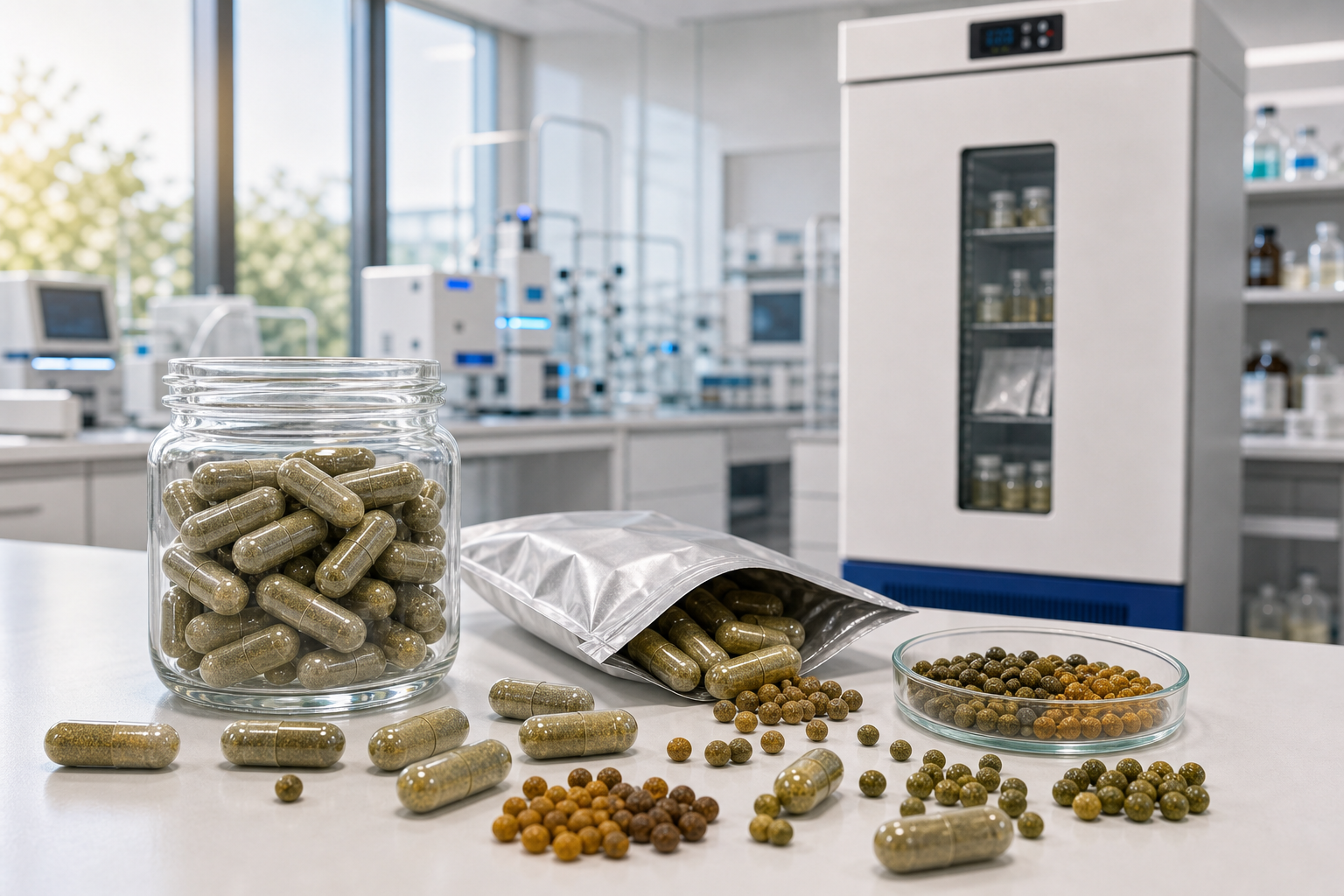
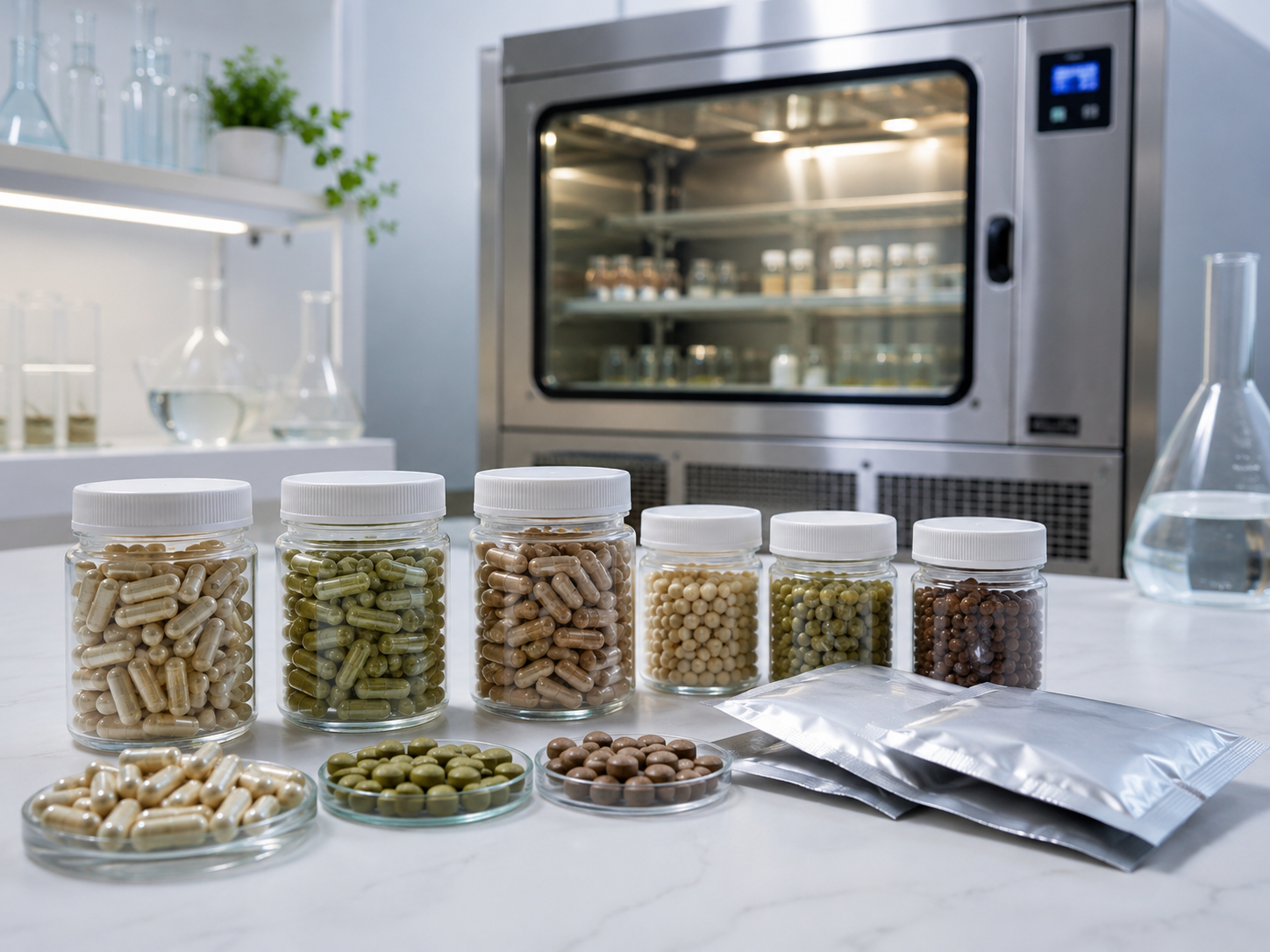
Eight product categories within the hard capsule and granule format are differentiated by their shell material, granulation method, and functional purpose.

  • Hard Gelatin Capsules produced from bovine or porcine gelatin are the most widely used capsule shell type due to their low cost, rapid dissolution, and compatibility with a wide range of active ingredients. Gelatin Capsule Shells contain approximately 13 to 15% Moisture Content, which must be considered when filling moisture-sensitive herbal actives, as water migration from the shell into the fill can accelerate degradation.
  • HPMC Capsules (Hydroxypropyl Methylcellulose Capsules) are Vegetarian Capsules preferred by consumers who do not accept animal-derived gelatin. HPMC Shells have a lower Moisture Content of 5 to 8% and better moisture barrier properties than Gelatin, making them more suitable for moisture-sensitive active ingredients and products intended for Halal-certified and Vegetarian-labeled markets.
  • Pullulan Capsules are Vegan Capsules produced from Pullulan, a polysaccharide derived from microbial fermentation. Pullulan Capsules have lower Oxygen Permeability than HPMC, making them the preferred shell type for oxidation-sensitive actives such as Coenzyme Q10 and Astaxanthin.
  • Enteric Capsules (Acid-Resistant Capsules) are designed to remain intact in the acidic gastric environment and dissolve in the intestine, used for Probiotic preparations, Enzymes, and actives that are acid-labile or require intestinal absorption.
  • Spray-Dried Granules produced by the spray-drying process yield a free-flowing powder with a narrow particle size distribution and good dissolution properties, suitable for capsule-filling operations where uniformity and flow are critical.
  • Wet Granulated Granules produced by Wet Granulation have larger particle sizes and higher bulk density than Spray-Dried, and are better suited for direct compression into tablets or for filling large-volume capsules.
  • Coated Granules incorporate a Coating system to modify the Release Profile of the active ingredient, protecting pH-sensitive actives from gastric acid, masking bitter taste, or achieving extended-release kinetics.
  • Probiotic Granules use Microencapsulation systems to protect live Probiotic microorganisms from heat, moisture, and the effervescent environment during dissolution, and are among the most stability-demanding formats in the herbal dietary supplement category.

Specific Stability Challenges of Capsule and Granule Systems

Seven challenges specific to hard capsule and granule systems in tropical humid climates are addressed in TIBD’s stability protocol.

  1. The first is Capsule Shell stability. Hard Gelatin Capsules may soften, deform, or become sticky at the elevated temperature and humidity of ASEAN Zone IVb (40°C / 75% RH under Accelerated conditions). HPMC Capsules, while more moisture-resistant, remain at risk for brittleness at low humidity and for dimensional changes at elevated temperatures over long-term storage. Shell integrity must be assessed at every Pull Point.
  2. The second is Capsule Shell Brittleness. In conditions of very low relative humidity, Gelatin Capsules may become brittle and crack during handling and transport. Brittleness is assessed by Drop Test and Compression Test that simulate mechanical stresses in the supply chain.
  3. The third is Granule Flowability change. Moisture absorption during storage causes hygroscopic granule blends to cake and form agglomerates, reducing Flowability and compromising Filling Accuracy in the capsule-filling operation. For products with tight content uniformity specifications, flowability data throughout the study period provides early warning of filling process risk.
  4. The fourth is Marker Compound degradation. Herbal marker compounds are individually sensitive to heat, moisture, and light, with each compound requiring a specific Stability Indicating analytical method. The method must distinguish the marker compound from its degradation products and confirm that the content remains within specification throughout the shelf life.
  5. The fifth is moisture absorption affecting Disintegration and Dissolution. Granules that absorb moisture from the environment during storage may undergo changes in Disintegration Time as the granule matrix softens or hardens, and may show altered Dissolution profiles that affect bioavailability. Moisture Content and Water Activity must be monitored at every Pull Point.
  6. The sixth is Probiotic CFU reduction. Probiotic microorganisms in capsule and granule formats are subject to viability loss at ambient tropical temperatures. The rate of CFU/g decline depends on the Probiotic species, the Microencapsulation system, the storage temperature, and the moisture content of the fill material. Probiotic Viability assessment per ISO 19344 or ISO 7889 at defined Pull Points throughout the shelf life is a mandatory component of the stability protocol for Probiotic-containing products.
  7. The seventh is color change of the Capsule Shell or Granules from Maillard reaction between reducing sugars and amino acids present in the fill material or excipient blend, or from degradation of natural colorants such as Curcuminoids, Anthocyanins, or Carotenoids used in the formulation. Color change is a first-notice consumer quality signal and is assessed by CIELAB colorimetry and visual examination at each Pull Point.
Stability testing for herbal hard capsules and granules

Testing Parameters: Disintegration, Fill Weight, Particle Size

TIBD’s stability testing protocol for hard capsules and granules covers the full set of compendial and product-specific parameters.

  • Disintegration Time is measured by a Disintegration Tester per Ph.Eur. 2.9.1 in water at 37°C. The standard specification for hard capsules is Not More Than 30 minutes. An increase in Disintegration Time indicates moisture-induced changes in the capsule shell or granule matrix that may affect bioavailability.
  • Fill Weight and Weight Variation are assessed by weighing 20 capsules individually per Ph.Eur. 2.9.5. The Relative Standard Deviation (RSD) of fill weight must not exceed 5.0% for standard capsule products. A change in fill weight uniformity during storage indicates caking of the granule blend affecting the fill volume per capsule.
  • Content Uniformity is assessed per Ph.Eur. 2.9.6 for products with a low Active Pharmaceutical Ingredient (API) dose per capsule. This test confirms that each individual capsule contains the stated quantity of active ingredient within the pharmacopoeia-defined acceptance limits.
  • Capsule Shell Integrity is assessed by visual examination under magnification at each Pull Point, checking for cracks, delamination, surface stickiness, and color change. Any visible defect in the shell is grounds for immediate review of the storage condition specification and packaging system.
  • Capsule Shell Brittleness is tested by Drop Test and Compression Test to assess mechanical durability under conditions representative of transport and handling in the distribution chain.
  • Moisture Content of the Granule fill is measured by Karl Fischer Titration or Loss on Drying. The standard specification for herbal granule fills is typically 3 to 5%. Values exceeding this range indicate inadequate moisture barrier performance of the packaging system.
  • Water Activity (aw) is measured by a Water Activity Meter. The acceptance criterion for granule and powder systems is typically Not More Than 0.6 to inhibit microbial growth, and Not More Than 0.3 to minimize chemical degradation rates.
  • Particle Size Distribution is measured by Laser Diffraction Particle Size Analyzer or Sieve Analysis. Changes in the particle size distribution during storage indicate aggregation or de-agglomeration of the granule system, which affects flowability and capsule-filling uniformity.
  • Bulk Density and Tapped Density are measured per Ph.Eur. 2.9.34 to calculate Carr’s Index and Hausner Ratio, which are indirect indicators of powder flowability and compressibility.
  • Flowability is assessed by Angle of Repose or Flow Through Orifice Test per USP monograph on Powder Flow. Changes in Flowability during storage confirm that moisture-induced caking is occurring in the granule blend.
  • Dissolution Testing per Ph.Eur. 2.9.3 in simulated gastrointestinal media (Simulated Gastric Fluid pH 1.2 and Simulated Intestinal Fluid pH 6.8) is required for capsule products making specific bioavailability or therapeutic efficacy claims. Dissolution data confirms that the active ingredient is released from the dosage form at the intended rate throughout the declared shelf life.

Marker Compound Analysis and Probiotic Viability

Each herbal active ingredient requires a dedicated Stability Indicating HPLC method validated per ICH Q2(R1) to separate the marker compound from its degradation products.

Withanolides in Ashwagandha (Withania somnifera) capsules: Analyzed by HPLC with UV detection at 220 nm. Withanolide A is the primary marker compound, and the method must resolve it from Withanoside degradation products formed under acidic and thermal stress conditions.

Curcuminoids in Turmeric (Curcuma longa) capsules: Analyzed by HPLC with UV detection at 425 nm using a Stability Indicating Method that separates Curcumin, Demethoxycurcumin, and Bisdemethoxycurcumin. All three curcuminoids contribute to the total Curcuminoid content and each has a distinct stability profile under Zone IVb conditions.

Andrographolide in Andrographis (Andrographis paniculata) capsules: Analyzed by HPLC with UV detection at 225 nm. Andrographolide is heat-sensitive and must be stored under refrigeration during sample preparation. The method must be validated as Stability Indicating to confirm separation from thermal degradation products.

Asiaticoside in Centella (Centella asiatica) capsules: Analyzed by HPLC with Evaporative Light Scattering Detection (ELSD) or UV detection at 200 nm. Asiaticoside, Madecassoside, and Asiatic Acid are the primary marker compounds in standardized Centella extracts.

Resveratrol in Grape (Vitis vinifera) capsules: Analyzed by HPLC with UV detection at 306 nm. Trans-Resveratrol is the bioactive form; isomerization to Cis-Resveratrol under UV exposure is a primary degradation pathway.

Glucosamine and Chondroitin Sulfate in Joint Health capsules: Analyzed by HPLC with UV detection or by High-Performance Anion-Exchange Chromatography with Pulsed Amperometric Detection (HPAEC-PAD) for accurate quantification in complex matrices.

Coenzyme Q10 (CoQ10) in CoQ10 capsules: Analyzed by HPLC with UV detection at 275 nm. The method must resolve CoQ10 (Ubiquinone) from its reduced form Ubiquinol to function as a Stability Indicating method.

Saw Palmetto Extract in prostate health capsules: Analyzed by HPLC with ELSD or UV detection at 200 nm for total fatty acid content as the primary marker of extract standardization.

All marker compounds must be maintained at Not Less Than 90% of the initially declared value throughout the stated shelf life.

Probiotic Viability assessment is conducted by Colony Forming Unit (CFU/g) enumeration per ISO 19344 or ISO 7889 at Pull Points 0, 3, 6, 12, 18, and 24 months. The declared CFU/g must be maintained at the label claim value throughout the shelf life, typically 1×10⁹ CFU/g or above. Manufacturers of Probiotic capsules and granules commonly include a viability Overage of 30 to 100% above the label-declared CFU/g at the time of manufacture to compensate for expected viability decline during storage under Zone IVb conditions. Acid Tolerance Testing and Bile Tolerance Testing are required for Probiotic products making specific gastrointestinal health efficacy claims.

Testing Conditions and Pull Point Schedule per ICH Q1A(R2)

Long-term Stability testing uses 30°C / 75% RH conditions per ASEAN Zone IVb for a minimum of 24 months. Accelerated Stability testing uses 40°C / 75% RH for 6 months.

For Probiotic Capsule and Probiotic Granule products, an additional Long-term Stability condition at 25°C / 60% RH is included to align with Zone IVa conditions applicable to markets with milder climate profiles. A Cool Storage condition at 5°C is included for products labeled for refrigerated storage throughout the shelf life.

Standard Pull Points for Long-term testing are at months 0, 3, 6, 9, 12, 18, and 24. Standard Pull Points for Accelerated testing are at months 0, 1, 2, 3, and 6.

Photostability testing per ICH Q1B using a Solar Simulator is required for capsule and granule products where the active ingredient is known to be light-sensitive and where the packaging does not provide complete light protection. Samples must receive a minimum of 1.2 million Lux-hours of visible light and 200 Wh/m² of UVA energy in a Solar Simulator cabinet.

Capsule Shell and Excipient Selection for Tropical Climates

Selecting the appropriate Capsule Shell for a specific herbal active requires matching the shell’s physical and chemical properties to the moisture and oxygen sensitivity of the fill material.

Gelatin Capsules are suitable for general herbal actives that are not highly moisture-sensitive, are cost-effective, and provide rapid dissolution. They are not recommended for actives with a Critical Moisture Content below 3%, as moisture migration from the Gelatin Shell into the fill occurs continuously at equilibrium, and this migration accelerates at elevated temperature and relative humidity.

HPMC Capsules are recommended for moisture-sensitive herbal actives, for Vegetarian and Halal-certified products, and for Plant-Based positioned brands. Their lower Moisture Content (5 to 8%) reduces water migration into the fill, making them the first-choice shell type for moisture-sensitive standardized herbal extracts under Zone IVb conditions.

Pullulan Capsules are recommended for oxygen-sensitive actives including Coenzyme Q10, Astaxanthin, and Resveratrol, which degrade primarily through oxidation. Pullulan’s low Oxygen Permeability provides a passive oxygen barrier within the capsule shell itself, complementing the oxygen barrier provided by the primary packaging.

Enteric Capsules with an acid-resistant coating are recommended for Probiotic preparations to protect live microorganisms from destruction by gastric acid, ensuring viable bacteria reach the intestinal site of action.

Excipients commonly used in herbal granule blends include Microcrystalline Cellulose (MCC) as a Filler and Disintegrant, Lactose Monohydrate as a general-purpose Filler, Maltodextrin as both a Filler and Spray-Drying Carrier, Magnesium Stearate as a Lubricant at concentrations of 0.25 to 1.0%, and Colloidal Silicon Dioxide (Aerosil) as a Glidant to improve powder flow.

Packaging system selection is critical for moisture-sensitive herbal capsule products. High-Density Polyethylene (HDPE) bottles with induction-sealed caps and integrated Silica Gel desiccant provide adequate moisture protection for most products. Amber glass bottles are required for products containing light-sensitive actives. Aluminum-Aluminum Blister Packs provide the highest moisture and oxygen barrier of any primary packaging format and are recommended for Probiotic Capsule products. Single-dose sachet packaging using multi-layer aluminium laminate is suitable for Probiotic Granule products and Effervescent Granule products. The inclusion of Desiccant and Oxygen Absorber in bottle packaging extends the effective moisture and oxygen protection throughout the declared shelf life.

Stability testing for herbal hard capsules and granules

Thai FDA Registration and Thai Herbal Pharmacopoeia (THP 2021)

Registration of herbal capsule and granule products with the Thai FDA is conducted under the Herbal Product Act B.E. 2562 (2019).

The Product Information File required for registration must include a Drug Master File for each herbal raw material, Quality Specification covering identity, purity, and potency of the active ingredient, stability data covering Marker Compound content at Pull Points throughout the declared shelf life, physical parameter stability including Disintegration, Moisture Content, and Capsule Shell Integrity, microbiological assessment, and safety data appropriate to the route of administration and product category.

For products making therapeutic efficacy claims, pharmacological activity data from pre-clinical studies and, where required, clinical study data must be submitted to the Thai FDA as part of the registration dossier.

The Thai Herbal Pharmacopoeia 2021 (THP 2021) is the primary quality standard for herbal materials and herbal products in Thailand, specifying identification tests, assay methods, and acceptance criteria for listed herbal substances. Products containing herbs listed in THP 2021 must comply with the pharmacopoeia monograph requirements for identity and purity, and the Stability Indicating HPLC methods used in the stability study must be consistent with or demonstrate superior performance to the pharmacopoeia analytical method.

For export within the ASEAN market, the ASEAN Health Supplement Scientific Committee (AHSSC) provides harmonized guidelines for health supplement products. Exporters must additionally comply with the specific regulatory requirements of each destination country, including Indonesia’s BPOM, Malaysia’s MOH, Singapore’s HSA, Vietnam’s DAV, and the Philippines’ FDA.

For export to international markets, the United States Pharmacopeia (USP), European Pharmacopoeia (Ph.Eur.), and British Pharmacopoeia (BP) each contain herbal monographs for major medicinal plants including Ashwagandha, Turmeric, Andrographis, and Centella that specify identity, purity, and assay requirements. Stability data demonstrating compliance with these monograph specifications throughout the declared shelf life supports market access in ASEAN, the European Union, and the United States.

VISBIO’s Role as an Independent Quality Assurance Verifier (IQAV)

The analytical credibility of herbal capsule stability data depends on the independence and technical capability of the testing laboratory. VISBIO, acting as an Independent Quality Assurance Verifier (IQAV), conducts Disintegration, Fill Weight, Content Uniformity, Particle Size, Flowability, Marker Compound Assay by HPLC, Probiotic Viability assessment (CFU/g), and microbiological testing on samples collected at TIBD’s Pull Points, using Validated Methods per ICH Q2(R1) with full traceability documentation at every step and operations conducted under ISO/IEC 17025 standards.

For herbal capsule and granule products intended for Thai FDA registration under the Herbal Product Act B.E. 2562 or for export to international markets requiring independent third-party analytical evidence, VISBIO’s role as an independent IQAV provides the documentary credibility that regulatory authorities and import partners expect from a Thai manufacturer seeking to compete in the ASEAN and international health supplement market.

TIBD Team Expertise

The Hard Capsule and Herbal Granules Stability Testing service is conducted in partnership with Dr. Wuttipong Panitsettakorn, Advisor and Co-Founder, who specializes in commercial technology management for the health and beauty industry, and Ms. Mandhamon Uttamo, Advanced Formulator, with experience in developing herbal capsule formulations and Probiotic preparations. Our team includes researchers specializing in Capsule Technology, Granulation Technology, Probiotic Science, and Quality Control of Herbal Products, with specific expertise in Stability Indicating HPLC method development for herbal marker compounds, Probiotic CFU enumeration, and THP 2021 compliance for herbal product registration.

Is your herbal capsule or granule product ready for Thai FDA registration under the Herbal Product Act or for export to ASEAN and international markets? If you need stability data based on ICH Q1A(R2), Marker Compound Assay by HPLC, Disintegration testing, Probiotic Viability assessment, and THP 2021-compliant analytical methods for your hard capsule or granule formulation, contact TIBD for a customized protocol and starting price from ฿15,000.

References

  • International Council for Harmonisation of Technical Requirements for Pharmaceuticals for Human Use. (2003). Stability testing of new drug substances and products: Q1A(R2). ICH Harmonised Tripartite Guideline. https://database.ich.org/sites/default/files/Q1A%28R2%29%20Guideline.pdf
  • Royal Thai Government Gazette. (2019, April 30). Herbal Products Act B.E. 2562 (2019). Royal Thai Government Gazette, 136(56 Kor), 1–29. (In Thai)
  • International Organization for Standardization. (2017). Microbiology of the food chain — Quantification of probiotics in food, animal feed and pharmaceutical/nutraceutical products by flow cytometry (ISO 19344). https://www.iso.org/standard/64658.html
  • European Directorate for the Quality of Medicines & HealthCare. (2023). European Pharmacopoeia 11.0: Capsules, Disintegration test (2.9.1). Council of Europe. https://www.edqm.eu/en/european-pharmacopoeia
  • United States Pharmacopeial Convention. (2024). Powder Flow ⟨1174⟩. United States Pharmacopeia 47-NF 42. https://www.usp.org

Apply for Hard Capsule and Herbal Granules Stability Testing Service

If you have any questions or would like to receive a free consultation regarding Hard Capsule and Herbal Granules Stability Testing Service, or if you would like to visit us in person in Bangkok, Thailand, you are warmly welcomed and feel free to contact us via the contact form below.

  • This field is for validation purposes and should be left unchanged.