Description

Gummy and jelly dietary supplements are among the fastest-growing product formats in Thailand and the ASEAN market, driven by consumer demand for convenient, great-tasting supplements suitable for children and adults who prefer not to swallow capsules. Vitamin Gummy, Collagen Gummy, and Multivitamin Gummy are the most popular categories.

The challenge for gummy and jelly products in the ASEAN Zone IVb tropical-humid climate is that these products rely on sugar and water as primary components, making them vulnerable to microbial growth, caking inside the pouch, sugar crystallization, and physical deformation from heat.

TIBD’s service is specifically designed for gummy and jelly products. It covers evaluation of hardness (Texture/Hardness), water activity (aw), moisture content, Brix value, caking, vitamin quantification by HPLC, and microbiological testing, all conducted under ASEAN Zone IVb conditions in collaboration with VISBIO, an Independent Quality Assurance Verifier (IQAV).
Gummy and Jelly Dietary Supplements in the Thai Market

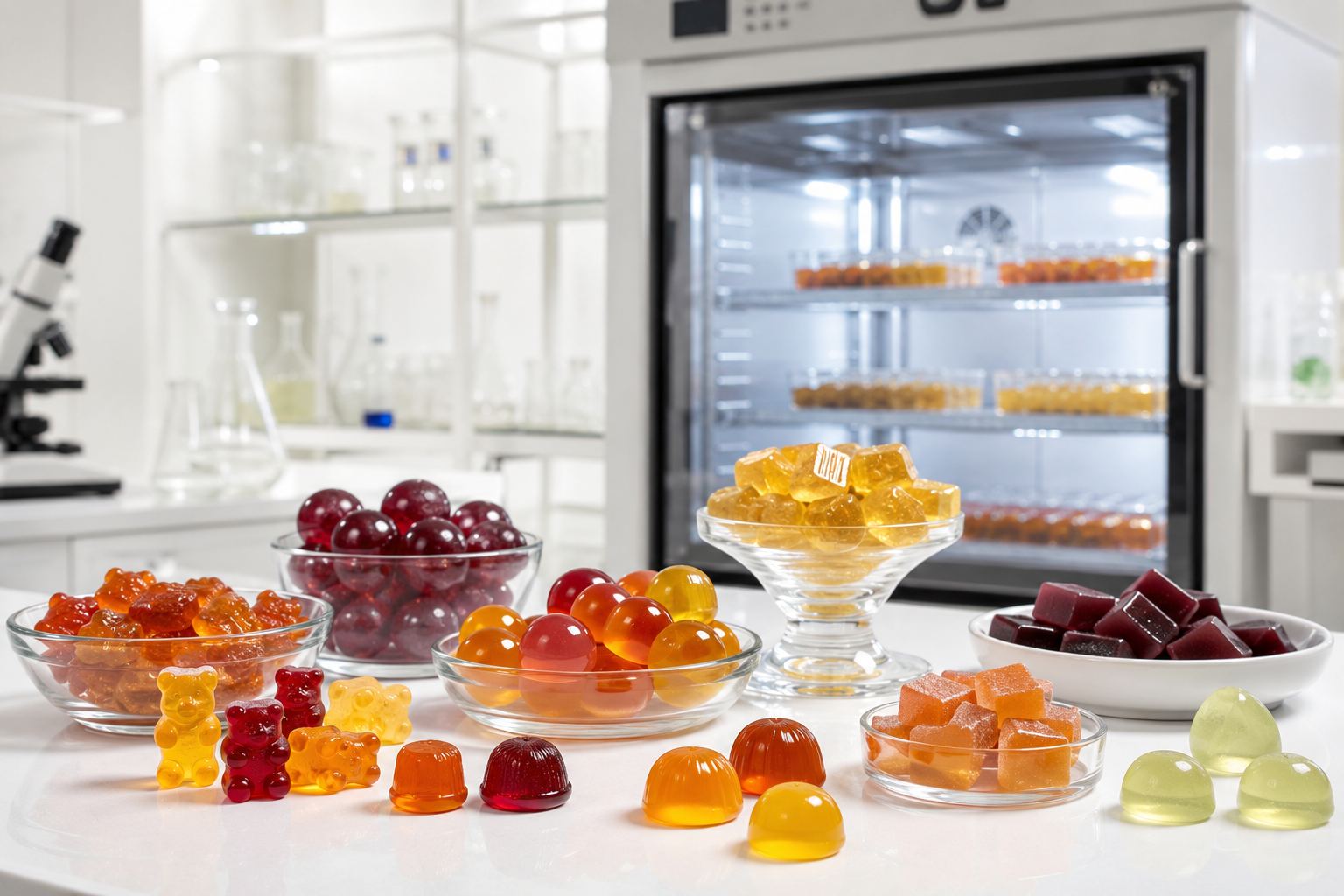
Products in this category are classified by intended use:

  • Vitamin Gummy containing multivitamins or specific vitamins such as Vitamin C, Multivitamin, and Vitamin D, popular for children and adults who prefer not to take tablets
  • Collagen Gummy with collagen peptides as the primary active ingredient, used for skin and joint support
  • Functional Gummy with specific health claims such as improved sleep quality, immune support, and stress reduction
  • Probiotic Gummy containing live microorganisms, with the unique challenge of maintaining CFU/g count within a sugar-based matrix
  • Jelly products (Jelly Stick / Jelly Pouch) packaged in single-serve sachets, ready to consume as is

Specific Challenges of Jelly Systems in Tropical Humid Conditions

Gummy and jelly products face a range of distinct stability challenges.

  • The first challenge is structural stability of the jelly matrix. Pectin is sensitive to pH and Gelatin is sensitive to heat, while Carrageenan and Agar serve as more stable vegetarian-friendly alternatives. Products may soften or harden excessively when stored under fluctuating temperature conditions.
  • The second challenge is sugar crystallization, which can develop over extended storage and alter the texture and taste of the product.
  • The third challenge is caking of gummy pieces inside the pouch, particularly in high-temperature environments where the gummy surface may soften and stick together.
  • The fourth challenge is the degradation of vitamins and active ingredients. Vitamin C is especially susceptible to degradation in aqueous systems, while Vitamin D may degrade from light exposure that passes through the packaging.
  • The fifth challenge is microbial growth. Sugar and moisture in the matrix provide a growth substrate for yeast and mold, making the preservative system and water activity control critical requirements.
  • The sixth challenge is flavor degradation. Natural flavors used in Vitamin C, Strawberry, and Orange Gummy are sensitive to heat and oxidation. Sensory panel evaluation is an important indicator that can detect quality decline before consumers notice any change.
  • Gummy products with Sour Coating or Sugar Coating face additional challenges related to surface integrity: the coating may become sticky, dissolve, or peel under high-temperature and high-humidity conditions. Evaluating coating integrity at each sampling timepoint is a key requirement.
Stability testing for supplement jellies and gummies

Testing Parameters: Texture, aw, Brix, Marker

TIBD’s protocol covers parameters specifically designed for gummy and jelly products:

  • Hardness and texture (Texture/Hardness), measured with a Texture Analyzer covering Hardness, Springiness, Chewiness, and Gumminess. A change exceeding 20% indicates structural alteration of the jelly matrix.
  • Water activity (aw), measured with a Water Activity Meter. The value must not exceed 0.85 for semi-moist gummy products to inhibit microbial growth.
  • Moisture content, measured by Karl Fischer Titration. The standard range for gummy products is 10 to 15%.
  • Brix value, measured with a Refractometer. A change exceeding 5% indicates a shift in the sugar system.
  • pH of the gummy or jelly, which must remain stable within ±0.5 units.
  • Caking, assessed by visual inspection.
  • Active ingredient assay, measured by HPLC. Vitamin content must not fall below 90% of the labeled value. Microbiological testing follows Ministry of Public Health notifications.
  • Springiness and Cohesiveness, measured by Texture Analyzer using Texture Profile Analysis (TPA). A decline in Springiness indicates degradation of the hydrocolloid system and loss of jelly elasticity.

Vitamin and Microbiological Analysis

Vitamin quantification in gummy products uses HPLC with a stability-indicating method. Sample extraction must be carried out carefully to avoid degradation during preparation, using an appropriate mobile phase.

  • Vitamin C is analyzed by HPLC with a UV detector at 245 nm, using a mobile phase containing Metaphosphoric Acid.
  • Vitamin B-complex is analyzed by HPLC with a multi-wavelength UV detector.
  • Collagen Peptide is analyzed by HPLC measuring Hydroxyproline content, which serves as the collagen marker.
  • Microbiological assessment follows Ministry of Public Health notifications, covering total viable count, yeast and mold, and pathogenic microorganisms.
  • For Probiotic Gummy, CFU/g count of live microorganisms is a critical requirement and must remain within the range stated on the label throughout the shelf life.
  • In probiotic gummy systems, live microorganisms in a sugar and moisture-rich matrix degrade faster than in dry powder systems. Microencapsulation is a widely used technique for protecting probiotics in gummy formulations.

Testing Conditions and Sampling Schedule

The protocol follows ICH Q1A(R2) conditions for ASEAN Zone IVb.

Long-term stability testing is conducted at 30°C / 75% RH for a minimum of 12 months. Accelerated stability testing is conducted at 40°C / 75% RH for 6 months. For Probiotic Gummy, a condition of 5°C ± 3°C is added for the long-term study.

Standard sampling timepoints are months 0, 3, 6, 9, 12, 18, and 24 for long-term testing, and months 0, 1, 2, 3, and 6 for accelerated testing.

Thai FDA Registration for Dietary Supplement Products

Gummy and jelly dietary supplement products must be registered with the Thai FDA under the Food Act B.E. 2522. The Product Information File (PIF) must include stability data covering Texture, aw, Marker values, and microbiological test results.

For products carrying specific health claims, supporting data is required to confirm that the active ingredient content continues to deliver the claimed benefit throughout the entire shelf life.

Market Trends for Gummy and Jelly Products in Asia

The gummy and jelly dietary supplement market in Asia is expanding in the Sugar-free Gummy, Vegan Gummy, and Functional Gummy segments. These products use polyols such as Maltitol, Sorbitol, and Erythritol in place of conventional sugar, and Pectin or Carrageenan instead of Gelatin.

Developing Sugar-free Gummy presents specific challenges. Polyols can absorb more moisture than regular sugar and may undergo crystallization over time. Stability evaluation under Zone IVb conditions is a critical requirement that must be addressed from the formulation development stage.

Beyond scientific evaluation, gummy and jelly products must undergo sensory assessment by a trained sensory panel evaluating taste, texture, aroma, and chewing experience. Changes in flavor over time serve as indicators of stability issues that may directly affect consumer repurchase decisions.

A Consumer Acceptance Test with a test panel of 50 to 100 actual consumers is an additional requirement for new brands entering the market, confirming that the product meets consumer expectations.

Formulating Gummy Products Resistant to Tropical Humid Conditions

Designing gummy formulations for the ASEAN Zone IVb tropical-humid market requires consideration of both the hydrocolloid matrix and the preservative system. Pectin, commonly used in vegetarian-friendly gummy products, has greater heat resistance than Gelatin and does not melt at ambient temperatures of 30°C. Combining Pectin with Gellan Gum or Carrageenan can produce a texture comparable to Gelatin-based gummies.

Preservative systems in gummy products commonly use Sodium Benzoate and Potassium Sorbate, which are effective in low-pH environments. Formulating at pH 3.5 to 4.5 allows the preservative system to function efficiently and inhibit microbial growth.

Gummy products with Sugar Coating or Sour Coating require consideration of the coating’s ability to prevent moisture uptake and surface changes. Using Beeswax or Carnauba Wax as an outer layer helps prevent moisture absorption and reduces adhesion between gummy pieces inside the pouch.

Technical Risk Assessment Expertise

Technical risk assessment is a key component that TIBD incorporates when designing stability testing protocols. Failure Mode and Effects Analysis (FMEA) for each formulation helps identify points of accelerated degradation and design tests that detect early warning signals before commercial launch. This assessment covers chemical, physical, microbiological, and packaging-related risks.

Stability study planning based on Quality by Design (QbD) gives manufacturers comprehensive, actionable data for commercial decision-making. Defining Critical Quality Attributes (CQA) and Critical Process Parameters (CPP) from the development stage significantly reduces long-term risk.

Stability testing for supplement jellies and gummies

VISBIO’s Role as the IQAV Data Verifier

VISBIO, as the Independent Quality Assurance Verifier (IQAV), conducts Vitamin Assay analysis, physical assessment, and microbiological testing using validated analytical methods per ICH Q2(R1). All steps are supported by a full traceability documentation system and carried out in accordance with ISO/IEC 17025 standard practices.

TIBD Team Expertise

The gummy and jelly stability testing service is led in collaboration with Dr. Wuttipong Panitsettakorn, advisor and co-founder with expertise in commercial technology management for the health and beauty industry, and Khun Mantamon Uttamo, Senior Advanced Formulator with experience in Vitamin and Collagen Gummy formulation development. Our team includes specialists who are researchers in Hydrocolloid Technology and Functional Food.

Is your gummy or jelly dietary supplement ready for Thai FDA registration? Contact TIBD to receive a custom protocol designed specifically for your product.

เอกสารอ้างอิง (References)

Apply for Stability Testing Service for Gummy and Jelly Dietary Supplements (Jelly/Gummy Stability)

If you have any questions or would like to receive a free consultation regarding Stability Testing Service for Gummy and Jelly Dietary Supplements (Jelly/Gummy Stability), or if you would like to visit us in person in Bangkok, Thailand, you are warmly welcomed and feel free to contact us via the contact form below.

  • This field is for validation purposes and should be left unchanged.