Description

Thai herbal products in Chewable Tablet and Traditional Thai Herbal Tablet formats are popular in both the domestic market and export markets, as they offer convenient consumption and can carry active compounds in quantities sufficient for efficacy per traditional formulation. Consumers in Thailand and ASEAN countries use these products for everyday health maintenance, while export market consumers in Singapore, Malaysia, Japan, and the Middle East are increasingly accepting Thai herbs as a natural healthcare alternative.

The stability challenge for chewable tablets and herbal tablets is that both formats are sensitive to moisture and to degradation of herbal Marker Compounds. Chewable tablets have a large surface area and no protective coating, making them prone to moisture uptake in a tropical humid climate. Traditional Thai herbal tablet products made by traditional processes have complex chemical compositions and multiple Marker Compounds that must be tracked for stability simultaneously.

TIBD’s service is designed specifically for Thai herbal products in tablet and chewable tablet formats. It covers Moisture Content assessment, Tablet Hardness, Disintegration Time, Marker Compound analysis by High-Performance Liquid Chromatography (HPLC), TLC/HPTLC Fingerprinting, and microbiological assessment, conducted under ASEAN Zone IVb conditions and per the Thai Herbal Pharmacopoeia (THP 2021) acceptance criteria, in partnership with VISBIO as an Independent Quality Assurance Verifier (IQAV).
Thai Herbal Products in Tablet and Chewable Tablet Formats

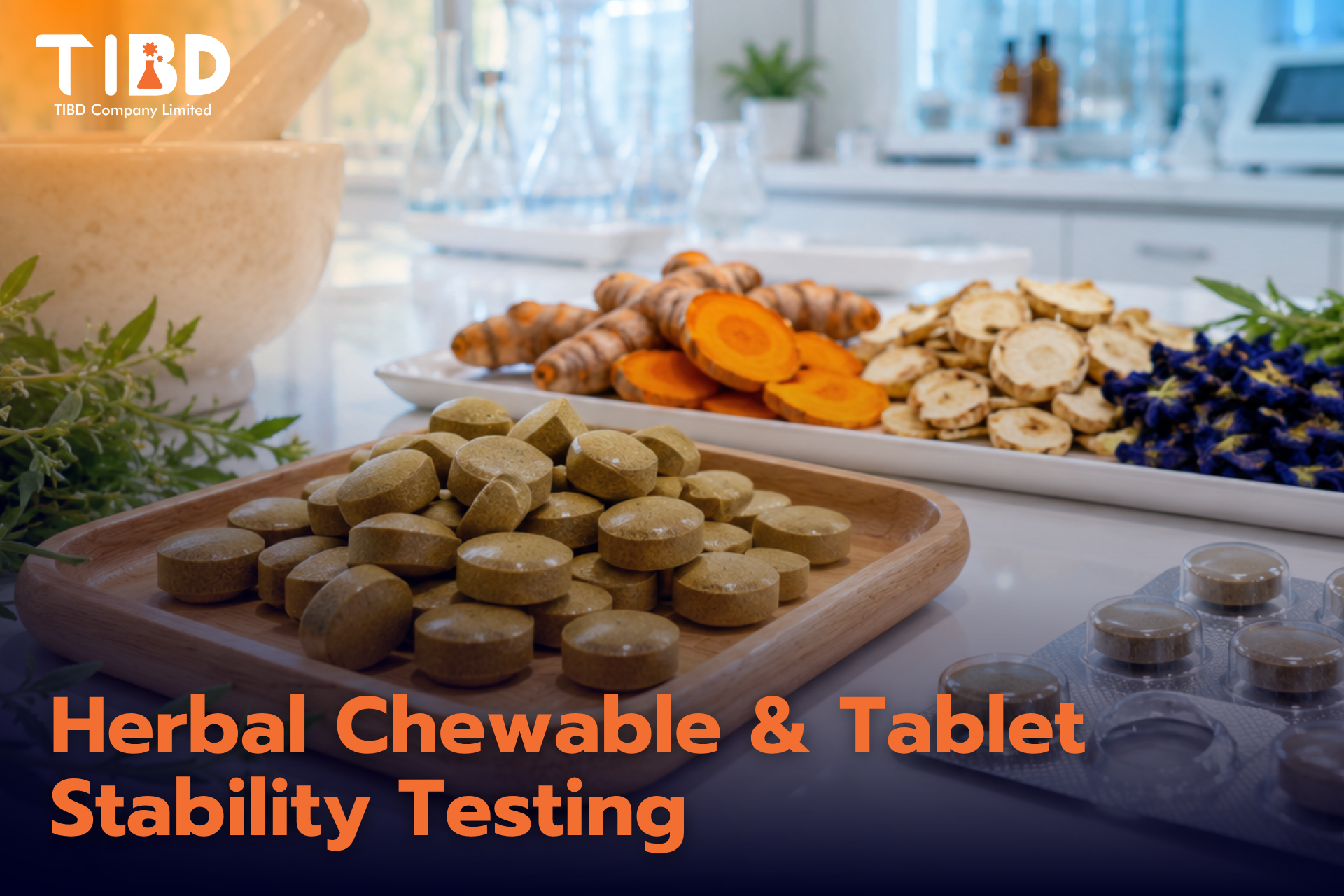
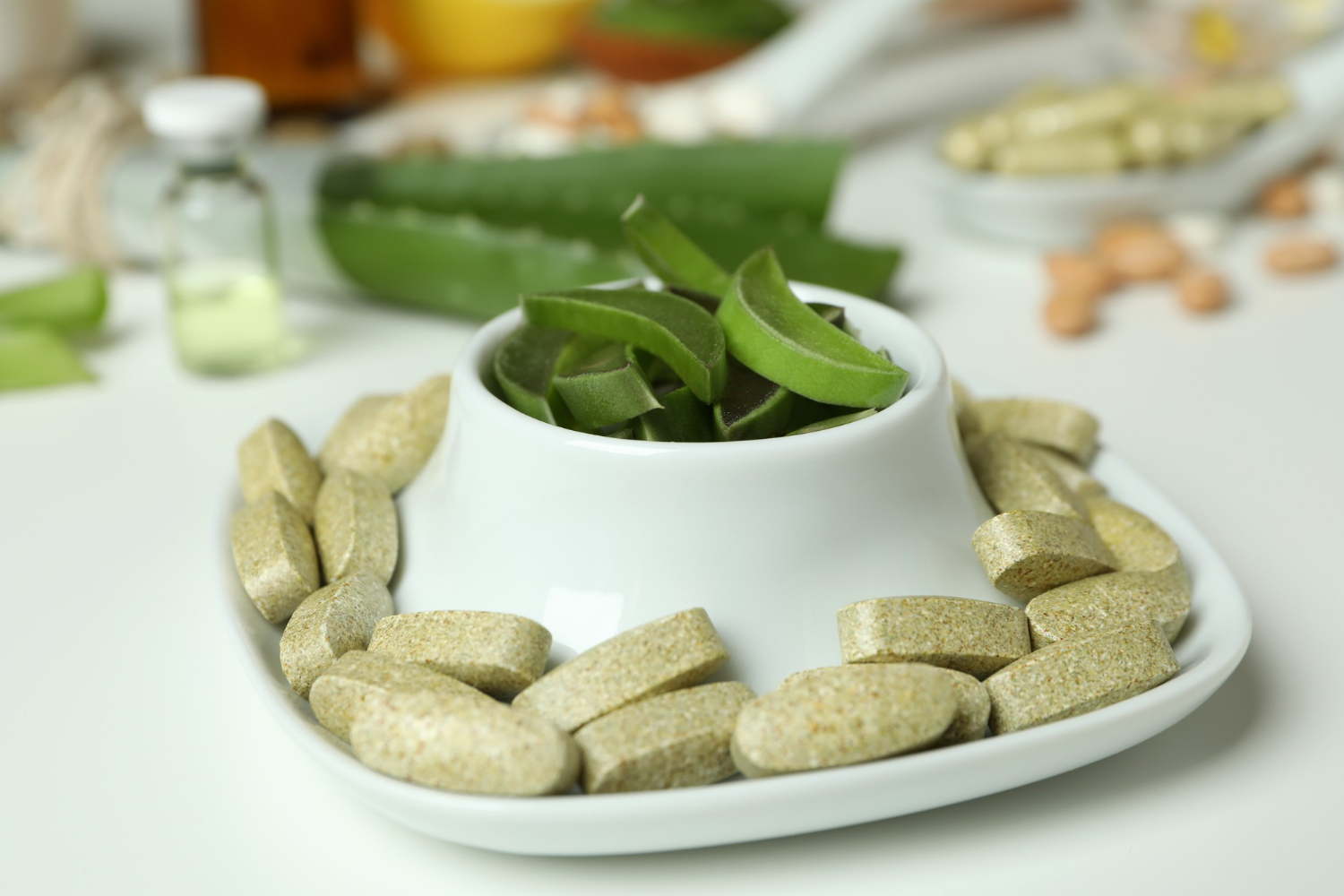
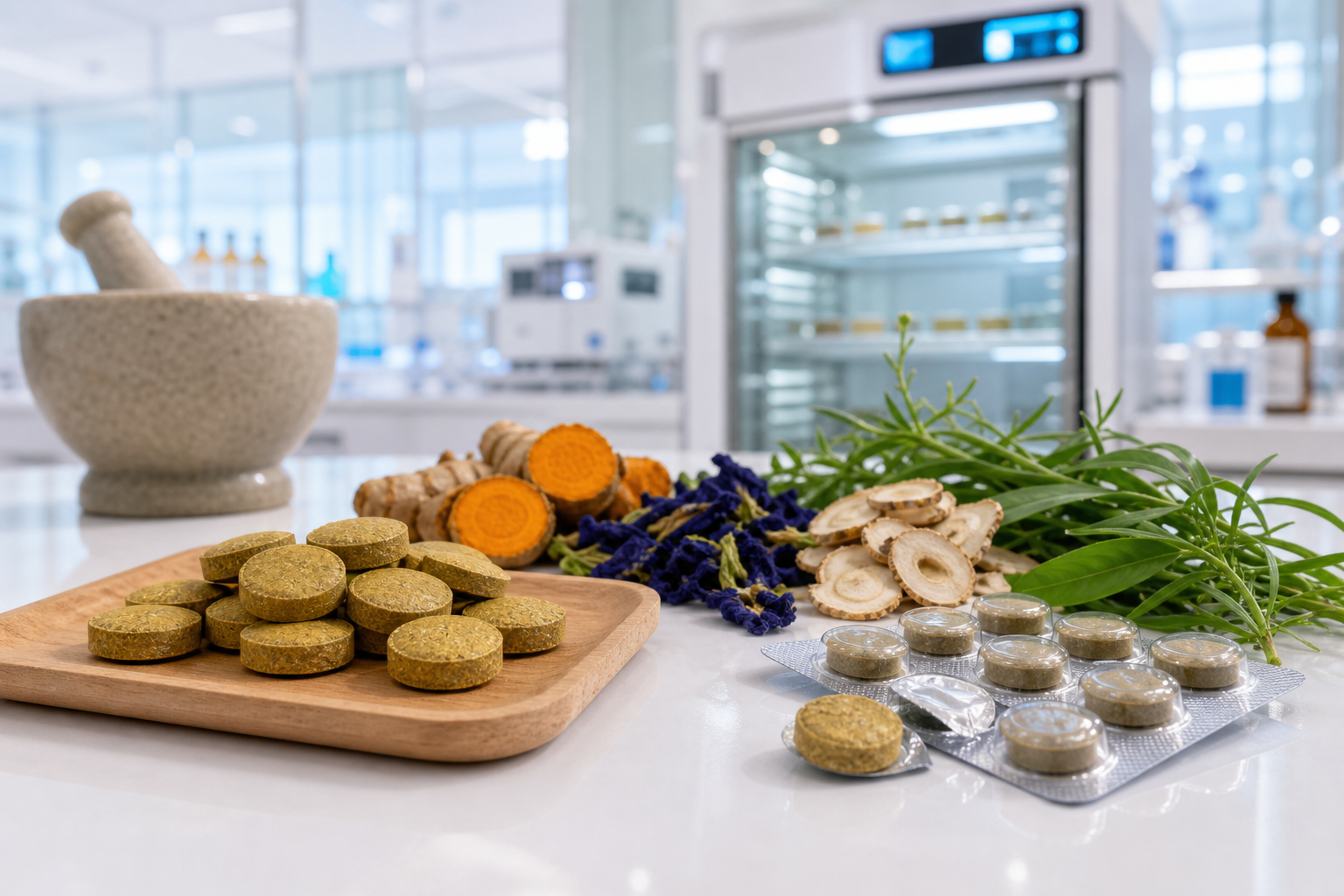
Herbal products in Tablet format are widely used to deliver defined quantities of herbal active compounds. The category covers several sub-types: Plain Herbal Tablets compressed from herbal powder or extracts, Chewable Herbal Tablets designed to be chewed before swallowing, Film-Coated Herbal Tablets with a polymer coating for protection, and Sugar-Coated Tablets with a sugar shell to mask odor and flavor.

Traditional Thai herbal tablets such as Yahom Thephachit, Prasabored, and Triphala fall into a specific category that must reference Thai Traditional Medicine formulations per Ministry of Public Health notifications, and require stability data per the Thai Herbal Pharmacopoeia and the Herbal Product Act B.E. 2562 (2019).

The market for Thai herbal products in tablet format is strong both domestically as consumers turn to Thai traditional medicine for health care, and in export markets where international importers want products backed by scientific evidence. Having complete stability data meeting international standards is therefore a prerequisite for market expansion.

Stability testing for herbal chewable tablets and Thai herbal tablets

Specific Challenges of Chewable Tablets and Herbal Tablets in Tropical Humid Climates

Chewable tablets and uncoated herbal tablets face specific stability testing challenges under ASEAN Zone IVb conditions that differ from coated tablets and capsules.

  • The first challenge is Moisture Uptake. Chewable tablets without a protective coating and with a large surface area absorb moisture from the atmosphere easily, particularly under the 30°C / 75% RH conditions of ASEAN Zone IVb. A Moisture Content increase of more than 5% from the initial value signals packaging problems or a formula that absorbs moisture rapidly, and may affect hardness, disintegration, and microbial growth.
  • The second challenge is Marker Compound stability. Herbal products have complex chemical compositions and multiple Marker Compounds that may degrade at different rates. Curcuminoids in Turmeric are sensitive to light and oxygen. Andrographolide in Andrographis is sensitive to heat. Tannins in Amla are comparatively more stable. Testing must analyze diverse Marker Compounds at each pull point.
  • The third challenge is physical change. Tablet Hardness may change over time: tablets may soften on moisture uptake, or harden if Binder materials undergo state transitions. Coating Integrity for coated tablets must be verified through Disintegration Time testing and moisture monitoring.
  • The fourth challenge is microbial growth. Products with a Water Activity (aw) value above 0.60 are at risk of yeast, mold, and bacterial growth. Per THP 2021, chewable tablets must maintain aw not exceeding 0.60 throughout shelf life.

Testing Parameters: Moisture, Hardness, Disintegration and Marker Compound

TIBD’s stability testing protocols for herbal tablets and chewable tablets cover parameters designed specifically for the characteristics of these dosage forms.

  • Moisture Content is measured by Karl Fischer Titration or Loss on Drying (LOD) at 105°C. The typical range for herbal tablets is 1-5% depending on the specific formula. An increase of more than 2% from the initial value is considered a significant change and signals a packaging issue.
  • Water Activity (aw) is measured by Water Activity Meter. The value must not exceed 0.60 throughout shelf life per THP 2021 and international pharmacopoeias.
  • Tablet Hardness is measured by Hardness Tester in Newton (N) or Kilopond (kp). The acceptable range is plus or minus 20% of the initial value.
  • Disintegration Time is measured per USP pharmacopoeia using a Disintegration Apparatus in the specified medium. Disintegration time must not exceed 30 minutes for chewable tablets and 60 minutes for uncoated herbal tablets.
  • Marker Compound content is analyzed by HPLC for non-volatile compounds such as Curcuminoids, Andrographolide, and Asiaticoside. The value must not fall below 90% of the initial value throughout shelf life.
  • Appearance covers surface color, texture, and tablet integrity compared against the initial reference sample.
  • Microbial Limit Test results per the Thai Herbal Pharmacopoeia must not exceed the specified limits and must show absence of designated pathogenic microorganisms.

Marker Compound Analysis and TLC Fingerprinting

Stability analysis for Thai herbal products uses two techniques together to provide a complete picture of chemical stability.

Marker Compound analysis uses HPLC with a Reverse Phase Column and UV Detector or Diode Array Detector (DAD) for compounds with a Chromophore, such as Curcuminoids in Turmeric at 425 nm wavelength, Andrographolide in Andrographis at 224 nm, and Asiaticoside in Centella at 200 nm. For compounds without a prominent Chromophore, LC-MS/MS or a Refractive Index Detector is used.

Phytochemical Fingerprinting (TLC/HPTLC Fingerprinting) captures the overall profile of multiple compound groups simultaneously, providing a Similarity Index for comparing the chemical profile of the product between T0 and Tx. A value above 0.95 indicates the profile remains close to the initial state.

Using both techniques together provides complete information. Marker Compound analysis answers whether the primary active compounds are still present in sufficient quantity, while TLC Fingerprinting answers whether the overall chemical profile remains consistent with the manufactured and registered form.

For traditional Thai herbal tablets containing multiple herbs, TLC Fingerprinting carries particular importance, as a single Marker Compound may not be sufficient to represent the stability of the overall product.

Stability testing for herbal chewable tablets and Thai herbal tablets

Testing Conditions and Sampling Schedule per ASEAN Zone IVb

TIBD’s testing protocols use conditions per ICH Q1A(R2) for ASEAN Zone IVb, with adjustments appropriate for herbal tablets and chewable tablets.

Long-term Stability testing is conducted at 30°C / 75% RH for a minimum of 12 months to simulate storage conditions in pharmacies and consumers’ homes in tropical humid climates. Accelerated Stability testing is conducted at 40°C / 75% RH for 6 months to support preliminary shelf-life prediction. Intermediate Stability testing at 30°C / 65% RH for 12 months is used when accelerated results show significant change.

Standard pull points for long-term testing are at months 0, 3, 6, 9, 12, 18, and 24. For accelerated testing, pull points are at months 0, 1, 2, 3, and 6. For chewable tablets that are sensitive to moisture, TIBD adds a pull point at month 0.5 and monthly intervals in the first 3 months to capture Moisture Content changes in detail.

Acceptance Criteria per Thai Herbal Pharmacopoeia (THP 2021)

The Thai Herbal Pharmacopoeia (THP 2021) specifies acceptance criteria for herbal tablets, used in conjunction with ICH Q1A(R2) standards.

  • Marker Compound content at the initial time point must be within 90-110% of the specified quantity, and must not fall below 90% throughout shelf life. TLC Fingerprinting Similarity Index between T0 and Tx must not fall below 0.95.
  • Water Activity (aw) must not exceed 0.60 throughout shelf life. Moisture Content must remain within the range specified in the product specification. Tablet Hardness must remain within plus or minus 20% of the initial value. Disintegration Time must not exceed the specified limit.
  • Microbiological test results per THP 2021 require total Aerobic Mesophilic Bacteria not exceeding 100,000 CFU/g, Yeast and Mold not exceeding 100 CFU/g, absence of Salmonella spp., and passing results for Heavy Metals, pesticide residues, and Aflatoxin per specified criteria.

Thai FDA Registration and Export

Herbal products in tablet and chewable tablet formats sold in Thailand must obtain registration with the FDA under the Herbal Product Act B.E. 2562 (2019).

Documentation required for submission covers raw material herbal identification and quality data, Marker Compound analysis for both raw materials and finished products, stability data per ICH Q1A(R2) of at least 6 months of accelerated data and 6-12 months of long-term data, microbiological testing data, and safety data.

For ASEAN exports under the ASEAN Traditional Medicine Guidelines, herbal products must have stability data referenced to ASEAN Zone IVb conditions with Marker Compound data and TLC/HPTLC Fingerprinting.

For Japan and South Korea markets where consumers place high importance on quality standards, 24 months of stability data from 3 production lots is the standard requirement.

VISBIO’s Role as an Independent Quality Assurance Verifier (IQAV)

VISBIO, acting as an Independent Quality Assurance Verifier (IQAV), performs Marker Compound analysis by HPLC, TLC/HPTLC Fingerprinting, microbiological testing, and physical assessment on samples collected at TIBD’s pull points, using Validated Methods per ICH Q2(R1) with full traceability documentation at every step and operations conducted under ISO/IEC 17025 standards.

TIBD Team Expertise

The herbal tablet and chewable tablet stability testing service is conducted in partnership with Dr. Wuttipong Panitsettakorn, Advisor and Co-Founder, who specializes in commercial technology management for the health and beauty industry, and Ms. Mandhamon Uttamo, Advanced Formulator, with experience in Thai herbal tablet and chewable tablet formulation development. Our team includes researchers specializing in Pharmacognosy, Botanical Standardization, and Solid Dosage Form Development.

Is your Thai herbal tablet or chewable tablet product ready for FDA registration or for export? If you need stability data referenced to ICH Q1A(R2), the ASEAN Stability Guideline, and the Thai Herbal Pharmacopoeia (THP 2021), Contact TIBD for a customized protocol designed for your product. Related articles are available in the TIBD Thai Herbal Product Stability Testing Service Hub.

References

Apply for Herbal Chewable Tablet and Thai Herbal Tablet Stability Testing Service

If you have any questions or would like to receive a free consultation regarding Herbal Chewable Tablet and Thai Herbal Tablet Stability Testing Service, or if you would like to visit us in person in Bangkok, Thailand, you are warmly welcomed and feel free to contact us via the contact form below.

  • This field is for validation purposes and should be left unchanged.