Description

The Thai Herbal Product Act B.E. 2562 (2019) classifies registered herbal products into 14 sub-form categories covering solid oral dosage forms, liquid oral dosage forms, topical preparations, inhalation and spray products, and granules and powder formats. Each sub-form category has its own stability-critical parameters, pharmacopoeial acceptance criteria, and regulatory documentation requirements for Thai FDA registration. Manufacturers producing herbal products across multiple dosage form categories require a stability testing partner who understands the technical requirements of each sub-form and can design an appropriate stability protocol per ICH Q1A(R2) for the ASEAN Zone IVb climate.

TIBD’s Herbal Sub-Form Stability Testing service covers all 14 dosage form categories recognized under B.E. 2562, applying Thai Herbal Pharmacopoeia 2021 (THP 2021) as the primary acceptance criteria reference, supplemented by USP, EP, BP, and Chinese Pharmacopoeia where THP 2021 does not provide a relevant monograph, and by In-house Specification developed per WHO stability testing guidelines and ICH Q1A(R2) where no pharmacopoeial standard is available. Testing is conducted in partnership with VISBIO as an Independent Quality Assurance Verifier (IQAV) operating under ISO/IEC 17025 standards.
Dosage Form Classification Under the Thai Herbal Product Act B.E. 2562

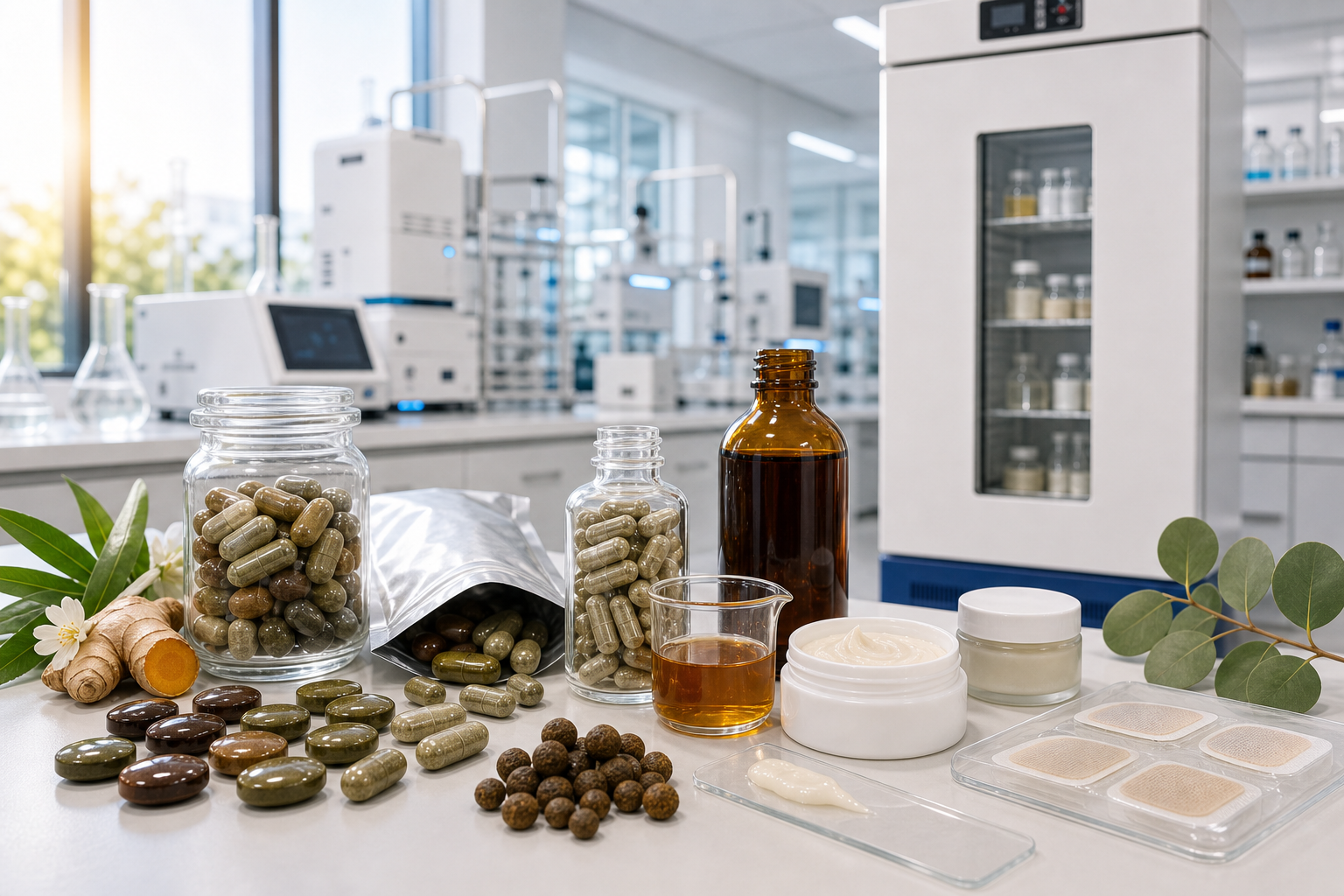
The 14 sub-form categories under B.E. 2562 cover five major format groups: Solid Oral, Liquid Oral, Topical, Inhalation and Spray, and Granules and Powder.

  • Solid Oral Sub-Forms include Plain Tablet (ยาเม็ดธรรมดา), Film-Coated Tablet (ยาเม็ดเคลือบฟิล์ม), Sugar-Coated Tablet (ยาเม็ดเคลือบน้ำตาล), Hard Gelatin Capsule (ยาแคปซูลแข็ง), Soft Gelatin Capsule (ยาแคปซูลนิ่ม), Softgel (ซอฟเจล), and Traditional Lycap (ลูกกลอน). Each of these sub-forms has distinct compendial test methods, acceptance criteria, and stability-critical parameters as detailed in the individual service pages for Herbal Tablet, Capsule, and Softgel stability testing.
  • Liquid Oral Sub-Forms include Herbal Syrup (ยาน้ำเชื่อม), Herbal Oral Solution (ยาน้ำใส), and Herbal Suspension (ยาน้ำแขวนตะกอน). Testing parameters for Liquid Oral sub-forms include pH, Brix, Viscosity, Sedimentation Rate, Clarity, Microbiology, Preservative Efficacy Test (PET) per ISO 11930, and Marker Compound Assay by HPLC throughout the shelf life.
  • Topical Sub-Forms include Herbal Cream and Lotion (ครีมและโลชั่น), Herbal Balm and Ointment (ยาหม่องและขี้ผึ้ง), and Herbal Transdermal Patch (แผ่นแปะผิวหนัง). Testing parameters for Topical sub-forms include Viscosity, pH, Emulsion Stability (Phase Separation, Creaming), Skin Adhesion for Patches, Drug Release Profile by Franz Diffusion Cell, Microbiology including Preservative Efficacy Test, and Marker Compound Assay by HPLC.
  • Inhalation and Spray Sub-Forms include Herbal Nasal Spray and Aromatherapy Spray (ยาสเปรย์ฉีดพ่น). Testing parameters include Spray Pattern uniformity, Particle Size Distribution for aerosol products, pH, Microbiology, Volatile Compound stability by GC-MS, and Marker Compound Assay.
  • Granules and Powder Sub-Forms include Herbal Granule (ยาผงเม็ด) and Herbal Powder Sachet (ยาผงซอง). Testing parameters include Moisture Content, Water Activity, Particle Size Distribution, Hygroscopicity by DVS Sorption Isotherm, Solubility, Microbiology, and Marker Compound Assay by HPLC.
Stability testing for herbal sub-forms

Common Stability Challenges Across Sub-Forms in Tropical Climates

Seven stability challenges are common to multiple herbal product sub-forms when stored under ASEAN Zone IVb conditions of 30°C / 75% RH long-term and 40°C / 75% RH accelerated.

  1. The first common challenge is Marker Compound degradation. All herbal product sub-forms containing standardized extract with a declared Marker Compound content must demonstrate that the content remains at Not Less Than 90% of the labeled value throughout the declared shelf life. Degradation rates vary by sub-form: liquid oral preparations generally show faster degradation than solid dosage forms due to greater molecular mobility in aqueous solution.
  2. The second common challenge is moisture-related physical instability. Solid sub-forms including Tablets, Capsules, Granules, and Powders absorb moisture from the humid ambient environment, increasing Disintegration Time, reducing Hardness, causing Caking, and promoting microbial growth. Liquid sub-forms may undergo concentration change through evaporation or dilution by condensed moisture. Topical sub-forms may exhibit phase separation or viscosity change from moisture ingress.
  3. The third common challenge is microbial growth under tropical storage conditions. All liquid and semi-solid herbal sub-forms require Microbial Limit testing and Preservative Efficacy testing at each Pull Point. The hot and humid ASEAN Zone IVb environment accelerates microbial growth in water-containing formulations with inadequate preservative systems.
  4. The fourth common challenge is color change from oxidation of natural pigments, Maillard reaction, or enzyme-catalyzed browning. Color assessment by CIE Lab* Colorimetry is applied to all sub-forms where color is a quality indicator, including Tablets, Capsules, Syrups, Creams, and Patches.
  5. The fifth common challenge is pH change in liquid sub-forms from acid production by microbial activity, hydrolysis of ester or glycoside bonds, or oxidation reactions. pH monitoring at each Pull Point provides an early indicator of chemical or microbial instability in all liquid oral and topical sub-forms.
  6. The sixth common challenge is aroma and volatile compound loss from aromatic herbal products, including essential oil-containing syrups, balms, patches, and sprays. Volatile Compound stability is monitored by GC-MS headspace analysis for products where aroma is a quality attribute.
  7. The seventh common challenge is packaging integrity failure under tropical temperature cycling. Blister seal integrity, bottle closure performance, sachet seal strength, and tube closure reliability must all be confirmed throughout the shelf life under ASEAN Zone IVb conditions. Packaging integrity failure results in moisture ingress, microbial contamination, and active ingredient loss regardless of formulation quality.

Sub-Form-Specific Testing Parameters by Category

  • For Solid Oral Sub-Forms (Plain Tablet, Film-Coated Tablet, Lycap): Hardness 30 to 200 N depending on sub-form (Lycap 30 to 80 N; Plain Tablet 50 to 150 N; Film-Coated Tablet 70 to 200 N), Disintegration Time Not More Than 15 to 60 minutes by sub-form, Friability Not More Than 1%, Dissolution Q not less than 75% in 30 to 45 minutes for Immediate Release, Moisture Content 3 to 6%, Water Activity not more than 0.6, Coating Integrity by Stereomicroscope for Film-Coated sub-forms.
  • For Hard Gelatin and HPMC Capsule Sub-Forms: Disintegration Time Not More Than 30 minutes, Dissolution Q not less than 75% in 30 to 45 minutes, Moisture Content 3 to 7%, Water Activity not more than 0.6, Two-Tier Dissolution in pepsin medium when Disintegration exceeds twice the initial value (Gelatin cross-linking check).
  • For Soft Gelatin Capsule (Softgel) Sub-Forms: Shell Integrity by visual inspection, Hardness by Texture Analyzer, Brittleness Drop Test, Disintegration Not More Than 30 minutes, Shell Moisture 5 to 10%, Peroxide Value Not More Than 10 mEq/kg, Anisidine Value Not More Than 20, TOTOX Not More Than 26 (for lipid-fill products).
  • For Liquid Oral Sub-Forms (Syrup, Solution, Suspension): pH 3.5 to 5.5 (Not More Than plus or minus 0.5 units change), Brix 50 to 70°Bx for Syrups (Not More Than 5% drop), Viscosity within 20% of initial, Sedimentation Rate assessment, PET per ISO 11930, Total Microbial Count and Yeast Mold Count per THP 2021.
  • For Topical Sub-Forms (Cream, Lotion, Balm, Ointment): Viscosity by Brookfield Viscometer within 20% of initial, pH 4.0 to 7.0 for Creams and Lotions, Phase Separation visual check, PET per ISO 11930, Drug Release by Franz Diffusion Cell for products with penetration claims.
  • For Transdermal Patch Sub-Forms: Adhesion Force by Probe Tack Test or 180-degree Peel Test, Drug Release per USP Apparatus 5 (Paddle-Over-Disk) or Apparatus 6 (Cylinder), Moisture Content of Patch Matrix, In-vitro Permeation by Franz Diffusion Cell with Synthetic Membrane (Strat-M).
  • For Spray Sub-Forms: Spray Pattern uniformity, Droplet Size Distribution for aqueous nasal sprays, Volatile Compound profile by GC-MS, Microbiology, pH within acceptance range.
  • For Granule and Powder Sub-Forms: Moisture Content 3 to 5%, Water Activity not more than 0.6, Particle Size Distribution by Laser Diffraction, Hygroscopicity by DVS Sorption Isotherm, Solubility and Dispersibility within 5 minutes.

Analytical Methods: Marker Compound HPLC, TLC Fingerprinting, GC-MS, and Contaminant Testing

TIBD and VISBIO apply compound-specific HPLC methods validated as Stability Indicating methods per ICH Q2(R1) for all Marker Compounds in each sub-form. The analytical platform is selected based on the compound’s spectroscopic properties and the matrix complexity of the specific sub-form: UV detection for Andrographolide (225 nm), Curcuminoids (425 nm), Glycyrrhizin (254 nm), Plumbagin (268 nm), Berberine and 6-Gingerol (280 nm), Withanolide (220 nm); ELSD or UV 200 nm for Asiaticoside and Ginsenoside; Fluorescence Detection for Vitamin E and Vitamin K2; Electrochemical Detection for Ubiquinol; GC-FID for EPA and DHA per AOCS Ce 1i-07.

  • TLC Fingerprinting per THP 2021 monograph requirements provides botanical identity confirmation and adulterant detection for all registered herbal sub-forms. HPTLC with Densitometry provides a quantitative fingerprint suitable for pharmacopoeial compliance documentation.
  • GC-MS Headspace analysis for Volatile Compound monitoring is applied to all sub-forms containing essential oils, aromatic herbal extracts, or herbal actives that are partly volatile, including Zingiber officinale (ginger), Cinnamomum verum (cinnamon), Curcuma longa (turmeric), Ocimum sanctum (holy basil), and Cymbopogon citratus (lemongrass).
  • Heavy Metal by ICP-MS per ICH Q3D: Lead not more than 10 mg/kg, Arsenic not more than 5 mg/kg, Cadmium not more than 0.3 mg/kg, Mercury not more than 0.5 mg/kg. Heavy metal testing is required at registration and at the 12-month Pull Point for all sub-forms.
  • Pesticide Residue by QuEChERS Multi-Residue Method per LC-MS/MS and GC-MS/MS, against Codex Alimentarius or EU MRL criteria. Required for all sub-forms containing whole herb powder or non-purified extract.
  • Mycotoxin including Aflatoxin B1 not more than 2 ppb and total Aflatoxins not more than 4 ppb per Codex Alimentarius, and Ochratoxin A not more than 10 ppb per EU Regulation 1881/2006, for sub-forms containing susceptible herbs.

Stability Testing Conditions per ICH Q1A(R2)

Long-term Stability testing uses 30°C / 75% RH per ASEAN Zone IVb for a minimum of 24 months. Accelerated Stability testing uses 40°C / 75% RH for 6 months. For some herbal product categories where THP 2021 specifies or Thai FDA guidance recommends longer shelf life claims (such as Traditional Herbal Powder and Lycap in sealed packaging), a 36-month Long-term study is required.

Intermediate Stability at 30°C / 65% RH is added when significant instability is observed under Accelerated conditions, or when the ICH Q1E extrapolation calculation requires intermediate data to support a shelf life claim beyond 24 months.

Standard Pull Points for Long-term testing are months 0, 3, 6, 9, 12, 18, 24, and 36 (where required). Standard Pull Points for Accelerated testing are months 0, 1, 2, 3, and 6. Pull Points for Topical, Spray, and Patch sub-forms additionally include an In-use Stability assessment after the first opening of the primary container.

Photostability testing per ICH Q1B in a Solar Simulator is required for all sub-forms in transparent or semi-transparent packaging and for sub-forms containing photosensitive Marker Compounds including Curcuminoids, Anthocyanins, Carotenoids, and Vitamin D3.

Acceptance Criteria: THP 2021, USP/EP/BP, and In-house Specification

Thai Herbal Pharmacopoeia 2021 (THP 2021) provides the primary acceptance criteria for the identity, purity, assay, and microbial limits of each herbal ingredient with a THP monograph. TIBD confirms compliance with THP 2021 for all regulated herbal sub-forms as the first-tier acceptance criteria hierarchy under Thai FDA requirements.

USP (United States Pharmacopeia), EP (European Pharmacopoeia), BP (British Pharmacopoeia), and Chinese Pharmacopoeia are applied as supplementary references when THP 2021 does not provide a complete monograph for the specific herbal ingredient or dosage form. These pharmacopoeiae are referenced in the order listed under the pharmacopoeial hierarchy used by Thai FDA evaluators for imported or internationally registered herbal products.

In-house Specification developed per WHO Guidelines on Stability Testing of Active Pharmaceutical Ingredients and Finished Pharmaceutical Products (TRS 953) and ICH Q1A(R2) is applied for novel herbal formulations, new dosage form innovations, or combination products without a pharmacopoeial precedent. In-house Specifications are documented in the Product Specification dossier and submitted as part of the Thai FDA registration package.

Stability testing for herbal sub-forms

Thai FDA Registration Framework and ASEAN Export Requirements

Under the Herbal Product Act B.E. 2562 (2019), the registration dossier for each herbal sub-form must include a Drug Master File for each raw material, a finished product Quality Specification, stability data covering the claimed shelf life, safety data (toxicology or reference to established safety), and efficacy data if therapeutic claims are made on the label.

ASEAN Traditional Medicine and Health Supplement Guidelines provide harmonized stability requirements for products intended for cross-border registration within the ASEAN region, including minimum stability study duration, required Pull Points, and acceptability of data generated from one ASEAN Zone IVb member state for registration in another.

Codex Alimentarius contaminant limits (Heavy Metal, Aflatoxin, Ochratoxin) and the ASEAN traditional medicine import requirements of the destination country must be confirmed for all herbal products intended for export beyond the Thai domestic market.

VISBIO’s Role as an Independent Quality Assurance Verifier (IQAV)

VISBIO, acting as Independent Quality Assurance Verifier (IQAV), conducts all stability testing parameters relevant to the specific sub-form at each Pull Point, including physical, chemical, microbiological, and contaminant testing using Validated Methods per ICH Q2(R1) with full Traceability documentation and operations conducted under ISO/IEC 17025 standards. VISBIO’s independence from the manufacturer ensures that stability data submitted in Thai FDA registration dossiers and in ASEAN regulatory submissions meets the credibility requirements of regulatory evaluators who require data generated by a qualified third-party laboratory.

TIBD Team Expertise

The Herbal Sub-Form Stability Testing service is led by Dr. Wuttipong Panitsettakorn, Advisor and Co-Founder, who specializes in commercial technology management for the health and beauty industry, and is supported by our team of researchers specializing in Phytochemistry, Tablet and Capsule Technology, Liquid Formulation Technology, Topical and Transdermal Technology, Spray Drying, Analytical Chemistry, Microbiology, and Regulatory Affairs for the Thai and ASEAN herbal product market. TIBD’s cross-functional team covers all 14 dosage form sub-forms recognized under B.E. 2562 from a single service partner, reducing the coordination burden for manufacturers with multi-format product portfolios.

Does your herbal product portfolio span multiple dosage form sub-forms? Contact TIBD for a customized stability protocol covering all your registered or planned formats from a single service partner, starting from ฿15,000.

ReferencesInternational Council for Harmonisation of Technical Requirements for Pharmaceuticals for Human Use. (2003). Stability testing of new drug substances and products: Q1A(R2). ICH Harmonised Tripartite Guideline. https://database.ich.org/sites/default/files/Q1A%28R2%29%20Guideline.pdf

Apply for Herbal Product Sub-Form Stability Testing Service

If you have any questions or would like to receive a free consultation regarding Herbal Product Sub-Form Stability Testing Service, or if you would like to visit us in person in Bangkok, Thailand, you are warmly welcomed and feel free to contact us via the contact form below.

  • This field is for validation purposes and should be left unchanged.