Description

Herbal Inhalers and Herbal Oils are traditional Thai medicine and health product formats that use essential oils as the primary active ingredient. Product types covered include bottled inhalers containing essential oils combined with spices and herbs, Nasal Inhaler Sticks that use a cotton wick to absorb the aromatic oil, body oils for massage or external application, herbal oils for aromatherapy, and pure essential oils used as raw materials.

The key stability challenges for herbal inhalers and oils in the tropical-humid climate of ASEAN Zone IVb include evaporation of volatile compounds leading to loss of potency, oxidative reactions causing rancidity, color changes, degradation of terpenes and aromatic compounds that indicate product quality, and packaging leakage.

TIBD’s service is specifically designed for herbal inhalers and herbal oils, covering volatile compound profiling by Gas Chromatography Mass Spectrometry (GC-MS), peroxide value (PV), anisidine value (AnV), TOTOX index, density, refractive index, color and clarity, olfactory evaluation, and headspace volume assessment under ASEAN Zone IVb conditions, conducted in collaboration with VISBIO as an Independent Quality Assurance Verifier (IQAV).

Herbal Inhalers and Herbal Oils in the Health Product Market

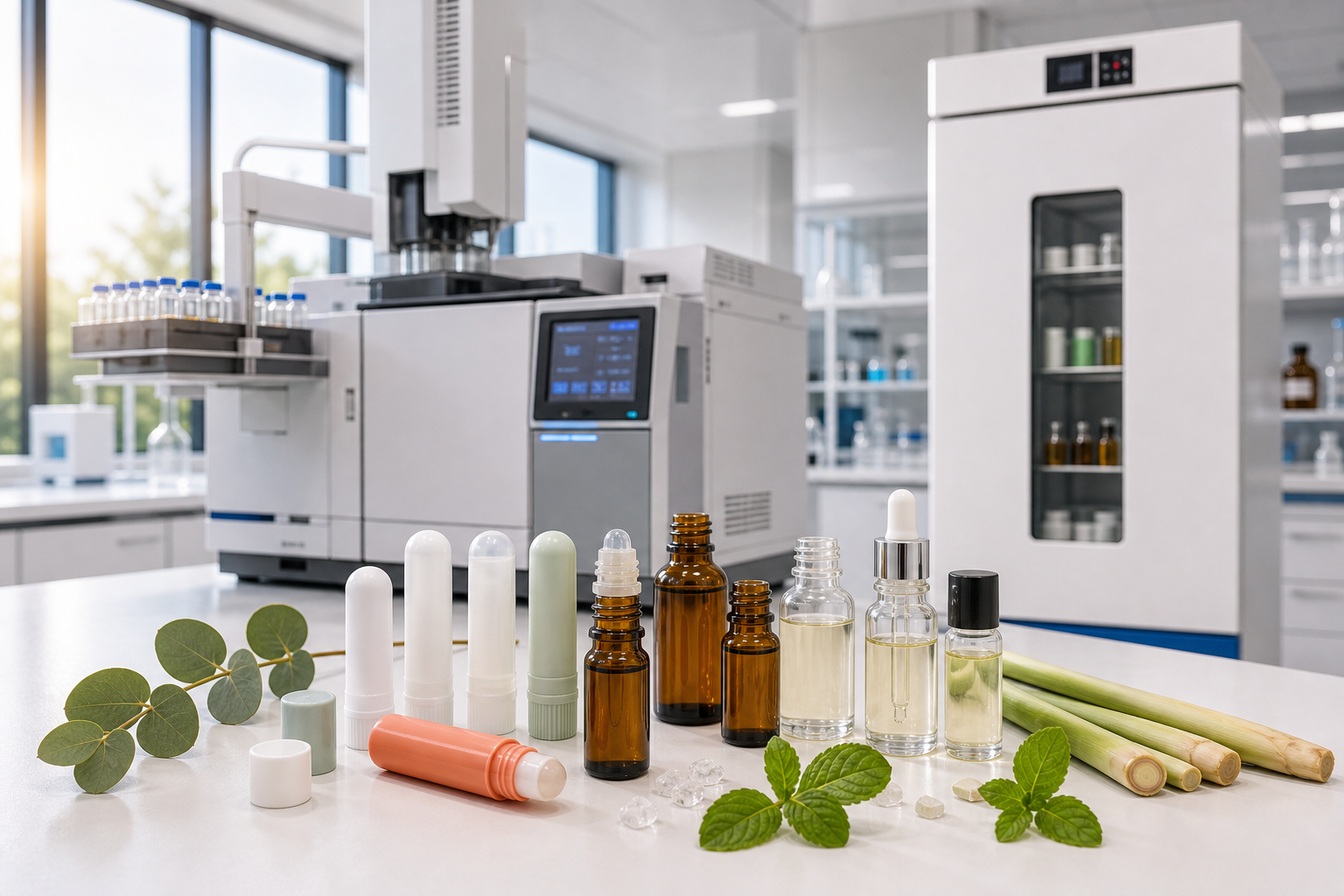
Herbal inhalers and herbal oils in the Thai and ASEAN markets fall into several subcategories.

  • Traditional Thai herbal inhalers formulated according to traditional Thai medicine, such as the Smelling Salt type in glass bottles used for inhaling to relieve dizziness and lightheadedness. Core ingredients typically include Borneol, Camphor, Menthol, Eucalyptus Oil, Peppermint Oil, and Clove Oil.
  • Nasal Inhaler Sticks that use a Cotton Wick or Sponge Wick to absorb the aromatic oil, compact and portable, and well-suited to the export market across Asia.
  • New-formula inhalers developed with concentrated extracts and contemporary aromatics such as Lavender, Eucalyptus Globulus, and Peppermint.
  • Body Oils and Massage Oils for external and massage use, produced from carrier oils such as Sesame Oil, Coconut Oil, and Sweet Almond Oil combined with essential oils.
  • Aromatherapy herbal oils for use in diffusers or spa products, formulated to emphasize fragrance profiles that support mood and wellbeing.
  • Pure Essential Oils used as raw materials in finished products, including Eucalyptus Oil, Tea Tree Oil, Lavender Oil, Lemongrass Oil, Citronella Oil, Ginger Oil, and Turmeric Oil.
  • Herbal balms (Yaa Mong) with essential oils as the primary active ingredient, applied topically to relieve muscle aches and itching.
Stability testing for herbal inhalers and herbal oils

Specific Challenges of Essential Oil Systems

Essential oils in tropical-humid environments face a distinct set of stability challenges.

  • The first challenge is evaporation of volatile compounds. Essential oils contain compounds that evaporate readily at room temperature. Frequent opening or storage in non-airtight packaging causes volatile compounds to be lost, affecting fragrance intensity and product potency.
  • The second challenge is oxidation of terpene hydrocarbons upon contact with oxygen and light, particularly Limonene and Pinene, which produces degradation products that may cause skin sensitization.
  • The third challenge is scent degradation, which consumers perceive immediately. Changes in fragrance character can directly affect repeat purchase decisions.
  • The fourth challenge is color change from clear to yellow or brown, which indicates advanced oxidative breakdown.
  • The fifth challenge is degradation of the carrier oil in body oils. A rising peroxide value indicates oxidation of unsaturated fatty acids.
  • The sixth challenge is packaging leakage. Essential oils can cause swelling or degradation of certain plastic types, making compatible packaging selection a critical requirement.
  • The seventh challenge is degradation of the Cotton Wick in Nasal Inhaler Sticks, which may accumulate oxidation products and discolor over time.

Testing Parameters: Volatile, PV, AnV, Refractive Index

TIBD’s protocol covers parameters specific to herbal inhalers and herbal oils.

  • Volatile Compound Profile, measured by Headspace Gas Chromatography Mass Spectrometry (HS-GC-MS), identifies and quantifies individual volatile compounds. Values must remain stable throughout the shelf life.
  • Peroxide Value (PV), measured by Titration per AOCS Cd 8b-90. The accepted limit for body oils is not more than 20 mEq/kg.
  • Anisidine Value (AnV), measuring secondary oxidation products. The accepted limit is not more than 10.
  • TOTOX Index (2 × PV + AnV), indicating overall oxidation status. The accepted limit is not more than 26.
  • Density, measured by Pycnometer or Density Meter, compared against pharmacopoeial standard ranges for each oil type.
  • Refractive Index, measured by Refractometer at 20°C. Values must fall within the standard range defined for each oil type.
  • Optical Rotation, measured by Polarimeter, for essential oils containing chiral compounds.
  • Boiling Point and Flash Point, for oils where these values are stated in the product specification.
  • Color and Clarity, measured by Spectrophotometer or Colorimeter.
  • Olfactory Evaluation, conducted by a trained sensory panel with assessed fragrance identification capability.

Terpene and Aromatic Compound Analysis by GC-MS

Analysis of marker compounds in essential oils uses specially configured gas chromatography methods.

  • GC-FID (Flame Ionization Detector) is used for quantification of known compounds in the oil using an Internal Standard Method. GC-MS (Mass Spectrometry) is used for identification and quantification against NIST or Wiley spectral databases.
  • Key marker compounds measured per oil type are as follows:
  • Eucalyptus Oil (Eucalyptus globulus): 1,8-Cineole (Eucalyptol) not less than 70%, Alpha-Pinene, Limonene, Para-Cymene.
  • Tea Tree Oil (Melaleuca alternifolia): Terpinen-4-ol not less than 30%, Gamma-Terpinene, Alpha-Terpinene, 1,8-Cineole not more than 15% (per ISO 4730).
  • Lavender Oil (Lavandula angustifolia): Linalool, Linalyl Acetate, Camphor.
  • Peppermint Oil (Mentha piperita): Menthol not less than 35%, Menthone, Menthyl Acetate.
  • Lemongrass Oil (Cymbopogon citratus): Citral (Geranial + Neral) not less than 75%.
  • Citronella Oil: Citronellal, Geraniol, Citronellol.
  • Ginger Oil (Zingiber officinale): Zingiberene, Beta-Sesquiphellandrene, Alpha-Curcumene.
  • Turmeric Oil (Curcuma longa): Ar-Turmerone, Alpha-Turmerone, Beta-Turmerone.
  • Camphor Oil: Camphor, Borneol, Cineole.
  • Wintergreen Oil: Methyl Salicylate not less than 96%.
  • Total marker compound content must not fall below 90% of the value stated on the product label throughout the shelf life. For oils referenced against ISO standards or pharmacopoeial monographs, each individual compound must remain within the specified range.

Testing Conditions and Sampling Schedule

The protocol follows ICH Q1A(R2) conditions for ASEAN Zone IVb, with additional conditions appropriate for essential oils.

  • Long-term Stability is conducted at 30°C / 75% RH for a minimum of 24 months. Accelerated Stability is conducted at 40°C / 75% RH for 6 months. Cool Storage conditions at 5°C ±3°C are applied for oils sensitive to heat.
  • Standard sampling timepoints for long-term testing are months 0, 3, 6, 9, 12, 18, and 24. For accelerated testing, sampling occurs at months 0, 1, 2, 3, and 6.
  • Photostability assessment per ICH Q1B is conducted in Solar Simulator chambers that replicate visible and UV light exposure.
  • Headspace Loss assessment is conducted at every sampling timepoint to monitor evaporation and verify packaging integrity.
  • In-use Stability assessment is conducted under actual usage conditions: the packaging is opened at a defined frequency and parameters are measured at each sampling timepoint.

Packaging Systems and Evaporation Prevention

Packaging design is the single most critical factor for essential oil products.

  • Amber glass bottles are the standard packaging format, providing light protection and chemical non-reactivity with oils.
  • Closure systems using a Polyolefin Liner or Teflon Liner prevent evaporation. Rubber liners should be avoided as they may degrade in contact with oils.
  • Dropper pipette systems with an airtight seal provide controlled dosing.
  • Roll-on bottles with plastic roller balls must pass a compatibility assessment with the specific oil formula.
  • Nasal Inhaler Sticks with Cotton Wicks must be enclosed in HDPE or PP plastic shells that are resistant to oil contact and seal tightly.
  • Tamper-Evident Seals protect product integrity during transport and provide a visible indication of product condition.
  • Storage under Cool Storage conditions (15 to 25°C) in temperature-controlled warehouses reduces the rate of evaporation and extends shelf life.
  • Labels must include the instructions “Store in a cool place,” “Close cap tightly after use,” and “Keep away from open flames” as required consumer communication.
Stability testing for herbal inhalers and herbal oils

Registration and Export

Registration of herbal inhalers and herbal oils with the Thai FDA follows the classification of each product type.

  • Traditional Thai herbal inhalers produced according to a recognized formula are registered under the Herbal Product Act B.E. 2562 (2019).
  • Body oils and aromatherapy oils are registered under the Cosmetic Act B.E. 2558 (2015) via the Cosmetic Notification system.
  • Pure essential oils exported as raw materials must comply with applicable ISO standards, including ISO 4730 (Tea Tree Oil), ISO 770 (Eucalyptus Oil), and ISO 856 (Peppermint Oil).
  • For the European Union market, Cosmetic Regulation EC 1223/2009 requires that fragrance allergens from the established list of 26 allergens be declared on the label when present above defined threshold concentrations.
  • For the United States market, the FDA and FTC have requirements for essential oils making health-related claims. Any claim of drug-like therapeutic effects requires registration as an OTC Drug.

The Role of VISBIO as an IQAV

VISBIO, acting as an Independent Quality Assurance Verifier (IQAV), performs Volatile Compound Profile analysis by GC-MS, along with PV, AnV, TOTOX, Density, Refractive Index, Optical Rotation, olfactory evaluation, and Headspace Loss assessment. All analytical methods are validated in accordance with ICH Q2(R1), supported by full traceability documentation at every stage, and conducted under ISO/IEC 17025 best-practice standards.

TIBD Team Expertise

The stability testing service for herbal inhalers and herbal oils is conducted in collaboration with Dr. Wuttipong Phanitsetsakorn, Advisor and Co-founder, whose expertise spans commercial technology management for the health and beauty industry, and Ms. Manjamon Utomo, Senior Product Formulator with extensive experience in herbal inhaler and aromatherapy oil development. The team includes specialists in Essential Oil Chemistry, Volatile Analysis, Aromatherapy, and Natural Product Chemistry.

Is your herbal inhaler or herbal oil ready for FDA registration? Contact TIBD to receive a customized protocol design tailored to your product. Contact TIBD

References

Apply for Stability Testing Service for Herbal Inhalers and Herbal Oils (Herbal Inhaler & Oil Stability)

If you have any questions or would like to receive a free consultation regarding Stability Testing Service for Herbal Inhalers and Herbal Oils (Herbal Inhaler & Oil Stability), or if you would like to visit us in person in Bangkok, Thailand, you are warmly welcomed and feel free to contact us via the contact form below.

  • This field is for validation purposes and should be left unchanged.