Description

Oil-based extracts including Oleoresin, CO2 Supercritical Fluid Extract (SFE), MCT Carrier Extract, Lipid-Soluble Functional Actives, and Essential Oils are a class of natural products used in dietary supplements, functional food ingredients, cosmetic actives, and aromatherapy. The primary stability challenge of all oil-based extract formats is lipid oxidation, the chain reaction degradation of unsaturated fatty acids and lipid-soluble active compounds by free radical, photo-oxidative, and enzymatic mechanisms, producing Hydroperoxides as primary products and Aldehydes, Ketones, and Alcohols as secondary products responsible for rancid aroma, off-flavor, and loss of active compound potency.

In the ASEAN Zone IVb environment of 30°C / 75% RH long-term and 40°C / 75% RH accelerated, oil-based extract stability is challenged by elevated ambient temperature (Q10 effect on oxidation rate), dissolved oxygen in the oil phase, residual moisture acting as a pro-oxidant co-factor, metal ion contamination (Cu and Fe as Fenton catalyst), and direct light exposure driving photosensitized oxidation. Accurate stability data for oil-based extracts is required by Thai FDA for food supplement Product Information File (PIF) submissions under the Food Act B.E. 2522, by Thai FDA for Cosmetic Notification under the Cosmetic Act B.E. 2558, by the European Food Safety Authority (EFSA) for Novel Food applications, and by the US FDA for New Dietary Ingredient (NDI) Notifications where a minimum of 12 months of stability data is required.

TIBD’s Oil-Based Extract Stability Testing service covers Peroxide Value by AOCS Cd 8b-90, Anisidine Value (AnV), TOTOX calculation, Free Fatty Acid by Titration, Oxidative Stability Index (OSI) by Rancimat, Color and Clarity by Spectrophotometer, Active Compound Assay by HPLC-PDA, HPLC with Fluorescence, and HPLC with Electrochemical Detection, under ASEAN Zone IVb conditions per ICH Q1A(R2), in partnership with VISBIO as an Independent Quality Assurance Verifier (IQAV) using Validated Methods per ICH Q2(R1).

Oil-Based Extract Product Types

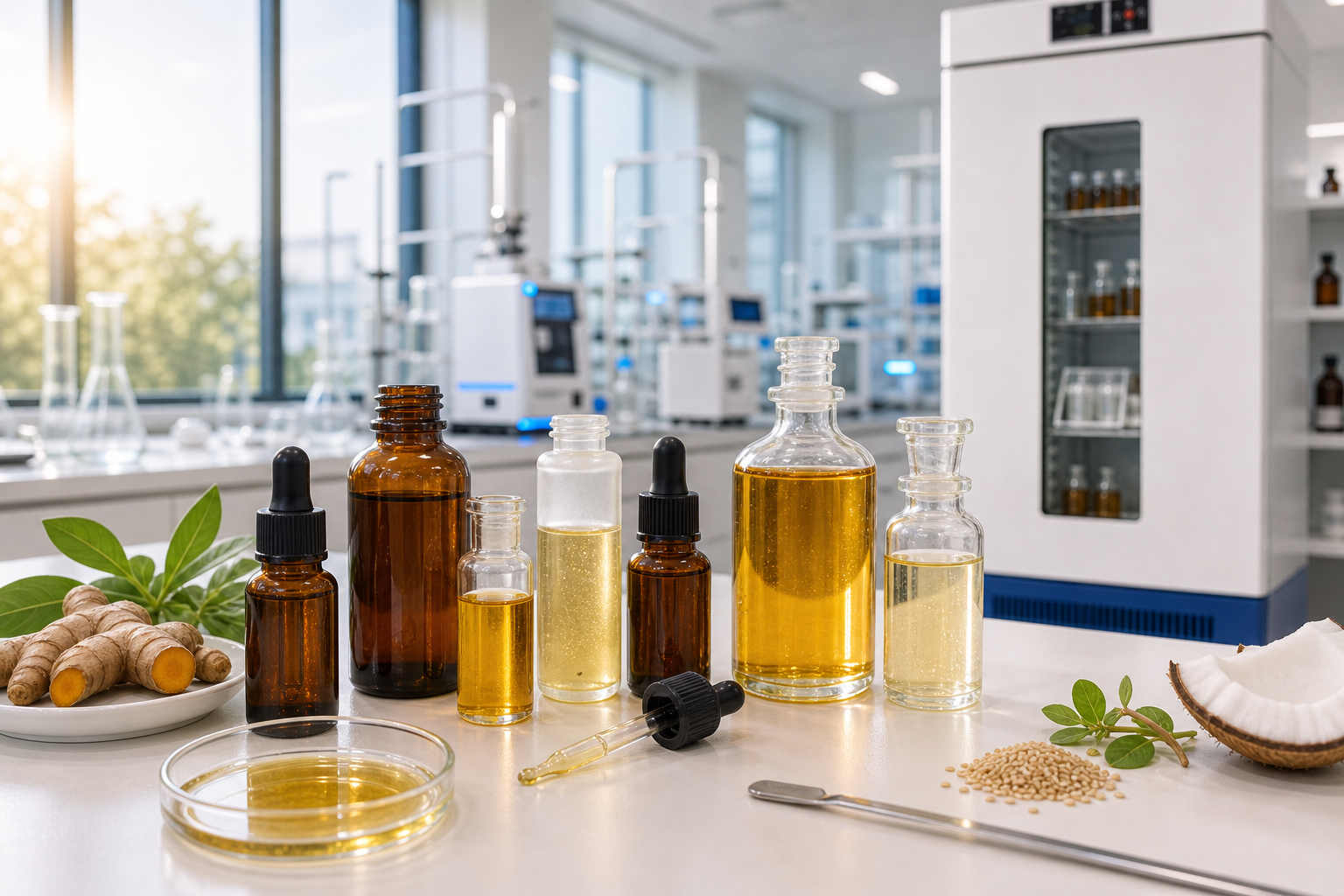
Five oil-based extract formats are covered by TIBD’s service.

  • Oleoresin is produced by solvent extraction of dried plant material, followed by solvent removal to yield a viscous, non-aqueous concentrate of the lipid-soluble and resinous constituents of the herb. Representative Oleoresins include Turmeric Oleoresin (Curcuminoids 40 to 90%), Paprika Oleoresin (Capsanthin and Capsorubin, used as a natural food colorant in the EU and ASEAN food industries), and Ginger Oleoresin (Gingerols and Shogaols). Oleoresins are intermediate ingredients supplied in bulk to food manufacturers and supplement producers, and as such must demonstrate stability throughout the intended supply chain storage period. Stability testing of Oleoresins requires monitoring of both the lipid oxidation markers (PV, AnV, TOTOX) and the specific active compound content (Curcuminoids, Capsanthin, Gingerols).
  • CO2 and Supercritical Fluid Extract (SFE) is produced by extraction with supercritical carbon dioxide at controlled temperature and pressure, yielding a pure, solvent-free extract of the lipophilic constituents. CO2 extraction does not use organic solvents, which is advantageous for cosmetic and supplement applications where solvent residue limits apply. CO2 extracts of Rosemary (for the antioxidant Carnosic Acid and Carnosol), Sea Buckthorn (for Omega-7 Fatty Acids and Carotenoids), Seabream (for Astaxanthin), and Cannabis (for CBD) are high-value products requiring detailed stability documentation.
  • MCT Carrier Extract is produced by dissolving or dispersing an active compound in Medium-Chain Triglyceride (MCT) Oil derived from coconut or palm kernel oil. MCT Carrier Extracts are the most common format for lipid-soluble supplements intended for sublingual drops, softgel fills, and functional beverage additions. Active compounds formulated in MCT include CBD from Cannabis, Vitamin D3, Vitamin E Tocopherol, CoQ10, and Lutein. MCT oil itself is relatively stable due to the absence of polyunsaturated fatty acids, but the dissolved actives may degrade independently of the carrier.
  • Lipid-Soluble Functional Actives include Astaxanthin from Haematococcus pluvialis (for its potent singlet oxygen quenching activity), Lycopene from tomato (cardiovascular health), Lutein and Zeaxanthin from Marigold (macular health), and Ubiquinol (reduced Coenzyme Q10, preferred form for bioavailability). These compounds are highly susceptible to oxidative and photodegradative degradation, requiring complete characterization of the Cis and Trans isomer distribution by HPLC-PDA at each Pull Point in addition to total content.
  • Essential Oils produced by steam distillation or cold pressing of aromatic plant material are used in cosmetic formulations, soap, perfumery, and aromatherapy products. The stability of Essential Oils is characterized by their volatile compound profile measured by GC-MS headspace analysis, since monoterpene and sesquiterpene constituents evaporate or undergo oxidation, hydration, and isomerization under storage conditions. Stability testing for Essential Oils confirms that the characteristic volatile compound profile (verified against established pharmacopoeial standards) is maintained throughout the declared shelf life.
Stability testing for oil-based extracts

Lipid Oxidation Mechanisms and Degradation Pathways

Understanding the three degradation mechanisms enables appropriate design of the stability testing protocol and the antioxidant system.

  • Auto-oxidation is a free radical chain reaction proceeding through three phases. In the Initiation phase, a free radical initiator (heat, metal ions, or a trace radical from peroxide decomposition) abstracts a hydrogen atom from a bis-allylic methylene group in an unsaturated fatty acid or lipid-soluble active compound, forming a carbon-centered radical. In the Propagation phase, the carbon-centered radical reacts with dissolved molecular oxygen to form a Peroxy Radical, which abstracts hydrogen from an adjacent lipid molecule, forming a Hydroperoxide (the primary oxidation product detected as Peroxide Value) and a new carbon-centered radical, propagating the chain. In the Termination phase, two radical species combine to form non-radical products. Secondary oxidation products (Aldehydes, Ketones, Alcohols, Alkenes) are formed by the thermal or metal-catalyzed decomposition of Hydroperoxides. These secondary products are responsible for rancid aroma and off-flavor in oil-based extracts, and are detected and quantified by Anisidine Value (AnV) measurement per AOCS Cd 18-90, which reacts specifically with p-anisaldehyde and other alpha-beta unsaturated aldehydes. TOTOX (Total Oxidation Value) is calculated as 2 times Peroxide Value plus Anisidine Value, and provides a composite measure of both primary and secondary oxidation products.
  • Photo-oxidation is initiated by UV light or visible blue light (wavelengths below 500 nm) activating sensitizer molecules present in the oil phase, including Chlorophyll, Pheophytin, and certain carotenoid pigments. Activated sensitizer molecules transfer energy to ground-state triplet oxygen, generating singlet oxygen, a highly reactive form that reacts directly with double bonds in unsaturated fatty acids without requiring a radical initiation step. Photo-oxidation proceeds much faster than auto-oxidation at low temperatures and is the primary oxidation pathway for oil-based extracts in transparent packaging exposed to retail shelf lighting or solar radiation.
  • Enzymatic Oxidation by Lipoxygenase (LOX) is relevant for Oleoresin products containing residual plant enzymes from incomplete deactivation during extraction. LOX catalyzes the regio-specific addition of molecular oxygen to polyunsaturated fatty acids at the sn-2 position, producing specific hydroperoxide regioisomers. LOX activity is inactivated by heat treatment during processing; residual LOX activity can be detected by the specific hydroperoxide isomer profile in HPLC oxidation product analysis.
  • Factors that accelerate lipid oxidation in tropical conditions include elevated ambient temperature (Q10 rule: oxidation rate approximately doubles for every 10°C increase in temperature, significantly accelerating degradation in ASEAN Zone IVb long-term storage at 30°C compared to Zone II countries), dissolved oxygen in the oil phase (the primary reactant in auto-oxidation), residual moisture (water activity above 0.3 promotes oxidation by increasing ionic strength and free radical mobility), metal ion contamination from stainless steel equipment or botanical raw materials (Cu and Fe at sub-ppm concentrations catalyze Hydroperoxide decomposition to reactive radicals via Fenton and Haber-Weiss reactions), and light exposure for products in transparent packaging.

Testing Parameters: PV, AnV, TOTOX, FFA, OSI, and Color

TIBD’s stability testing protocol for oil-based extracts covers the primary physical and chemical oxidation parameters.

  • Peroxide Value (PV) per AOCS Cd 8b-90 or Ph.Eur. 2.5.5 measures the concentration of Hydroperoxides in milliequivalents per kilogram of oil. Acceptance criteria by product category: edible oil and food supplement oil-based extracts not more than 10 mEq/kg (GOED Monograph for Omega-3 concentrates), cosmetic oil-based extracts not more than 20 mEq/kg, Oleoresin intermediates up to the specification agreed with the customer for the intended use.
  • Anisidine Value (AnV) per AOCS Cd 18-90 measures the concentration of secondary oxidation products (primarily alpha-beta unsaturated aldehydes including 2-alkenals and 2,4-alkadienals). Acceptance criterion for edible applications: not more than 10 for most vegetable oils and oil-based extracts.
  • TOTOX is calculated as 2 times PV plus AnV. Acceptance criterion per GOED Monograph for Omega-3 Concentrates: not more than 26. TOTOX above 26 indicates a product that has undergone significant oxidative degradation and is approaching or past its acceptable sensory quality threshold.
  • Free Fatty Acid (FFA) by Acid-Base Titration (AOCS Cd 3d-63 or Ph.Eur. 2.5.1) measures the content of free fatty acids released by hydrolysis of triglycerides or ester bonds in the oil phase. FFA content above specification indicates enzymatic or chemical hydrolysis of the oil carrier, which increases the pro-oxidant content and accelerates further oxidation.
  • Oxidative Stability Index (OSI) by Rancimat (ISO 6886 or AOCS Cd 12b-92) measures the induction period of the oil at an accelerated temperature (typically 100°C or 110°C) under forced air flow. The OSI induction period correlates with the ambient-temperature shelf life and is used as a rapid predictive tool during formulation optimization to compare antioxidant systems before committing to a full ICH-style stability study. A higher OSI induction period indicates a more oxidatively stable oil-based extract.
  • Color and Clarity by Spectrophotometer at product-specific wavelengths or by CIE Lab* Colorimetry. Color development indicates Maillard browning in extracts containing both lipid and amino acid components, or indicates carotenoid degradation (bleaching of Astaxanthin, Lycopene, or Lutein). Clarity change (turbidity, haze) indicates wax crystallization at low temperature or precipitation of high-molecular-weight components.

Active Compound and Isomer Analysis

TIBD and VISBIO apply compound-specific HPLC methods with appropriate detectors for each active compound class in oil-based extracts.

  • Curcuminoids (Curcumin, Demethoxycurcumin, Bisdemethoxycurcumin) by HPLC with UV detection at 425 nm for Turmeric Oleoresin and MCT-based Curcumin extracts. The method resolves all three curcuminoid fractions. High Curcumin products (standardized above 90% Curcuminoids) require a purity assay in addition to the total content assay.
  • Carotenoids (Astaxanthin, Lycopene, Lutein, Zeaxanthin, Beta-Carotene) by HPLC with Photodiode Array (PDA) detection at 450 to 475 nm. The method resolves individual carotenoid compounds and their geometric isomers (All-Trans, 9-Cis, 13-Cis). Cis isomer formation is an indicator of oxidative stress and light-induced degradation; monitoring the Trans-to-Cis ratio at each Pull Point provides a sensitive early indicator of photo-oxidative degradation before the total content falls below the acceptance criterion.
  • Tocopherols (Alpha-Tocopherol, Beta-Tocopherol, Gamma-Tocopherol, Delta-Tocopherol) and Tocotrienols (Alpha-, Beta-, Gamma-, Delta-) by HPLC with Fluorescence Detection (Excitation 295 nm / Emission 330 nm), providing high sensitivity for the low concentrations of each individual homolog in palm, rice bran, and annatto-derived Tocotrienol oils.
  • CBD and Cannabinoids by HPLC with Photodiode Array (PDA) detection at 220 nm for Cannabis extracts in MCT Carrier. The method resolves Cannabidiol (CBD), Cannabidiolic Acid (CBDA), Cannabinol (CBN), Delta-9-Tetrahydrocannabinol (THC), and Tetrahydrocannabinolic Acid (THCA) in a single chromatographic run. THC content monitoring is required to confirm compliance with the legal limit for hemp-derived CBD products.
  • CoQ10 (Ubiquinone) and Ubiquinol (Reduced CoQ10) by HPLC with UV detection at 275 nm (for Ubiquinone) or by Electrochemical Detection (ECD at +600 mV, for Ubiquinol). ECD provides superior sensitivity for Ubiquinol because the reduced form is electrochemically active. Monitoring both forms tracks the Ubiquinone-to-Ubiquinol ratio, which indicates the oxidative stress level in the formulation; Ubiquinol converts to Ubiquinone under oxidative conditions.
  • Gingerols (6-Gingerol, 8-Gingerol, 10-Gingerol) and Shogaols (6-Shogaol) by HPLC with UV detection at 280 nm for Ginger Oleoresin. The conversion of Gingerols to Shogaols (their dehydration products) under elevated temperature is a stability indicator unique to Ginger extracts and is monitored by the Gingerol-to-Shogaol ratio.

All active compound content values are held at Not Less Than 90% of the labeled value throughout the declared shelf life.

Testing Conditions and Pull Point Schedule per ICH Q1A(R2)

Long-term Stability testing uses 30°C / 75% RH per ASEAN Zone IVb for a minimum of 24 months. Accelerated Stability testing uses 40°C / 75% RH for 6 months.

  • Cool Storage conditions at 5°C ± 3°C are included for heat-sensitive oil-based extracts including Astaxanthin, high-EPA/DHA Omega-3 concentrates, and Probiotic-containing oil products where the manufacturer declares a refrigerated storage condition on the label.
  • Standard Pull Points for Long-term testing are months 0, 3, 6, 9, 12, 18, and 24. Standard Pull Points for Accelerated testing are months 0, 1, 2, 3, and 6.
  • Photostability testing per ICH Q1B in a Solar Simulator with full-spectrum light (visible 400 to 700 nm plus UV 320 to 400 nm) is a critical component of the stability protocol for all oil-based extracts, particularly for light-sensitive Carotenoids (Astaxanthin, Lycopene, Lutein), Curcuminoids, CBD, and Vitamin D3. The Solar Simulator exposes the sample to the total illumination equivalent specified in ICH Q1B (1.2 million lux-hours visible; 200 W·h/m² UV). Light-exposed versus dark-control samples are compared to quantify the photodegradation contribution independently of thermal degradation.
  • Headspace Oxygen assessment by Gas Chromatography confirms the residual oxygen concentration in the sealed container headspace at T0 and at selected Pull Points. Oxygen breakthrough from packaging indicates seal failure or inadequate packaging barrier performance.
  • Inert gas storage at 5°C is used as a reference condition for heat-sensitive actives where the manufacturer needs to confirm stability under ideal cool-chain conditions for regulatory purposes.

Antioxidant System and Carrier Oil Selection

  • Carrier Oil selection is the first formulation decision affecting oxidative stability. MCT Oil derived from coconut has no polyunsaturated fatty acids (all C8 and C10 saturated) and has inherently very high oxidative stability, making it the preferred carrier for lipid-soluble supplements where oil oxidation could confound the active compound stability data. Olive Oil Extra Virgin contains natural polyphenol antioxidants (Hydroxytyrosol, Oleuropein) that extend oxidative stability and are appropriate for supplements targeting cardiovascular health. High-Oleic Sunflower Oil (greater than 85% Oleic Acid) has substantially better oxidative stability than conventional Sunflower Oil due to its low polyunsaturated content and is used for cost-sensitive applications requiring better stability than standard vegetable oils. Rice Bran Oil contains natural Tocotrienols and Gamma-Oryzanol with built-in antioxidant activity, making it suitable for functional food oil applications without requiring additional antioxidant addition.
  • Antioxidant system design is critical for polyunsaturated oil-based extracts including Omega-3 concentrates and Astaxanthin products. Mixed Tocopherol Concentrate (predominantly Gamma and Delta homologs, which have superior radical-scavenging capacity compared to Alpha-Tocopherol alone) provides primary chain-breaking antioxidant activity in the lipid phase. Ascorbyl Palmitate (lipid-soluble Vitamin C ester) acts as a synergistic co-antioxidant that regenerates Tocopherol radicals. Rosemary Extract (standardized for Carnosic Acid and Carnosol content) provides natural phenolic antioxidant activity and is accepted as a natural food additive under EU Regulation 1333/2008 (E392). Tertiary Butylhydroquinone (TBHQ) is a highly effective synthetic antioxidant approved for use in edible fats and oils under Codex Alimentarius Standard CXS 19-1981 at levels up to 200 mg/kg.
  • Packaging selection completes the antioxidant protection system. Amber Glass Bottles (Type III or Type I depending on application) provide UV and visible light protection for light-sensitive oil-based extracts. Aluminum Foil Laminate Sachets with PE heat-seal layer provide both light barrier and oxygen barrier for single-serving oil products (sublingual drops, single-use cosmetic actives). Nitrogen Flushing during filling and capping reduces headspace oxygen concentration to below 2%, significantly extending the induction period for auto-oxidation. Bottle closure selection (induction seal plus screw cap) ensures adequate seal integrity throughout the declared shelf life.
Stability testing for oil-based extracts

Thai FDA and ASEAN Export Registration Requirements

  • Under the Food Act B.E. 2522, oil-based extract dietary supplements require submission of a Product Information File (PIF) that includes: product formula and specification, stability data covering the claimed shelf life, quality and safety data for each raw material including Certificate of Analysis and Specification, and Contaminant data (Heavy Metal, Mycotoxin, Pesticide Residue) for botanical raw material inputs.
  • For Cosmetic oil-based extracts (Essential Oils, CO2 Extracts for cosmetic use, Astaxanthin for anti-aging cosmetics), notification under the Cosmetic Act B.E. 2558 requires product formula, safety data, and stability or shelf life substantiation data.
  • For products intended for export to ASEAN member states, ASEAN Cosmetic Directive and the ASEAN Health Supplement Cosmetic Committee (AHSCC) harmonized requirements govern stability study design and documentation.
  • For EU market entry, EFSA Novel Food Notification for novel lipid-soluble active extracts including Astaxanthin, Lycopene at specific concentrations, and certain CO2 extracts requires a minimum of 12 months stability data generated under ICH Q1A(R2) conditions.
  • For US market entry, New Dietary Ingredient (NDI) Notification to the US FDA under DSHEA requires a minimum of 12 months stability data, certificate of analysis from an accredited laboratory, and traceability of all Reference Standards to USP, Ph.Eur., or Japanese Pharmacopoeia (JP).
  • Reference Standard traceability is maintained by VISBIO through procurement of analytical Reference Standards from USP Reference Standards, Sigma-Aldrich Analytical Standards, or EP Reference Standards, with full Chain of Custody documentation at each Pull Point to support regulatory submission.

VISBIO’s Role as an Independent Quality Assurance Verifier (IQAV)

VISBIO, acting as Independent Quality Assurance Verifier (IQAV), conducts Peroxide Value, Anisidine Value, TOTOX, Free Fatty Acid, OSI by Rancimat, Color and Clarity, Active Compound Assay by HPLC-PDA, Fluorescence, and Electrochemical Detection, and GC-MS Volatile Compound analysis on samples collected at each Pull Point, using Validated Methods per ICH Q2(R1) with full Traceability documentation at every step and operations conducted under ISO/IEC 17025 standards.

TIBD Team Expertise

The Oil-Based Extract Stability Testing service is conducted in partnership with Dr. Wuttipong Panitsettakorn, Advisor and Co-Founder, who specializes in commercial technology management for the health and beauty industry, and Ms. Mandhamon Uttamo, Advanced Formulator, who has extensive experience in lipid-soluble natural product formulation and functional cosmetic active development. Our team includes researchers specializing in Lipid Chemistry, Natural Product Chemistry, Oxidative Stability, HPLC Isomer Analysis, and Regulatory Affairs for Thai FDA PIF and international supplement registrations.

Is your oil-based extract or oleoresin ready for Thai FDA registration, ASEAN export, or EU Novel Food submission? Contact TIBD for a customized stability protocol and starting price from ฿15,000.

References

Apply for Oil-Based Extract Stability Testing Service

If you have any questions or would like to receive a free consultation regarding Oil-Based Extract Stability Testing Service, or if you would like to visit us in person in Bangkok, Thailand, you are warmly welcomed and feel free to contact us via the contact form below.

  • This field is for validation purposes and should be left unchanged.