Description

Many products in the health and beauty industry contain light-sensitive active ingredients. Exposure to light during transport, retail storage, and consumer use can cause active substances to degrade, produce breakdown products that may pose safety concerns, and reduce product performance below the levels stated on the label.

Photostability Testing in accordance with the ICH Q1B standard is a legally and technically required condition for products making efficacy claims: sunscreens claiming an SPF value, vitamin C serums claiming a specific concentration, retinol serums claiming anti-ageing performance, and herbal products claiming a quantified marker compound content.

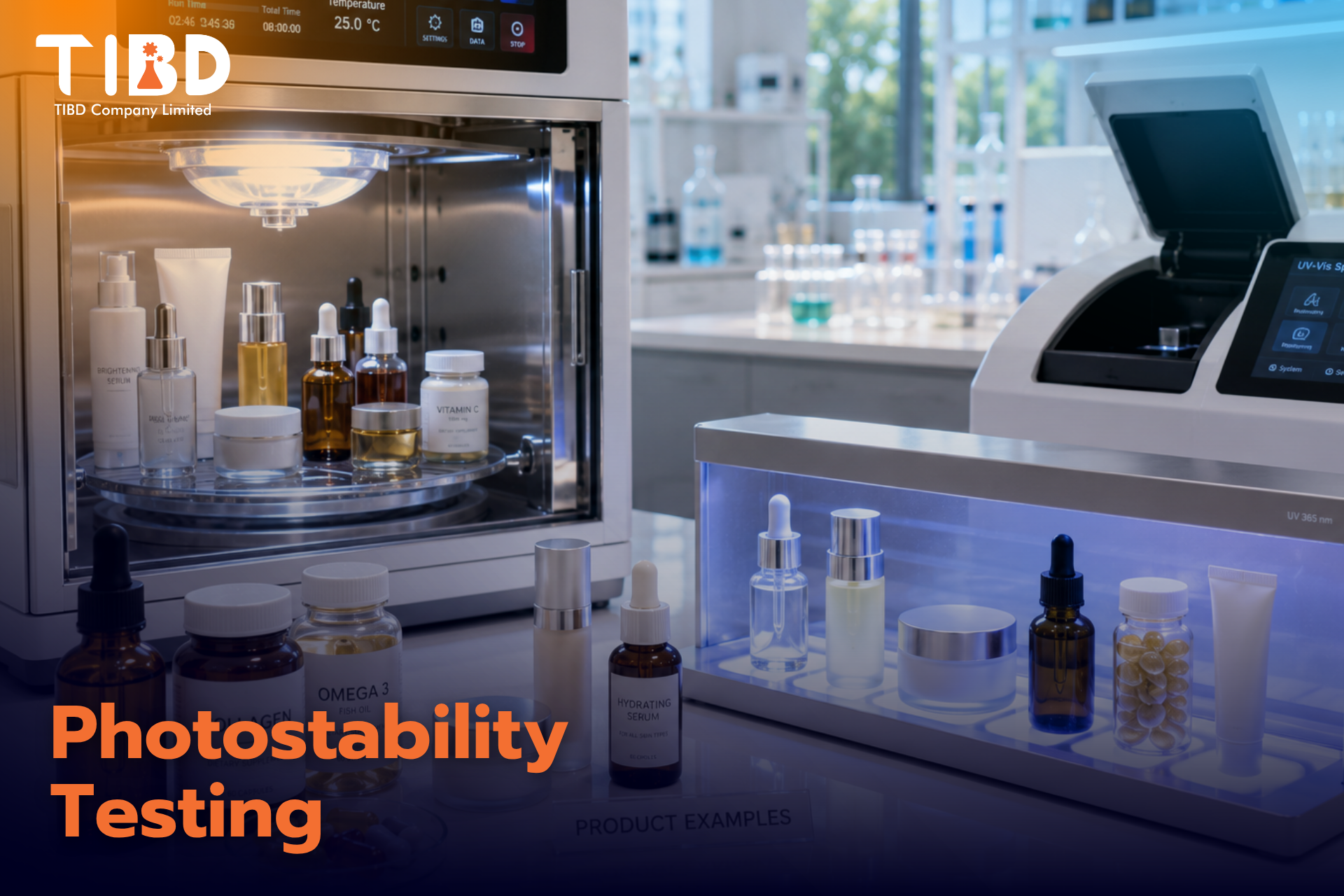
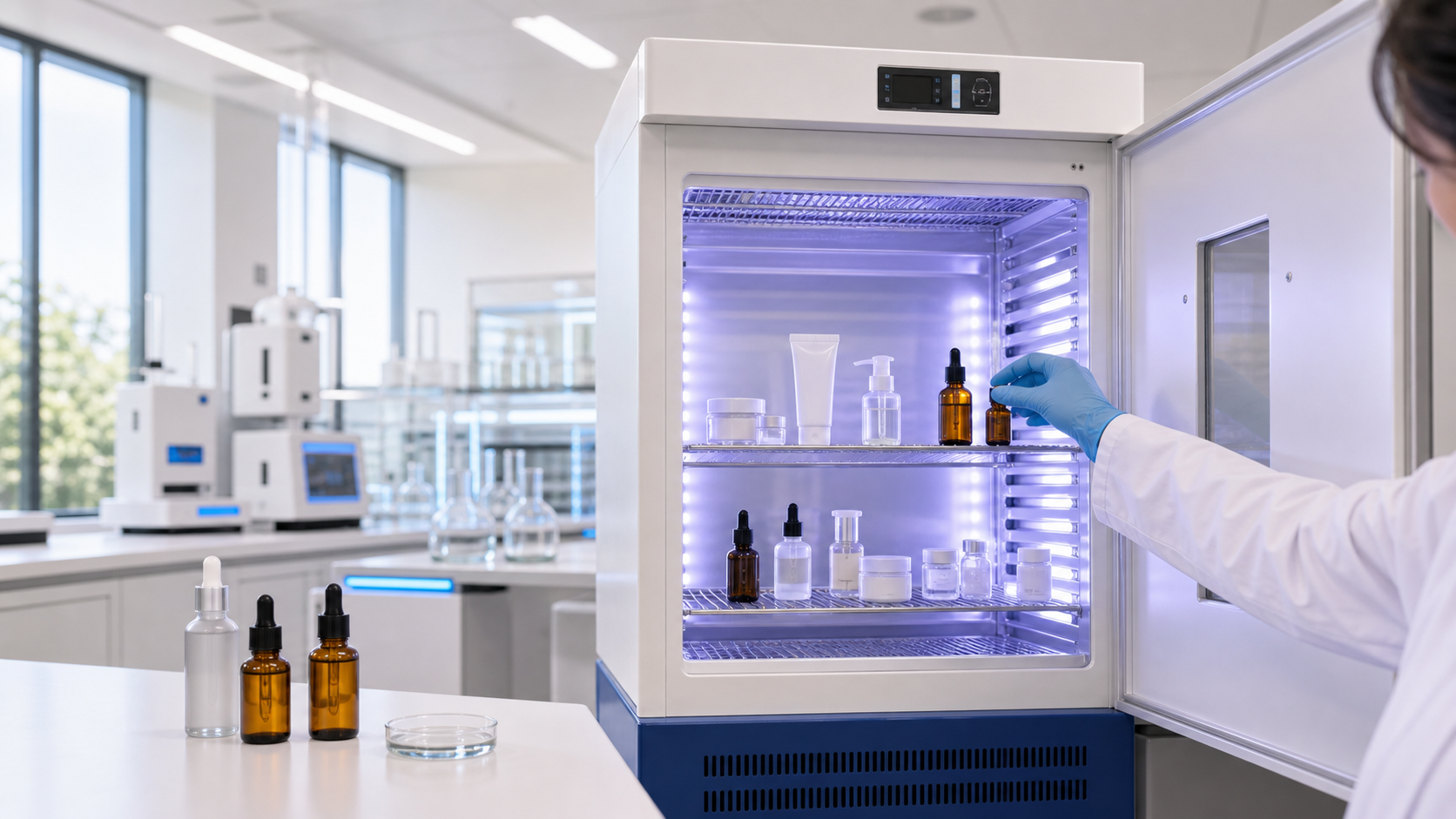
TIBD’s Photostability service covers protocol design in accordance with ICH Q1B, controlled light exposure using a Photostability Chamber equipped with D65 or equivalent lamps, chemical and physical change analysis following light exposure, and result interpretation to support Thai FDA registration and export market expansion, in collaboration with VISBIO as an Independent Quality Assurance Verifier (IQAV).

What Is Photostability Testing, and Why Is It Necessary?

Photostability Testing is a study that evaluates the effect of light on a product’s characteristics across chemical, physical, and performance dimensions, under controlled light energy conditions aligned with international standards. ICH Q1B designates this testing as a mandatory component for pharmaceutical products and a standard accepted by regulatory authorities across cosmetics and dietary supplements.

There are three key reasons why products require Photostability Testing. The first is scientific: photodegradation results from light energy reacting with the chemical structure of active ingredients. Products containing double bonds, aromatic compounds, or dyes are particularly susceptible and can degrade within hours without a photostabilization system in place. The second is regulatory: the Thai FDA expects Photostability data for products making efficacy claims, and this data forms part of the Product Information File for Cosmetic Notification submissions. The third concerns market safety: products that degrade under light may produce irritant or unsafe breakdown products, presenting a reputational risk if consumers are affected.

Products That Require Photostability Testing

Several product categories in Thailand’s health and beauty industry require Photostability testing, both for registration documentation and during the product development process.

  • Sunscreen products are the first priority group, as they are directly exposed to light during use. Avobenzone, Octinoxate, Oxybenzone, and other organic UV filters are light-sensitive and can degrade within a matter of hours without an effective photostabilization system.
  • Serums and creams containing Vitamin C (Ascorbic Acid and derivatives such as Sodium Ascorbyl Phosphate) are particularly sensitive to both light and oxygen. Photostability testing is essential for products claiming vitamin C concentrations and efficacy in reducing dark spots.
  • Products containing Retinol and its derivatives, including Retinaldehyde and Retinyl Palmitate, require photostability testing because retinol is highly sensitive to both light and oxygen. Degradation reduces anti-ageing efficacy and may produce undesirable breakdown compounds.
  • Products containing natural colorants, such as Beta-carotene, Curcumin, and Anthocyanins, as well as dietary supplement products containing antioxidant actives, require photostability testing to confirm that color and efficacy remain stable throughout the intended shelf life.
  • Thai herbal products containing light-sensitive marker compounds, such as Curcuminoids in turmeric and Coumarin-group compounds in certain herbs, must undergo Photostability testing under conditions specified in the Thai Herbal Pharmacopoeia (THP 2021).
Photostability testing according to ICH Q1B

ICH Q1B Principles and Light Exposure Conditions

ICH Q1B sets the standard for Photostability testing used in product registration with regulatory authorities worldwide, including Thailand’s FDA and ASEAN member agencies.

The standard requires that test samples receive a minimum total light exposure of 1.2 million Lux-hours for visible light and a minimum UVA energy of 200 Wh/m². The test chamber must use a light source that simulates the spectrum of natural sunlight. ICH Q1B specifies two options: Option 1 uses a lamp simulating the D65 or ID65 spectrum, covering both visible light and UV radiation; Option 2 uses a Cool White Fluorescent lamp combined with a UV Fluorescent lamp.

Test design follows three levels according to the ICH Q1B Decision Tree. Level 1 is Drug Substance or Active Ingredient testing to assess the intrinsic stability of the pure substance. Level 2 is Drug Product testing in its normal packaging to evaluate the degree of protection the packaging provides. Level 3 is Drug Product testing in an open or stripped configuration to evaluate degradation under consumer-use conditions.

Testing Protocol and Sample Preparation

TIBD’s protocol follows ICH Q1B strictly, covering sample preparation, arrangement within the chamber, light energy control, and comparative reference sample collection.

Sample preparation involves two sets: test samples placed inside the Photostability Chamber, and control samples wrapped in aluminum foil to block all light, stored under identical conditions to separate the effect of light from temperature and humidity. Comparing results against the control samples makes it possible to confirm that any changes observed are attributable to light exposure rather than other variables.

Light energy is controlled using a Quinine Chemical Actinometer based on a 2% w/v Quinine Hydrochloride solution. Absorbance at 400 nm wavelength is measured after light exposure and used to calculate the actual energy delivered. Required thresholds are 1.2 million Lux-hours of visible light and 200 Wh/m² of UVA.

Sample collection occurs at the start and end of the light exposure period. For products with particularly high light sensitivity, TIBD adds intermediate collection points to capture early degradation, as may occur with Avobenzone, which can degrade within 30 to 60 minutes of exposure.

Analytical Parameters After Light Exposure

Post-exposure analysis covers a range of parameters depending on product type.

  • For products containing active ingredients: active ingredient content by High Performance Liquid Chromatography (HPLC); degradation products and related substances; and structural characterization of degradation products by Liquid Chromatography Mass Spectrometry (LC-MS/MS).
  • For sunscreen products: in-vitro SPF measurement per ISO 24443; in-vitro PA measurement; concentration analysis of each individual UV filter; and assessment of the Photostabilizer system’s integrity.
  • For products containing colorants: CIELAB color measurement by Spectrophotometer; visual evaluation; and pigment content analysis.
  • For herbal products: Marker Compound analysis by HPLC; TLC/HPTLC fingerprinting; and color and odor assessment.

Physical parameters assessed across all product types include changes in appearance, color, odor, texture, pH for water-based products, and viscosity for liquid formulations.

Result Interpretation and Application in Formula and Packaging Development

Photostability test results inform decisions across several aspects of product development and condition-setting.

If a product does not pass Photostability testing, improvements can be pursued through three main approaches.

The first is formula adjustment: adding photostabilizing agents, such as Octocrylene for products containing Avobenzone, Tocopherol for lipid-based products, or EDTA for products sensitive to heavy metal catalysis.

The second is changing the packaging system: using amber or brown glass bottles, aluminum containers, or packaging with an aluminum foil laminate layer for sachets or pouches.

The third is specifying storage conditions on the label, such as “keep away from direct sunlight,” “store in a dark place,” or “avoid direct sun exposure,” to clearly inform both consumers and distribution partners.

Application in Thai FDA Registration and Export Markets

Photostability data forms part of the Product Information File (PIF) required for Cosmetic Notification submissions to Thailand’s FDA and ASEAN regulatory agencies, particularly for products making efficacy claims or containing light-sensitive ingredients.

For pharmaceutical products, ICH Q1B designates Photostability as mandatory data within Module 3.2.P.8 of the Common Technical Document.

For export to the European Union, the Cosmetic Product Safety Report (CPSR) must include Photostability data evaluated by a qualified Safety Assessor.

For export to Japan under the Pharmaceutical and Medical Device Act, sunscreen products and products making specific benefit claims must have Photostability data generated by a JIS-accredited laboratory.

VISBIO’s Role as the IQAV

VISBIO, acting as an Independent Quality Assurance Verifier (IQAV), performs post-light-exposure sample analysis using validated analytical methods per ICH Q2(R1), maintains full document traceability at every stage of the process, and operates in accordance with ISO/IEC 17025 best practices.

TIBD Team Expertise

The Photostability service is carried out in collaboration with Dr. Wuttipong Panitsettakorn, Advisor and Co-Founder, who specializes in commercial technology management for the health and beauty industry, and Ms. Manthamon Utmo, Advanced Formulator, with hands-on experience resolving photostability challenges across cosmetic and dietary supplement products. Our team includes specialists who are active researchers in Photochemistry, Photoprotection, and Stability-Indicating Methods.

If your product contains light-sensitive ingredients and you need Photostability data to support registration or formula development, contact TIBD to receive a customized protocol design for cosmetics, sunscreens, dietary supplements, herbal products, or pharmaceuticals. [Contact TIBD]

References

Apply for Photostability Testing Service (Light Stability Testing) in Accordance with ICH Q1B

If you have any questions or would like to receive a free consultation regarding Photostability Testing Service (Light Stability Testing) in Accordance with ICH Q1B, or if you would like to visit us in person in Bangkok, Thailand, you are warmly welcomed and feel free to contact us via the contact form below.

  • This field is for validation purposes and should be left unchanged.