Description

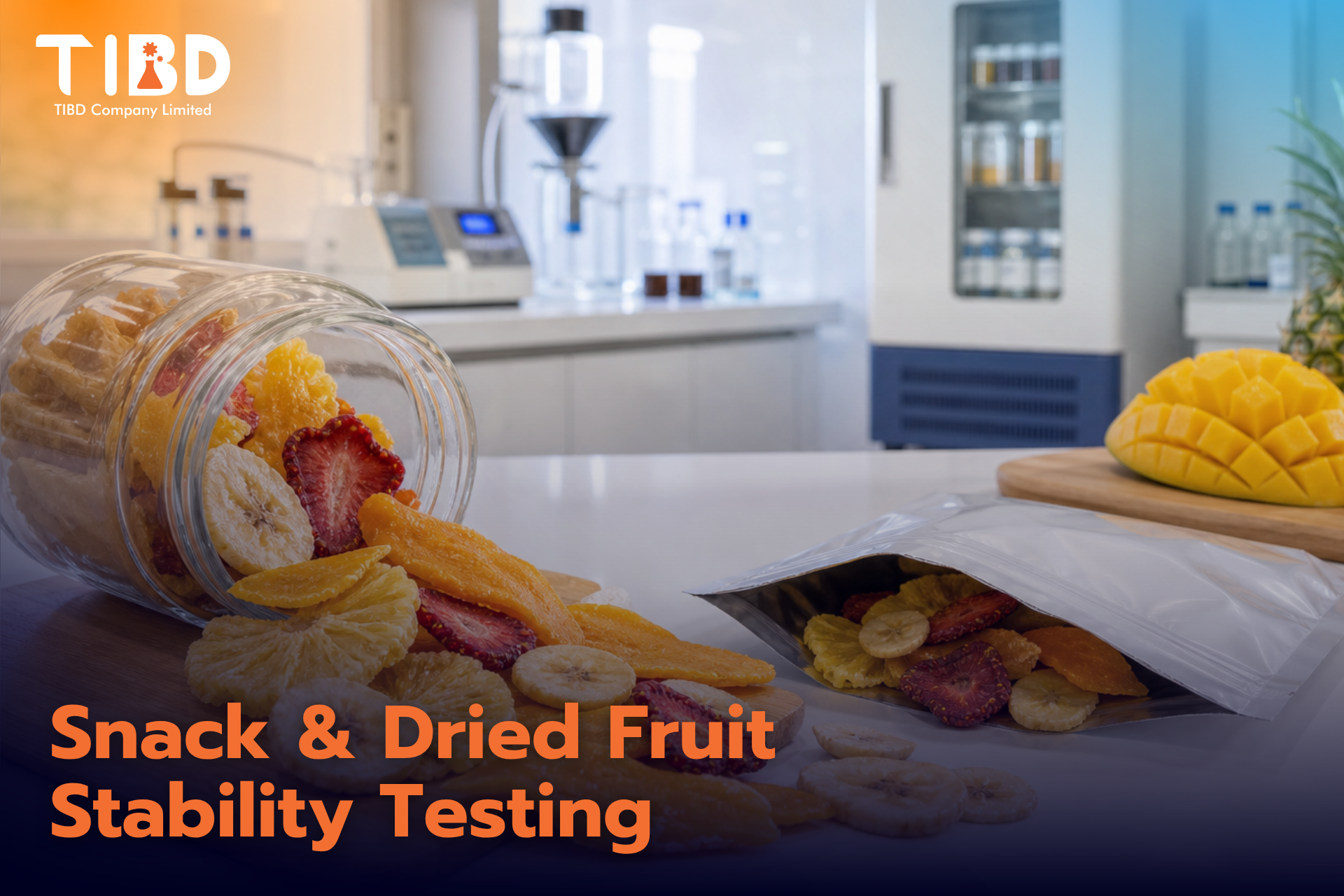
Snacks and Dried Fruits are a rapidly growing segment of the Healthy Snack and Functional Food market in Thailand and ASEAN. Products in this category include Crispy Snack from vegetables and fruits produced by Vacuum Frying or Air Frying, Trail Mix, Energy Bars, Protein Bars, Granola Bars, Fruit Snacks for children, and Functional Snacks with protein, fiber, or probiotic claims. Brand Owners, OEM manufacturers, and producers launching new Functional Snack products must complete stability testing before Thai FDA registration under the Food Act B.E. 2522 and before entering commercial distribution.

The specific challenges of Snacks and Dried Fruits stored in the hot and humid environment of ASEAN Zone IVb include moisture absorption causing loss of crispness, lipid oxidation in fried or oil-containing snacks generating rancidity, degradation of heat-sensitive nutrients such as Vitamin C and Polyphenols, microbial growth particularly mold when Water Activity rises above safe limits, and color change from Maillard reaction or pigment degradation.

TIBD’s service is designed specifically for Snacks and Dried Fruits, covering Moisture Content by Loss on Drying and Karl Fischer Titration, Water Activity (aw), Texture analysis including Hardness, Crispness, and Fracturability by Texture Analyzer, Peroxide Value by AOCS Cd 8b-90 for lipid-containing snacks, Free Fatty Acid, Color by CIE Lab* Colorimeter, Vitamin and Active Compound Assay by HPLC, Microbiology per Ministry of Public Health Notification No. 364, Aflatoxin, and Sensory Evaluation by Trained Sensory Panel, under ASEAN Zone IVb conditions per ICH Q1A(R2), in partnership with VISBIO as an Independent Quality Assurance Verifier (IQAV) using Validated Methods per ICH Q2(R1).
Snack and Dried Fruit Product Types in the Thai and ASEAN Market

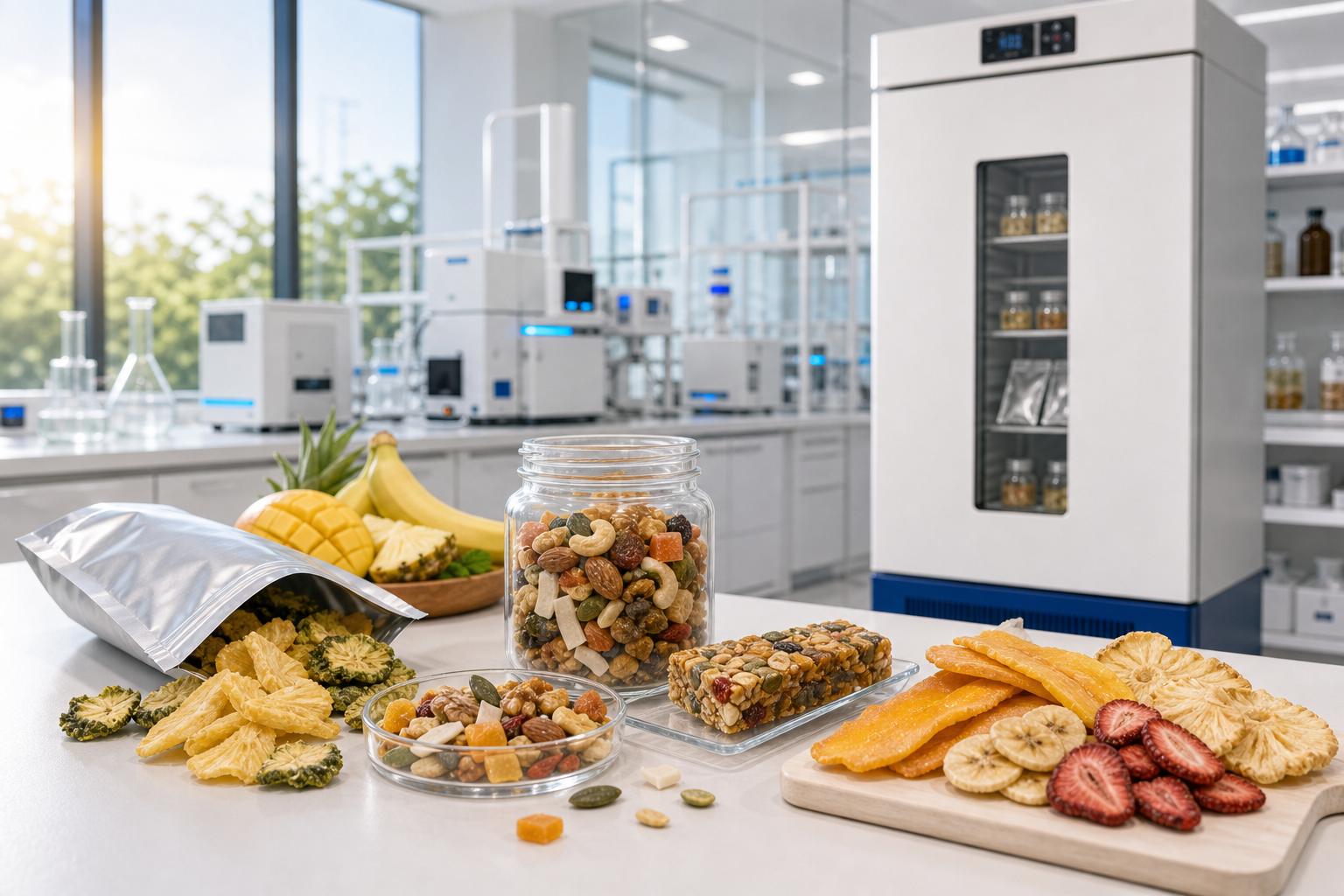
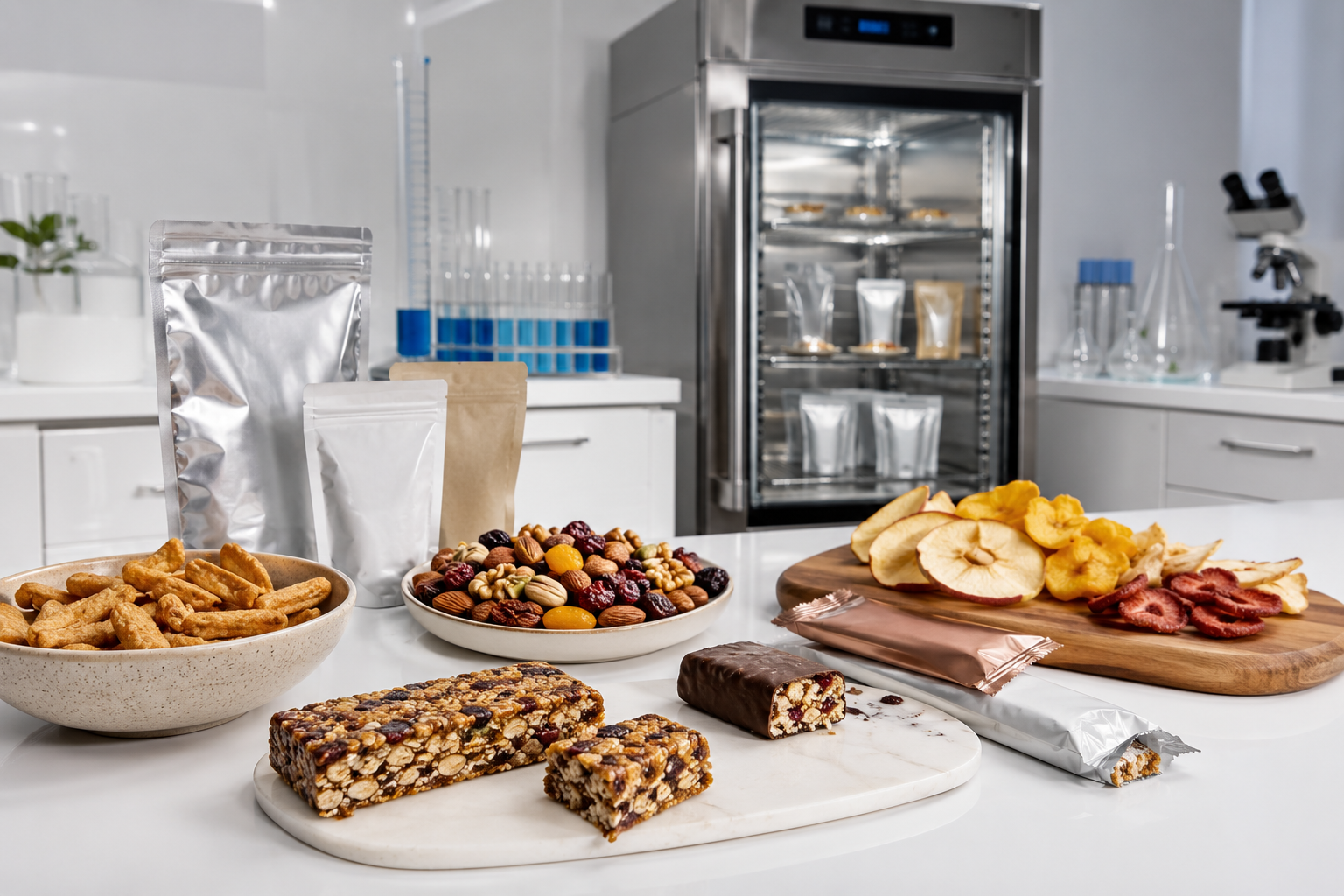
Six product types cover the main Snack and Dried Fruit formats in the Thai and ASEAN functional food market.

  • Crispy Snack from Vegetables produced by Vacuum Frying or Air Frying includes Sweet Potato Chips, Pumpkin Chips, Crispy Ginger, and Crispy Pandan Leaf. Vacuum Frying at lower temperatures and reduced pressure preserves more nutritional value than conventional oil frying and produces lower oil content, supporting Healthy Snack claims. Air Frying eliminates added oil entirely for calorie-reduced positioning.
  • Crispy Snack from Fruits includes Crispy Durian, Crispy Jackfruit, Crispy Mango, Crispy Pineapple, and Crispy Longan. These products are strong performers in Asian export markets, particularly in China, Japan, and South Korea, where Thai tropical fruit snacks have established consumer acceptance. Crispy Fruit products require careful control of Water Activity and packaging oxygen barrier performance to prevent re-absorption of moisture and loss of crispness during extended shelf life.
  • Healthy Bars including Energy Bars, Protein Bars, and Granola Bars contain protein, vitamins, or functional actives as labeled nutrients and are positioned for health-conscious consumers. These products have higher Moisture Content than crispy snacks (10 to 15%) and require monitoring of Water Activity, microbial stability, and nutrient content throughout the shelf life to support the nutritional claims declared on the label.
  • Trail Mix and Mixed Nut products combine dried fruits, nuts, and seeds in Premium Healthy Snack formats. These products present the combined stability challenges of both the nut (lipid oxidation) and dried fruit (moisture, Aflatoxin) components and require comprehensive testing protocols covering both categories simultaneously.
  • Fruit Snacks for Children including Fruit Strips and Fruit Leather produced from pureed, concentrated fruit pulp are targeted at the pediatric consumer segment. These products require particular attention to microbial stability, Aflatoxin limits, and the preservation of natural Vitamin C content throughout the declared shelf life.
  • Functional Snacks making specific health claims including High Protein, High Fiber, Probiotic, and Low Sugar formats are the fastest-growing segment. Stability testing for Functional Snacks must cover all parameters relevant to the specific claims: Protein Content by Kjeldahl or Dumas Method, Dietary Fiber by Enzymatic-Gravimetric Method per AOAC 985.29, Probiotic Viability (CFU/g) throughout the shelf life, and Net Carbohydrate calculation for Keto-positioned products.
Stability testing for snacks and dried fruit

Specific Stability Challenges of Snacks and Dried Fruits in Tropical Climates

Six stability challenges specific to Snacks and Dried Fruits must be addressed in a stability protocol designed for ASEAN Zone IVb conditions.

  1. The first challenge is moisture migration and loss of crispness. Products with low initial Water Activity absorb moisture from the humid ASEAN Zone IVb environment, increasing Water Activity above the critical threshold and causing the product to lose its crisp texture. Measuring the Critical Moisture Content and Critical Relative Humidity (CRH) of the specific product matrix is essential for designing the packaging specification and storage condition label. The CRH is determined from the DVS Sorption Isotherm.
  2. The second challenge is loss of crispness detected by Texture Analyzer. The decrease in Hardness and Fracturability measured by the Texture Analyzer correlates with consumer perception of textural degradation, which directly affects repurchase decision. A reduction in Hardness exceeding 20% from the T0 value is considered a significant change.
  3. The third challenge is lipid oxidation in fried snacks, nut-containing products, and Trail Mix. Vacuum Frying and Air Frying Crispy Snacks and nut components of Trail Mix are susceptible to lipid oxidation during storage, producing Hydroperoxides (measured as Peroxide Value) as primary products, then Aldehydes and Ketones as secondary products responsible for rancid aroma. Peroxide Value is measured per AOCS Cd 8b-90; the acceptance criterion is typically Not More Than 10 to 20 mEq/kg depending on the product type.
  4. The fourth challenge is nutrient degradation. Vitamin C (Ascorbic Acid) in fruit snacks degrades rapidly under tropical ambient temperature conditions, losing its antioxidant activity and diminishing the nutritional value claim on the label. Polyphenols and Anthocyanins in dark-colored fruit snacks such as Blueberry, Acai, and Roselle degrade under heat and light exposure. Nutrient content must be maintained at Not Less Than 80% of the labeled value throughout the declared shelf life per Thai FDA requirements.
  5. The fifth challenge is microbial growth, particularly mold, when Water Activity rises above 0.65 during storage. Certain mold species such as Aspergillus flavus can produce Aflatoxins in nut and dried fruit products. Aflatoxin monitoring is mandatory for all products containing groundnuts, tree nuts, and susceptible dried fruits.
  6. The sixth challenge is color change from Maillard reaction between reducing sugars and amino acids in the product matrix, and from degradation of Carotenoid pigments in fruit-based products under heat and light exposure. Color is assessed quantitatively by CIE Lab* Colorimetry. A color difference (Delta E) of more than 3 units from T0 is considered a visually significant change.

Testing Parameters: Moisture, Water Activity, Texture, Peroxide Value

TIBD’s stability testing protocol for Snacks and Dried Fruits covers the full set of physical, chemical, and sensory parameters.

  • Moisture Content is measured by Loss on Drying (LOD) or Karl Fischer Titration. Acceptance criteria by product type: Crispy Snack 2 to 4%, Dried Fruit 15 to 20%, Energy Bar and Healthy Bar 10 to 15%. Moisture Content exceeding the upper acceptance limit is the primary predictor of texture and microbial stability failure.
  • Water Activity (aw) is measured by Water Activity Meter at each Pull Point. Acceptance criteria: Crispy Snack 0.2 to 0.3, Dried Fruit 0.4 to 0.6, Healthy Bar Not More Than 0.60. Water Activity above 0.65 indicates conditions favorable for yeast and mold growth.
  • Texture analysis by Texture Analyzer covers Hardness (peak force in Newton), Crispness (area under the force-deformation curve at fracture), and Fracturability (force at first fracture event). Analysis methods include Texture Profile Analysis (TPA), Three-Point Bending Test for bar-shaped snacks, and Single Compression for chip-format products.
  • Peroxide Value (PV) per AOCS Cd 8b-90 measures primary lipid oxidation products (Hydroperoxides) in snacks containing oil. Acceptance criterion: Not More Than 10 mEq/kg for edible oil components, Not More Than 20 mEq/kg for whole product matrices depending on product type.
  • Free Fatty Acid (FFA) is measured by Titration and indicates hydrolysis of triglycerides in the oil component. FFA increase correlates with rancid flavor development.
  • Color assessment by CIE Lab* Colorimeter quantifies changes in Lightness (L*), Red-Green axis (a*), and Yellow-Blue axis (b*). A Delta E of more than 3 units indicates a color change visible to consumers.
  • Sensory Evaluation by Trained Sensory Panel at each Pull Point covers color, aroma, texture, crispness, and taste. The appearance of rancid aroma, off-flavor, or off-aroma is an early warning indicator of lipid oxidation before the Peroxide Value reaches the acceptance limit. Consumer Acceptance Test with a panel of 50 to 100 actual consumers is conducted as an additional assessment for new brands entering the market.

Nutrient and Active Compound Analysis

TIBD and VISBIO apply method-specific analytical techniques validated for each nutrient and active compound class.

  • Vitamin C (Ascorbic Acid and Dehydroascorbic Acid) by HPLC with UV detection at 245 nm, using a Stability Indicating Method per AOAC procedure. Both the reduced form (Ascorbic Acid) and the oxidized form (Dehydroascorbic Acid) are quantified. The method is required for all snack products making Vitamin C content claims.
  • Vitamin E (Tocopherols and Tocotrienols) by HPLC with Fluorescence Detection, providing high sensitivity for the low concentrations of fat-soluble vitamins present in nut and seed-containing snacks.
  • Beta-Carotene and Lutein in fruit and vegetable snacks by HPLC with Photodiode Array (PDA) detection at 450 to 475 nm, resolving individual carotenoid fractions.
  • Total Polyphenol by Folin-Ciocalteu Method, expressed as Gallic Acid Equivalent (GAE) per gram of product. This method provides a rapid quantitative indicator of the overall antioxidant compound content for products making antioxidant claims.
  • Anthocyanin total by pH Differential Method per AOAC 2005.02, expressed as Cyanidin-3-Glucoside Equivalent. This method is applied to products containing blueberry, roselle, purple sweet potato, or other anthocyanin-rich fruit ingredients.
  • Protein Content by Kjeldahl Method per AOAC 991.20 or Dumas Method (Combustion). Required for all Protein Snack and High Protein claims.
  • Dietary Fiber Total by Enzymatic-Gravimetric Method per AOAC 985.29. Required for High Fiber claims.
  • Total Sugar by HPLC-RI or High-Performance Anion Exchange Chromatography with Pulsed Amperometric Detection (HPAEC-PAD), resolving Glucose, Fructose, Sucrose, Lactose, and Maltose individually.
  • Energy value is calculated from Protein, Fat, and Carbohydrate contents per the conversion factors specified in the Thai FDA labeling regulations. All declared nutrient values must be maintained at Not Less Than 80% of the labeled value throughout the declared shelf life per Thai FDA food labeling requirements under the Food Act B.E. 2522.

Microbiology, Aflatoxin, and Sensory Evaluation

Microbiology assessment per Ministry of Public Health Notification No. 364 B.E. 2556 covers Total Aerobic Microbial Count, Total Combined Yeast and Mold Count, Coliform, Escherichia coli, Salmonella spp., and Staphylococcus aureus at each Pull Point.

Aflatoxin testing is a mandatory requirement for products containing groundnuts, tree nuts (almonds, cashews, pistachios, peanuts), and susceptible dried fruits. Aflatoxin limits per Codex Alimentarius Standard CXS 193-1995 (Amendment 2023) vary by product and intended use: ready-to-eat peanuts not more than 15 µg/kg total Aflatoxins (B1 + B2 + G1 + G2), dried fruits not more than 10 µg/kg total Aflatoxins, dried fruit Aflatoxin B1 alone not more than 5 µg/kg. Products destined for export to the European Union must comply with EU Commission Regulation 1881/2006 and its amendments, which set stricter limits for certain product-market combinations.

Testing Conditions and Pull Point Schedule per ICH Q1A(R2)

  • Long-term Stability testing uses 30°C / 75% RH conditions per ASEAN Zone IVb for a minimum of 12 months. Accelerated Stability testing uses 40°C / 75% RH for 6 months.
  • Standard Pull Points for Long-term testing are months 0, 3, 6, 9, 12, and 18. Standard Pull Points for Accelerated testing are months 0, 1, 2, 3, and 6.
  • DVS Sorption Isotherm is conducted at T0 to map the moisture absorption behavior of the product matrix across relative humidity values from 0% to 95% RH, determining the Critical Relative Humidity (CRH) for the specific product and informing the packaging moisture barrier specification.
  • Photostability testing per ICH Q1B in a Solar Simulator is required for products in transparent or semi-transparent packaging and for products with Vitamin or Carotenoid content claims where light-induced degradation is a significant stability risk.

Packaging Selection for Snacks and Dried Fruits

Packaging selection is the primary technical control for moisture and oxygen stability in Snack and Dried Fruit products.

  • Aluminum Foil Lamination packaging (Metallized PET or Aluminum Foil with PE heat-seal layer) provides low Water Vapor Transmission Rate (WVTR) and low Oxygen Transmission Rate (OTR), and is the standard primary packaging material for most Crispy Snack products.
  • Modified Atmosphere Packaging (MAP) replaces air inside the package with Nitrogen gas or a Nitrogen and Carbon Dioxide mixture before sealing. Nitrogen reduces oxygen concentration to below 1%, significantly slowing lipid oxidation in nut-containing and fried snack products and extending the effective shelf life.
  • Oxygen Absorber sachets placed inside the sealed package scavenge residual oxygen from the headspace to below 0.1%, providing additional oxidation protection for high-fat snacks where MAP alone is insufficient.
  • Silica Gel or Molecular Sieve Desiccant sachets maintain low internal humidity for highly hygroscopic crispy snacks, protecting crispness throughout the shelf life.
  • Resealable Zipper closures for multi-serving packs reduce repeated air and moisture contact between servings after the package is first opened, maintaining crispness and flavor quality for the full in-use period.
  • Opaque or UV-blocking packaging materials protect light-sensitive Vitamins, Carotenoids, and Anthocyanins from photodegradation.
  • Product labeling must comply with Thai FDA requirements under the Food Act B.E. 2522 and the relevant Ministerial Notifications, including nutrition information, ingredient list, production date, expiry date, storage conditions, and applicable health warnings.
Stability testing for snacks and dried fruit

Commercial Evaluation and New Product Development

Stability data from ASEAN Zone IVb testing supports shelf life declaration for Thai FDA registration and can be used as supporting data for registration in other ASEAN member states with equivalent climatic zones, reducing the regulatory timeline for regional market entry.

For new product development targeting specific market segments including Gluten-Free Snacks, Keto Snacks, Pediatric Snacks, and Export-ready products, TIBD provides formulation consultation alongside stability testing, ensuring that the stability protocol covers all parameters relevant to the specific nutritional and functional claims intended for the product.

Post-Market Surveillance through systematic collection and testing of commercial samples from retail channels provides ongoing quality confirmation after launch and generates data to support formulation or packaging optimization in subsequent production runs.

VISBIO’s Role as an Independent Quality Assurance Verifier (IQAV)

VISBIO, acting as Independent Quality Assurance Verifier (IQAV), conducts Moisture Content, Water Activity, Texture analysis, Peroxide Value, Active Compound and Vitamin Assay by HPLC, Microbiology including Aflatoxin testing, and Sensory Evaluation on samples collected at each Pull Point, using Validated Methods per ICH Q2(R1) with full Traceability documentation at every step and operations conducted under ISO/IEC 17025 standards.

TIBD Team Expertise

The Snack and Dried Fruit Stability Testing service is conducted in partnership with Dr. Wuttipong Panitsettakorn, Advisor and Co-Founder, who specializes in commercial technology management for the health and beauty industry, and Ms. Mandhamon Uttamo, Advanced Formulator, who has extensive experience in the development of Healthy Snack and Functional Food products. Our team includes researchers specializing in Food Science, Snack Technology, Sensory Evaluation, Food Packaging, and Nutritional Analysis.

Is your Snack or Dried Fruit product ready for Thai FDA registration or ASEAN export? Contact TIBD for a customized stability protocol and starting price from ฿15,000.

References

Apply for Snack and Dried Fruit Stability Testing Service

If you have any questions or would like to receive a free consultation regarding Snack and Dried Fruit Stability Testing Service, or if you would like to visit us in person in Bangkok, Thailand, you are warmly welcomed and feel free to contact us via the contact form below.

  • This field is for validation purposes and should be left unchanged.