Description

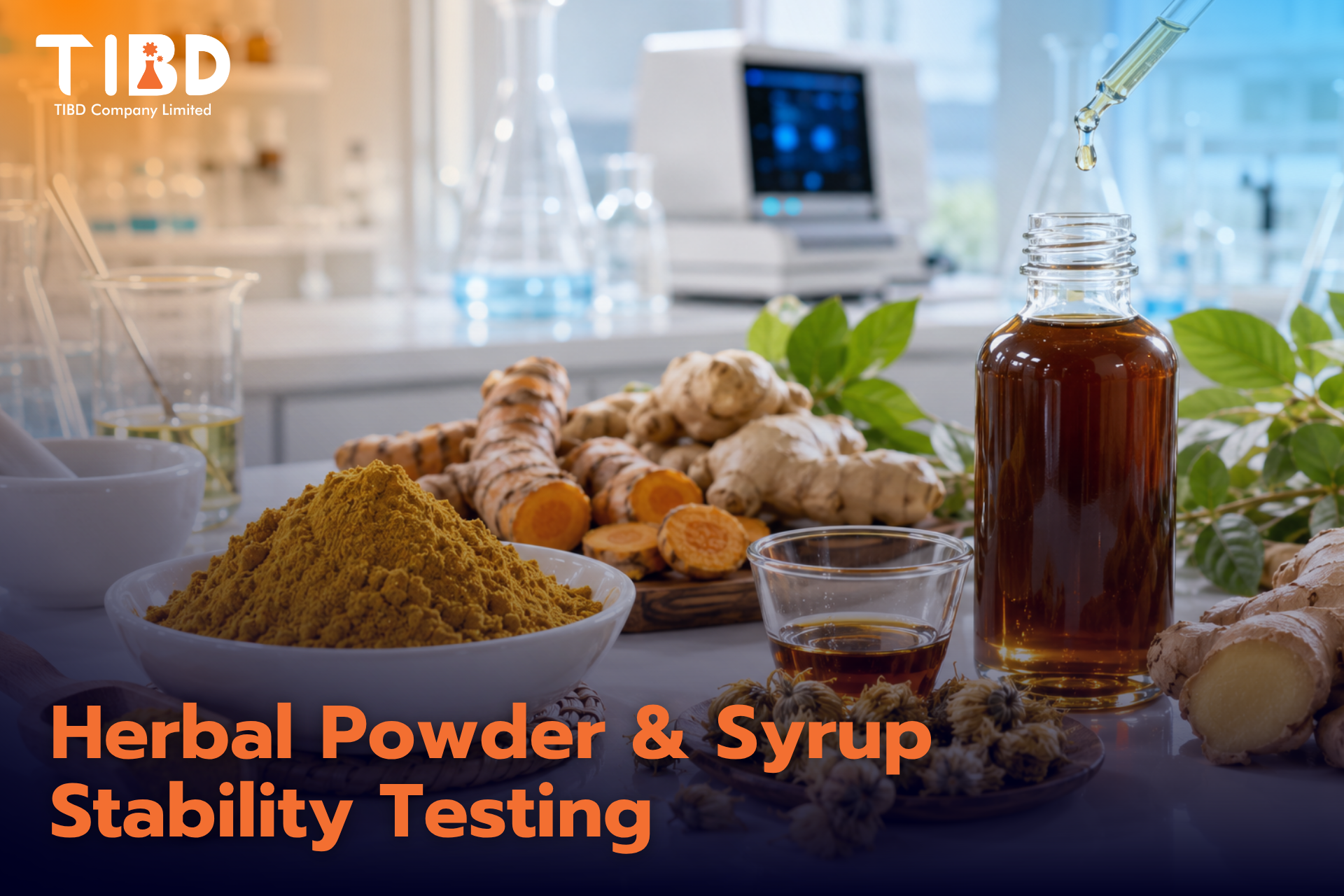
Herbal powders and syrups are two dosage forms regulated under the Thai Herbal Product Act B.E. 2562 (2019) that are particularly sensitive to the high temperature and humidity of ASEAN Zone IVb. Herbal Powder products prepared by spray drying, freeze drying, or direct milling of dried herbs present challenges including moisture absorption, Caking, Hygroscopicity, Maillard reaction, and microbial growth. Herbal Syrup products formulated with sugar, honey, or polyols as the main vehicle present challenges including microbial growth, sedimentation of suspended herb particles, glycoside hydrolysis, pH change, and Brix drop from sucrose inversion under acidic conditions and elevated temperature.

TIBD’s service is designed specifically for Herbal Powder and Syrup dosage forms, covering Moisture Content, Water Activity, Particle Size, Hygroscopicity by Dynamic Vapor Sorption (DVS) Sorption Isotherm, pH, Brix by Refractometer, Viscosity, Sedimentation Rate, Microbiology including Total Microbial Count, Yeast and Mold Count, and Preservative Efficacy Test (PET) per ISO 11930, Marker Compound Assay by High Performance Liquid Chromatography (HPLC), TLC Fingerprinting, and GC-MS for Volatile Compounds under ASEAN Zone IVb conditions per ICH Q1A(R2), in partnership with VISBIO as an Independent Quality Assurance Verifier (IQAV) using Validated Methods per ICH Q2(R1).

Herbal Powder and Syrup Product Types in the Thai and ASEAN Market

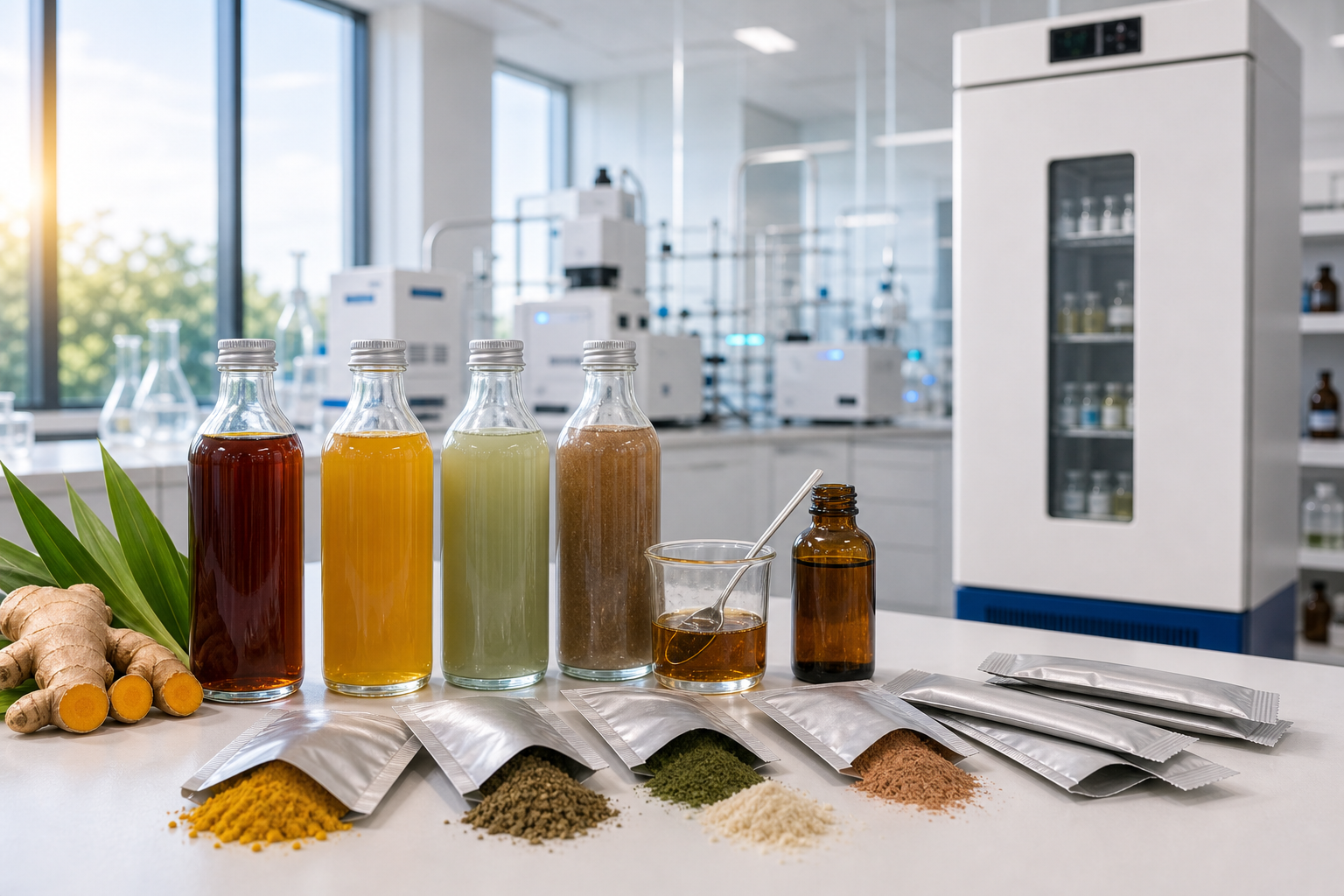
Nine product types covering the main Herbal Powder and Syrup formats are commercially produced in Thailand and the ASEAN region.

  • Spray-Dried Herbal Extract Powder is produced by atomizing a liquid herbal extract into a heated drying chamber where the droplets evaporate rapidly to form hollow microspheres. Spray-dried powders have high surface area and are highly hygroscopic; they require strict Moisture Content and Water Activity control and appropriate packaging to prevent Caking during storage.
  • Freeze-Dried Herbal Extract Powder (Lyophilized Powder) is produced at low temperature and pressure, preserving thermolabile Marker Compounds such as Asiaticoside and enzymes better than spray drying. Freeze-dried powders are very porous and highly hygroscopic. They are typically filled into sachets or capsules rather than stored as bulk powder.
  • Whole Herb Powder is produced by milling dried herb material to a defined particle size range. This format contains the full herb matrix including fiber, starch, and cell wall material. Whole Herb Powders for direct consumption or sachet use require Moisture Content control and Aflatoxin monitoring, particularly for ginger, turmeric, and black pepper.
  • Instant Herbal Powder (Soluble Sachet) is produced by blending spray-dried extract with soluble carriers such as Maltodextrin, Inulin, or Sucrose and packaging in foil-laminate sachets. Stability challenges include moisture absorption causing Caking, Maillard browning between reducing sugars and amino acids, and aroma loss from volatile Marker Compound degradation.
  • Traditional Herbal Syrup is produced by decocting dried herbs in water and concentrating with sugar or honey to achieve a Brix of 50 to 70°Bx. This format is widely used in Thai traditional medicine for respiratory, digestive, and tonic preparations and is registered under the Thai National Formulary.
  • Contemporary Herbal Syrup uses a standardized herbal extract in a formulated syrup base with Xanthan Gum or Carbomer as suspending agent, Sodium Benzoate or Potassium Sorbate as preservative, and Citric Acid or Lactic Acid for pH adjustment. This format allows quantitative Marker Compound claims on the label.
  • Honey-Based Herbal Syrup incorporates honey as both the main vehicle and natural preservative. The stability of honey-based syrups depends on the Water Activity of the honey, which must be below 0.6 to prevent yeast fermentation. Monitoring Brix and Water Activity is particularly important for this format.
  • Pediatric Herbal Syrup is formulated for children with a lower sugar concentration, pleasant taste masking, and age-appropriate dosing per unit volume. The microbial stability of pediatric syrups is critical because of the repeated opening and closing of the bottle during use; In-use Stability testing is required to confirm microbial safety throughout the in-use period.
  • Herbal Syrup for Cough, Respiratory, and Tonic Applications represents the highest-volume category of herbal syrup products in Thailand, with registered products based on Andrographis paniculata, Clinacanthus nutans, Morinda citrifolia, Zingiber officinale, and Thai traditional formula combinations. These products must comply with THP 2021 monograph specifications and Thai FDA Herbal Product Act requirements.
Stability testing for herbal powders and syrups

Specific Stability Challenges in Tropical Climates

Eight stability challenges specific to Herbal Powders and Syrups must be addressed in a stability protocol designed for ASEAN Zone IVb conditions.

  1. The first challenge is Hygroscopicity and Caking in Herbal Powder products. Spray-dried and freeze-dried herbal powders absorb moisture rapidly from the ambient environment, increasing Water Activity above the 0.6 safety threshold and causing individual powder particles to stick together into hardened lumps (Caking). Hygroscopicity is measured quantitatively by Dynamic Vapor Sorption (DVS) Sorption Isotherm, which maps the moisture absorption behavior of the powder across a range of relative humidity values. This data informs the selection of packaging material and desiccant requirements for the product.
  2. The second challenge is Maillard reaction in powder products containing both reducing sugars and amino acids. The Maillard reaction is a non-enzymatic browning reaction between carbonyl groups from reducing sugars (Glucose, Fructose, Maltose) and free Amino Groups from amino acids or proteins in the herbal extract, producing brown-colored melanoidin compounds and characteristic aroma changes. Maillard browning is accelerated by elevated temperature and moisture. Color change is assessed by CIE Lab* Colorimetry.
  3. The third challenge is aroma and flavor change in Herbal Powders and Syrups from degradation of Volatile Compounds. Essential oil constituents including Terpenes, Phenylpropanoids, and Sesquiterpenes evaporate or degrade under elevated temperature storage, causing loss of characteristic aroma and taste. Volatile Compound stability is monitored by GC-MS headspace analysis.
  4. The fourth challenge is microbial growth in Herbal Syrups, particularly in pediatric and honey-based formulations. Syrups with Brix below 50°Bx or Water Activity above 0.6 are susceptible to yeast and mold contamination during shelf life. Preservative Efficacy Test (PET) per ISO 11930 confirms that the preservative system maintains microbial control throughout the product life, including the In-use period.
  5. The fifth challenge is Sedimentation and phase separation of suspended herb particles in Herbal Syrups. Suspended particulates settle over time under gravitational force, producing a sediment layer that may be difficult to re-suspend and that causes non-uniform dosing. Sedimentation Rate is assessed by visual observation and by Turbidimeter measurement at each Pull Point.
  6. The sixth challenge is glycoside hydrolysis in acidic Herbal Syrups. The glycosidic bond of herbal Marker Compounds such as Andrographoside, Baicalin, and Glycyrrhizin is cleaved by acid hydrolysis under the low pH and elevated temperature conditions of tropical storage, releasing the aglycone. Stability Indicating HPLC methods must resolve the parent glycoside from its aglycone degradation product.
  7. The seventh challenge is pH change and sucrose inversion in sugar-based Herbal Syrups. Sucrose undergoes acid-catalyzed hydrolysis to Glucose and Fructose (inversion) under acidic conditions and elevated temperature, causing a decrease in Brix and a change in sweetness profile. A pH drop of more than 0.5 units or a Brix drop of more than 5% from the initial value is considered significant and indicates formulation or packaging instability.
  8. The eighth challenge is Marker Compound degradation. The HPLC assay must confirm that the Marker Compound content is maintained throughout the declared shelf life for both powder and syrup dosage forms. Degradation rates in liquid (syrup) formulations are generally faster than in solid dosage forms due to greater molecular mobility and direct contact with water.

Testing Parameters for Herbal Powder

Moisture Content is measured by Karl Fischer Titration or Loss on Drying. The acceptance criterion for spray-dried herbal extract powders is 3 to 5%. Moisture Content exceeding 5% is associated with Caking, accelerated Maillard browning, and increased microbial risk.

  • Water Activity (aw) is measured by Water Activity Meter. The acceptance criterion is Not More Than 0.6 to prevent microbial growth. Monitoring Water Activity is particularly important for hygroscopic powders stored in packaging with inadequate moisture barrier performance.
  • Particle Size Distribution is measured by Laser Diffraction or Sieve Analysis. Caking causes a shift in the Particle Size Distribution toward larger agglomerate sizes. Monitoring D50 and D90 values at each Pull Point detects the onset of Caking before it becomes apparent by visual inspection.
  • Hygroscopicity is assessed by Dynamic Vapor Sorption (DVS) Sorption Isotherm analysis, which measures moisture uptake as a function of relative humidity. The DVS data is used to calculate the Critical Relative Humidity (CRH) above which the powder absorbs moisture rapidly, informing the specification for storage conditions and packaging requirements.
  • Solubility and Dispersibility confirm that spray-dried and instant herbal powders reconstitute completely in the specified volume of water within the specified time at each Pull Point.
  • Residual Solvent (if spray drying uses organic solvents): Measured by GC-Headspace per ICH Q3C. This test is required when the extract is produced using ethanol or other Class 2 or Class 3 solvents per ICH Q3C.

Testing Parameters for Herbal Syrup

  • pH is measured by pH Meter at each Pull Point. The acceptance criterion for most Herbal Syrups is 3.5 to 5.5, with a maximum change of plus or minus 0.5 units from the initial measurement. pH values outside this range indicate decomposition of the acid buffer system or microbial activity.
  • Brix (Total Soluble Solids) is measured by Digital Refractometer at each Pull Point. The acceptance criterion for most Herbal Syrups is 50 to 70°Bx. A Brix drop of more than 5% from the initial value indicates sucrose inversion or dilution from moisture ingress, and predicts a reduction in microbial stability.
  • Viscosity is measured by Brookfield Viscometer or Rotational Rheometer at each Pull Point. Viscosity change indicates degradation of the suspending agent polymer (Xanthan Gum, Carbomer, or Carrageenan), which affects both product pourability and the Sedimentation Rate of suspended particles.
  • Sedimentation Rate is assessed by measuring the height of the sediment layer after allowing the sample to stand for a defined period. Products with increasing sedimentation over the shelf life require re-evaluation of the suspending agent system.
  • Preservative Efficacy Test (PET) per ISO 11930 is conducted at T0 and at the last Pull Point to confirm that the preservative system remains effective throughout the shelf life. PET requires inoculation of the product with defined concentrations of Staphylococcus aureus, Pseudomonas aeruginosa, Escherichia coli, Candida albicans, and Aspergillus brasiliensis and measurement of viable cell counts over 28 days. Category A or Category B acceptance criteria apply depending on the intended use of the product.
  • Total Microbial Count, Total Combined Yeast and Mold Count, and absence of specified pathogens (E. coli, S. aureus, Salmonella spp.) are assessed at each Pull Point per THP 2021 or USP microbial limit requirements.
  • In-use Stability testing simulates the repeated opening, closing, and dosing of the syrup bottle over the in-use period. Samples are subjected to repeated air exposure and temperature cycling to confirm that microbial quality and Marker Compound content are maintained throughout the in-use period declared on the label.

Marker Compound HPLC and Volatile Compound Analysis

TIBD and VISBIO apply compound-specific HPLC methods validated as Stability Indicating methods for all registered Marker Compounds in the formulation.

  • Andrographolide (225 nm): Primary Marker Compound for Andrographis paniculata syrups, including cough and respiratory formulas. The method resolves Andrographolide from its acid hydrolysis product Andrographolactone.
  • Curcuminoids (425 nm): Primary Marker Compounds for Curcuma longa (Khamin Chan) syrups. Curcuminoids are unstable in aqueous solution, particularly at alkaline pH, and degrade rapidly above pH 7. The HPLC method resolves all three curcuminoid fractions.
  • Glycyrrhizin (254 nm): Primary Marker Compound for syrups containing Glycyrrhiza glabra (licorice). Glycyrrhizin undergoes acid hydrolysis to Glycyrrhetic Acid under the acidic conditions of herbal syrups; the HPLC method resolves both the parent glycoside and its aglycone.
  • Asiaticoside (ELSD or 200 nm): Primary Marker Compound for Centella asiatica (Bua Bok) syrups.
  • Berberine (280 nm): Primary Marker Compound for syrups containing Coptis chinensis or Phellodendron bark.
  • Volatile Compound analysis by GC-MS Headspace: Measures the content and composition of volatile Terpenes, Phenylpropanoids, and Sesquiterpenes in aromatic herbal syrups such as Zingiber officinale (ginger), Cinnamomum verum (cinnamon), and Ocimum sanctum (holy basil). Changes in the volatile compound profile indicate aroma degradation and are used to set the shelf life for aroma-sensitive products.
Stability testing for herbal powders and syrups

Testing Conditions and Pull Point Schedule per ICH Q1A(R2)

Long-term Stability testing uses 30°C / 75% RH conditions per ASEAN Zone IVb for a minimum of 24 months. Accelerated Stability testing uses 40°C / 75% RH for 6 months. Intermediate Stability at 30°C / 65% RH is added for syrups showing significant pH or Brix change under Accelerated conditions.

Standard Pull Points for Long-term testing are months 0, 3, 6, 9, 12, 18, and 24. Standard Pull Points for Accelerated testing are months 0, 1, 2, 3, and 6.

In-use Stability testing is conducted under ambient conditions (25°C ± 2°C / 60% RH ± 5% RH) for the In-use period declared on the label, typically 4 to 8 weeks for liquid syrups after first opening.

DVS Sorption Isotherm is conducted at T0 for Herbal Powder formulations to generate the full moisture sorption curve and calculate Critical Relative Humidity, which informs packaging specification and storage condition labeling.

Formulation and Packaging Design Consultation

TIBD provides formulation consultation for manufacturers seeking to improve the stability of their Herbal Powder or Syrup product before committing to a full stability study.

  • For Herbal Powder: Carrier selection for spray drying (Maltodextrin DE 10-20, Gum Arabic, Inulin, or Beta-Cyclodextrin) affects both encapsulation efficiency and hygroscopicity. Beta-Cyclodextrin is used for volatile compound encapsulation in aromatic herbal powders. Anti-caking agents including Silicon Dioxide (aerosol), Magnesium Stearate, or Calcium Silicate reduce hygroscopicity and improve powder flowability.
  • For Herbal Syrup: Preservative selection must balance microbial efficacy with regulatory requirements. Sodium Benzoate (as benzoic acid, effective below pH 4.5) and Potassium Sorbate (effective up to pH 6.5) are the most widely accepted preservatives for registered herbal syrups. The combination at sub-limit concentrations provides broader spectrum coverage than either agent alone. pH adjustment to 3.5 to 4.5 using Citric Acid or Malic Acid maximizes preservative efficacy and slows Maillard browning.
  • For Packaging: Herbal Powder in foil-laminate sachets (Alu-Alu with MOPP or metallized PET) provides maximum moisture barrier for hygroscopic powders. HDPE bottles with induction-sealed liners are used for bulk powder products. Herbal Syrups in amber PET or amber glass bottles with tamper-evident caps provide light protection and reduce photodegradation of Curcuminoids and Anthocyanins. Child-resistant closures are required for registered liquid herbal products containing ethanol.

VISBIO’s Role as an Independent Quality Assurance Verifier (IQAV)

VISBIO, acting as Independent Quality Assurance Verifier (IQAV), conducts Moisture Content, Water Activity, pH, Brix, Viscosity, Microbiology including PET per ISO 11930, Marker Compound Assay by HPLC, and GC-MS Volatile Compound analysis on samples collected at each Pull Point, using Validated Methods per ICH Q2(R1) with full Traceability documentation at every step and operations conducted under ISO/IEC 17025 standards.

TIBD Team Expertise

The Herbal Powder and Syrup Stability Testing service is conducted in partnership with Dr. Wuttipong Panitsettakorn, Advisor and Co-Founder, who specializes in commercial technology management for the health and beauty industry, and Ms. Mandhamon Uttamo, Advanced Formulator, who has extensive experience in the development of Thai traditional medicine and herbal supplement products across multiple dosage forms. Our team includes researchers specializing in Phytochemistry, Liquid Formulation Technology, Spray Drying Process, Microbiology, and Stability Indicating HPLC method development for herbal actives.

Is your Herbal Powder or Syrup ready for Thai FDA registration or ASEAN export? Contact TIBD for a customized stability protocol and starting price from ฿15,000.

References

  • International Council for Harmonisation of Technical Requirements for Pharmaceuticals for Human Use. (2003). Stability testing of new drug substances and products: Q1A(R2). ICH Harmonised Tripartite Guideline. https://database.ich.org/sites/default/files/Q1A%28R2%29%20Guideline.pdf
  • Royal Thai Government Gazette. (2019, April 30). Herbal Products Act B.E. 2562 (2019). Royal Thai Government Gazette, 136(56 Kor), 1–29. (In Thai)
  • International Organization for Standardization. (2019). Cosmetics — Microbiology — Evaluation of the antimicrobial protection of a cosmetic product (ISO 11930). https://www.iso.org/standard/75058.html
  • Bureau of Drug and Narcotic, Department of Medical Sciences, Ministry of Public Health. (2021). Thai Herbal Pharmacopoeia 2021. Department of Medical Sciences. https://bdn-thp.dmsc.moph.go.th/home
  • Royal Thai Government Gazette. (2013, May 22). Notification of the Ministry of Public Health (No. 364) B.E. 2556 (2013) Re: Standards for Pathogenic Microorganisms in Food. Royal Thai Government Gazette. (In Thai)

Apply for Herbal Powder and Syrup Stability Testing Service

If you have any questions or would like to receive a free consultation regarding Herbal Powder and Syrup Stability Testing Service, or if you would like to visit us in person in Bangkok, Thailand, you are warmly welcomed and feel free to contact us via the contact form below.

  • This field is for validation purposes and should be left unchanged.