Description

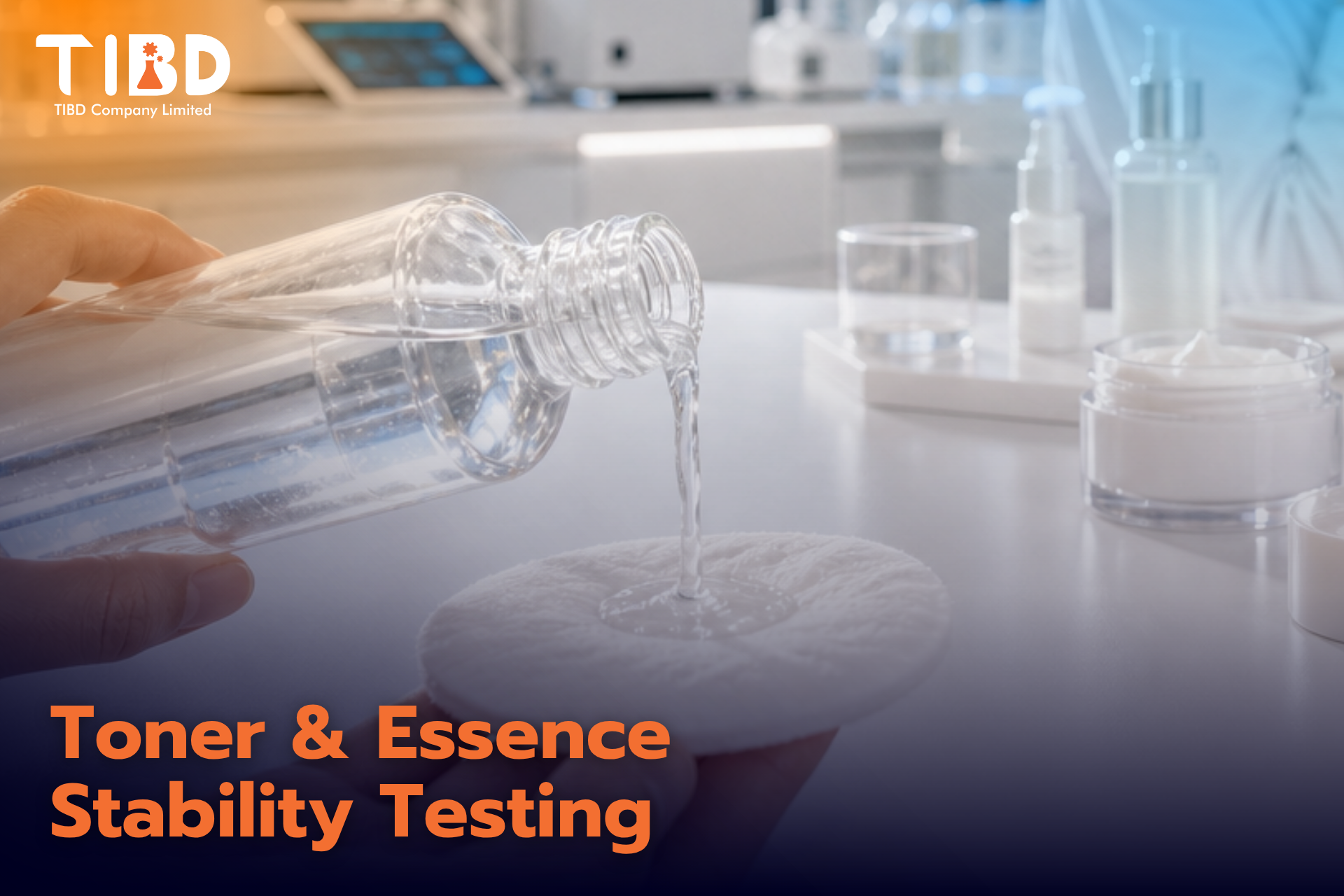
Toners, essences, and hydrating toners (น้ำตบ) are among the most popular product categories in the Thai cosmetics market, driven by K-Beauty and J-Beauty routines that have made multi-step skincare a mainstream consumer practice. These products, which are high-water-content and frequently contain high concentrations of active ingredients such as Vitamin C, Niacinamide, Hyaluronic Acid, Retinol, and Peptides, face specific stability challenges that differ from cream or lotion products.

The hot and humid conditions of Thailand and the ASEAN region, classified as ASEAN Zone IVb (30°C / 75% RH long-term), accelerate the oxidation and degradation of active ingredients, alter the pH balance, and promote microbial growth in water-based formulations. These conditions make comprehensive stability testing not just a regulatory requirement but a quality assurance necessity for products claiming active ingredient benefits.

TIBD’s service covers stability protocol design, active ingredient assay by High Performance Liquid Chromatography (HPLC) and advanced analytical methods, Preservative Efficacy Testing (PET) per ISO 11930, microbial limit testing per ISO 17516, and physical parameter assessment, in partnership with VISBIO as an Independent Quality Assurance Verifier (IQAV) using Validated Methods per ICH Q2(R1), to produce a stability report supporting Thai FDA Cosmetic Notification, export market submissions, and Product Information File (PIF) preparation.
Toner, Essence and Hydrating Toner in the Thai Cosmetics Market

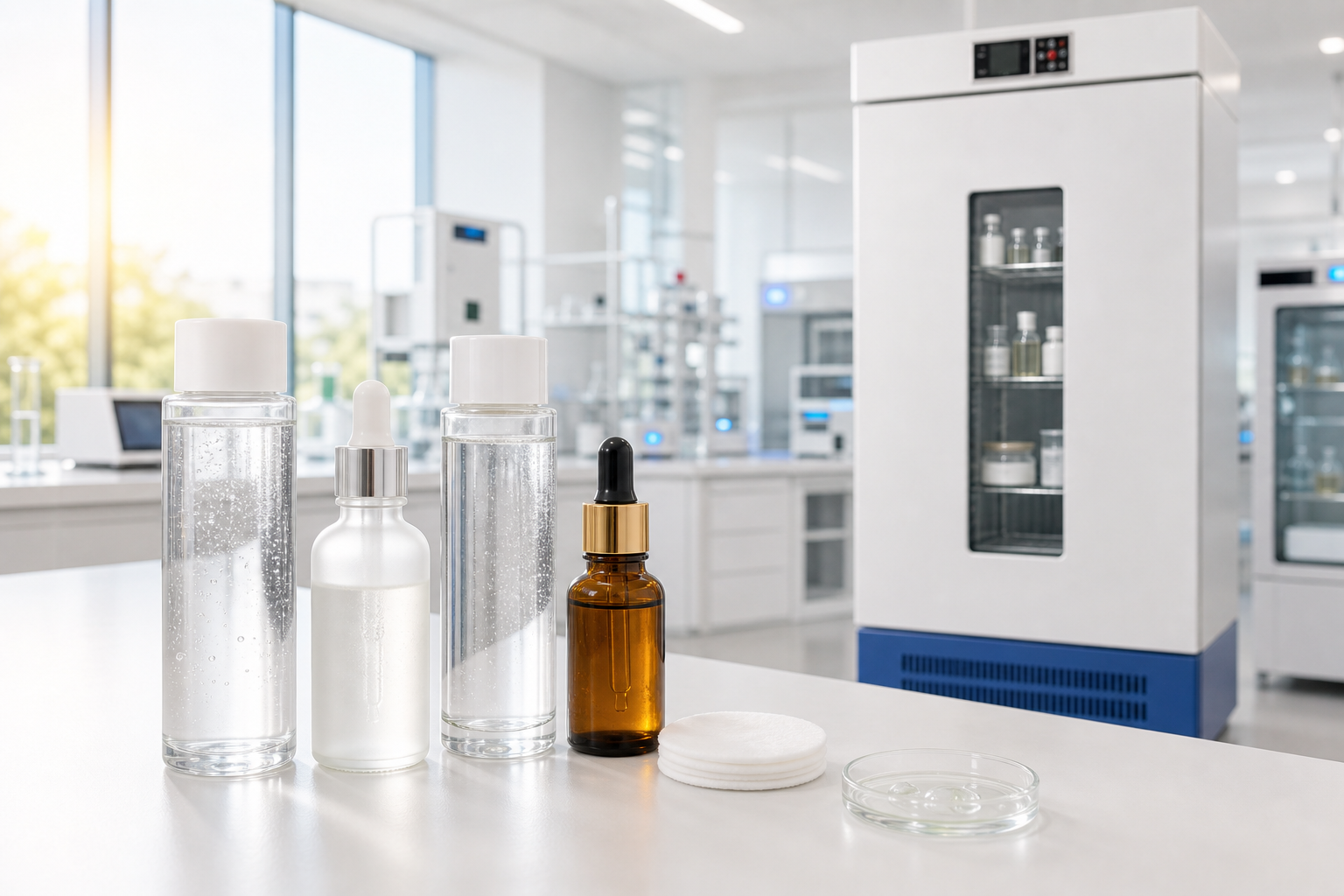
These three product types are related in their high-water-content format but serve distinct functions in the skincare routine and require different stability considerations.

  • Traditional Astringent Toner was the original format, with a water and alcohol base designed to remove residual cleanser, tighten pores, and prepare skin for subsequent steps. This format generally has simpler stability requirements due to its high alcohol content providing inherent antimicrobial protection, but must still be assessed for pH stability and fragrance degradation.
  • Hydrating Toner or น้ำตบ is the format popularized through K-Beauty routines. It is a water-rich, low- or no-alcohol product applied in multiple layers (the 7-Skin Method) to deliver deep hydration. This format typically contains Hyaluronic Acid, Glycerin, Panthenol, and botanical extracts. Without alcohol as a preservative, the microbial challenge is more significant, and PET per ISO 11930 is essential.
  • Essence is a more concentrated format positioned between toner and serum, often containing higher concentrations of targeted active ingredients such as Vitamin C (10 to 20%), Niacinamide (5 to 10%), Retinol, Peptides, or Ferment Filtrates. The high active ingredient concentration creates complex stability challenges across pH, oxidation, and ingredient-ingredient interactions that require active ingredient assay testing at multiple Pull Points throughout the study.
Stability testing for toners and essences

Challenges of High-Concentration Active Liquid Systems

Four specific challenges arise in stability testing of toners and essences that do not commonly occur in emulsion-based products.

  1. The first is Vitamin C oxidation. Pure L-Ascorbic Acid (Vitamin C) at effective concentrations (typically 10 to 20%) requires a pH of 3.0 to 3.5 to maintain stability. At higher pH values, it oxidizes rapidly to Dehydroascorbic Acid, which is then further degraded to inactive compounds. Color change from clear or pale yellow to orange or brown is the first visual indicator of significant Vitamin C degradation.
  2. The second is preservative system stability in a challenging pH environment. Products formulated at pH 3.0 to 3.5 for Vitamin C stability present a challenge for broad-spectrum preservative systems, as many preservatives have reduced efficacy at low pH or are restricted in concentration under regulatory frameworks. PET per ISO 11930 must be conducted under the same pH and formula conditions as the final product.
  3. The third is pH change over time. The pH of water-based formulations can shift during storage due to CO2 absorption from the environment, degradation of acidic active ingredients, or reaction between formula components. A pH change of more than 0.5 units from the initial value is typically considered a significant change in cosmetic stability assessment.
  4. The fourth is component separation or turbidity. Essences containing botanical extracts, high molecular weight Hyaluronic Acid, or poorly soluble compounds may develop turbidity or sedimentation over time, particularly at refrigerated storage conditions or following temperature cycling tests.

Specific Testing Parameters for Toners and Essences

TIBD’s stability testing for toners and essences covers parameters designed to capture both physical stability and active ingredient integrity.

  • pH measurement at plus or minus 0.5 from the initial value is the primary physical parameter. For Vitamin C formulations, the pH specification is typically 3.0 to 3.5 and must be maintained throughout the study period.
  • Clarity and Turbidity assessment is conducted by visual inspection under standardized lighting and, where applicable, by Nephelometry. Turbidity development in a product that is initially clear indicates physical instability of dissolved or dispersed components.
  • Cloud Point testing is conducted for formulations containing surfactants or polymers, particularly nonionic surfactants that can become turbid at elevated temperatures. This test is relevant for products formulated with Polysorbates or PEG-based solubilizers.
  • Active Ingredient Assay by HPLC is the central analytical test for essence stability, measuring whether the active ingredient content remains within specification throughout the study. The specification is typically Not Less Than 90% of the initial declared value.
  • Color Stability is assessed by CIELAB colorimetry (L*, a*, b* coordinates), quantifying color changes that are not perceptible by visual inspection alone. For Vitamin C formulations, a* and b* values (red-yellow axis) are particularly sensitive indicators of oxidation.
  • Microbial Limit Testing per ISO 17516 and Preservative Efficacy Testing (PET) per ISO 11930 are conducted to confirm that the product remains microbiologically safe throughout the declared shelf life.

Active Ingredient Analysis Methods

Different active ingredients require different analytical methods. TIBD and VISBIO apply the appropriate validated method for each compound.

  • Vitamin C (L-Ascorbic Acid and Derivatives): Pure L-Ascorbic Acid is analyzed by HPLC using a C18 Reverse Phase Column with detection at 245 nm and a mobile phase containing Metaphosphoric Acid as a stabilizing agent to prevent oxidation during sample preparation. Stable derivatives including Sodium Ascorbyl Phosphate (SAP), Magnesium Ascorbyl Phosphate (MAP), and Ascorbyl Glucoside (AG) can be analyzed under modified conditions specific to each compound.
  • Niacinamide: Analyzed by HPLC with UV detection at 261 nm. Niacinamide is generally stable under neutral to slightly acidic conditions but may be converted to Nicotinic Acid (Niacin) under high heat, which can cause skin flushing at elevated concentrations.
  • Hyaluronic Acid: Quantified by the Carbazole Colorimetric Method for total glucuronic acid content, or by Size Exclusion Chromatography (SEC) for molecular weight distribution assessment. SEC provides information on whether the high molecular weight fraction, which provides film-forming and hydrating effects, is being degraded to lower molecular weight fractions over storage.
  • Retinol: Analyzed by HPLC with UV detection at 325 nm under light-protected conditions. Retinol is highly sensitive to light and oxygen. All sample preparation must be conducted under red or amber light with nitrogen purging to prevent oxidation during analysis.
  • Peptides: Analyzed by Liquid Chromatography Mass Spectrometry (LC-MS/MS) to confirm molecular integrity and detect degradation fragments. This method is required for complex peptides such as Palmitoyl Pentapeptide-4 (Matrixyl) and Acetyl Hexapeptide-3 (Argireline).
  • Botanical Extracts: Total Polyphenol Content (TPC) is quantified by the Folin-Ciocalteu colorimetric method. Antioxidant activity can be assessed by the DPPH radical scavenging assay, providing evidence that the bioactive fraction of the extract remains active throughout the study.

Testing Conditions and Pull Point Schedule per ICH Q1A(R2)

Long-term Stability testing for products intended for distribution in Thailand and the ASEAN region uses 30°C / 75% RH conditions per ASEAN Zone IVb. Pull Points are typically at 0, 3, 6, 9, and 12 months for a 12-month study supporting a 24-month shelf life claim with extrapolation per ICH Q1E.

Accelerated Stability testing at 40°C / 75% RH for 6 months supports preliminary shelf life prediction and formula screening prior to committing to long-term studies. Results showing significant change at accelerated conditions indicate a formula stability issue requiring reformulation before market launch.

Photostability testing per ICH Q1B is particularly important for Vitamin C, Retinol, and products with fragrance systems. Samples must receive a minimum of 1.2 million Lux-hours of visible light and 200 Wh/m² of UVA energy. Vitamin C formulations must demonstrate that color change and active content loss after light exposure remain within specification.

For products containing oxidation-sensitive actives such as Retinol and unsaturated botanical extracts, TIBD additionally recommends an oxygen-rich atmosphere test conducted in headspace vials with elevated oxygen content, to predict stability under conditions where packaging integrity may be compromised during consumer use.

Thai FDA Cosmetic Notification and Export Requirements

Submitting a Cosmetic Notification to the Thai FDA for toners and essences making active ingredient claims requires a complete Product Information File (PIF) including stability evidence.

The Thai FDA and ASEAN regulatory authorities require Active Ingredient Assay data confirming that the claimed concentration remains within specification throughout the declared shelf life, alongside pH and physical parameter data, Microbial Limit Test results per ISO 17516, and PET per ISO 11930 for all water-containing formulations.

For export to other ASEAN markets, stability data tested in Thailand under Zone IVb conditions is accepted by Indonesia’s BPOM, Malaysia’s NPRA, Singapore’s HSA, Vietnam’s DAV, and the Philippines FDA under the ASEAN Cosmetic Directive framework. Stability data from Zone IVb testing demonstrates that the product can withstand the most challenging climatic conditions within the ASEAN region.

For export to the European Union under Cosmetic Regulation (EC) No 1223/2009, the Cosmetic Product Safety Report (CPSR) must include active ingredient stability data across the full shelf life and a microbiological safety assessment. EU regulations additionally require substantiation of any active ingredient claims made in marketing materials, which must be supported by the same stability data set.

Stability testing for toners and essences

K-Beauty and J-Beauty Market Trends

The multi-step K-Beauty skincare routine (Cleanse, Tone, Essence, Serum, Moisturizer, SPF) and J-Beauty minimalist philosophy (Cleanse, Lotion, Emulsion) have both significantly shaped consumer expectations for toner and essence products in Thailand.

Korean beauty trends have driven demand for Hydrating Toners with ferment filtrates (Bifida Ferment Lysate, Galactomyces Ferment Filtrate), multi-layering application methods, and essence products with visible efficacy indicators such as brightening and skin texture improvement. These complex formulations require compatibility studies between active ingredients, particularly combinations of Vitamin C and Niacinamide, which can form a yellow complex (Niacin-Ascorbate) at certain pH ranges and ratios.

Japanese beauty philosophy has driven demand for high-purity single-active formulations and products with minimalist ingredient lists, where stability evidence for each active compound is critical to brand credibility. The J-Beauty segment commands premium pricing, and brand owners in this segment require comprehensive stability documentation including SEC data for Hyaluronic Acid and LC-MS for Peptides.

Compatibility studies between actives in multi-ingredient formulations are a specialized form of stability assessment that TIBD can design, evaluating whether combinations such as Vitamin C at acidic pH and Niacinamide, or Retinol and AHA exfoliants, remain stable and compatible when formulated together.

Multi-Active Essence Development for the Premium Market

Developing a premium multi-active essence requires stability data as an integral part of the formulation process, not as an afterthought before registration.

A typical premium brightening essence combining Vitamin C at 10%, Niacinamide at 5%, and Hyaluronic Acid at 2% must be evaluated for: the pH range at which all three actives are simultaneously stable (generally pH 3.0 to 3.5 for Vitamin C stability, which requires assessment of Niacinamide and HA stability at this low pH), the effect of the low-pH environment on the PET challenge test organisms, and the impact of high-concentration Hyaluronic Acid on the viscosity and physical appearance throughout the study.

Where pure L-Ascorbic Acid cannot be stabilized in the desired formula, TIBD can provide formulation advice on encapsulation technologies for the active ingredient. Available approaches include Liposomal Encapsulation, Cyclodextrin Inclusion Complex, and the use of stable Vitamin C derivatives (SAP, MAP, AG), each with different stability profiles and bioavailability characteristics. Encapsulated actives require modified HPLC protocols to extract the active from the carrier system prior to analysis.

VISBIO’s Role as an Independent Quality Assurance Verifier (IQAV)

The analytical credibility of toner and essence stability data depends on the independence of the testing laboratory. VISBIO, acting as an Independent Quality Assurance Verifier (IQAV), conducts Active Ingredient Assay by HPLC and LC-MS/MS, Preservative Efficacy Testing per ISO 11930, Microbial Limit Testing per ISO 17516, and colorimetric and physicochemical testing on samples collected at TIBD’s Pull Points, using Validated Methods per ICH Q2(R1) with full traceability documentation at every step and operations conducted under ISO/IEC 17025 standards.

For brand owners submitting Cosmetic Notifications or preparing PIFs for export, having active ingredient assay data generated by an independent ISO/IEC 17025-aligned laboratory strengthens the credibility of claims made on the product label and in regulatory submissions.

TIBD Team Expertise

The Toner, Essence and Hydrating Toner Stability Testing service is conducted in partnership with Dr. Wuttipong Panitsettakorn, Advisor and Co-Founder, who specializes in commercial technology management for the health and beauty industry, and Ms. Mandhamon Uttamo, Advanced Formulator, with experience in developing water-based active formulations including Vitamin C serums, multi-active essences, and hydrating toners. Our team includes researchers specializing in Analytical Chemistry, HPLC Method Development, and Cosmetic Microbiology, and a network of researchers covering LC-MS/MS Peptide analysis, SEC for Hyaluronic Acid characterization, and encapsulation system stability.

Is your toner or essence ready for Thai FDA registration or for export to ASEAN and international markets? If you need stability data based on ICH Q1A(R2), HPLC Active Ingredient Assay, PET per ISO 11930, and Microbial Limit Testing per ISO 17516 for your water-based active formulation, contact TIBD for a customized protocol and starting price from ฿15,000.

References

Apply for Toner, Essence and Hydrating Toner Stability Testing Service

If you have any questions or would like to receive a free consultation regarding Toner, Essence and Hydrating Toner Stability Testing Service, or if you would like to visit us in person in Bangkok, Thailand, you are warmly welcomed and feel free to contact us via the contact form below.

  • This field is for validation purposes and should be left unchanged.