

Cold plasma in agriculture / Article 02
Cold plasma treated seeds: reducing seed-borne pathogens in vegetable seed without a chemical coating
Cold plasma vegetable seed priming for F1 vegetable seed, controlled environment farms and organic vegetable exporters — the mechanism, the evidence, the limits, and the testing sequence to use.
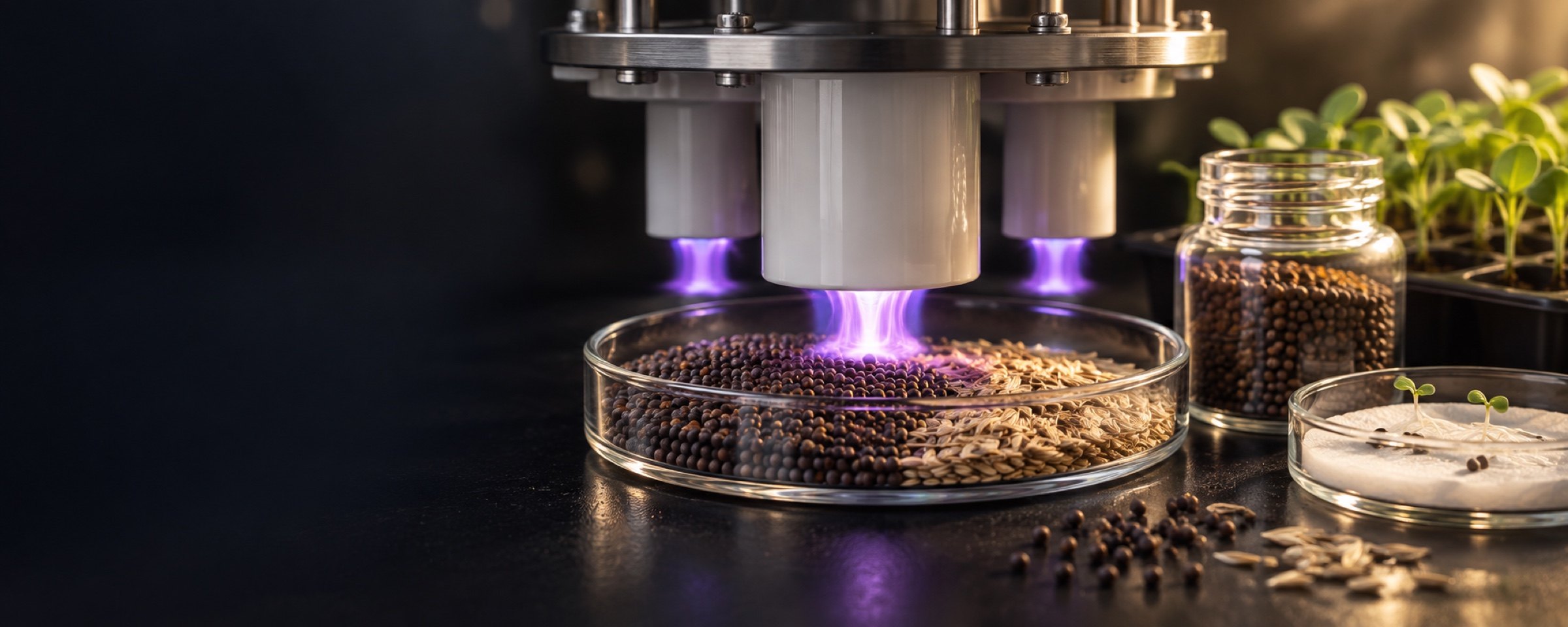
Cold plasma seed priming for vegetable seed means using plasma struck in air at room temperature to condition the seed surface for better water uptake and to reduce the pathogens carried on the seed coat, with no chemicals, no heat and no residue.
What makes vegetable seed a different problem from rice is the value per seed. First-generation hybrid vegetable seed — cherry tomato, sweet pepper, Japanese cucumber, speciality salad varieties — costs tens of times more per seed than field crop seed. At that spread, investing in seed quality pays back far more clearly.
01Where the problem sits in vegetable seed
The problem splits into two dimensions that have to be solved in different ways.
The first is germination performance. Controlled environment farms and hydroponic systems need seed that germinates almost completely and germinates together, because harvest cycles are scheduled. A seedling two or three days behind the rest throws the whole tray out of step.
The second is seed-borne pathogens, and each vegetable group has its own problem organisms.
Seed-borne organisms that are a standing problem for each vegetable group
- Brassicas (cabbage, cauliflower, broccoli, leafy brassicas) — Alternaria brassicicola and Xanthomonas campestris pv. campestris, the causes of black spot and black rot.
- Tomato and pepper — bacterial leaf spot, and Fusarium wilt carried on the seed and spreading in the greenhouse.
- Salad and leafy vegetables — Pseudomonas and Xanthomonas species contaminating the seed and pushing germination down significantly.
When these organisms enter a greenhouse or a field with the seed, the damage is rarely confined to one plant. It spreads through the lot.
02How cold plasma handles this
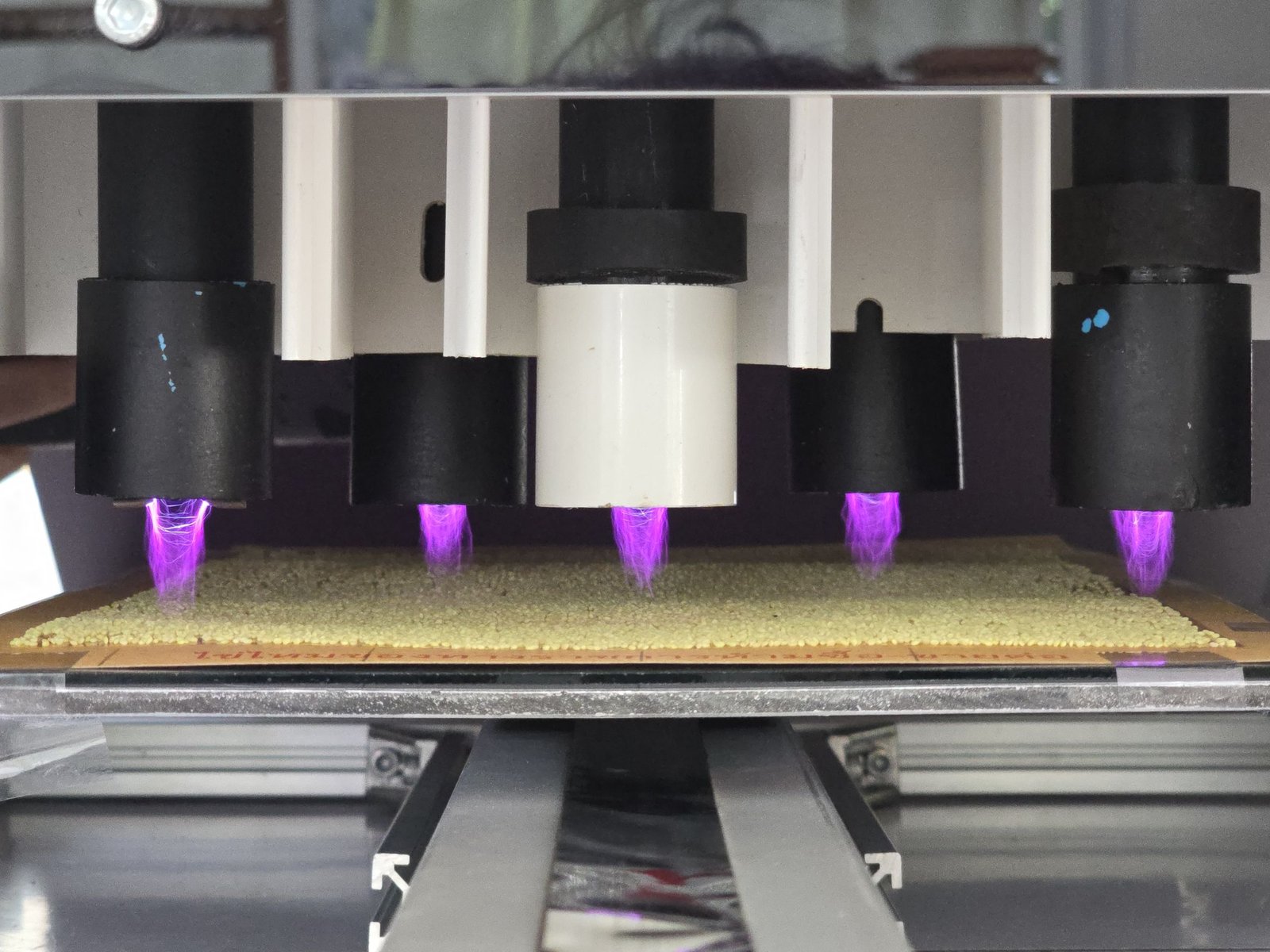
Cold plasma does two things at once in a single step: it changes the seed surface, and it reduces the microorganisms sitting on that surface.
On the surface side, the active species in the plasma react with the outer layer at the nanometre scale, lowering the contact angle of a water droplet so that water spreads and soaks in faster. Water uptake is the first step of germination. Make that first step more uniform across a whole lot and the germination that follows is more uniform too.
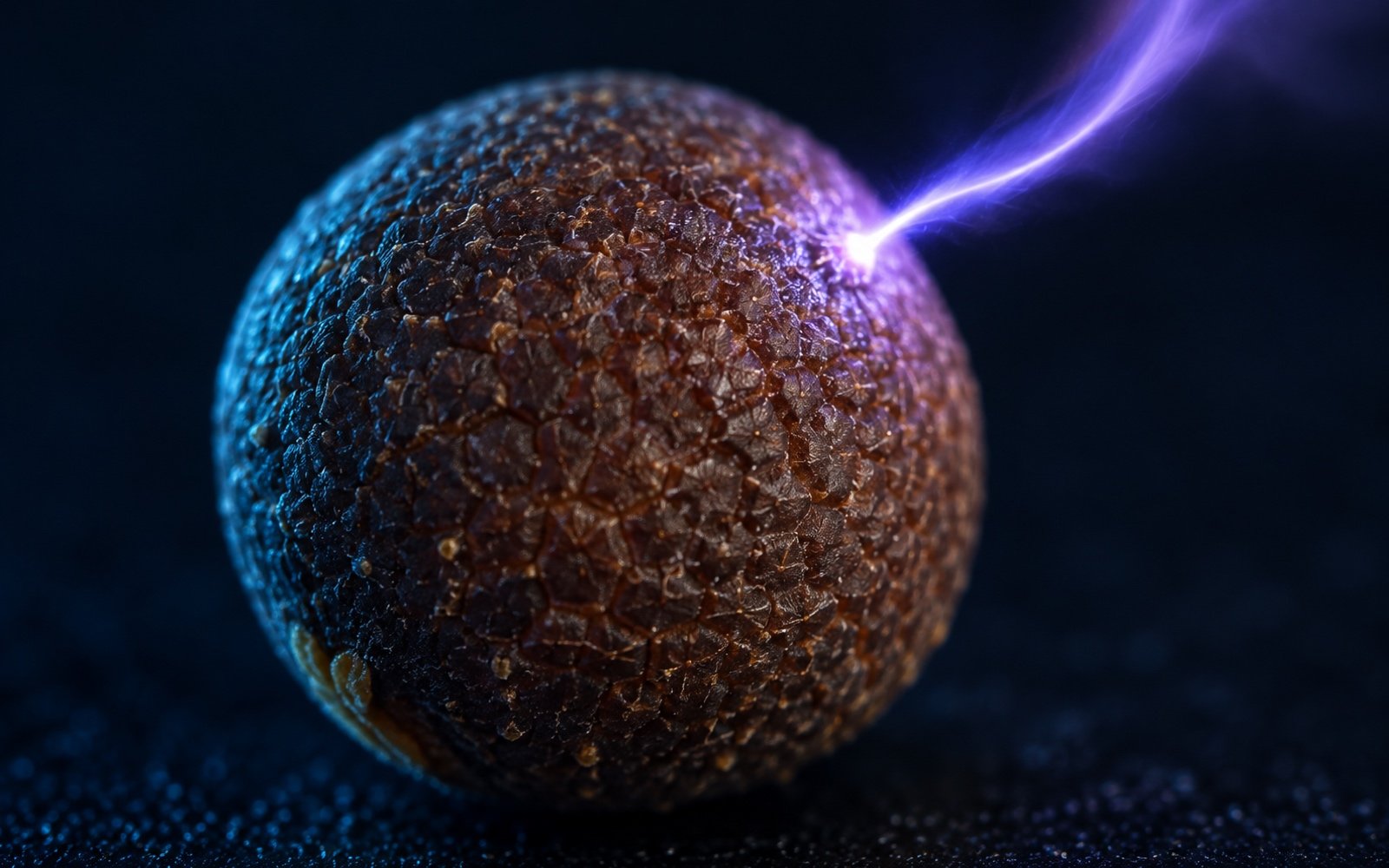
On the pathogen side, the same species break down the cell structure of the microorganisms on the seed surface through oxidation, with no disinfectant added at all.
For some vegetable seed the research team combines plasma with a plasma-activated liquid, so the activity reaches the grooves and fissures on the seed surface that gas alone does not get into.
03What the research reports
Most of the work directly relevant to vegetable seed comes from the research team at Kasetsart University and is published in international journals.
| Study | Journal | What it reports |
|---|---|---|
| Srisonphan (2018) | ACS Applied Materials & Interfaces | Explains the underlying mechanism by which cold plasma changes the wettability of a material surface within seconds to minutes. |
| Suwannarat et al. (2021) | ACS Applied Materials & Interfaces | Using discharge plasma in liquid together with plasma-activated water to reduce Alternaria brassicicola on brassica seed while keeping germination performance at a commercial level. |
| Suwannarat et al. (2024) | ACS Applied Bio Materials | Extends the work to Xanthomonas campestris on brassica seed, reducing the population several-fold without causing toxicity in the seedlings that follow. |
| Tephiruk et al. (2025) | Results in Engineering | Using DBD plasma together with plasma-activated water on sunflower seed, significantly raising germination rate and shortening mean germination time against the control. |
| Khamsen et al. (2016) | ACS Applied Materials & Interfaces | The paper that started this line of work, carried out on rice seed, and the basis of the methods adapted for vegetable seed. |
What has to be read correctly: the reduction figures in these studies were measured under laboratory conditions on the specific seed named. They are not values that transfer immediately to every kind of seed.
04How it compares with chemical coating and heat treatment
The vegetable seed market uses three main methods. Each has something it does well and something it leaves you to manage.
| Method | Handles pathogens | Effect on germination | What it leaves you to manage |
|---|---|---|---|
| Chemical coating | Well, with a long data record. | Does not speed up water uptake. | Residues that have to be declared, and rising regulatory pressure. |
| Heat treatment | To a degree. | Can affect viability if the temperature control slips. | Risky for thin-coated seed such as salad and microgreens. |
| Cold plasma | Yes, depending on the organism and the conditions used. | Conditions the surface for faster water uptake at the same time. | Conditions have to be found for each variety by testing. |
On the regulatory side, the European Union withdrew approval for Thiram in 2018 and banned Mancozeb from January 2022, while the default maximum residue level for substances with no specific limit sits at 0.01 mg/kg under Regulation (EC) No 396/2005, and Japan's Positive List System uses the same 0.01 ppm threshold. That trend gives physical methods a steadily growing structural advantage.
05Who should be interested
Who this fits most directly
- Vegetable seed companies building a premium seed line for controlled environment and organic farms.
- Controlled environment and hydroponic operators who need high, uniform germination to manage harvest cycles.
- Organic vegetable exporters who have to demonstrate a residue-free chain starting from the seed.
- Brassica seed producers dealing with Alternaria and Xanthomonas as standing problems.
- Commercial propagators wanting to cut waste at the seedling stage and raise survival before transplanting.
06The testing sequence to use
Start by measuring the baseline on a real lot: seed moisture, baseline germination percentage, starting microbial load, and screening for the specific pathogens of that vegetable. Without knowing where you start, a post-treatment result means nothing.
Then run a preliminary efficacy test at small batch scale with seed from the producer's own real lot. The result at this stage is information for a decision, not a guaranteed germination figure.
Where the results support it, design the process and the equipment around the real throughput of the line, with operating procedures and team training.
Verification should be separate from the technology developer. In TIBD's case it is carried out by VISBIO, an affiliated company acting as the independent verifier, covering germination rate, vigour index, mean germination time, microbial reduction, and screening for the specific pathogens of each vegetable group.
For the standard that buyers recognise internationally, testing follows the guidance of the International Seed Testing Association, (ISTA) while organic vegetable export sits under IFOAM, EU Organic Regulation 2018/848, the USDA National Organic Program, Japan's JAS Organic, and the Organic Thailand standard.
07In summary: four points before deciding
Four things to remember before deciding
- Cold plasma does two things in a single step: it changes the seed surface, and it reduces the microorganisms sitting on that surface.
- The real problem for a controlled environment farm is uniformity. A seedling two or three days behind the rest throws the whole tray out of step.
- Most of the work directly relevant to vegetable seed comes from the Kasetsart University research team and is published in international journals.
- The baseline on a real lot has to be measured first — moisture, baseline germination and microbial load — or the post-treatment result means nothing.
08Frequently asked questions
Does cold plasma kill every kind of organism on the seed?
Not every kind. Effectiveness depends on whether the organism sits on the seed surface or deeper inside the seed. Plasma works best on organisms at the surface and in surface grooves; anything embedded deeper needs another method alongside. The target organism therefore has to be named before the testing is designed.
Will thin-coated vegetable seed be damaged?
Cold plasma works at room temperature, so there is none of the heat that damages seed in an oven. But too much energy or too long an exposure can still reduce germination. Finding the right window for thin-coated seed is an important part of the preliminary testing.
Can it be used alongside conventional seed coating?
In some cases yes, but the order matters, because coating applied after surface conditioning can cover over what has just been done. The sequence has to be designed together according to the goal for each lot.
Should treatment be before storage or before sale?
Because a more hydrophilic seed surface also picks up moisture from the air more readily, where this step sits in the line affects storage life. Generally, placing it near the end before packing is easier to manage, but it has to be confirmed with a real storage trial.
09Talk through your problem with the TIBD team
If you produce vegetable seed and are stuck on germination uniformity, or on pathogens carried on the seed surface, start by sending the baseline figures for a real lot.
TIBD works alongside researchers and technology owners so that research carries on from the laboratory through to a real production line. The first thing we do is assess together whether your problem genuinely suits this technology. If it does not, we will say so at the start.
Message us on LINE @tibdglobal or use the contact form at tibdglobal.com/contact and tell us about the problem in your process.
Read next
- Cold plasma and rice seedWhy a plasma-treated seed takes up water faster, and how far the research goes
- Reducing mycotoxins in agricultural raw materialsWhere the research stands before you decide
- Extending the shelf life of fresh produce with cold plasmaReducing post-harvest microorganisms without adding a residue
← Back to Cold Plasma · Cold plasma services · Talk to the team
Sources Srisonphan (2018) ACS Applied Materials & Interfaces · Suwannarat et al. (2021) ACS Applied Materials & Interfaces · Suwannarat et al. (2024) ACS Applied Bio Materials · Tephiruk et al. (2025) Results in Engineering · Khamsen et al. (2016) ACS Applied Materials & Interfaces DOI: 10.1021/acsami.6b04555 · Standards framework: International Rules for Seed Testing (ISTA), IFOAM Norms 2020, EU Regulation 2018/848, USDA NOP 7 CFR Part 205, Regulation (EC) No 396/2005, ACFS TAS 9000 Series · Cold plasma research in Thailand by Assoc. Prof. Dr. Siwapon Srisonphan Department of Electrical Engineering, Kasetsart University
About TIBD TIBD Company Limited works alongside researchers and technology owners so that research carries on from the laboratory into real industrial use, from feasibility assessment and test design to prototyping and scale-up of production, with VISBIO, an affiliated company, acting as the independent verifier. The office is at the Kasetsart Agricultural and Agro-Industrial Product Improvement Institute, Kasetsart University, Bangkhen.