

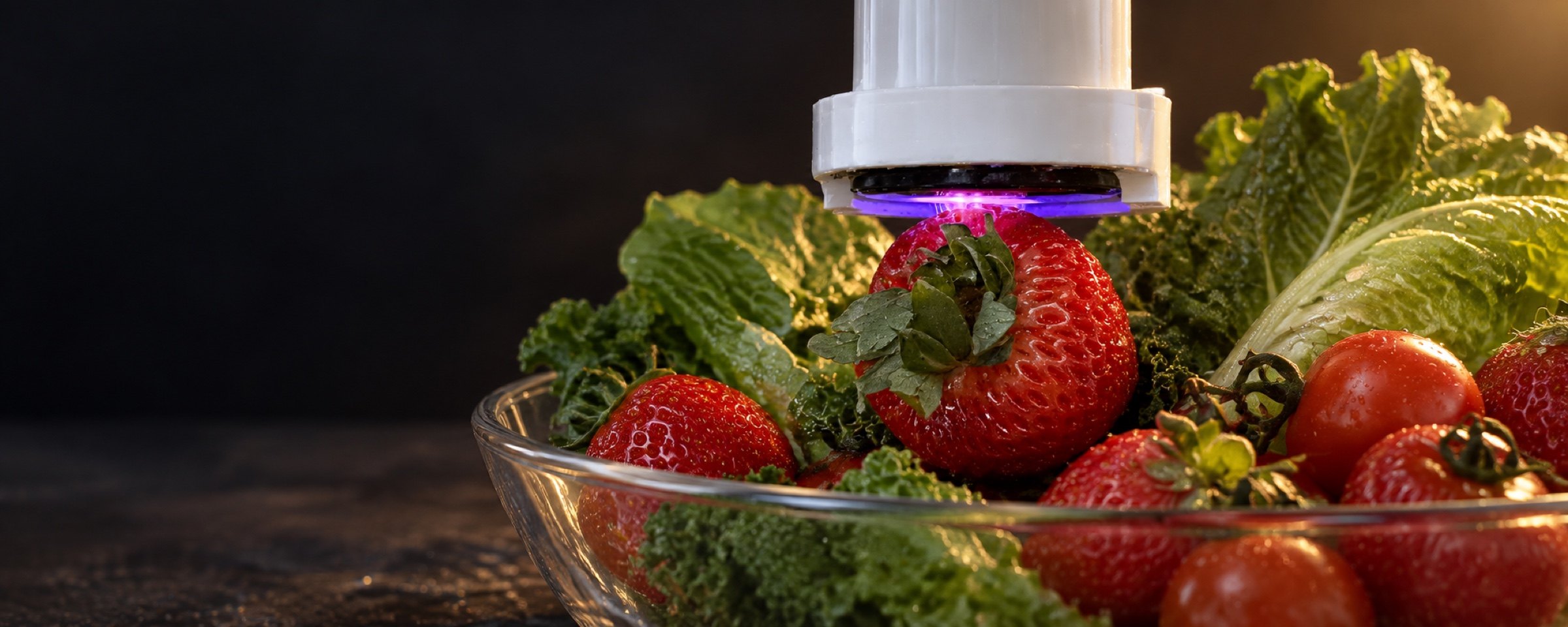
Cold plasma fresh produce sanitation for packhouses, fresh-cut processors and exporters — why it extends shelf life, by how much, and what it still cannot do.
Extending the shelf life of fresh produce with cold plasma means reducing the microbial population on the surface of the produce using plasma struck in air at room temperature, slowing spoilage without dosing chemicals into the wash water, without the heat that damages texture, and without leaving a residue that has to be declared in export documentation.
The reason this works is direct. Fresh produce spoils because microorganisms on the surface multiply. Lower the starting count and the time taken to reach visible damage gets longer.
What has to be said plainly at the outset: there is no general figure for how many days it adds, because it depends on the produce, the starting microbial load, the conditions used, and temperature control through the rest of the chain.
Why chlorine washing is becoming a problem
Washing with chlorinated water at roughly 50 to 200 ppm has been the global fresh-cut industry standard for decades, and it does reduce foodborne pathogens. The problem is not effectiveness. It is what follows.
Three pressures pushing exporters to look for alternatives
- Disinfection by-products that can remain on the product surface and in wastewater, which destination markets are testing for more closely.
- Organic certification limits. Both the USDA National Organic Program and EU Organic Regulation 2018/848 place strict conditions on chlorine use in organic food processing.
- The cost of managing contaminated wastewater, and the occupational health cost of staff handling chemicals.
On the loss side, the Food and Agriculture Organization of the United Nations estimates post-harvest losses of fresh produce in Southeast Asia at 24 per cent and above, with heat and humidity accelerating them. In a cost structure like that, even a small extension in shelf life changes the margin of an export chain significantly.
How cold plasma acts on the produce surface
When a high electric field is applied through air at room temperature, part of the gas breaks down and a set of chemically active species forms. Those species react with the cell membranes and biomolecular structures of the microorganisms on the produce surface, damaging the cells through oxidation, with no disinfectant added to the system.
Three features define the process: it starts from air and electricity alone, the species it creates are short-lived and decay back into ordinary air, and its intensity is set by energy and contact time, so it can be controlled as a number.
TIBD summarises the position of this technology in four things it does not do: no chemicals, no residue, no heat, no radiation. Each of those ties to a different commercial advantage.
How many ways it can go into a line
The installation format depends on how the plant’s production is paced.
| Format | Suits | What has to be prepared |
|---|---|---|
| Batch treatment chamber | Small lots, several kinds of produce alternating, testing before scaling. | Floor space for the cabinet and a plan for queuing lots. |
| In-line module | Continuous production on a conveyor with steady volume. | Space to insert into the existing conveyor, and adjusting line speed to match contact time. |
| Post-package treatment | Product packed under modified atmosphere needing a final treatment. | A compatible packaging film, and confirmation that the seal is unaffected. |
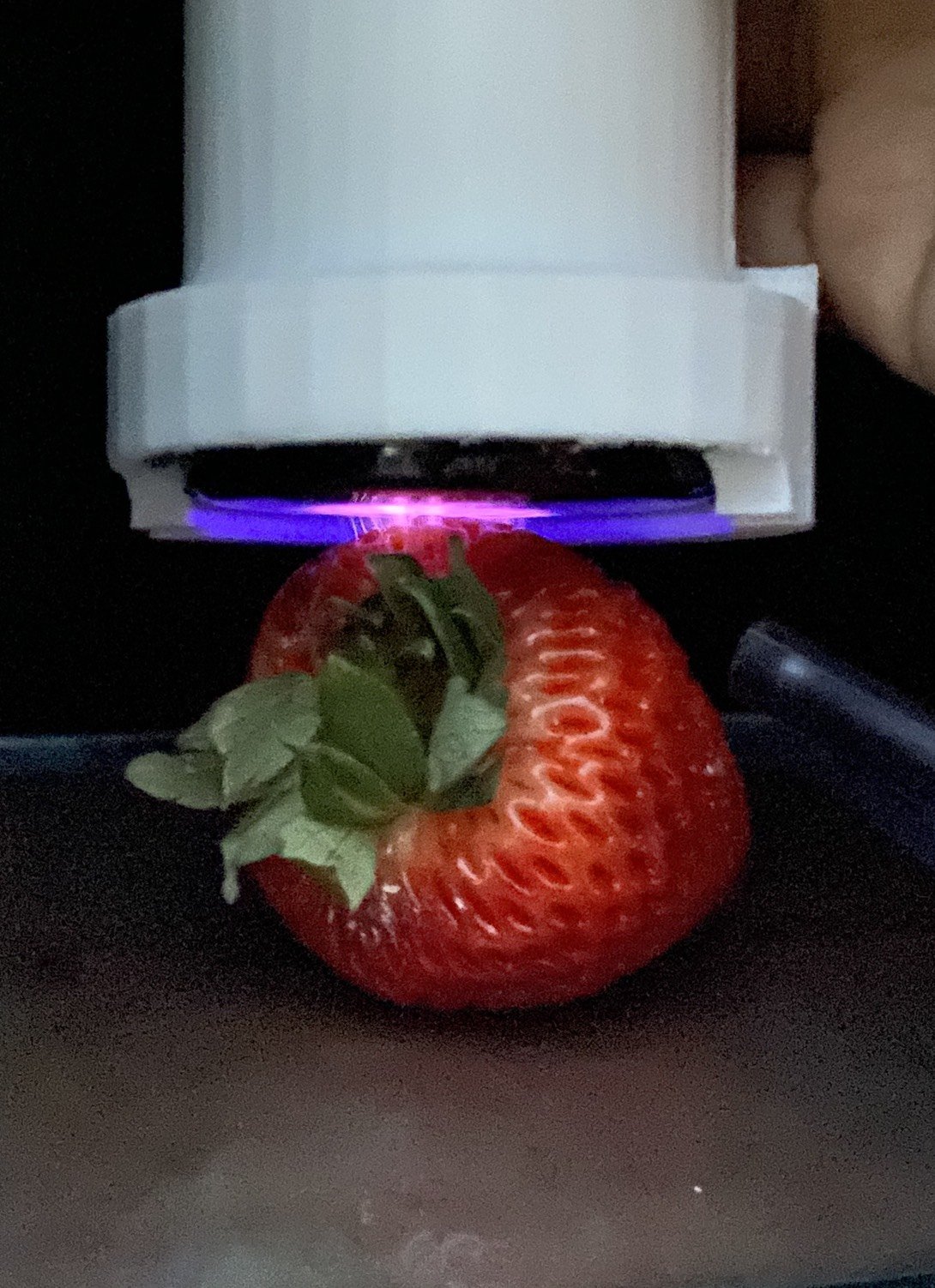
A handheld plasma head conditioning the skin of a strawberry
How far the research goes
The literature on cold plasma in the food industry has been accumulating for over a decade and covers leafy vegetables, fruit and high-risk products.
| Study | Journal | What it reports |
|---|---|---|
| Ziuzina et al. (2013) | Journal of Applied Microbiology | Reduction of Escherichia coli populations using atmospheric cold plasma inside sealed packaging. |
| Baier et al. (2014) | Food Control | Direct non-thermal plasma treatment of leafy vegetables, assessing physical and physiological effects alongside microbial reduction. |
| Lacombe et al. (2015) | Journal of Food Protection | Reduction of aerobic microorganisms on blueberries, with assessment of the effect on quality attributes. |
| Bourke et al. (2017) | Journal of Applied Microbiology | A mechanistic review of how cold plasma acts on microorganisms under a range of processing conditions. |
| Misra, Schlüter and Cullen (eds., 2016) | Academic Press | The standard academic text used as the engineering framework for designing parameters and equipment. |
What these studies have in common is that they report a level of microbial reduction under clearly stated conditions. They do not declare a figure that applies to all produce. Reading this literature means reading the conditions alongside the result, every time.
What you trade against what, compared with the conventional methods
| Method | Adds chemicals | Uses heat | What has to be managed |
|---|---|---|---|
| Chlorine wash | Yes | No | Residues, wastewater, and organic certification limits. |
| Blanching or heat | No | Yes | Texture, colour and nutritional value of fresh produce. |
| UV | No | No | Only reaches surfaces the light touches. Shadowed areas are not treated. |
| Cold plasma | No | No | Conditions have to be found for each kind of produce, and the insertion point in the line has to be designed. |
For an exporter, the documentation advantage weighs as much as the technical one. With no new residue created, there is no maximum residue level to manage for each destination market, and no disinfection by-product in the wastewater to deal with.
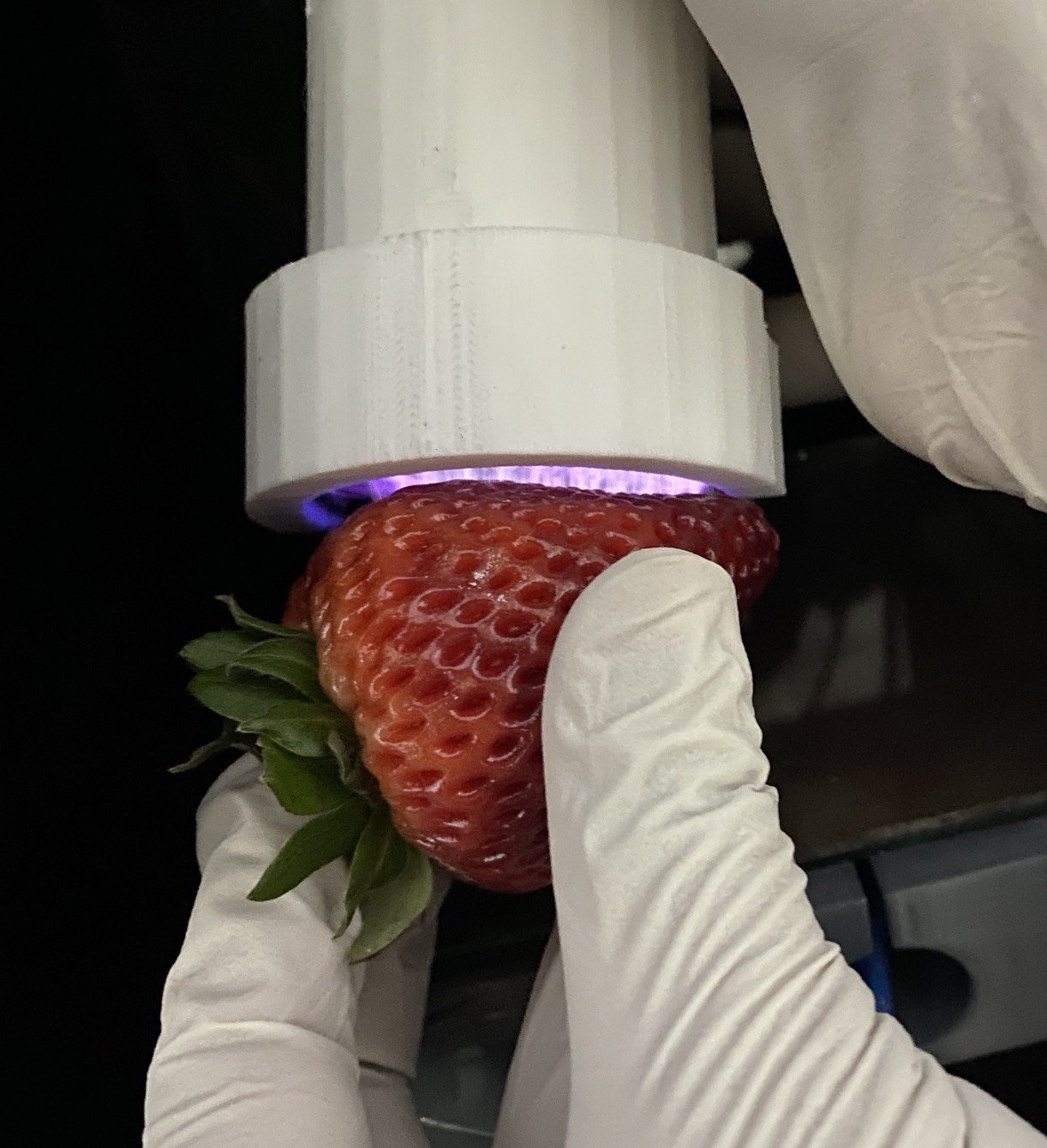
Close up as plasma meets the surface of fresh fruit
Why the effect is not the same at every point on the surface
Fresh produce does not have a flat surface. It has convex areas, concave areas, stems, grooves and leaf axils. Work by Assoc. Prof. Dr. Siwapon Srisonphan published in Plasma Chemistry and Plasma Processing in 2020 addresses this directly: the electric field intensifies by itself on convex curvature, while a shadow forms in concave regions that the plasma reaches less.
In practice that means the microbial reduction measured on the same sample can differ several-fold depending on whether the swab was taken from a convex or a concave area. This is why the sampling plan matters as much as the treatment conditions, and why a figure from one kind of produce cannot be carried across to another with a different shape.
Who should be interested
Those for whom the cost of the problem exceeds the cost of fixing it
- Packhouses and fresh-cut processors supplying modern retail.
- Exporters of fresh produce into markets with strict residue testing.
- Ready-to-eat producers selling through convenience stores and supermarkets.
- Producers of bean sprouts, microgreens and other products classed as high risk.
- Operators in organic fruit and vegetable export chains.
- Fresh-cut fruit processors supplying hotels, restaurants and catering.
How to start
The first step is measuring the baseline on real produce: starting microbial count, surface moisture and sensory quality before treatment. Those values are the base everything afterwards is compared against.
The second step is a preliminary efficacy test at small batch scale using produce from a real lot. What comes out of it is not a guaranteed level of reduction or a number of days added. It is the information needed to decide whether to continue.
The third step is designing the process and the equipment around the real throughput and the layout of the line, with operating procedures and team training.
Verification is carried out by VISBIO, an affiliated company acting as the independent tester, covering the target reduction level, sensory assessment, shelf life study and nutritional quality assessment. Separating the technology provider from the verifier means the documentation can be used with buyers and with regulators.
Within a food safety system, the plasma step can be defined as a critical control point in HACCP and designed to fit the user plant’s own good manufacturing practice.

Plasma passing through a mesh packaging material
In summary: five points before deciding
Five things to remember before deciding
- The problem with chlorine washing is not its effectiveness. It is what follows the wash.
- Cold plasma reduces microorganisms on the produce surface without adding a residue, and can be inserted into an existing conveyor line.
- Produce surfaces are not flat. They have convex and concave areas, stems and grooves, so the effect is not uniform. The 2020 paper by Assoc. Prof. Dr. Siwapon addresses this directly.
- There is no general figure for days of shelf life added. It depends on the produce, the conditions used, and the cold chain end to end.
- Start by measuring the baseline on real produce: microbial count, surface moisture and sensory quality.
Frequently asked questions
How many days of shelf life does it add?
There is no general figure. It depends on the produce, the starting microbial load, the conditions used, and above all on temperature control through the chain after treatment. Good treatment followed by transport at an unstable temperature will not deliver what the test showed.
Does cold plasma bruise produce or change its flavour?
Because the process uses no heat, it does not cause the kind of damage blanching does. But too much energy or too long an exposure can affect colour, aroma and texture. Sensory assessment therefore always has to run alongside the microbial measurement, rather than looking at counts alone.
Does it replace washing, or do we still wash?
In many cases washing is still needed to remove soil and debris. Cold plasma reduces microorganisms; it is not physical cleaning. Designs usually place plasma after the wash and drain steps rather than removing the wash.
Can it be used on organic produce?
Cold plasma is a physical treatment that adds nothing to the product, so it fits most organic frameworks. Final confirmation rests with the body holding each producer’s certificate, and should be discussed before it goes into a real line.
What is the difference between cold plasma food processing and plasma sterilization?
In English-language literature, cold plasma food processing is the broad term covering all use of plasma in food processes, while plasma sterilization refers specifically to microbial reduction. In a food plant, what is achievable is reducing the microbial count to a defined level, not achieving the complete sterility of a medical device.
Talk through your problem with the TIBD team
If your packhouse or fresh-cut line is looking to reduce its dependence on chlorine, start by talking through where the real bottleneck in the line actually is.
TIBD works alongside researchers and technology owners so that research carries on from the laboratory through to a real production line. The first thing we do is assess together whether your problem genuinely suits this technology. If it does not, we will say so at the start.
Message us on LINE @tibdglobal or use the contact form at tibdglobal.com/contact and tell us about the problem in your process.

Read next
- Process water Cold plasma sterilization without adding anything to the water
- Reducing mycotoxins in agricultural raw materials Where the research stands before you decide
- Cold plasma and vegetable seed Reducing seed-borne microorganisms without a chemical coating
← Back to Cold Plasma · Cold plasma services · Talk to the team
Sources
Srisonphan, Ruangwong and Thammaniphit (2020) Plasma Chemistry and Plasma Processing 40, 1253–1265 · Ziuzina et al. (2013) Journal of Applied Microbiology DOI: 10.1111/jam.12087 · Baier et al. (2014) Food Control · Lacombe et al. (2015) Journal of Food Protection · Bourke, Ziuzina, Han, Cullen and Gilmore (2017) Journal of Applied Microbiology · Misra, Schlüter and Cullen (eds., 2016) Cold Plasma in Food and Agriculture: Fundamentals and Applications, Academic Press · Standards framework: Codex Alimentarius CAC/RCP 53-2003, EU Regulation 1333/2008, EU Organic Regulation 2018/848, USDA NOP 7 CFR 205.601, US FDA 21 CFR Part 173 · Post-harvest loss data from the Food and Agriculture Organization of the United Nations · Cold plasma research in Thailand by Assoc. Prof. Dr. Siwapon Srisonphan Kasetsart University
About TIBD
TIBD Company Limited works alongside researchers and technology owners so that research carries on from the laboratory into real industrial use, from feasibility assessment and test design to prototyping and scale-up of production, with VISBIO, an affiliated company, acting as the independent verifier. The office is at the Kasetsart Agricultural and Agro-Industrial Product Improvement Institute, Kasetsart University, Bangkhen.