Thai Rice Reimagined: Rethinking How Thai Rice Is Grown and Used, from the Whole Grain to the Whole Plant
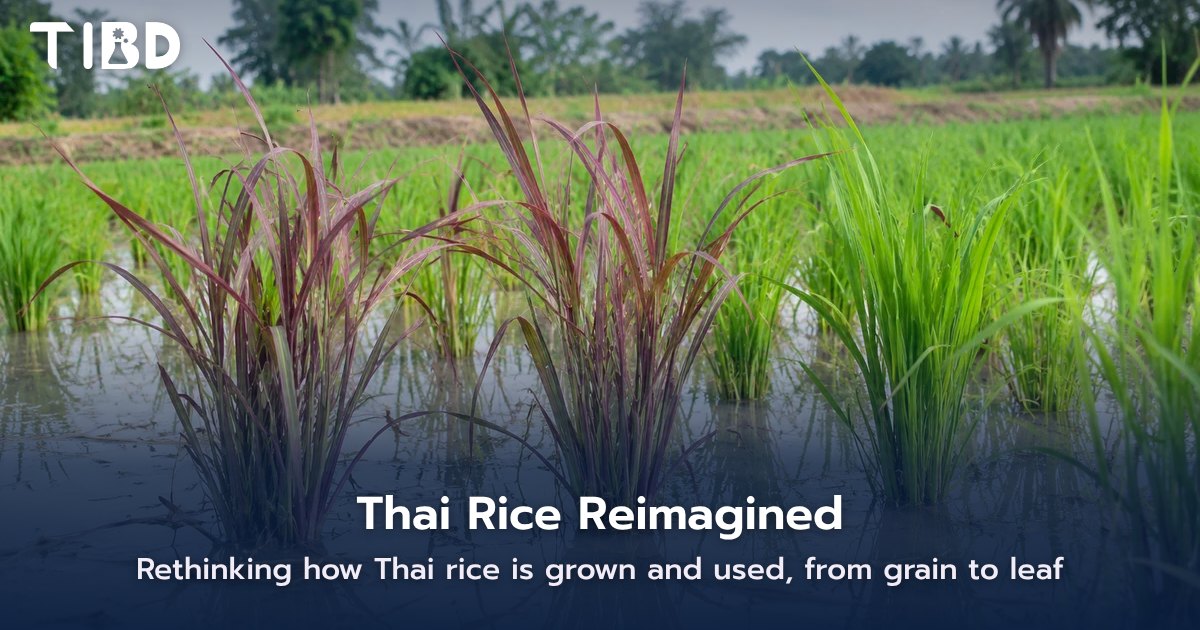
Rice is more than a cash crop in Thailand. It is tied to daily life, food and the income of millions of farming households. Today, though, Thai rice faces several challenges at once: competitors in the world market that improve varieties and costs quickly, an ageing farming population, rising water and fertiliser costs, and a climate that is harder to predict. The question is no longer only how to grow more rice, but how to reimagine the way Thai rice is grown and used (Thai Rice Reimagined) so that rice keeps earning a living and can coexist with the environment in the long term.
“Thai Rice Reimagined” is the title of the talk Prof. Dr. Apichart Vanavichit, Advisor to the Director of the Rice Science Center, Kasetsart University, gave at the international conference ICRF 2026 in November 2026. The talk set out the challenges facing Thai rice, two decades of breeding work, and the idea of moving “from whole grain to whole leaf”, which holds that the value of the rice plant does not lie in the grain alone.
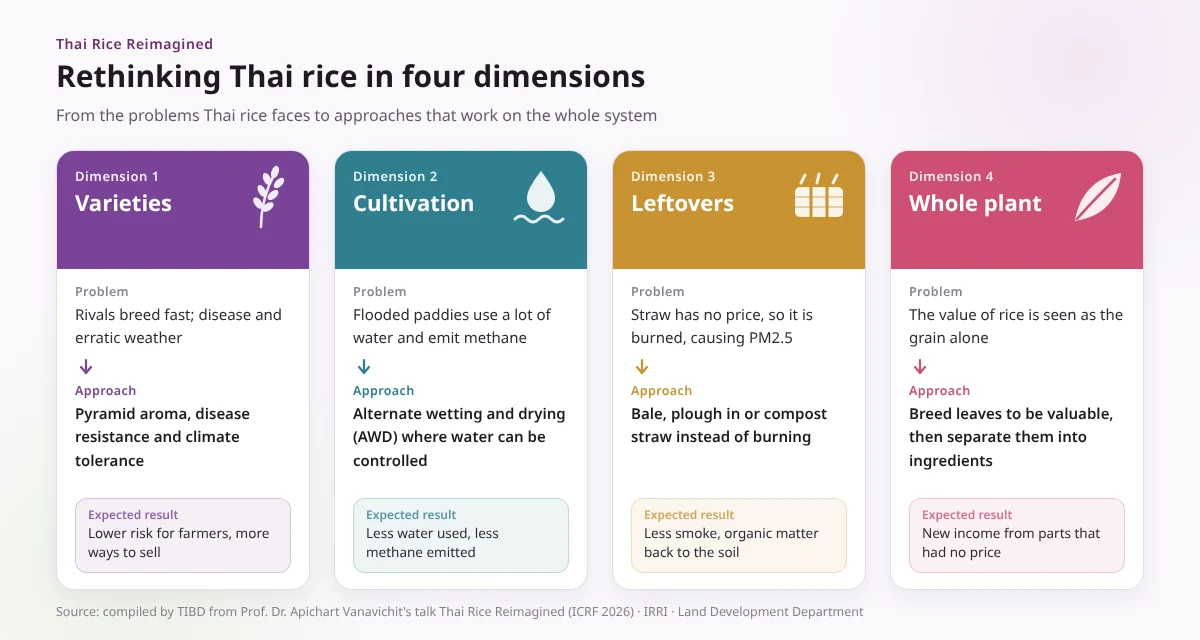
This article summarises the big picture of rethinking Thai rice in four dimensions: varieties, cultivation, managing field leftovers, and using every part of the rice plant. Each section links to an article that goes deeper.
What Thai rice is up against
Thai rice faces at least four connected challenges today.
- Competition in the world market. Other exporting countries are developing high-yielding varieties with cooking quality close to Thai rice more quickly. Thai rice sold only on volume and price finds it harder to compete.
- Ageing farmers and small holdings. Thailand’s 2023 Agricultural Census by the National Statistical Office counted about 8.7 million agricultural holders, with an average holding of about 16.4 rai (roughly 2.6 hectares; 1 rai = 1,600 m²). Small plots make it hard for each farmer to invest in machinery and new technology.
- Water and climate. Rice uses a lot of water, and continuously flooded paddies are a source of methane, an important greenhouse gas. Drought, floods and extreme heat also hit yields directly.
- Field leftovers. Straw, stubble and rice leaves mostly have no price, so burning is still the cheapest and fastest option for many farmers, even though it causes PM2.5 pollution.
These four challenges are linked, so solving one without looking at the others rarely lasts. Rethinking Thai rice means looking at the whole system, from the seed to what is left after harvest.
Dimension 1: Varieties designed to meet several needs at once
Modern rice breeding no longer aims at yield per rai alone. It uses trait pyramiding, combining several desired traits in one variety, such as aroma, resistance to diseases and insects, flood tolerance and nutritional quality, with molecular markers used to select plants carrying the right genes more quickly.
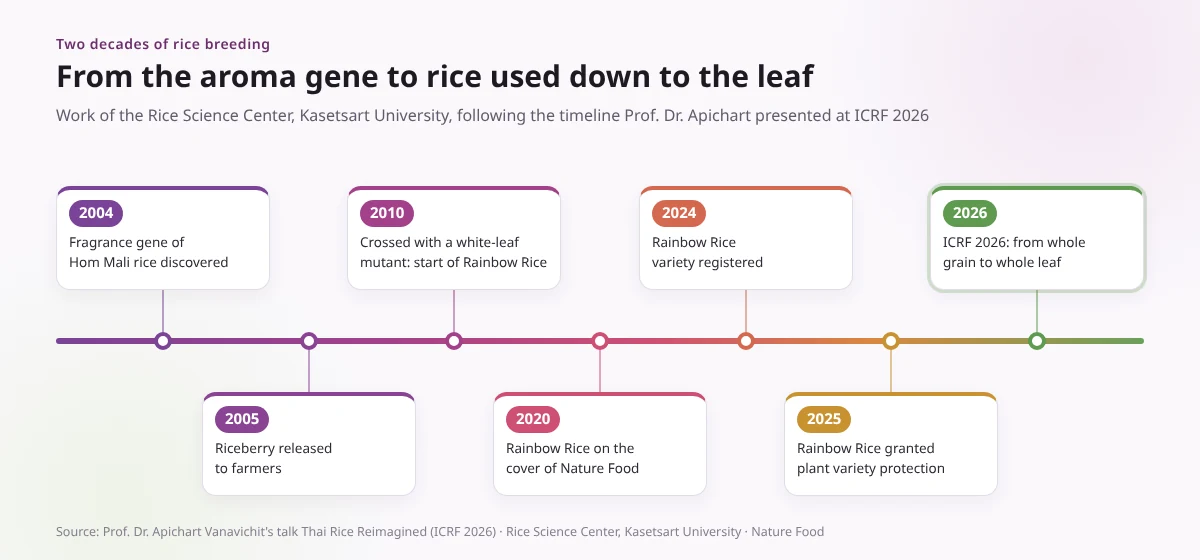
The Rice Science Center at Kasetsart University is an example of this work in Thailand. The timeline Prof. Dr. Apichart presented at ICRF 2026 lists key milestones, for example:
- 2004: the team discovered the fragrance gene of jasmine rice, the basis for selecting fragrant rice with molecular markers.
- 2005: Riceberry, a deep-purple rice from a cross between Jao Hom Nin and Khao Dawk Mali 105, was released to farmers.
- In the years that followed: pyramiding resistance to blast, bacterial leaf blight and brown planthopper with flood tolerance, and work on rice with lower stomatal density to reduce water loss.
Another important source of genetic variation is the mutant library of Jao Hom Nin, which the team built by inducing mutations and then selecting plants with new traits such as white-striped leaves, short stature or drought tolerance. All of this is crossing and selection, not genetic modification (Non-GMO).
Dimension 2: Growing rice with less water and fewer emissions
Paddies flooded all season leave the soil short of oxygen, so soil microbes produce methane. In Thailand, rice cultivation is the largest source of greenhouse gases in agriculture; documents from the Thai Rice NAMA project put it at more than half of agricultural emissions.
The most studied method is Alternate Wetting and Drying (AWD): letting the water level in the field drop until the soil surface begins to dry, then re-flooding, instead of keeping the field flooded all the time.
- Water: IRRI and CGIAR materials state that AWD can cut field-level water use by up to about 30%.
- Methane: the IPCC (2006) methodology assumes AWD reduces methane emissions by about 48% on average compared with continuous flooding; results in real fields vary with location and season.
- Limits: AWD works well where water can be controlled, such as irrigated paddies; rain-fed paddies in the wet season often cannot be drained.
Breeding and cultivation have to move together. At ICRF 2026, Prof. Dr. Apichart presented field trials growing several lines under both continuous flooding and AWD, to see which lines yield well and emit less under each water regime, an example of designing “varieties that fit the way they are grown”.
Dimension 3: Stop burning, and give field leftovers a price
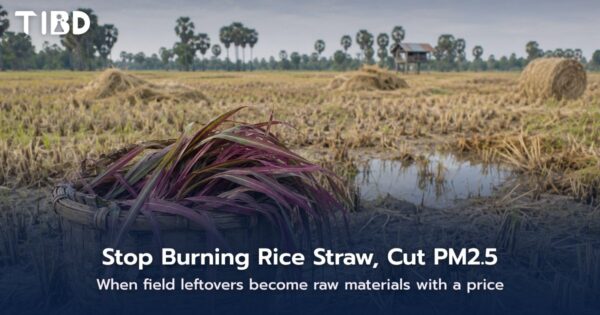
After harvest, much straw and stubble is still burned in the open to prepare the field for the next crop, because it is fast and almost free. But burning is a major source of PM2.5 in the dry season and strips organic matter from the soil.
There are several practical alternatives to burning in Thailand, and they can be combined.
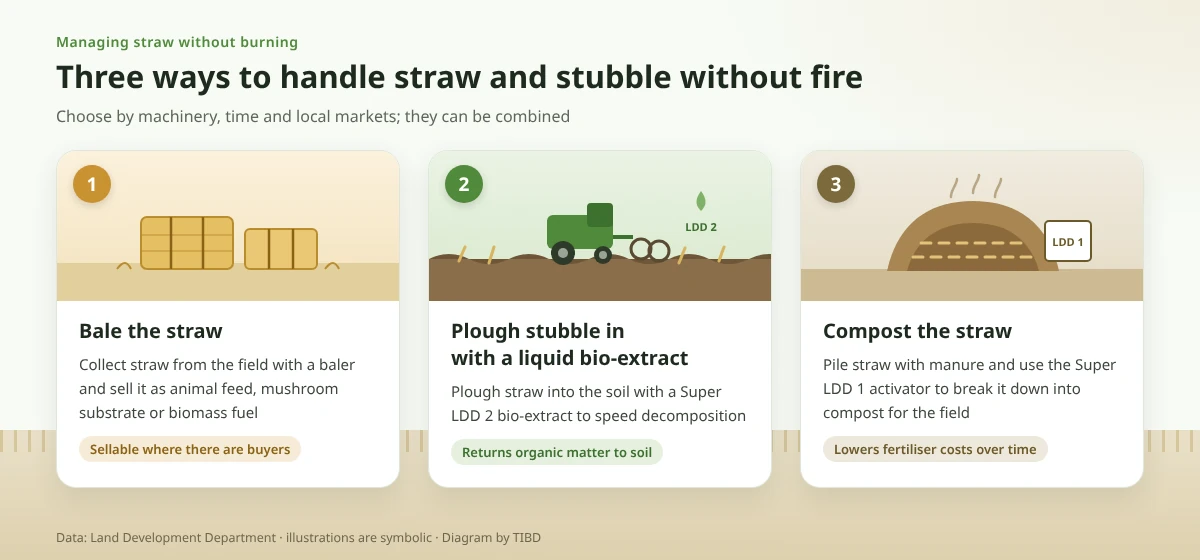
- Baling straw to sell as animal feed, mushroom substrate or biomass fuel
- Ploughing in stubble with bio-extract to return organic matter to the soil
- Composting straw to cut fertiliser costs over time
These options help, but straw still sells at a low price, so the incentive to stop burning is not yet strong enough in many areas. Lessons from other crops such as sugarcane show that when buyers pay differently for burned and unburned material, farmers’ behaviour really does change.
Read more about the size of the problem, government measures, lessons from India and all the options in Stop Burning Rice Straw, Cut PM2.5: When Field Leftovers Become Raw Materials with a Price.
Dimension 4: From whole grain to whole leaf
The idea of moving “from whole grain to whole leaf” that Prof. Dr. Apichart presented at ICRF 2026 goes further than finding a market for leftovers. It builds on grain work such as Riceberry and goes on to design varieties whose leaves are valuable from the start. The leaves are harvested while still green, before flowering, and can be cut several times. In the question session, he said that cutting the leaves lowers grain yield so much that harvesting the grain as well is not worthwhile, so in this approach Rainbow Rice is grown for its leaves.
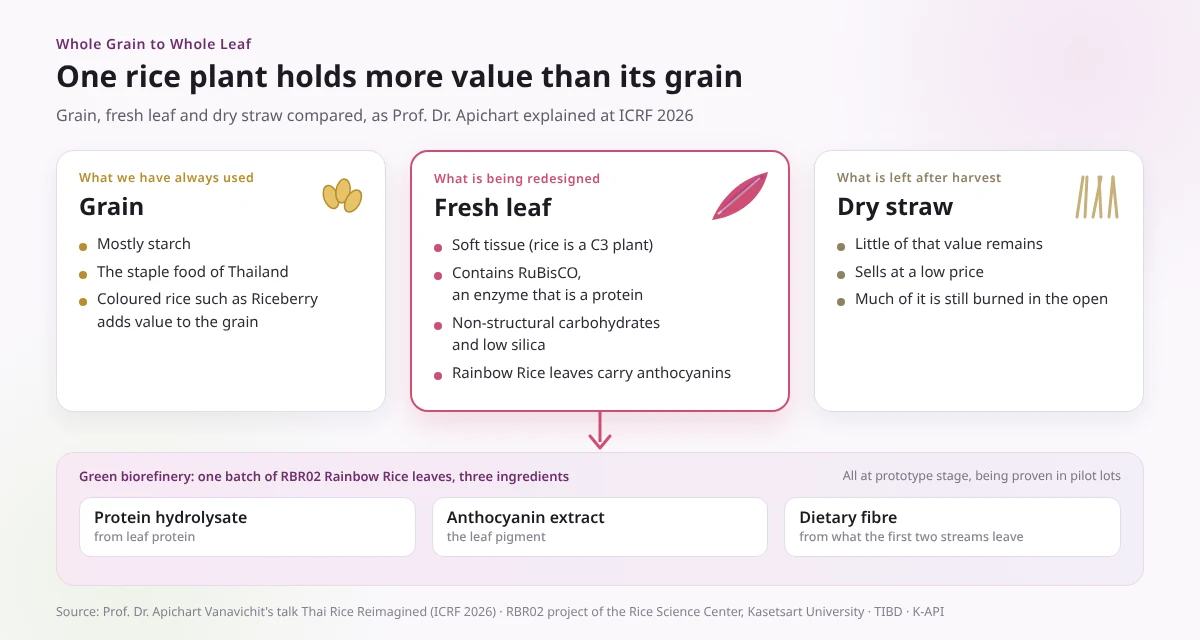
In the talk, Prof. Dr. Apichart explained that green rice leaves (rice is a C3 plant) are soft, rich in the enzyme RuBisCO, which is a protein, contain non-structural carbohydrates, and are low in silica, unlike dry straw after harvest, in which these substances are largely gone. Fresh leaves therefore have more potential as a raw material than straw.
Rainbow Rice: rice with coloured leaves
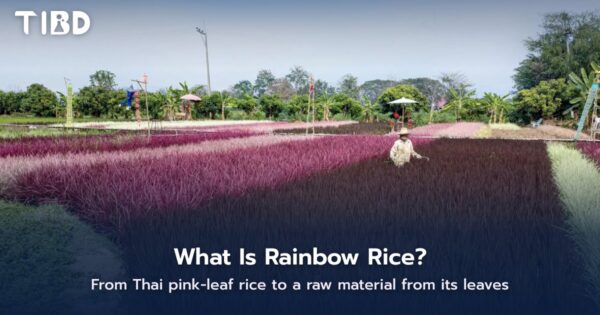
The clearest example is Rainbow Rice, a pink-to-purple-leaf rice the Rice Science Center developed by crossing a white-leaf mutant of Jao Hom Nin with a purple-leaf rice, then selecting further to obtain several lines. The leaf colour comes from anthocyanins. An image of Rainbow Rice appeared on the cover of Nature Food in 2020, and, as Prof. Dr. Apichart presented at ICRF 2026, Rainbow Rice was registered as a variety in 2024 and granted plant variety protection in 2025.
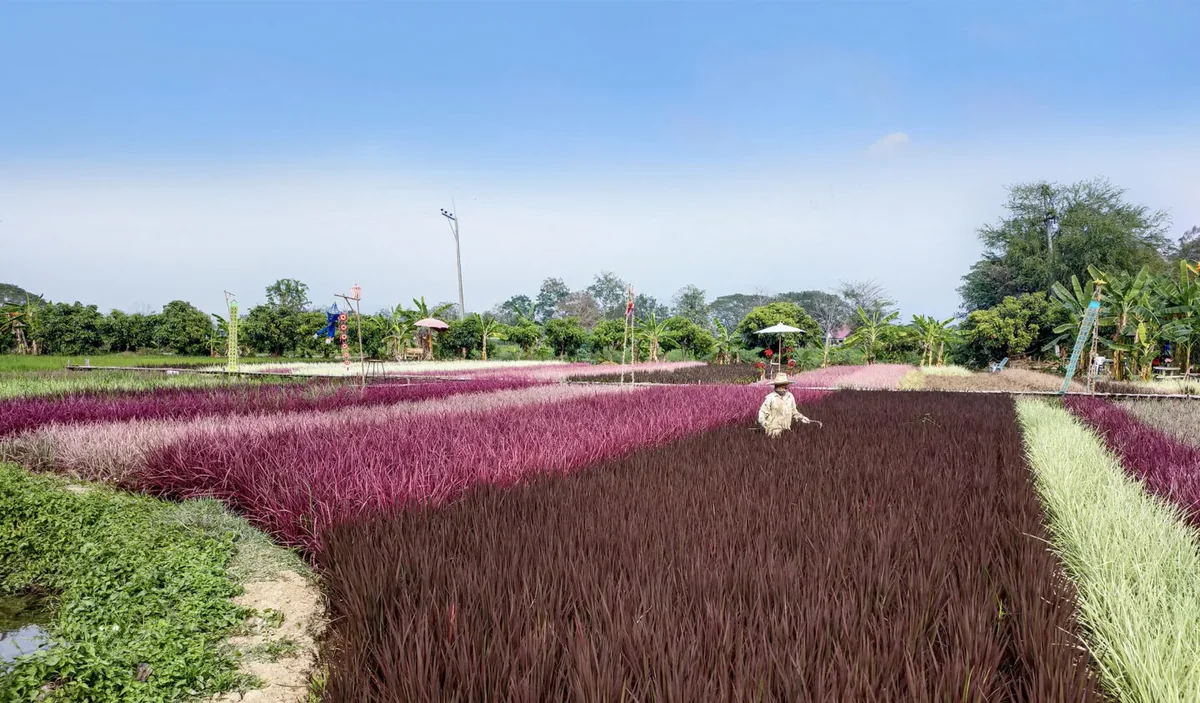
Rainbow Rice can therefore be used in two ways: the beauty of its fields draws agro-tourism, and its coloured leaves can be developed into raw materials. Read about its origin, lines and history in What Is Rainbow Rice?
One batch of leaves, three ingredients
Because rice leaves contain colour, protein and fibre, a green biorefinery can split one batch of leaves into several ingredients. In the RBR02 Rainbow Rice leaf project, in which the Rice Science Center, as developer of the variety, works with TIBD and K-API Co., Ltd., the leaves go into two tracks:
- Protein hydrolysate from the protein in the leaf
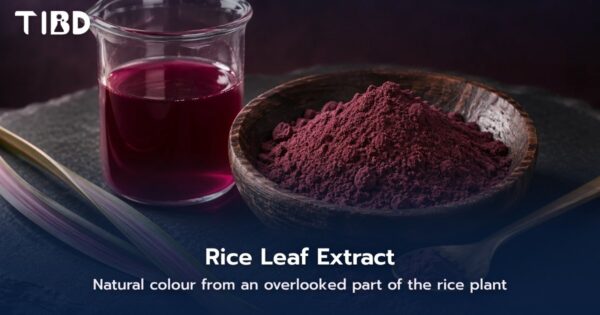
- Rice leaf extract, an anthocyanin colour for cosmetics and food development
- Dietary fibre from the residue of both tracks
In the question session after his talk, Prof. Dr. Apichart said Rainbow Rice leaves can be used as animal feed but are too costly for it, so the direction is to extract them into ingredients for products people use, such as food and cosmetics. All of these are still at prototype stage and are being proven in pilot lots; use in food is under regulatory-pathway assessment. Read about the project, the three ingredients and the proof path at Rainbow Rice RBR02.
The big picture: rice that creates value from the whole plant
Putting the four dimensions together shows a new, connected picture of Thai rice.
| Dimension | Approach | Expected result |
|---|---|---|
| Varieties | Pyramiding aroma, disease resistance, climate tolerance and leaf value | Lower risk for farmers and more ways to sell |
| Cultivation | Alternate wetting and drying where water can be controlled | Less water used, less methane emitted |
| Leftovers | No burning: baling, ploughing in, composting | Less PM2.5, organic matter returned to the soil |
| Every part of the plant | Valuable leaves as an industrial raw material | New income from parts that used to have no price |
This fits the theme of ICRF 2026, “One Health Rice”, which sees rice as linked to food, climate and farmers’ wellbeing at the same time. Every dimension, however, still needs to be proven in real fields: yield, cost and a market that buys.
TIBD’s role in connecting rice research with industry
TIBD connects university research with the needs of manufacturers in the food and cosmetics industries. For rice, TIBD’s role covers:
- Working with the Rice Science Center on the RBR02 Rainbow Rice leaf biorefinery project, in which the Center is the developer of the variety and the know-how, and TIBD takes the ingredients to buyers
- Listening to manufacturers’ briefs on which ingredients they need and in what kind of formula
- Planning ingredient tests in formulas, from initial colour to stability
- Helping build a traceable supply chain from organic fields to the plant
- Connecting related services, such as active ingredient innovation
TIBD also supported ICRF 2026 and ran a booth there to exchange views with rice researchers and entrepreneurs from several countries.
A new Thai rice begins with seeing the whole plant
Reimagining Thai rice does not mean throwing away what Thai rice already does well. It means building on decades of breeding know-how and moving towards cultivation that uses fewer resources, managing leftovers without burning, and looking for value in every part of the rice plant. When rice leaves and straw have buyers, stopping burning is no longer a burden on farmers alone; it becomes an opportunity for the whole chain.
Interested in testing rice-leaf ingredients or developing products from Thai rice? Contact the TIBD team
References
- Vanavichit, A. (23 November 2026). Thai Rice Reimagined. Talk at the 4th International Conference on Rice for the Future (ICRF 2026), Bangkok.
- 4th International Conference on Rice for the Future (ICRF 2026). https://hubs.nrct.go.th/?p=7837
- National Statistical Office of Thailand. 2023 Agricultural Census, Whole Kingdom (in Thai). https://www.nso.go.th/public/e-book/Census_Survey/Agricultural-Census-2566/154-155/
- CGIAR Research Program on Climate Change, Agriculture and Food Security. Putting Alternate Wetting and Drying (AWD) on the map, globally and nationally. https://www.gov.uk/dfid-research-outputs/putting-alternate-wetting-and-drying-awd-on-the-map-globally-and-nationally
- World Resources Institute. Wetting and Drying: Reducing Greenhouse Gas Emissions and Saving Water from Rice Production. https://www.wri.org/research/wetting-and-drying-reducing-greenhouse-gas-emissions-and-saving-water-rice-production
- Climate & Clean Air Coalition. Promoting low emissions rice production in Thailand (Thai Rice NAMA). https://www.ccacoalition.org/en/activity/promoting-low-emissions-rice-production-thailand
- CGIAR. Lessons learned from four low-emission technologies implemented by Thai Rice NAMA Project. https://www.cgiar.org/news-events/news/lessons-learned-from-four-low-emission-technologies-implemented-by-thai-rice-nama-project
- Rice Science Center, Kasetsart University. Rainbow Rice. https://dna.kps.ku.ac.th/research/breeding/rainbow-rice
- Nature Food, Volume 1 Issue 5, May 2020 (cover). https://www.nature.com/natfood/volumes/1/issues/5