

Cold Plasma / UC02
Use case UC02 · Seed hydration
Know when your seeds are ready, without guessing from soaking time
The same soaking time does not make every lot equally ready. The team's research shows that cold plasma surface treatment can change how seeds take up water. The next step is to set a measurable water uptake target and test it with your own lot.
Research by Assoc. Prof. Dr. Siwapon Srisonphan and the Plasma Innovations team, Department of Electrical Engineering, Kasetsart University
≈3,270 → ≈450 sTime for a water droplet to absorb into the upper surface of sunflower seeds, untreated vs a strongly responding group
≈10% → ≈12.7%Mass gain from water uptake in rice seeds at 5 h, untreated vs a strongly responding group
3 measuresContact angle, droplet absorption time and bulk water uptake answer different questions
Figures in this article are laboratory results under the conditions of the cited studies. Results with your own lot or growing system need to be tested.
The same soaking time does not mean the same readiness.
The real question is “Is this lot ready for the next step?”
When several seed lots need to be ready for scheduled sowing, surface measurements alone are not enough. You need readiness that is predictable, verifiable and useful for decisions in your process.
- Water uptake varies between lots Extra time is allowed for the slowest lot.
- Readiness is uncertain Repeated sampling and operator judgment fill the gap.
- Sowing starts at different times Variation can carry through to the next step.
- The usual answer is “soak longer.” Yet time may not be the only cause.
Before extending the soak, understand how your seeds take up water and ask: “Have they reached the target?”
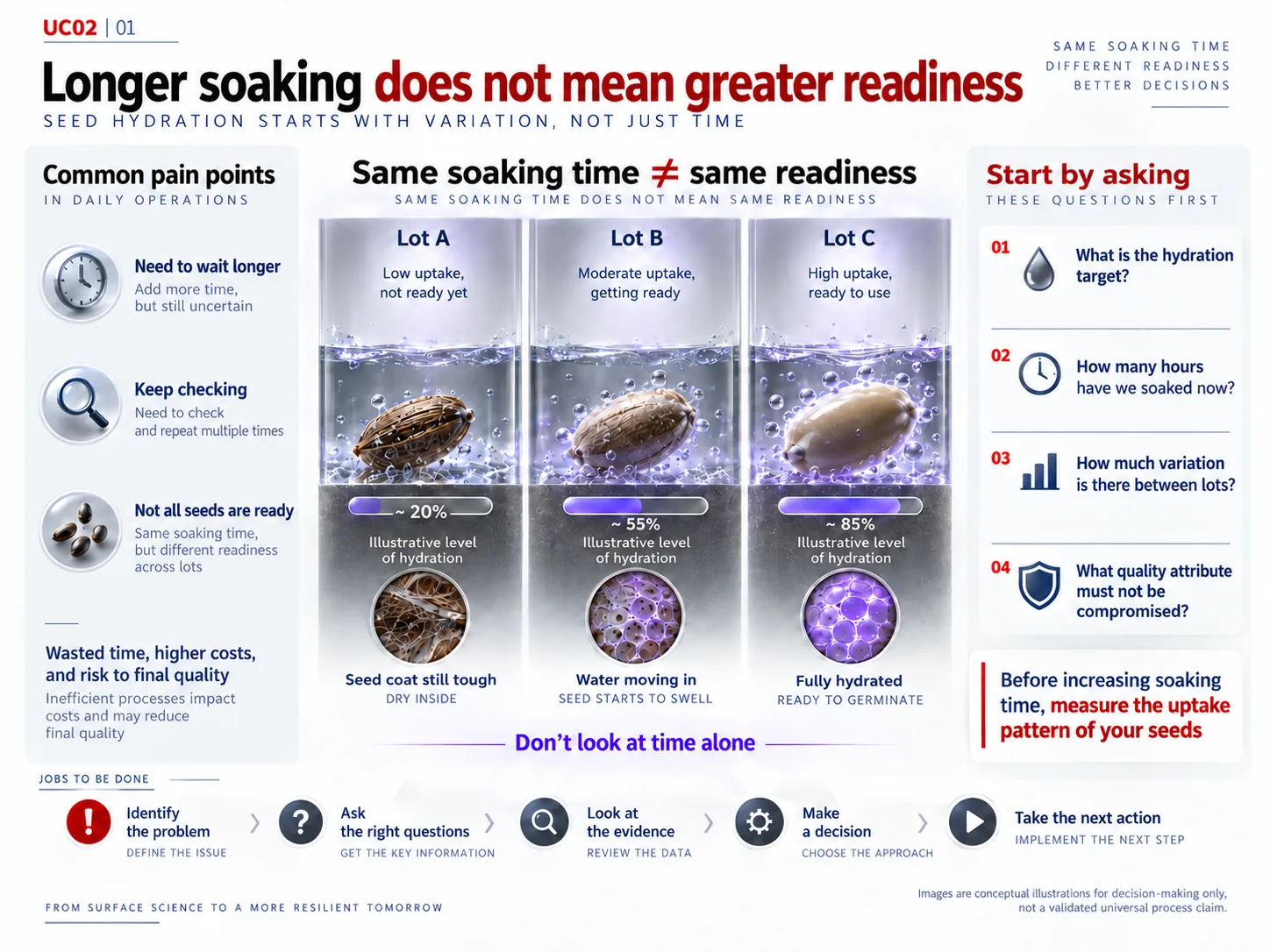
- Pain Identify the problem causing delays or uncertainty.
- Question Ask where the problem actually starts.
- Evidence Measure what will inform the decision.
- Decision Proceed / Refine / Stop against agreed criteria.
- Next action Choose a sample trial or the next step.
The UC02 principle: Understand your seeds’ water uptake before extending the soak.
What to establish before adding soaking time or changing the process
When seed preparation becomes unpredictable, the symptoms may be longer waits, repeated checks or lots reaching readiness at different times. The first question is: “Are the lots taking up water in the same way?”
Instead of using soaking time as the only criterion, define the required uptake level, time to reach it, consistency within the lot and quality to preserve. Then test whether surface treatment can help reach that target sooner or make it easier to control.
The intended value is more predictable seed preparation, from processing time to consistency within a lot. Better control of uptake could help teams schedule work and release lots to the next step with greater confidence.
Who uses the result, who decides and who helps validate it?
Seed producers need consistent lots. Seed preparation services need control of timing and scheduling. Microgreen growers need seeds ready for planned sowing. Identifying the main user helps the trial measure what actually affects the decision.
Projects can move faster when both the process owner and the person responsible for seed quality are involved. If equipment integration is needed, soaking tank, conveying and data system teams can help define practical conditions from the start.
Who Builds the Hydration Solution? Connect user needs with partner responsibilities.
- Seed processor Prepare lots to specification · Own seed quality
- Grower / nursery Start on schedule · Receive usable results
- Seed laboratory Test hydration and viability · Help define acceptance criteria
- System integrator Material handling and throughput · Connect the process with quality control
A useful starting point is to identify the problem lot, the bottleneck and the quality attributes to preserve. Agree on the baseline and decision criteria before choosing a method or system size.
Key messageMove from “Has the soaking time elapsed?” to “Have we reached the water uptake target?”
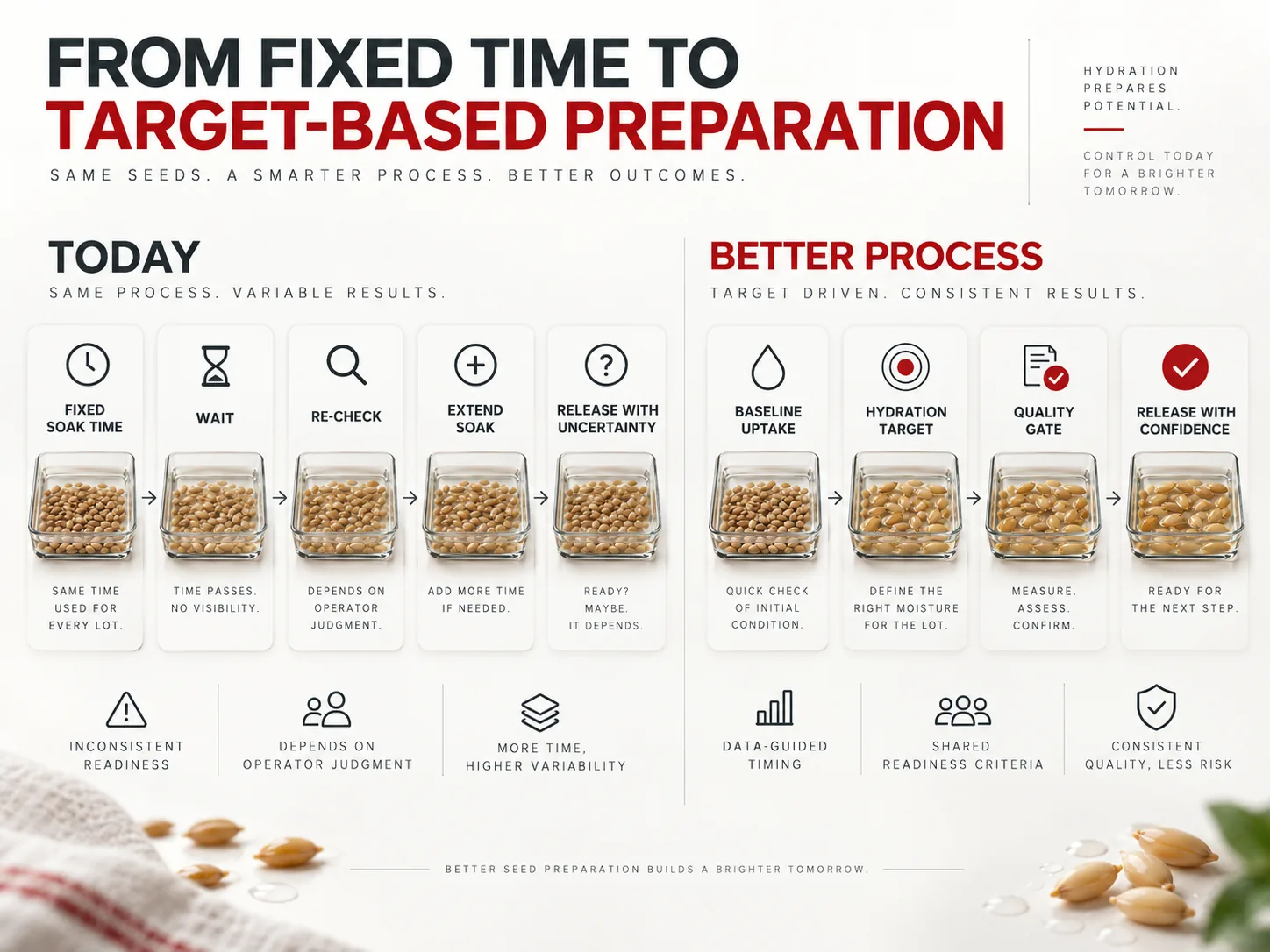
From fixed soaking time to measurable hydration targets
Ask “Is this lot ready?” rather than simply “Is the time up?”
A shared baseline, uptake target and quality criteria make lot decisions clearer and easier to compare.
With a clear uptake target, the team can identify which lots are ready, which need more time and which need further checks.
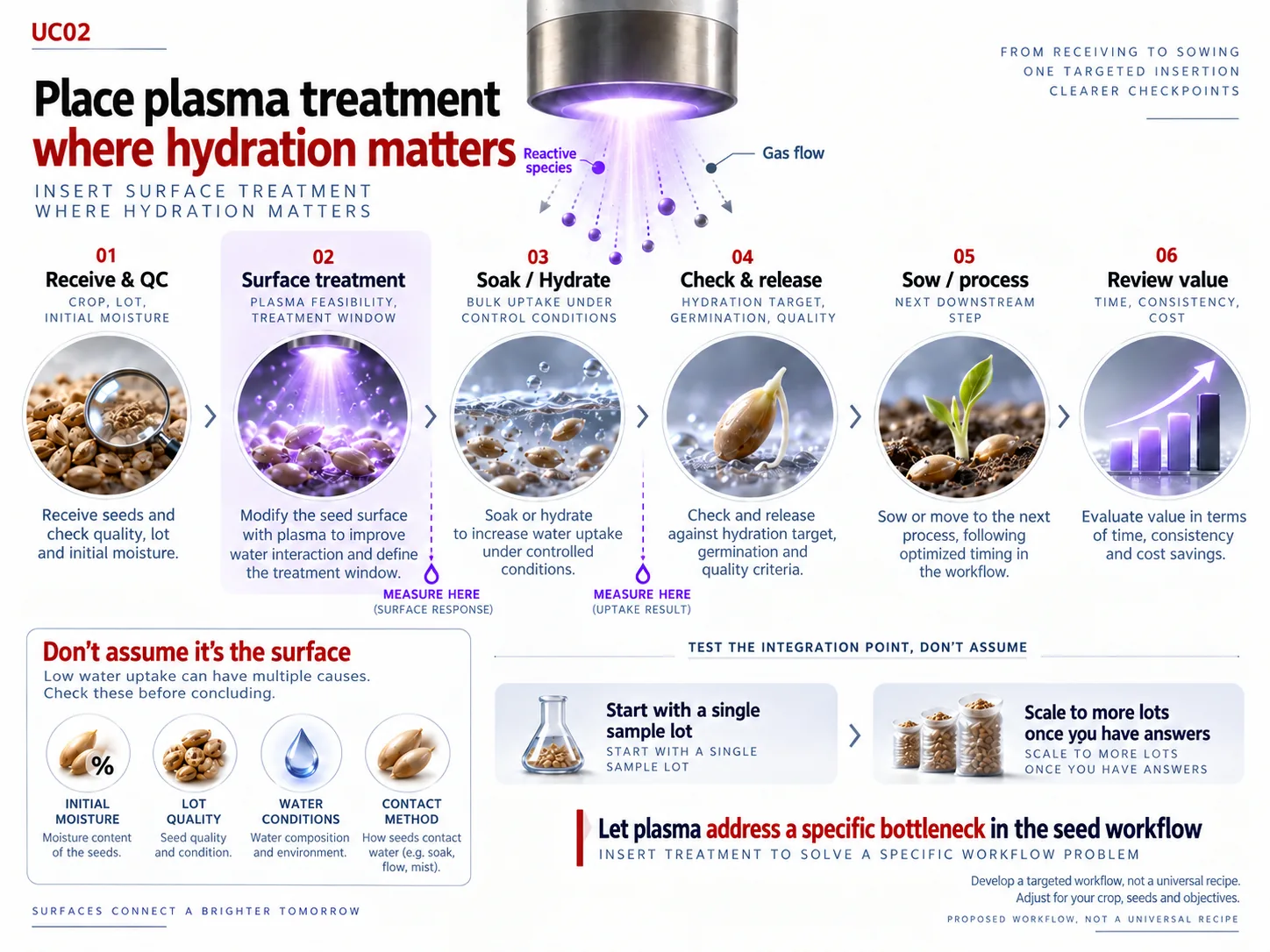
When seeds do not take up water within the required time, producers may need to wait, increase inspection or manage lots with different readiness. Before attributing this to the seed surface, check initial moisture, lot quality, water conditions and how seeds contact the water. Similar symptoms can have different causes.
The point to test is before the hydration step of interest: receiving QC → surface treatment → hydration → quality check → sowing or the next step. Checks after treatment and after hydration help distinguish surface changes from the benefit to the process.
Where Hydration Engineering Fits An intervention point to evaluate in the seed preparer’s workflow
- 01 Receive & QC Crop / lot / coating history · Baseline moisture
- 02 Surface treatment Plasma feasibility · Assess compatibility with seed quality
- 03 Soak / hydrate Compare with an appropriate control · Track overall water uptake
- 04 Check & release Water uptake target · Germination / quality
- 05 Sow / process Move to the next application step · Record the downstream response
- 06 Review value Time / Consistency / Cost · Proceed / Refine / Stop
You do not need to change every step of the existing system. A feasibility trial can begin with a sample from one lot and the current baseline, expanding to more lots once it is clear whether surface changes help the required outcome.
Key messageDefine the desired process first, then choose a treatment point that fits the existing workflow.
Address the hydration bottleneck within your existing workflow.
Start with your bottleneck, then establish whether plasma can help.
Many processes need a focused intervention: one that fits at a specific point, can be measured before and after, and can be stopped if it adds no practical value.
- 1 lot Start with a real problem lot; a large system can come later.
- Current baseline Establish the hydration curve produced by the current method.
- Surface + process Measure both the surface response and actual water uptake.
- Acceptance Involve the owner of quality and release criteria from the start.
Once the desired process is clear, connect surface modification → wetting → water entry with the outcome operators use to make decisions.
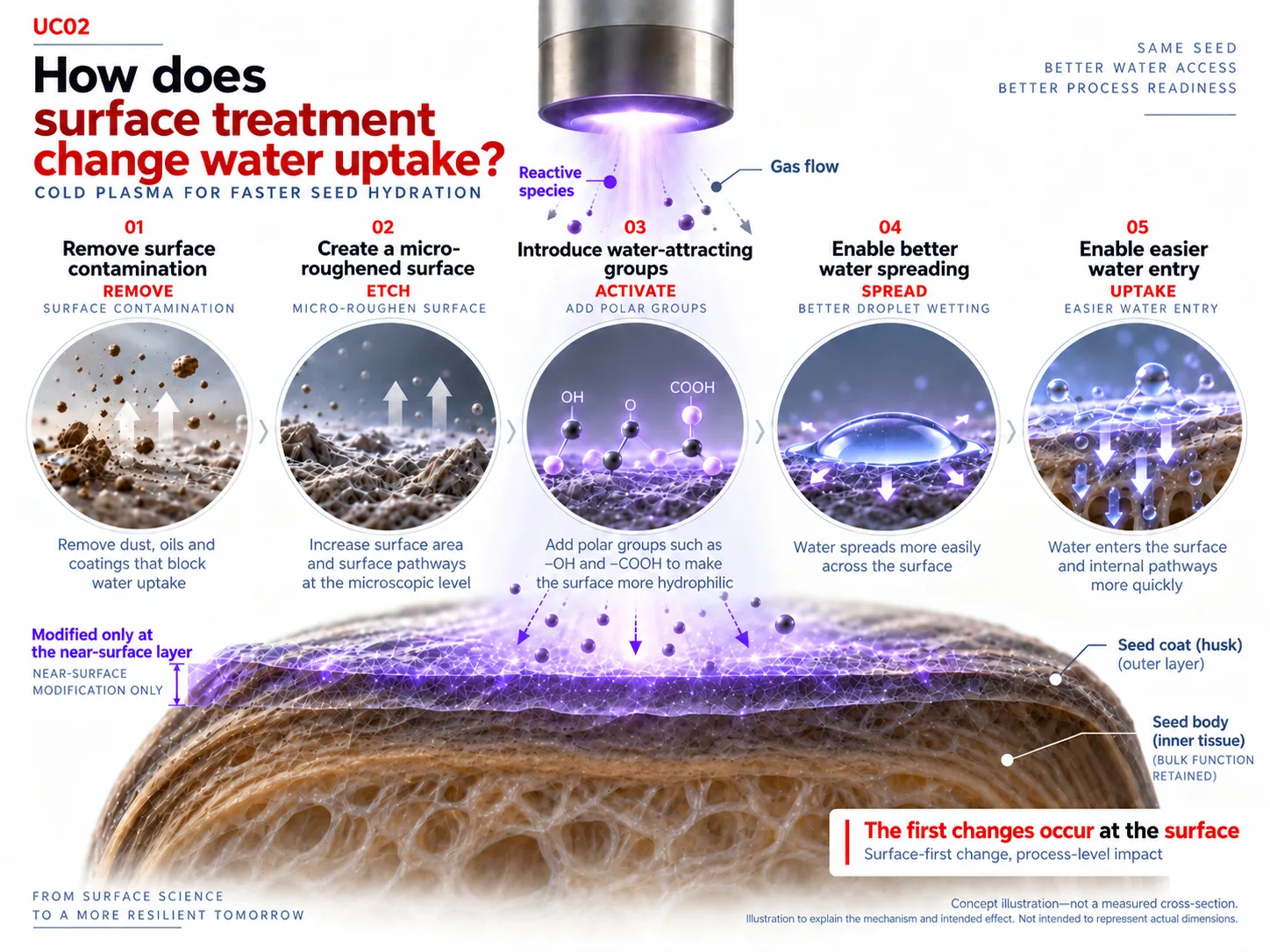
Nonthermal plasma can modify seed surfaces in the systems studied, affecting wettability and surface features associated with water contact. The atmospheric-pressure processes in these papers provide a basis for developing surface treatment before hydration, alongside options that adjust the soaking liquid.
This capability focuses on the surface, but other seed properties may also be affected. Trial design must therefore consider seed quality together with surface results, using measurements that explain how water uptake changes.
This page presents the technology’s role and evidence of the response. Operating settings, geometry and treatment sequence are developed for each project and validated for the intended use.
Key messageSurface modification is a tool for developing hydration control; each lot still needs its own evidence.
Which measurements help you make a real decision?
ACA, droplet WI and overall water uptake answer different questions. They are complementary measurements.
Surface measurements show whether the surface responds. Overall uptake and time to target are closer to the operator’s question: “Are the seeds ready to use?”
ACA and droplet WI help explain the surface response; overall uptake helps assess process value.
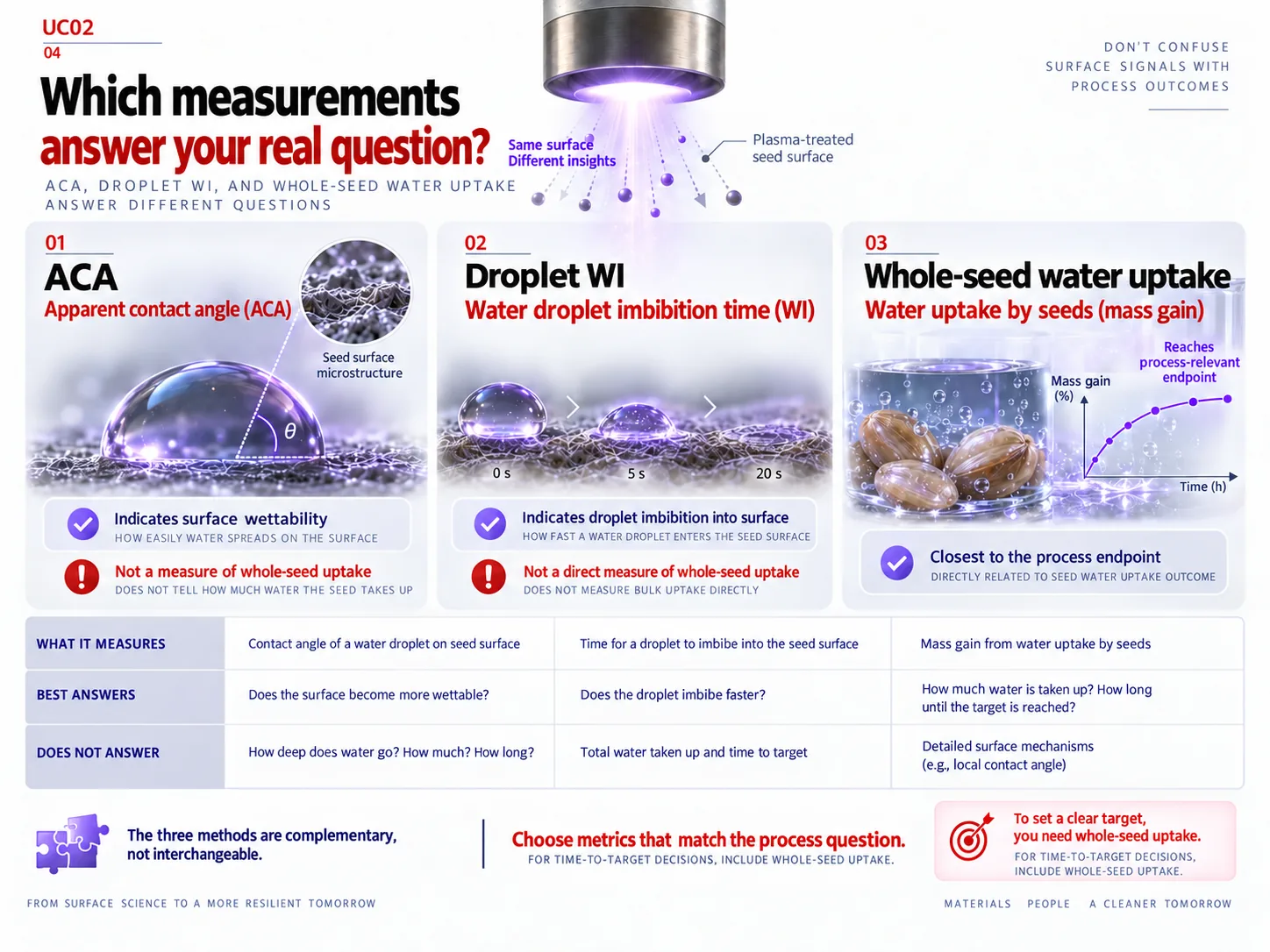
Distinguish surface wetting, droplet imbibition and water absorbed by the seed.
Apparent contact angle (ACA) describes a droplet’s behavior at the surface under the stated measurement method. Water droplet imbibition time (WI) measures how long a droplet of a specified size takes to be absorbed or disappear from that location. Overall seed water uptake uses mass or another measure of seed water during soaking as the outcome.
For UC02, overall uptake is the evidence closest to the process question, while ACA and droplet WI explain the surface response. Seeds that wet more easily may still differ in uptake with time and treatment level. The three measurements help explain the result together, but are not interchangeable.
ACA / Droplet WI / Bulk Uptake Three measurements, three different questions
- Apparent contact angle Droplet behavior at the surface · Surface wettability
- Droplet WI Time for a droplet of a specified size to be absorbed · Interaction between the droplet and the surface
- Bulk water uptake Water absorbed by seeds during soaking · Measured over time with a stated mass basis
Before a pilot, specify the basis of the target moisture content—for example, wet basis or dry basis—and when it will be measured. Mass gain relative to initial mass in Rongsangchaicharean et al. [2] is not automatically the final moisture content. Clear measurement terms keep research and production teams aligned.
Compare against the current method and the outcome the user needs.
Soaking and priming are part of many seed preparation processes, but suitability depends on the seed and purpose. Start with the user’s current method and add plasma as an isolated variable, instead of comparing groups that differ simultaneously in water, duration and initial quality.
The external microgreen study by Li and colleagues found that soaking did not consistently increase yield across experiments. This supports selecting appropriate comparators and checking quality after sowing; it does not establish that soaking or plasma is suitable or unsuitable for every crop.
| What to compare | Why it matters | Outcome to preserve |
|---|---|---|
| Current soaking method | Reflect actual time and cost | Germination / viability |
| Untreated seeds with equivalent water contact | Separate floating and contact effects | Water uptake over time |
| Plasma + existing hydration method | Test the value of the surface treatment step | Seed quality after sowing |
Dry plasma treatment is an exposure step, whereas priming manages water status and pre-germination processes. Different plasma treatments should not all be treated as the same priming protocol. Define the step being tested and each group’s scope clearly.
Key messageUse surface measurements to explain the response, and overall uptake, time to target and variation to guide decisions.
Rice results show that surface treatment can change seed water uptake.
The key finding for UC02: modifying the seed surface can produce a measurable change in overall water uptake.
Use this evidence to design trials on actual lots and determine whether they can reach the target sooner, respond more consistently and become easier to manage.
The next question: How much sooner or more consistently can your lot reach the same uptake target while maintaining the existing seed quality criteria?
Use overall water uptake as the main measurement, then establish whether your lot reaches the same target sooner or more consistently.
Direct evidence of water uptake during rice soaking
Rongsangchaicharean et al. [2] compares two water-contact conditions for untreated rice with plasma-treated groups during soaking. At 5 h, the Results report approximately 10% mass gain in untreated seeds and approximately 12.7% in a strongly responding treatment group. These values compare mass gain at the same elapsed time.
The improvement was not the same for every treatment throughout the observation period. Some shorter treatments differed clearly from untreated seeds only early in soaking. Showing all five groups preserves the response window and the importance of matching conditions to the required outcome.
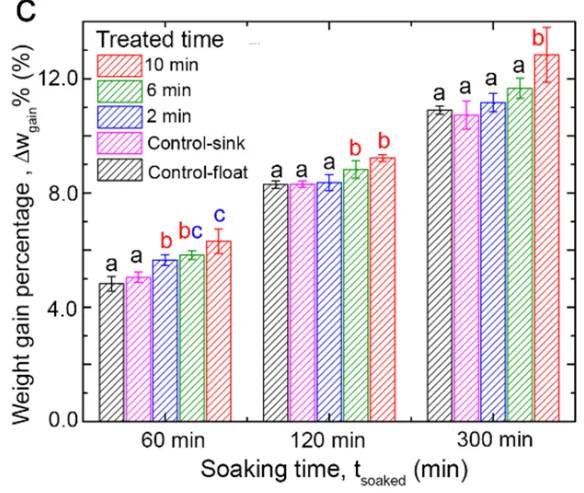
This evidence supports further development of rice hydration, but does not establish how much a user can reduce the time to a target moisture content. Build uptake curves with the actual target and soaking water, then compare the time each group takes to reach the same criterion.
Once the surface wets easily, keep measuring uptake.
Rongsangchaicharean et al. [2] shows that seeds with highly wettable surfaces did not have identical overall uptake under every condition. Once ACA approaches the measurement floor, it cannot distinguish all the uptake differences that occur during soaking.
The paper’s explanation links the results to the extent of surface modification, including physical and chemical changes. For a user’s application, use that hypothesis to select further tests—such as morphology or chemistry when needed—alongside direct uptake measurements. A single SEM image cannot establish the entire mechanism.
From Wetting to Hydration Easier surface wetting is a starting point; overall hydration requires a separate measurement.
- Surface response Droplet contact with the surface · ACA / droplet WI
- Water entry Water movement into the seed · Depends on the surface and seed
- Bulk hydration Water uptake over time · Weigh samples / Track uptake
Useful development identifies a range in which the surface response supports the required function while preserving seed quality. Minimizing ACA alone may not select the most suitable process.
Key messageWater uptake can change. The next question is how much that change can translate into shorter preparation, greater consistency and easier decisions.
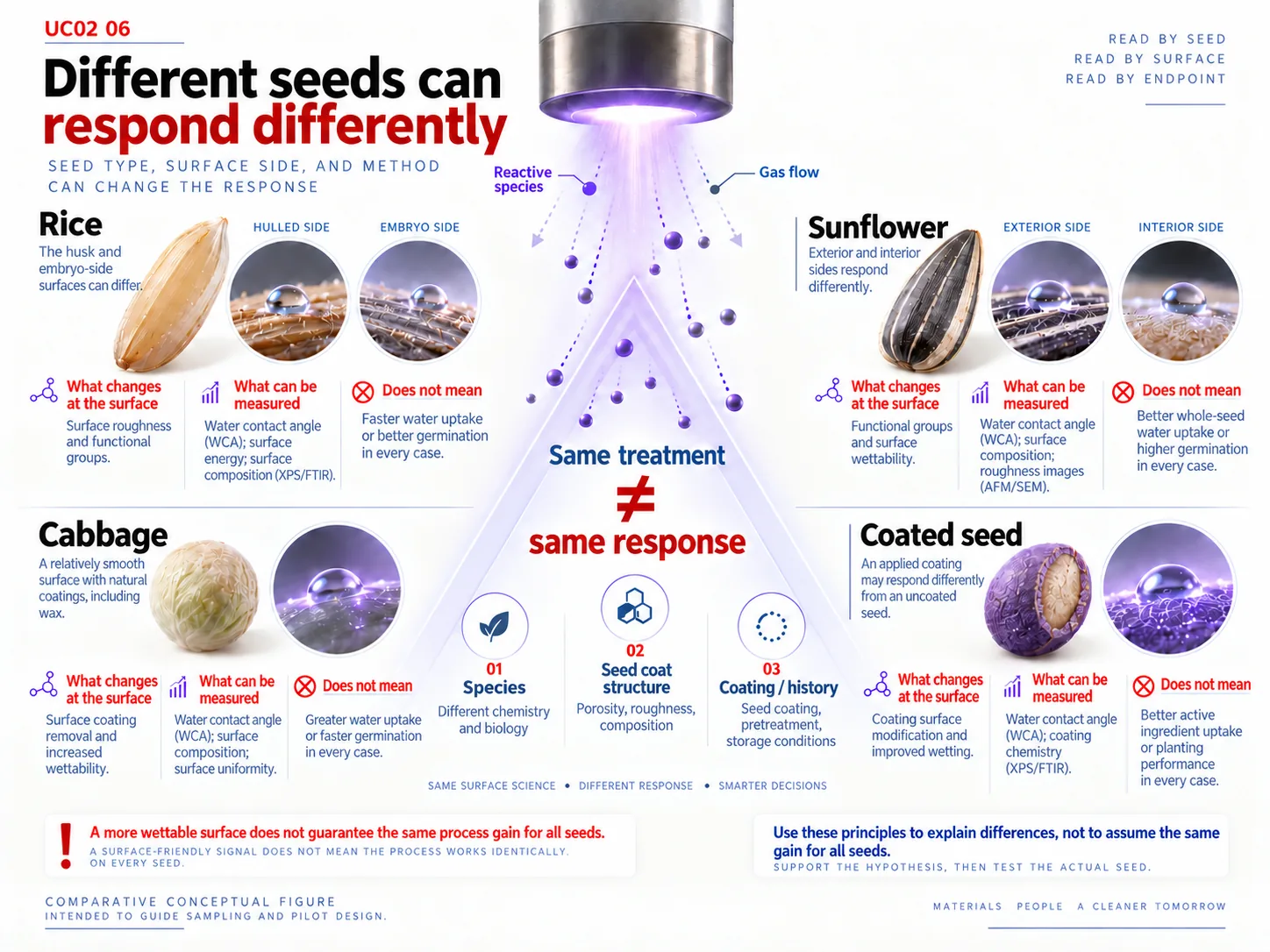
Different seed types, surface sides and lots can respond differently.
Validate published settings before applying them to your seeds.
Differences in species, surface side, lot and treatment window explain why feasibility should start with your actual seeds. The aim is to find the response that matters to your process.
Species, surface side, lot and treatment window are reasons to validate treatment on your own seeds.
What sunflower droplets add to the evidence
Srisonphan et al. [4] shows a reduction in droplet WI on sunflower seeds. The Results report upper-surface values falling from approximately 3,270 s in untreated seeds to approximately 450 s in a strongly responding group. This comparison uses a droplet of a specified size placed on the seed surface.
The graph separates upper and lower surfaces and shows fitted curves alongside the data points. Differences between the sides suggest that plasma exposure and surface characteristics can influence the response of actual seeds. Assess the spread of results when moving from samples to batches.
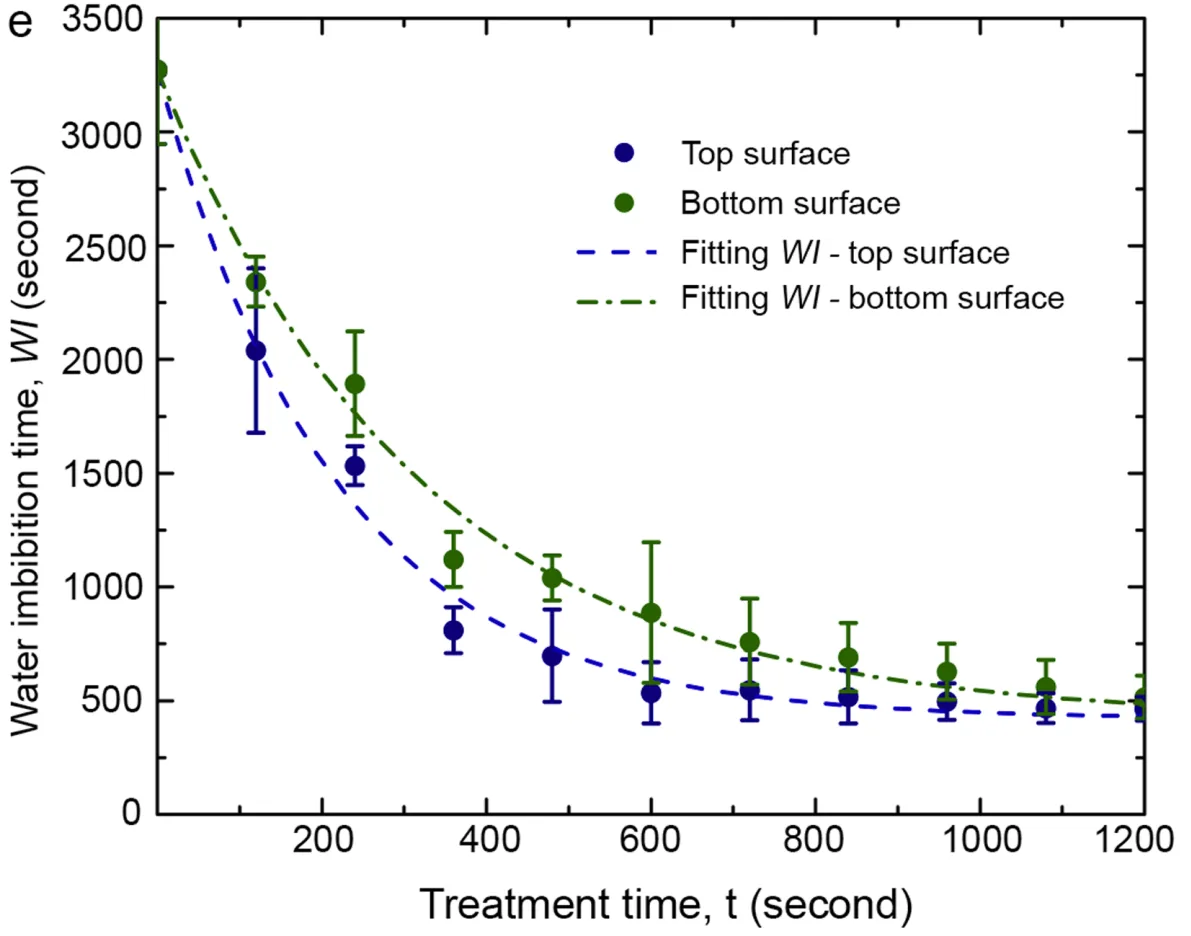
This supports the ability to modify seed–water interactions. Droplet times should not be substituted for the soaking time of an entire sunflower lot, and fitted saturation values are not measurements from every seed.
Differences between seed species and surface sides
Expanding an application means accounting for seed differences. Srisonphan et al. [5] studies rice and cabbage, including upper and sheltered surfaces, showing that changes on curved biological surfaces can relate to WI in different ways.
These findings guide feasibility questions for a new seed: Which sides should be checked? How variable is the response? Is the method appropriate for the seed size? A response in one species supports further investigation, rather than guaranteeing the outcome in another.
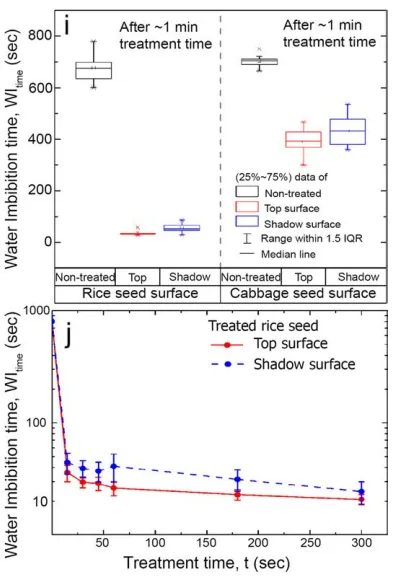
Batch development requires sampling from multiple positions and lots. Upper and sheltered surface responses in a paper do not establish uniform treatment of every seed in a tank or every area of its surface.
Key messageDroplet WI is surface evidence; the application still needs validation of overall uptake. Apply the principle with validation for each seed and process.
Better hydration must preserve seed quality.
If uptake improves but germination, vigor or performance after the waiting period fails, that condition is not ready for use.
A hydration benefit matters when it meets the application’s seed quality criteria and remains useful after the actual waiting period in the workflow.
Today’s improvement must still work when the seeds are used. Germination, vigor and waiting time define the quality requirements.
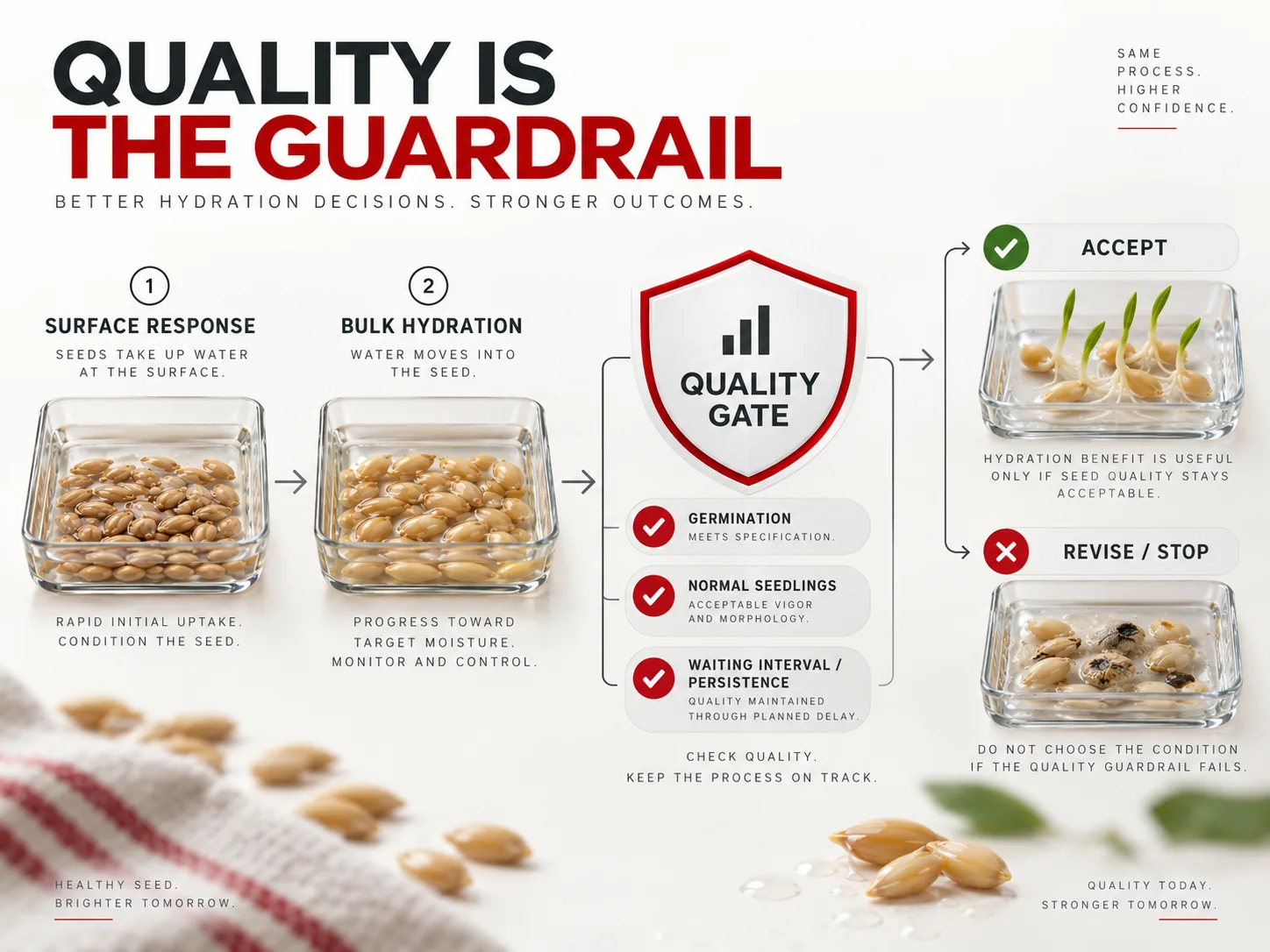
Faster water uptake is useful only if the seeds remain suitable for cultivation. Rongsangchaicharean et al. [2] assessed germination and seedling performance, including accelerated aging. Final germination did not differ significantly with treatment in the reported comparison, and some measures of germination speed changed after aging.
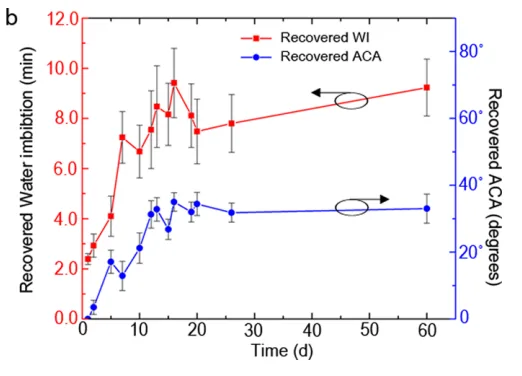
Srisonphan [1] follows wettability recovery during storage, helping frame the question of when to use treated seeds. Application trials should therefore include the actual waiting period, as well as freshly treated samples.
A useful assessment connects uptake, germination, normal seedlings and seed condition after waiting. If hydration improves but post-sowing quality fails the criteria, the condition should not yet be selected for delivery.
Key messagePost-sowing quality and waiting time belong in the hydration specification.
If water uptake becomes easier to control, what improves in your work?
The project aims to make seed preparation more predictable and help the team decide on each lot sooner.
We focus on practical outcomes: less guesswork, less waiting, fewer repeat checks and greater confidence when releasing a lot to the next step.
Turn trial findings into practical value: reduce uncertainty and repeat checks, improve release confidence, and develop the process without rebuilding the entire workflow.
- Less guesswork Use a baseline and an uptake target instead of estimating readiness from time.
- Less waiting Know when to stop or release a lot, rather than adding a time buffer to every lot.
- Fewer repeat checks Use shared readiness criteria to reduce checks driven by uncertainty.
- Better decisions Use the same evidence to decide whether to proceed, refine or stop.
A hydration challenge can lead to several project formats. This table connects users with their desired outcomes, treatment points and development partners.
We use the rice uptake results as a starting point, then design trials around the actual seeds and lots in each application to select a suitable route.
| User / Challenge | Plasma treatment point | Desired value | How to validate it | Development route / Partners |
|---|---|---|---|---|
| Rice preparer: uptake misses the target | Before soaking | Manage when each lot becomes ready | Time to target + Moisture distribution + Viability | Sample trial → Pilot; seed owner / Quality laboratory |
| Sunflower or microgreen grower: preparation varies between lots | Before the actual hydration step | More consistent preparation | Uptake curve + Seedling quality + Performance after waiting | Joint development; grower / Microgreen producer / Seed supplier |
| Seed preparation system developer | Between receiving the lot and the soaking tank | A repeatable process with usable data | Batch consistency + Material handling + Cost per cycle | Pilot → Module / Integration; equipment team |
The route is not fixed by user type. Treatment services can suit projects that need a quick, flexible start, while integration can suit repeated operation. Trials help identify the option that fits the operation and justifies further investment.
Key messageUseful value must be visible in the work and measurable with evidence the team can use together.
Start small and get an answer you can act on.
- You bring One problem lot + Current soaking method + Initial condition + Quality criteria
- We test Baseline uptake curve + Appropriate comparator and treatment + Quality checks
- You receive Uptake curves + Time-to-target comparison + Quality summary
- Decision Proceed / Refine / Stop using the same evidence
- Whatever the result, you still gain an uptake baseline for your own seeds to support the next decision.
The first step should answer three questions together: Does uptake improve? Does seed quality still pass? Is the benefit sufficient to develop toward actual use?
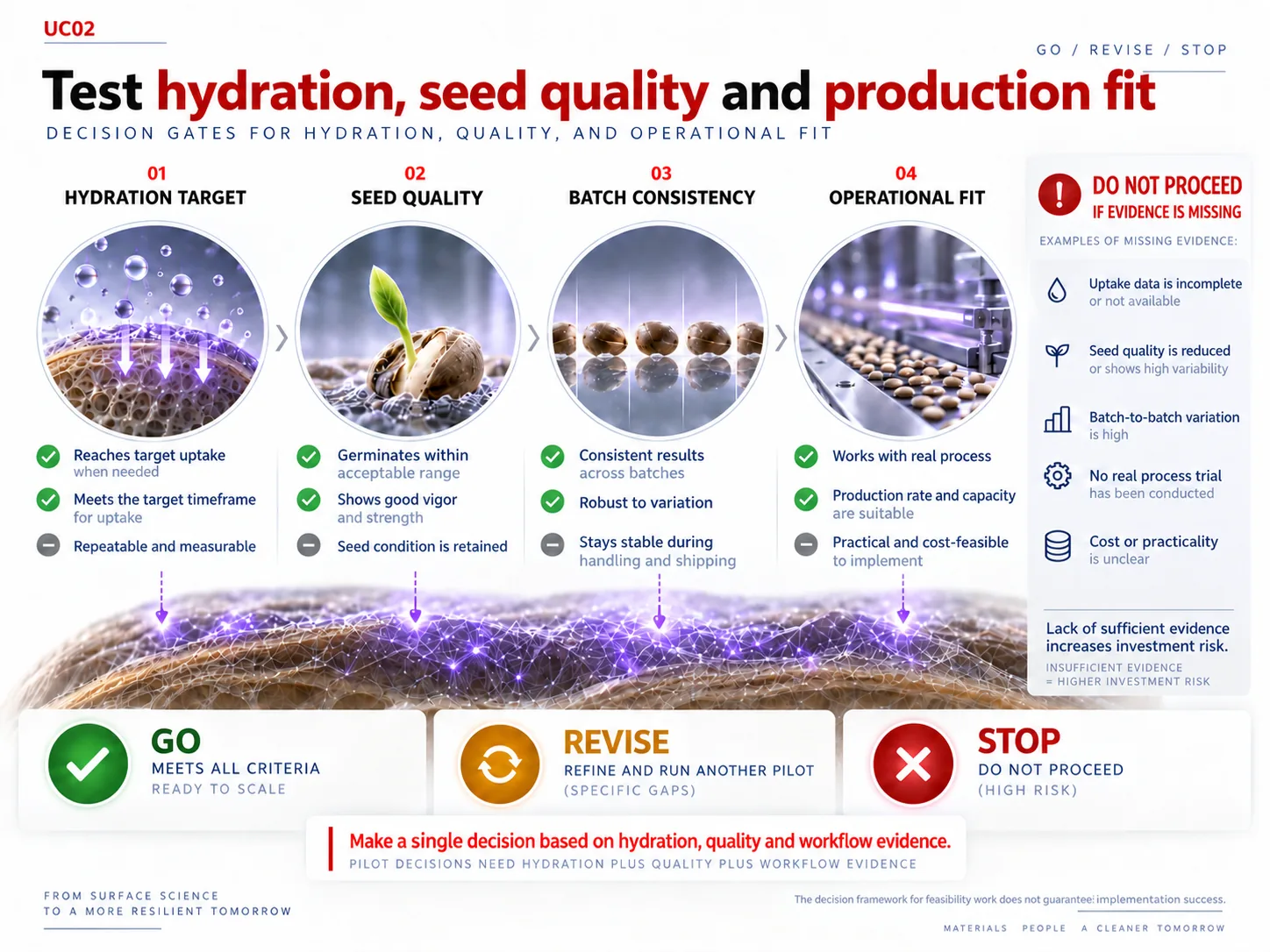
Start with the moisture target or hydration outcome the user needs. Define the basis, sampling method and measurement times before testing. Compare curves with the baseline and assess moisture distribution within the lot, rather than relying only on the mean at one time point.
Track quality after sowing and the resources actually used: water, time, handling, labor and total system energy. Assess both treatment and hydration; shorter soaking may otherwise conceal extra work elsewhere.
Hydration trial decision table Measure water uptake and seed quality in the same lot.
| Assessment area | What to track | Supporting information |
|---|---|---|
| Water uptake curve | Water uptake over time | Clear units and mass basis |
| Water uptake target | Set criteria in advance | Time to reach the same criterion |
| Seed quality | Germination / Seedling condition | Check viability alongside uptake |
| Process value | Variation between lots / Material handling | Cost per usable output |
Agree on proceed / refine / stop criteria for the application. If quality fails, stop or adjust the conditions. If results are close to baseline, assess whether consistency or handling offers enough value to continue. Do not derive acceptance thresholds from a paper’s results alone.
The first trial · A practical starting point
Start with a seed lot and a question—not an equipment purchase.
You bring
One problem lot + Current soaking method + Target and quality criteria
We test
Baseline uptake curve + Appropriate comparator and treatment + Germination and quality checks
You receive
Uptake curves + Time-to-target comparison + Quality summary + Recommendation to proceed, refine or stop
Whatever the final outcome,
you gain a baseline for your own seed lot that can support decisions and further process development.
Key messageA useful trial delivers a decision, as well as a graph.
From a sample to a repeatable process
One successful sample is a starting point. The next task is to reproduce the result across lots.
A useful system must repeat its performance across lots and days, connect uptake results with release criteria, and operate within production constraints.
Develop sample results into performance that repeats across lots, days and actual operations.
As scale increases, preserve the relationship between surface treatment, uptake and seed quality. Design seed feeding, exposure distribution, lot separation and the recording of acceptance criteria for each run.
For integration into real operations, involve equipment and production teams from the start to address material handling, safety and installation space.
When sample results are promising, move to pilot trials and increase scale progressively to maintain performance, consistency and practical operation.
Key messageScale-up must preserve both seed performance and operability.
Start before committing to a complete system.
The first question is: “What level of evidence do we need now?”
Begin with sample testing to understand the seed response → Run a pilot when the benefit is clear → Develop the process jointly as conditions stabilize → Integrate it when it is ready for repeated use.
Match the collaboration format to project readiness: sample testing → Pilot → Joint process development → System integration.
You do not need to buy equipment to begin. Start with sample testing to clarify the question, a pilot when value becomes visible, joint development as specifications become clearer, and integration when the evidence supports it.
The first stage tests feasibility using the actual seeds and soaking method. If results are clear, move to a pilot or joint development using the same criteria.
Once operating conditions and quality control are defined, choose the delivery format that fits: treatment services, a module or integration into the existing process.
Define deliverables from the start, such as uptake curves, a quality summary, pilot acceptance criteria and a proposal for integration into actual operations.
Key messageStart with the answer the user needs, then choose the right system format.
From uncertainty to repeatable hydration control
The goal is to know whether your seeds are genuinely ready.
When readiness can be measured and reproduced, the team can reduce guesswork and waiting, and use the same criteria for every lot.
The goal is to know whether seeds are ready, using consistent decision criteria across lots and days.
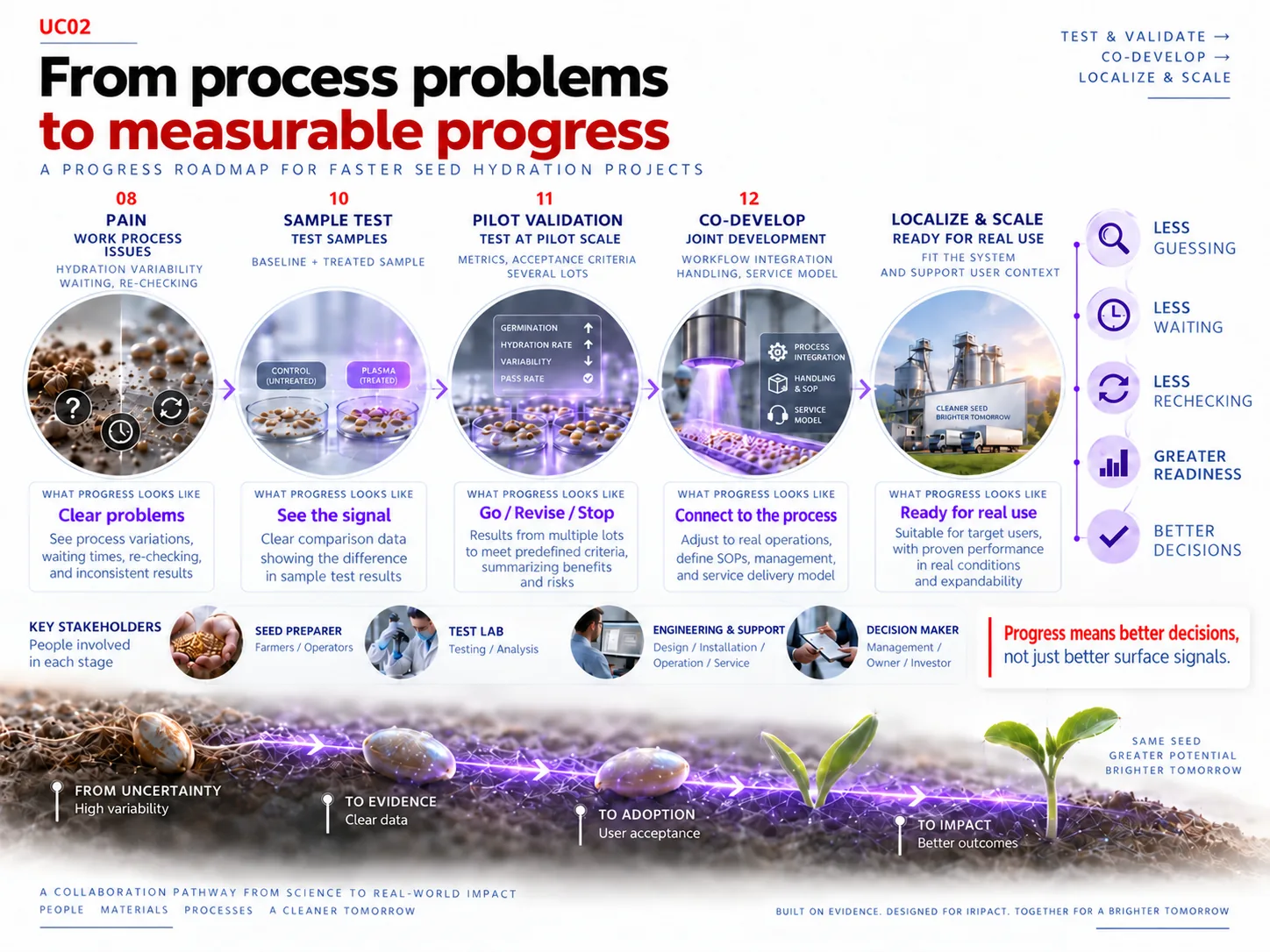
- The capability to build: Build the capability to measure hydration readiness, reproduce it and use it in lot release decisions.
- 01 · Less guesswork Understand the problem and baseline more clearly.
- 02 · Less waiting Know the time to target and the bottleneck.
- 03 · Fewer repeat checks Use measurements to reduce decisions based on impressions.
- 04 · Better decisions Know whether to proceed, refine or stop.
Useful starting information includes seed type and lot, storage conditions, initial moisture, current preparation method, soaking water, the problem to solve and post-sowing quality criteria. Together, these define a sample trial that answers the question without changing several factors at once.
When application results support further development, jointly define specifications and test integration with the actual workflow. Adapting to the operation means fitting the system format, maintenance and service to the user, rather than simply transferring laboratory settings to another machine.
Test & Validate → Co-develop → Adapt & Scale Start with a hydration problem in a specified seed type and lot.
- Test & Validate The seed challenge: Water uptake / Variability · Define the required outcome. · Sample testing: Compare uptake curves with the baseline. · Check quality alongside uptake. · Evidence for a decision: Time to target · Seed quality criteria met
- Joint development Joint development: Specifications + Material handling · With the user and testing laboratory · Integration trial: Multiple lots / Production days · Record process value.
- Localize & Scale Choose the delivery format: Service / Module / Application-specific system · When supported by the results
UC02 starts with a simple question: “Can our seeds reach the required hydration level more effectively?” Once an actual lot provides the answer, choose the delivery format that best fits the operation.
Key messageTest actual seeds, measure real process outcomes and develop repeatability.
Start with one lot and learn from your own process.
If a lot soaks unpredictably, needs extra time or leaves you unsure whether it is ready, the most useful first step is to establish its baseline and design a sample trial around that practical question.
- 01 · Seed + lot Species, lot and storage conditions
- 02 · Current process Soaking method, water, time and initial moisture
- 03 · Success criteria Uptake target + Germination and quality criteria
- 04 · Next decision Proceed / Refine / Stop based on the actual lot
Discuss your seed hydration challenge with Plasma Innovations or email [email protected]
Start with one of your lots
If you have a lot that is hard to predict after soaking, needs extra time, or leaves you unsure whether it is really ready, send its details to the Plasma Innovations team at [email protected]. We will build a baseline and design a sample test that answers your process question.
Email the research team[email protected]See other cold plasma use cases →What to prepare
- Seed species, lot and storage conditions
- Current soaking method, water, time and initial moisture
- Water uptake target plus germination or quality criteria
- The decision you need: proceed, refine or stop
References
- Srisonphan S. (2018). Tuning surface wettability through hot-carrier-initiated impact ionization in cold plasma. ACS Applied Materials & Interfaces, 10, 11297–11304. doi:10.1021/acsami.7b19495
- Rongsangchaicharean T., et al. (2022). Effect of dielectric barrier discharge plasma on rice (Oryza sativa L.) seed hydration and hygroscopicity. Journal of Physics D: Applied Physics, 55, 365201. doi:10.1088/1361-6463/ac791d
- Srisonphan S., Kasemsuwan V. (2021). Field electron emission enhanced streamer cold plasma interaction on seed surface wettability. Surfaces and Interfaces, 22, 100877. doi:10.1016/j.surfin.2020.100877
- Srisonphan S., Tephiruk N., Homkanchan S., Puttha J., Suwannarat S., Teerakawanich N. (2025). Synergistic DBD plasma and plasma-activated water enhance sunflower seed surface wettability and germination. Results in Engineering, 26, 105434. doi:10.1016/j.rineng.2025.105434
- Srisonphan S., Ruangwong K., Thammaniphit C. (2020). Localized electric field enhanced streamer cold plasma interaction on biological curved surfaces and its shadow effect. Plasma Chemistry and Plasma Processing, 40, 1253–1265. doi:10.1007/s11090-020-10098-8
- CDC/NIOSH Pocket Guide — Ozone. Useful for framing gas assessment questions; this reference does not establish equipment compliance or replace requirements at the installation site.
- CDC/NIOSH Pocket Guide — Nitrogen dioxide. As with the ozone reference, this source does not establish emissions from the system.
- Li, Lalk & Bi 2021 — Fertilization and pre-sowing soaking in ten microgreens. Use crop- and experiment-specific comparators for soaking and fertilization. Soaking did not improve yield in every case; the findings are external context, not performance results for Plasma Innovations.
- IRRI Rice Knowledge Bank — Using good, clean and healthy seed. Lot selection, germination checks and moisture-tight storage are relevant to seed quality.