What Is Silk Crystal? An Interview with FINECO Founder Dr. Garbeen Yim
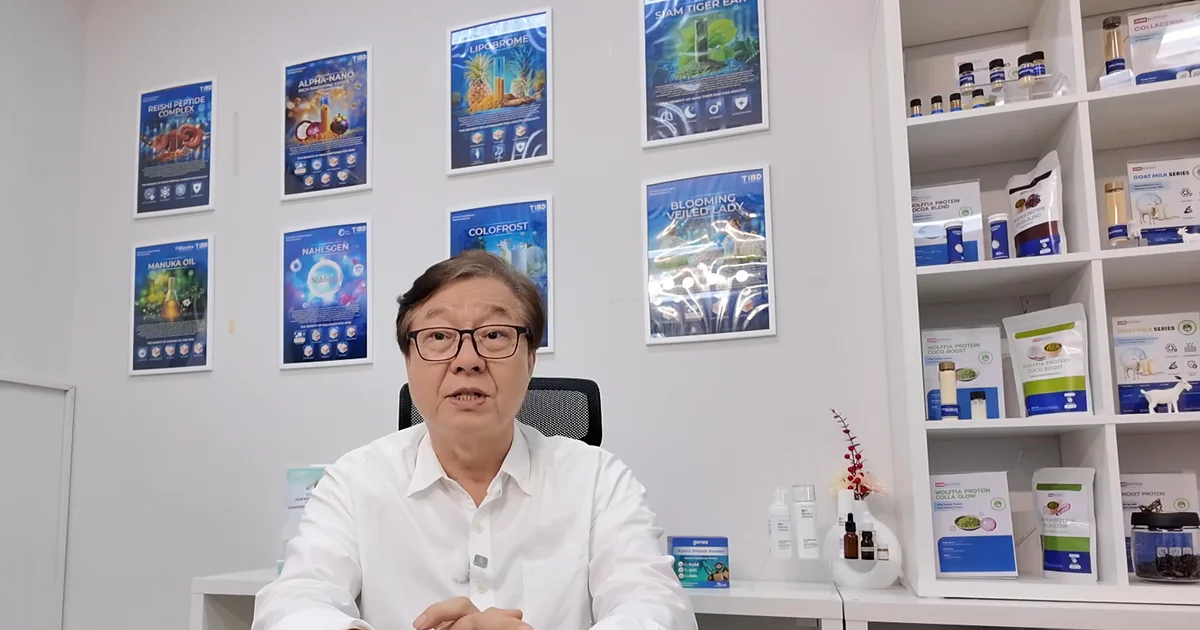
Interviewed and edited by Dr. Wuttipong Panitsettakorn, Managing Director, TIBD Company Limited · Recorded 9 October 2026
A conversation with Dr. Garbeen Yim, founder of FINECO LTD. in South Korea, and his two sons, the company’s second generation, about a biochemical engineer who came through a financial crisis, mushrooms and silk before arriving at an answer called Silk Crystal
Silk has been a cosmetic ingredient for so long that many brands in Thailand now treat it as old news. But most of the silk protein on the market has already been broken down into small pieces, sold as hydrolyzed silk or sericin, and what is left serves mainly as a source of amino acids.
Dr. Garbeen Yim, a South Korean biochemical engineer and the founder of FINECO LTD., saw a different question in that. How do you keep silk’s original properties intact? The first answer he brought to market is an ingredient called Silk Crystal.
“Mostly the market has hydrolyzed silk and sericin. I feel it’s not real silk anymore. It’s already broken, only a source of amino acids. So how can I deliver the original benefits of silk?”
— Dr. Garbeen Yim
This piece is edited from conversations with Dr. Yim and his two sons, Sang Hyuck (Steve) Lim and Joon Hyuck Lim.
Watch the full interview
How Silk Crystal differs from ordinary silk protein
Silk from the cocoon is made of two main proteins: fibroin, which forms the core of the fibre, and sericin, which coats it. Most silk ingredients used in cosmetics are made by breaking these proteins down into small fragments (hydrolysis), so that they dissolve in water and are easy to add to a formula.

The trade-off is that the protein’s original structure is lost along the way. Dr. Yim says he tried many ways around that, and Silk Crystal was the first result he could actually sell.
FINECO uses its proprietary process to form silk fibroin into a porous, three-dimensional network. This structure distinguishes Silk Crystal from hydrolysed silk peptides and silk amino acids.

“This is just one result. Many others are not commercialized yet. But as a first step, the commercialized ingredient is Silk Crystal.”
He did not go into the manufacturing process during the conversation, but he made two clear points about the market.
- It is hard to copy. “No one can do it, because it’s too complicated a step. Of course, if a big company participated they could. But the market is small, so big companies don’t come in.”
- Everything else the company makes is built on it. “The hydrogel mask cannot be made without Silk Crystal. The other related products too, the base should be Silk Crystal.”
An engineer who planned to own a business from day one

Dr. Yim studied chemical engineering, specializing in biochemical engineering, the field that uses biology to make products at industrial scale. During his master’s degree he worked on producing diagnostic antibodies by cultivating animal cells, a project that sent him to a medical school in Japan to work alongside Japanese doctors. For his PhD he moved into fermentation technology.
What held his interest was never the small-scale experiment. It was scale-up.
“I was especially interested in scale-up, not just a small scale. I always focused on how we can commercialize the results of basic research. So my role is in between basic science and industry.”
One of his research projects was producing gamma-linolenic acid (GLA) with microorganisms instead of extracting it from plants. It reached the Korean market as a health food ingredient.
His parents wanted him to become a professor. He had decided, from the day he entered engineering school, that he would build his own company. In Korea at the time, the economy ran on large conglomerates and the idea of a venture company barely existed, so he joined a big company to learn, and worked as if it were his own.
“Fermentation is cultivating microorganisms. It’s just like taking care of a baby. With fungi you have to cultivate for at least one week and check the pH and the nutrition level every two or three hours. Per week I could go home just one day or two.”
The company pushed its researchers to commercialize as fast as possible. At around 28 or 29, he was already deciding the research direction for his field. His team chose omega-3: crude fish oil refined by high-vacuum distillation and a string of purification steps. They also worked on natural ingredients such as phosphatidylcholine from soybean and egg yolk.
“At that time, nobody knew about omega-3. Now it’s a very big industry. Items I researched about 30 years ago have now become quite popular.”
Why did Korea invest so heavily in fermentation? Because the country has few natural resources, he explains. Cultivating microorganisms lets you produce active ingredients without large supplies of raw biomass.
The IMF crisis, and the decision to leave
The turning point came with the 1997 Asian financial crisis, known in Korea as “the IMF crisis.” Large companies that had grown on bank loans could no longer borrow. The first thing cut was research, because research is for the future and the companies had to protect the business they had today.
The biotech research department he ran had about 60 people. He was told to cut it by at least half in the first round. He was 34 or 35.
“I had to meet them one by one. I let many researchers go to other fields. It was very difficult. So I decided I myself had to leave. Without cutting myself, how could I appreciate them?”
The chairman and president asked him to stay, offering to spin the team out as a separate biotech venture. He had already made up his mind.
Starting over in Chuncheon, from tocopherol to mushrooms
At the same moment, the mayor of Chuncheon and a professor at the local university were preparing a biotech incubation centre funded by the local and central governments, but they did not know how to plan it. They had visited his company before he left, and they invited him to help.
He worked with the professor for several months, laying out the facility, selecting equipment and writing a master plan to attract small and medium-sized companies. Then, at around 38 or 39, he moved to Chuncheon alone.
His first plan was to extract tocopherol (vitamin E) from the residue that soybean oil manufacturers threw away. It collapsed before it started.
“When I worked for the big company, the oil manufacturers said, yes, we can sell to you cheap. After I started a small company, the same people, the same director, said no, we cannot sell to you, we export to Japan. I felt how big the difference is between working for a big company and running a small one.”
Chuncheon was surrounded by mushroom farmers, so he turned to mushrooms such as Agaricus blazei and Phellinus linteus, and developed health products in tea and tablet form.
The active compounds in these mushrooms are polysaccharides, and hot-water extraction pulls out only part of them. He used enzymes as a pre-treatment, kept the process away from high temperatures and finished with freeze-drying. When he showed the product at a health fair in Hong Kong, an alternative-medicine doctor who tasted it was surprised, and that became one of the company’s first contracts.
Why silk?
Silk came through a Japanese scientist friend, who told him that among Japan’s natural resources silk had traditionally carried high value, and that scientists there were starting to study silk protein. He sent Dr. Yim a technical book on silk written by Japanese researchers.
The more he read, the more interested he became. The business reason for choosing silk, though, was simpler.
“At the time silk was a minor, small area. The market is not big, so no big company was interested. Therefore silk will be suitable for a small company.”
The catch was that the market was already full of silk ingredients. The problem was not making silk. It was making it different, and that led to Silk Crystal.
Two years in the United States, and a project cancelled at the last step
Once Silk Crystal was ready, he presented it as a poster at a chemistry conference in the United States, with support from a local agency. Scientists from a global cosmetics company stopped at the booth and invited him to present at their research centre in New Jersey.
Two or three months after he sent samples, the research team wrote back that it was a really interesting material. The two sides worked together for about two years.
“Whenever I went there, more scientists came, from different fields. They said that when they used Silk Crystal in a formulation, it was very convenient, without using any strong chemical emulsifier.”
Clean, safe cosmetics were on the rise, and the company was preparing a large project for China and ASEAN. Dr. Yim invested in capacity step by step to be ready. Only the board meeting remained.
Then the project was cancelled over an ethics concern about animal-derived ingredients, something he had never anticipated.

Europe, silk with gold, and a lesson about vegan
He did not stop. He turned to Europe through a global cosmetic ingredients show, supported by the Korean government, and met several European companies who were interested.
- A Swiss company wanted to become a distributor.
- A German manufacturer, always looking for new and innovative materials, began using Silk Peptide Gold Complex in premium products.
- French companies: “The issue did not come up in our discussions with the French companies we worked with at the time.”
Sales grew for several years, until the German customers started buying less and less. When he asked why, the answer was that vegan had become a very strong trend in Germany, and they asked whether he could get vegan certification for the silk ingredient.
“Silk is classified as an animal source, so it’s impossible. So they gradually stopped using it.”
The lesson matters for any Thai company thinking about export. Market requirements are not only about quality and safety. They include the values of consumers in each country, and those values can change faster than you expect.

From ingredient to finished product, and the La Soie brand
Selling ingredients alone limited how far the company could grow, because most of the value is created further downstream. So he started making finished products.
At one trade show he met the owner of a German distribution company, a woman who worked in a large hospital and whose skin was so sensitive that she could hardly use any cosmetics. She told him she had no problems at all after using his sample cream, and wanted to know why the silk protein did not cause her the usual trouble.
Her company decided to go into business with him and sent formulation guidelines listing ingredients to avoid. Dr. Yim brought in an experienced formulator from a major Korean cosmetics company to develop formulas built on Silk Crystal, and exported them to the German customer under its own brand (OEM).
He later created his own brand, La Soie, for Asia and Korea, sold through hospitals and clinics in Korea, and expanded into Singapore and China.
China went well for several years through a distributor near Shanghai, until the country’s cosmetic registration rules changed several times. More than ten products had to be registered again and again, and the distributor declined to keep investing.

IP is the only asset
Throughout, Dr. Yim was careful about being copied.
“In Korea, once one company succeeds, other companies just try to copy. Researchers from a big company wanted to see our facility, carrying a camera. No, never. We are a small venture company. IP is the key asset. We have no money, only the software.”
That is another reason FINECO has always focused overseas. Before COVID he attended at least three or four trade shows a year, for ingredients and finished cosmetics, from Hong Kong and Thailand to Las Vegas.
Why silk did not sell in Thailand before, and why now is different
FINECO tried to sell Silk Crystal in Thailand once before, while the Thai cosmetics industry was growing. The response was this:
“They said silk is too old a concept. In Thailand silk is not new. Cosmetic companies are always trying to find new ingredients, but when they talk about silk, it’s old-fashioned, not interesting.”
The deeper problem was communication. Even chemists who had worked with many ingredients found it hard to see why Silk Crystal was different from hydrolyzed silk. He almost gave up on selling the ingredient in Asia and focused on finished products instead.
During the conversation, Dr. Wuttipong pointed out that the Thai market has changed. Brand owners now want ingredients with real scientific proof, the branded ingredient trend means buyers check that an ingredient is used at its recommended dose, and deep technology is in demand. Dr. Yim agreed.
“I think so. Right timing.”
A meeting on the last day of the show
This return to Thailand started at in-cosmetics Asia in Bangkok in 2025. Dr. Yim says a trade show is too short to explain a technology properly, and partners who simply buy and sell give up as soon as sales slow down. What he wanted was a partner who understands the technology.
When a long-time Japanese acquaintance told him about a technology-based company in Bangkok, he asked for a meeting straight away, even if it could only be one hour on the last day of the show.
From meeting to MOU
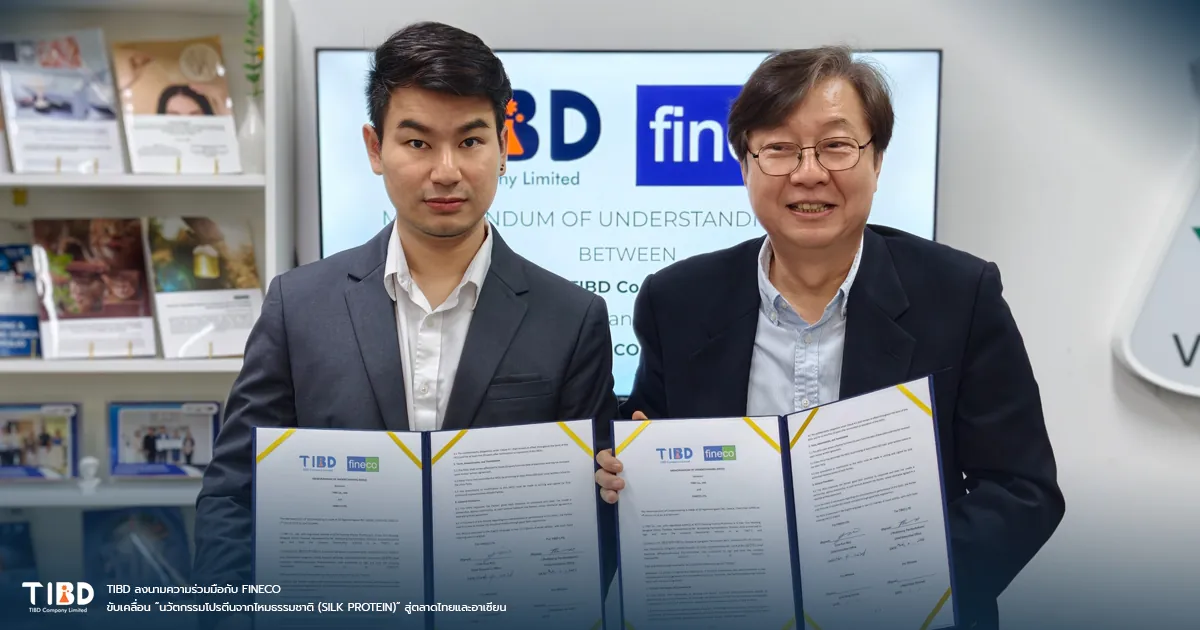
That meeting led to a memorandum of understanding (MOU) between TIBD Co., Ltd. and FINECO, signed in Bangkok on 4 March 2026, to jointly develop and extend silk protein innovation for the cosmetics and personal care industries in Thailand and ASEAN.
Under the MOU, TIBD acts as the bridge between technology and market: assessing market potential, planning how to bring the ingredient to market, connecting with brand owners and manufacturers, and supporting product development. FINECO shares know-how and technical data on silk protein.
FINECO’s second generation: Steve and the job of taking technology to market
Sang Hyuck (Steve) Lim, Dr. Yim’s son, moved to the United States at 15 and studied industrial engineering and mathematics at a university in Pennsylvania. He worked at an accounting firm in Korea for about a year before his father asked him to join the company.
He is candid that the company’s early attempts to expand into Vietnam, Myanmar and China did not succeed. Back in Korea, he learned every part of a compact company, from product development and quality control to testing and design. Today his main role is international business development.
“We have good materials, unique materials and technologies. But the biggest challenge is how we introduce them to the market. We are R&D-oriented, and marketing is where we have difficulties. The first generation already developed the technology. As the second generation, our goal is to commercialize it.”
Thai silk and the hydrogel mask, first
Steve’s plan is not just to sell products in Thailand, but to establish the company here and develop new materials from Thailand’s natural resources, with the long-term goal of building its own brand.
Asked which product he would start with, he named a hydrogel mask made from Thai golden or white silk.
“The mask sheet is the active material itself. It’s not a woven sheet, not a passive material.”
He does not see it as a mass-market product for online marketplaces, because of its price and its complex production process. It is better suited to beauty and aesthetic clinic channels.
Second on his list is an ingredient that combines Silk Crystal with astaxanthin.
“Astaxanthin is a very strong antioxidant, but the problem is that heat, light and oxygen change it very easily. We did a lot of tests on how to stabilize it, and we found a way using our silk technology.”
Clinics, brands and the question of price
The interviewer estimated that Thailand has around 20,000 beauty clinics, from surgery and laser clinics to acne treatment. Steve says the company has products for acne-prone skin, for after-laser care and a silk and gold serum, so it is ready to work with every type of clinic.
FINECO is also open to working with other brands, through technology sharing and OEM manufacturing, across facial care, hair care and body care.
“I want customers who are eager to find something new, a unique concept, not the general stuff in the market.”
On price, he is straightforward: it is not a cheap material, but it can be adjusted to fit a customer’s budget. What he does not want is a partner who only buys and resells without understanding the technology.
“We want customers who know the technology and understand it deeply. Not just trading.”
A name many people mispronounce
At the end of the conversation, Steve corrected a common mistake: many people assume the name is Japanese. It is pronounced “Fine-Co,” not “Fi-ne-co.”
“Fine means good, and Co is company. Fine company, Fine-Co. The name came from my dad.”
Joon: making the complicated easy to understand
Joon Hyuck Lim, Dr. Yim’s other son, does many jobs at the company: product development, production, customer communication and the presentations that explain its materials. He studied business administration, not science, and that has turned into an advantage.
“Our technology is kind of difficult to understand, and I’m not in the science field either. So I know how people can have a hard time understanding it. I try to make the product pages and presentations easier for people outside science, to show how our silk technology is different from the conventional silk in the market, like hydrolyzed silk.”
He has started using AI in research and development to speed up material development, and to make visuals that explain the technology more simply. He is also redesigning the company’s older brands for today’s market. All design work is done by the in-house team.
Products Joon recommends
- Water Essence, an all-in-one product that combines toner, essence and lotion in a single bottle. It uses Silk Crystal technology and has a very light texture, which he thinks suits Thailand’s hot, humid weather. It is the product he uses himself every day.
- Silk Crystal Veil, a commercially available silk ingredient for hair care, designed to coat the hair with a silk film that helps care for hair after perming or colouring and protects it from the heat of a hair dryer.
- Body care and cleansing products, such as shower gel and facial cleanser, made with the company’s silk materials.
For OEM customers, the company can start with small batches and help with design, packaging selection and registration.
“Communication is the key. Make complex things easier so people can understand.”
What Dr. Yim wants to build in Thailand
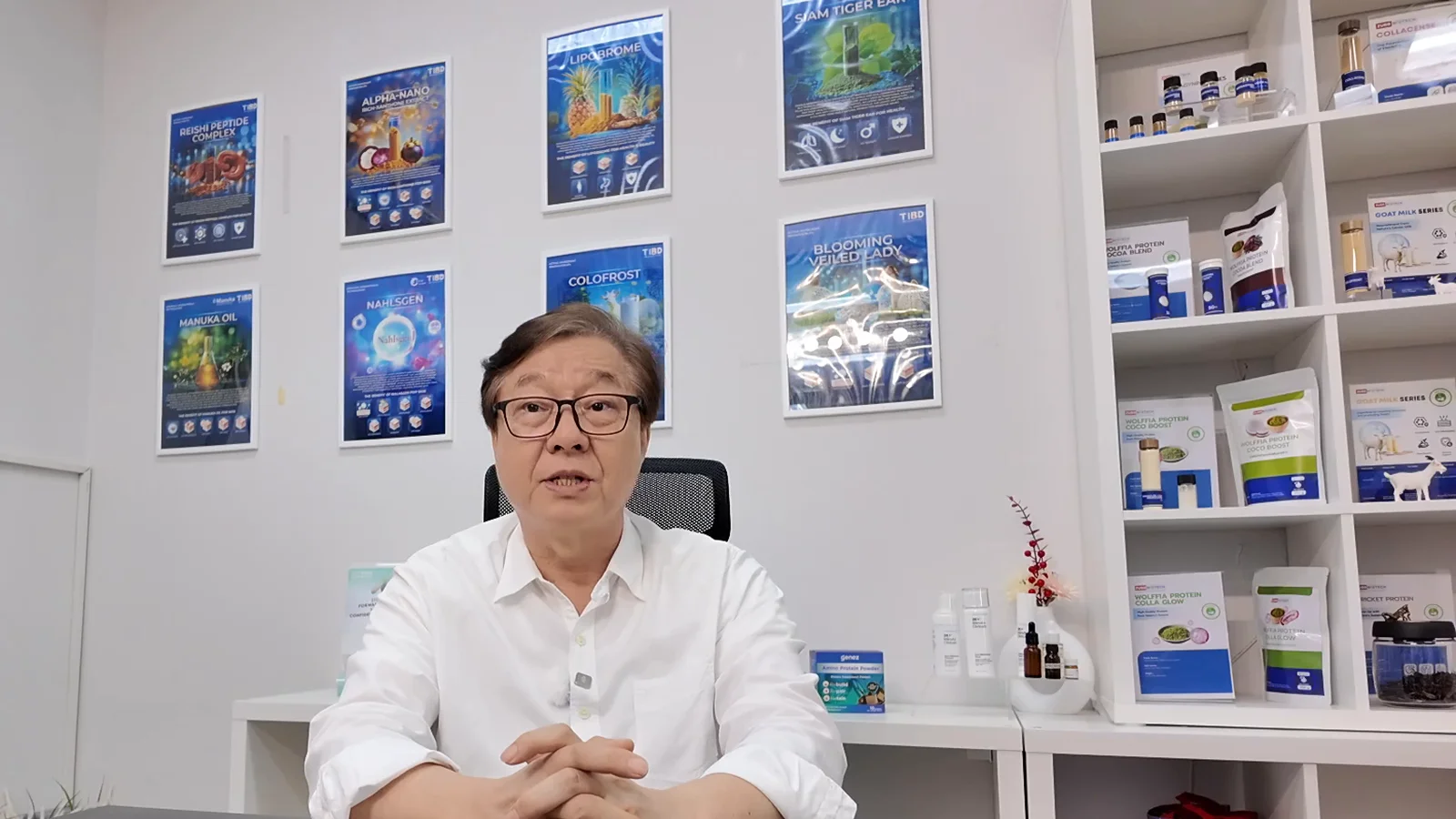
Dr. Garbeen Yim on his hope to spend part of his life in Thailand
Dr. Yim does not see Thailand only as a market. What interests him is co-development: projects that start from local market needs, then bring existing technology to them to create new value.
“If I can bind our existing technology or my idea to what the local market needs, we can create a new project, new value. Not just selling and buying.”
And when asked why Thailand, his answer was not about business.
“That’s not just a job. That is actually my dream. After retirement, I want to live in a warm country, not in a very cold winter. I want to enjoy a more relaxed life in good nature. And I still want to work, not aggressively, using my experience. I want to share it with young people in technology, researchers and scientists.”
He pictures half the year in Korea and half in Thailand, doing development or consulting.
Silk technology terms to know
Silk ingredients go by several names, and different sources use them differently. This table matches the common terms so that you can search further with the right words.
| Term | What it means |
|---|---|
| Silk Protein | Protein obtained from silk fibre and cocoons |
| Fibroin | The protein that forms the core of the silk fibre |
| Sericin | The protein that coats the outside of the silk fibre |
| Hydrolyzed Silk | Silk protein broken down into small fragments so that it dissolves in water |
| Silk Crystal | FINECO’s silk fibroin ingredient, formed by a proprietary process into a porous, three-dimensional network rather than broken down like hydrolyzed silk |
| Hydrogel Mask | A gel sheet mask; in FINECO’s case, the sheet itself is made from the silk material |
| Astaxanthin | A red-orange antioxidant that degrades easily with heat, light and oxygen |
| Emulsifier | An ingredient that helps oil and water mix in a cosmetic formula |
| Scale-up | Taking a process from the laboratory to industrial production |
| OEM (Original Equipment Manufacturer) | Manufacturing a product under the customer’s own brand |
| Branded Ingredient | An ingredient with a trade name and supporting data that brands can communicate to consumers |
Five things worth taking away
Five points to remember from this conversation
- Silk is not old-fashioned in itself. What looks old-fashioned is silk broken down until only amino acids remain. Silk Crystal is an attempt to keep silk’s original properties.
- Research reaches the market only if scale-up is part of the thinking from the start, as it has been for Dr. Yim from omega-3 to silk.
- Overseas markets ask for more than quality: animal-welfare concerns and the vegan trend among them. Study each country’s values before you plan.
- For a small company, intellectual property is the main asset, so choosing what to disclose, and to whom, matters as much as development.
- Good technology does not sell if it cannot be explained. That is why Dr. Yim’s two sons, FINECO’s second generation, put so much weight on making the difficult easy to understand, and on finding partners who really understand the technology.
Frequently asked questions about Silk Crystal and silk ingredients
How is Silk Crystal different from hydrolyzed silk?
Hydrolyzed silk is silk protein broken into small fragments so that it dissolves in water, which destroys the protein’s original structure. Dr. Yim developed Silk Crystal to avoid breaking silk down in that way. FINECO uses its proprietary process to form silk fibroin into a porous, three-dimensional network; the details of the process are the company’s intellectual property.
What products can Silk Crystal be used in?
According to the FINECO team in this interview, it is used across facial care, hair care and body care, including all-in-one essences, hydrogel masks, products for hair damaged by perming or colouring, shower gels and facial cleansers.
Can a silk ingredient be certified vegan?
No. Silk is classified as an animal-derived material, so brands that want to make vegan claims need to take this into account from the start.
Does FINECO offer OEM manufacturing for Thai brands?
Yes. The FINECO team says it can start with small batches and help with design, packaging and registration. Actual production terms are discussed case by case.
How do you pronounce FINECO?
“Fine-Co.” It comes from “Fine,” meaning good, and “Co,” short for company.
Interested in developing a product with silk technology? Where to start
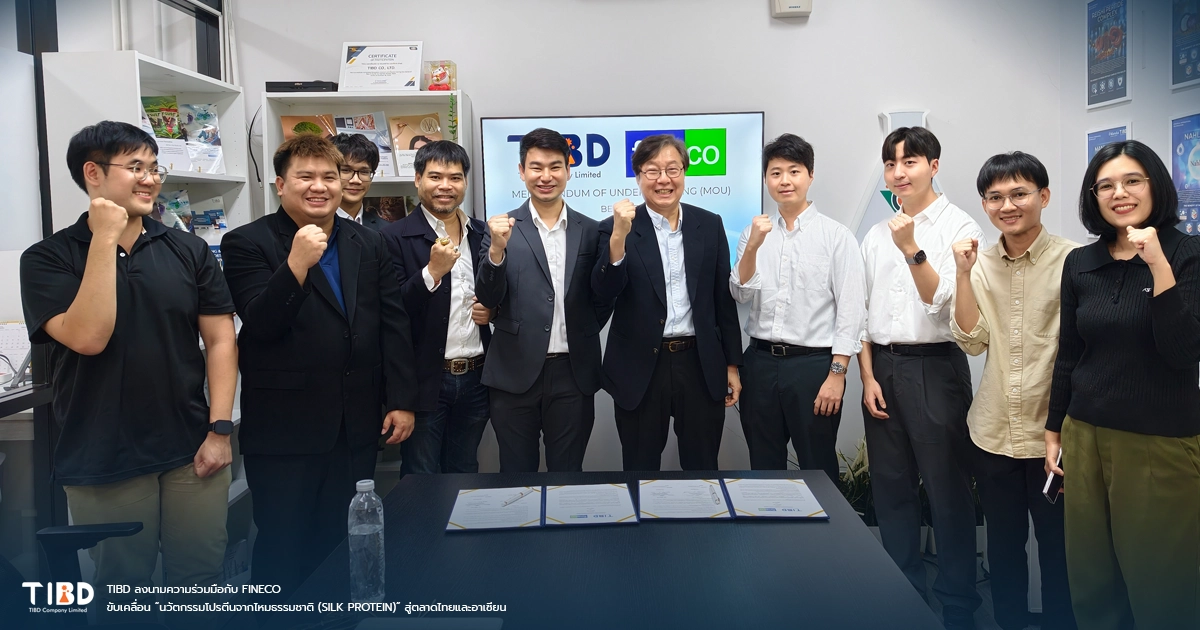
What Dr. Yim and his sons all said is that they are not looking for partners who simply buy and resell. They want partners who understand the technology and bring a clear problem. That is exactly the stretch TIBD works in: where a technology has to carry on into a product that sells in the Thai market.
If you are looking for an ingredient that sets your product apart, or want to co-develop with a technology owner, start with these three steps.
Start with three steps
- Pin down where your product needs to be different, and which channel it will sell through.
- Assess together whether a silk ingredient genuinely suits that problem and that customer group, including limits such as vegan claims.
- Start with a prototype formula or a small batch to test the market, then plan how to scale.
Message us on LINE @tibdglobal | Fill in the contact form
Read next
- TIBD Signs Strategic Partnership with FINECO Advancing Natural Silk Protein Innovation into the Thai and ASEAN Markets
- What Is Cold Plasma? An Interview with Assoc. Prof. Dr. Siwapon Srisonphan Another conversation with a technology owner, on taking research out of the lab.
← Back to Silk Crystal · TIBD x FINECO · Talk to the team
Sources
This piece is edited from interviews with Dr. Garbeen Yim, Sang Hyuck (Steve) Lim and Joon Hyuck Lim of FINECO LTD., recorded on 9 October 2026. The interviews were conducted in English; quotations are lightly edited for clarity. Product information reflects what the interviewees said and is not a claim of efficacy.
About TIBD
TIBD Company Limited works alongside researchers and technology owners so that research carries on from the laboratory into real industrial use, from active ingredient development and prototyping through to proving results, scaling production and reaching the market. The office is at the Kasetsart Agricultural and Agro-Industrial Product Improvement Institute, Kasetsart University, Bangkhen.