

Cold Plasma / UC08
Use case UC08 · Seed moisture
Bring moisture down while keeping seed quality intact
When seeds remain above the moisture target, cold plasma offers another route to investigate before storage, processing or the next operation. Rice-seed experiments show that starting moisture shapes the response, and that seed quality must always be checked alongside moisture.
Research by Assoc. Prof. Dr. Siwapon Srisonphan and the Plasma Innovations team, Department of Electrical Engineering, Kasetsart University
2 levelsStarting moisture of rice seeds in the research; the response depends on the starting point
3 comparatorsAmbient, gas-only and plasma-on conditions separate plasma effects from gas-flow effects
Moisture + qualityGermination, vigor and consistency measured together with moisture every time
Figures in this article are laboratory results under the conditions of the cited studies. Results with your own lot or growing system need to be tested.
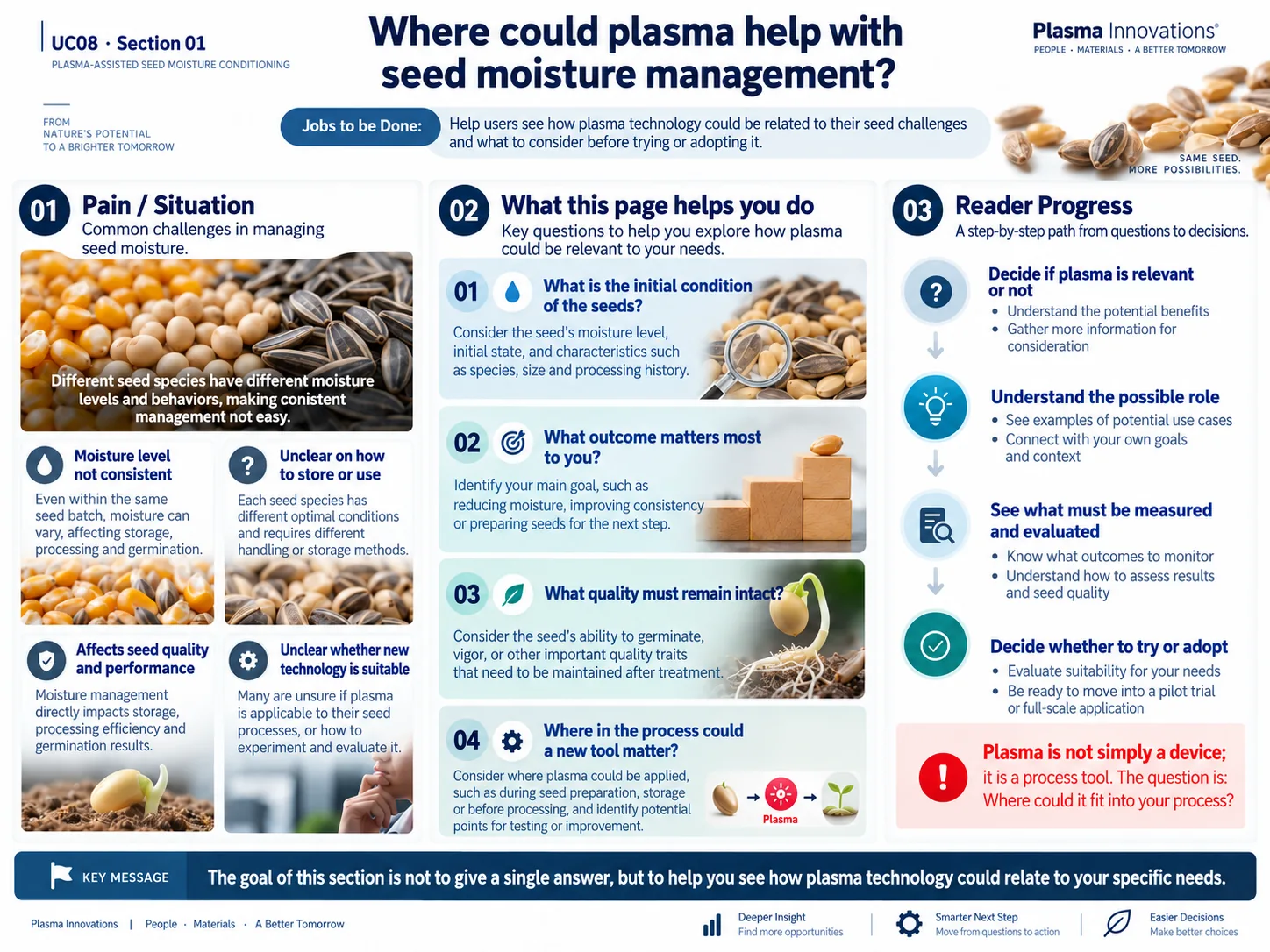
Seeds still too wet—how much moisture must you remove without losing quality?
Define the moisture target and the quality to preserve
If seeds remain above target, first establish how much moisture must be removed and how to do it while preserving seed quality.
Rice-seed experiments show that DBD plasma can change seed moisture under the studied conditions, providing a route worth testing with an actual lot.
Consider the seed's next task and the process step where cold plasma could add the most useful value. Process and quality owners should agree the target together.
Start with the seed's next task and define what must be preserved.
Apply this to your lotAsk ·What is the starting moisture, and what happens to the seeds next?
Next step ·Define a representative lot and moisture target, then assess whether plasma is worth testing.
Key messageCold plasma adds value where it helps the existing process reach an unmet target.
Before choosing a technology, define what moisture level counts as a pass
Use consistent starting conditions, targets and measurement methods
For a useful comparison, establish starting moisture, target moisture, measurement method and the quality that must remain intact.
Mixing wet-basis and dry-basis values makes results incomparable. Use the same calculation basis and measurement approach throughout the trial.
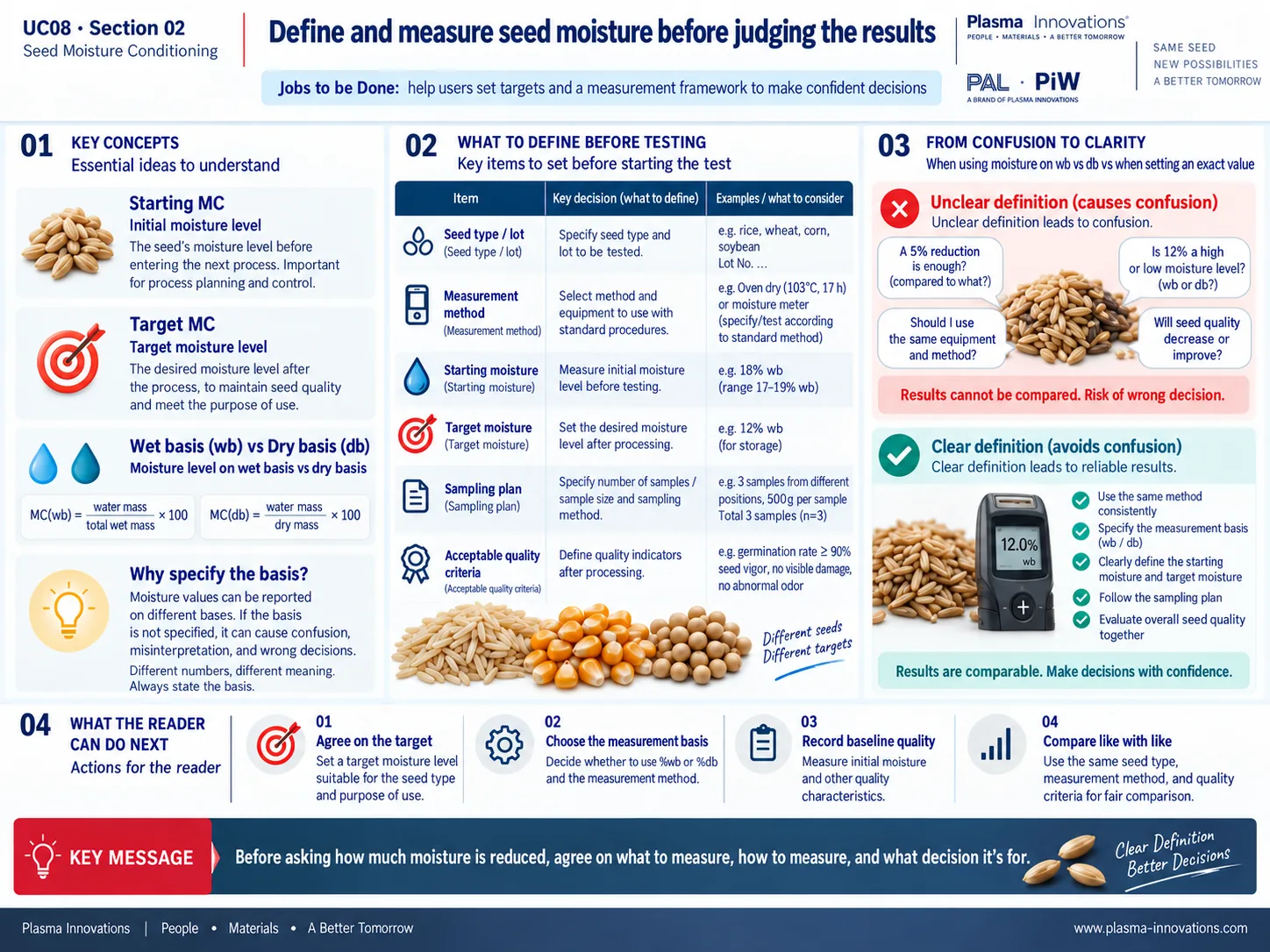
Record starting and target moisture, method and within-lot variation to identify which route most effectively approaches the goal.
Use consistent moisture targets and measurement methods for a meaningful comparison.
Apply this to your lotAsk ·Is your moisture content (MC) reported on a wet or dry basis? Which instrument measures it?
Next step ·Record starting MC, target MC, measurement method, within-lot variation and baseline quality.
Key messageAgree what to measure, how to measure it and what decision the number will support.
Where could cold plasma make a useful difference?
Compare with the current method to identify added value
Test a step where comparison with the current process is clear and there is an opportunity to reduce time or variation, or better reach the moisture target.
Rongsangchaicharean et al. [2] separates ambient, gas-only and plasma-on conditions, helping distinguish plasma effects from gas-flow effects.
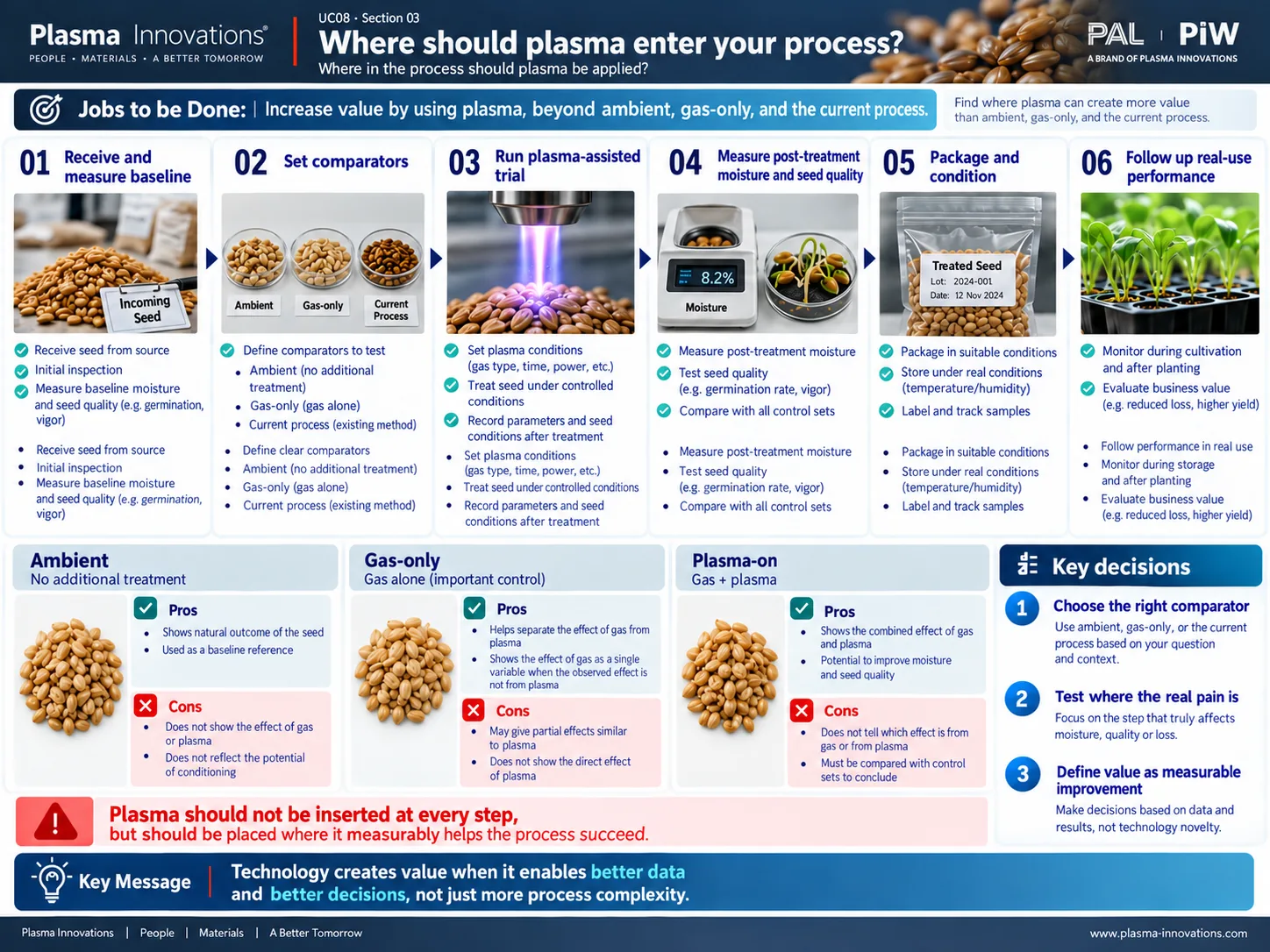
Compare plasma with the current method at the same starting point and target, assessing moisture, quality, time and resources together.
Choose the step where plasma can make the clearest useful difference.
Apply this to your lotAsk ·Is gas alone sufficient, or does plasma add a measurable benefit?
Next step ·Define ambient, gas-only, plasma-on and current-process comparators.
Key messageTechnology earns its place by improving the process.
Different starting moisture can produce different responses
Initial seed moisture strongly influences the response, so lots with different starting conditions may respond differently.
Rice-seed graphs at two starting moisture levels show why baseline moisture matters when selecting trial conditions.
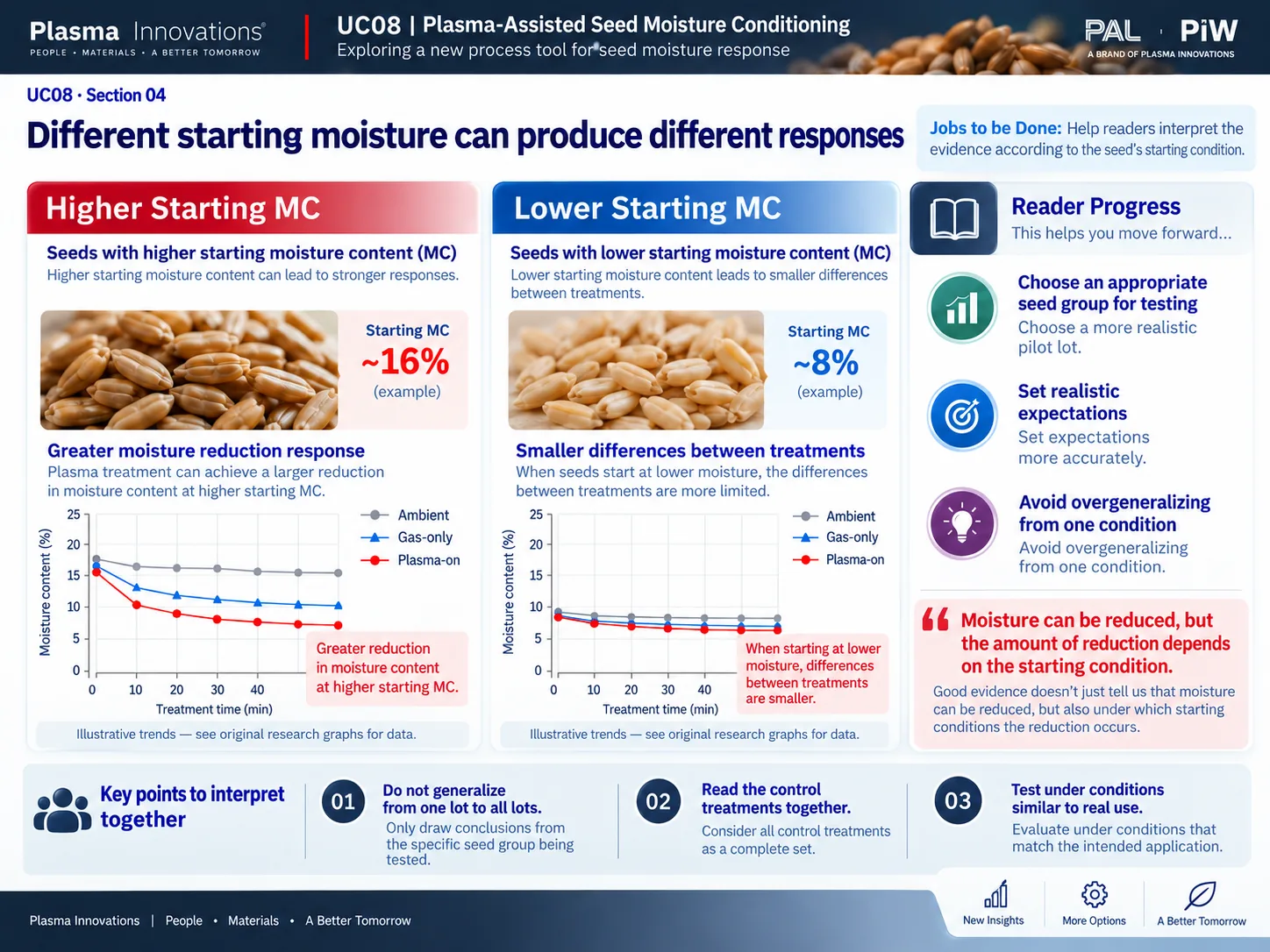
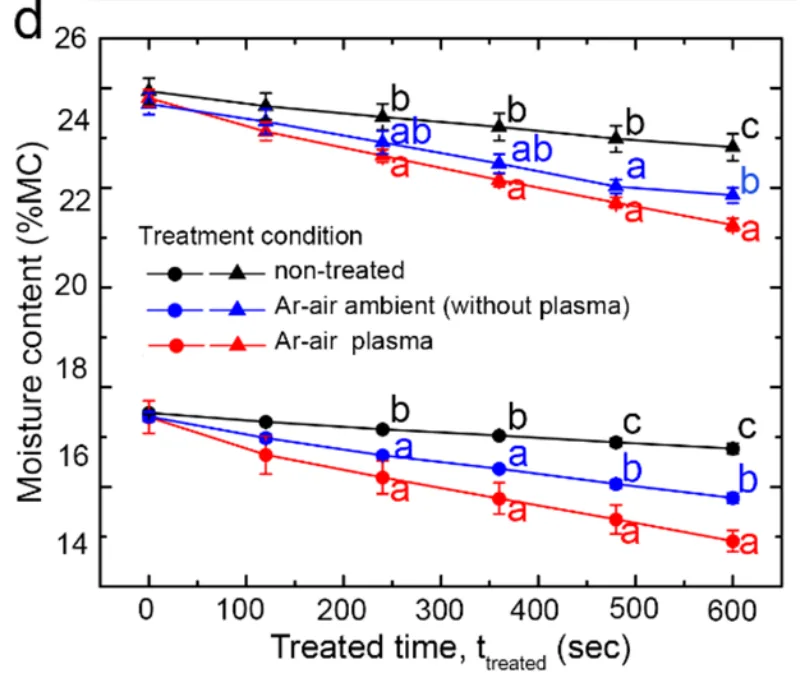
Read trends across the full test period and against both ambient and gas-only controls to assess plasma's contribution.
Use the lot's starting condition to select trial conditions.
Apply this to your lotAsk ·Does our lot start at a similar moisture level to those in the graphs?
Next step ·Group seeds by initial moisture and assess the responses separately.
Key messageInterpret a result alongside the lot's starting moisture.
What can cold plasma add when seeds are already dry?
For a dry lot, check whether another step still adds value
At low initial moisture, differences among plasma, gas-only and ambient conditions may narrow. The trial should establish whether the added plasma step is worthwhile.
Compare every group at the same times, including effect size, variation and seed quality, to assess the value of the extra step.
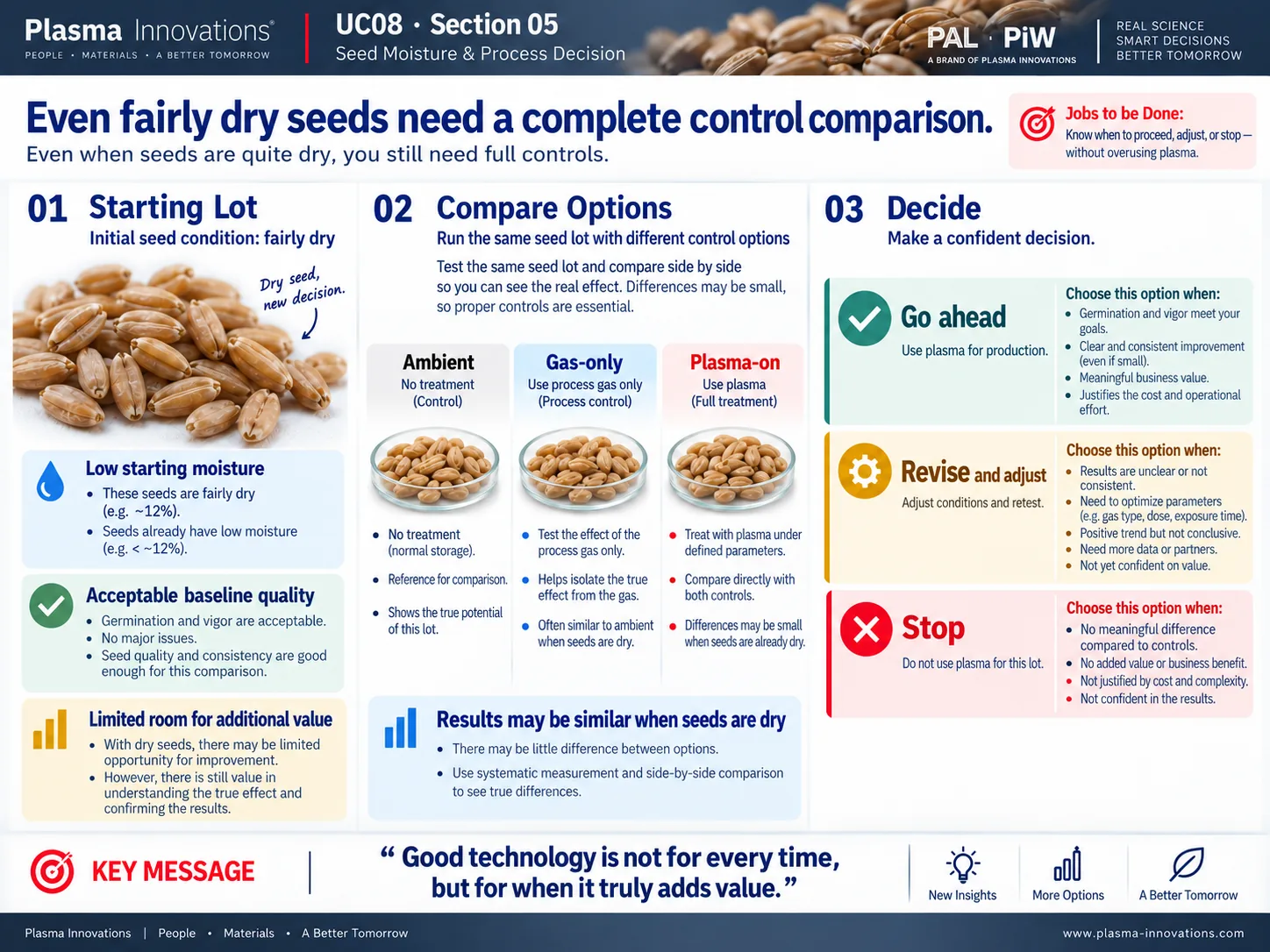
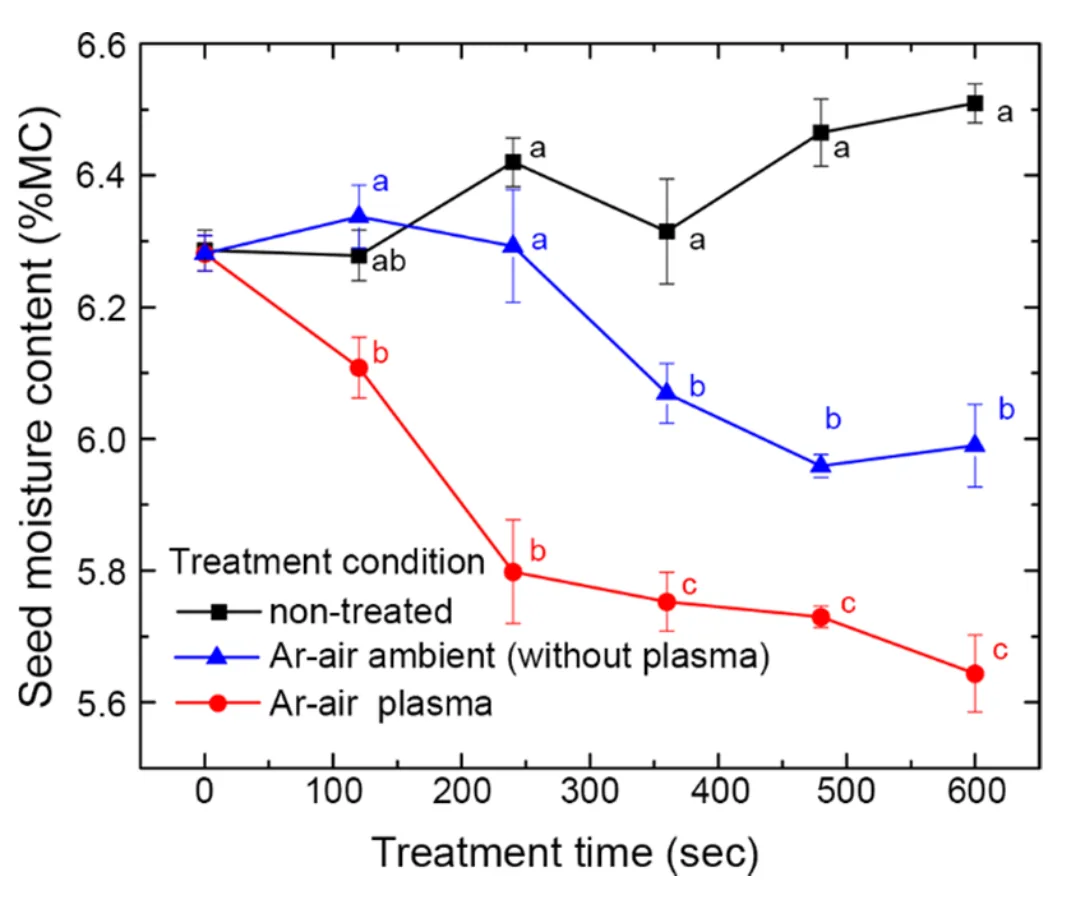
For already-dry seeds, aim for moisture suitable for the intended use, without unnecessary processing.
Use plasma where it adds demonstrable value.
Apply this to your lotAsk ·Does the additional response justify treatment when the seeds start dry?
Next step ·Base Go or Stop decisions on the measured difference from controls and the quality criteria.
Key messageUse cold plasma when it adds useful value.
Moisture reduction is not enough if seed quality also falls
Successful conditioning requires acceptable germination, vigor, integrity and lot consistency alongside moisture reduction.
Monitor seed temperature and environmental conditions together with moisture to capture both intended effects and possible side effects.
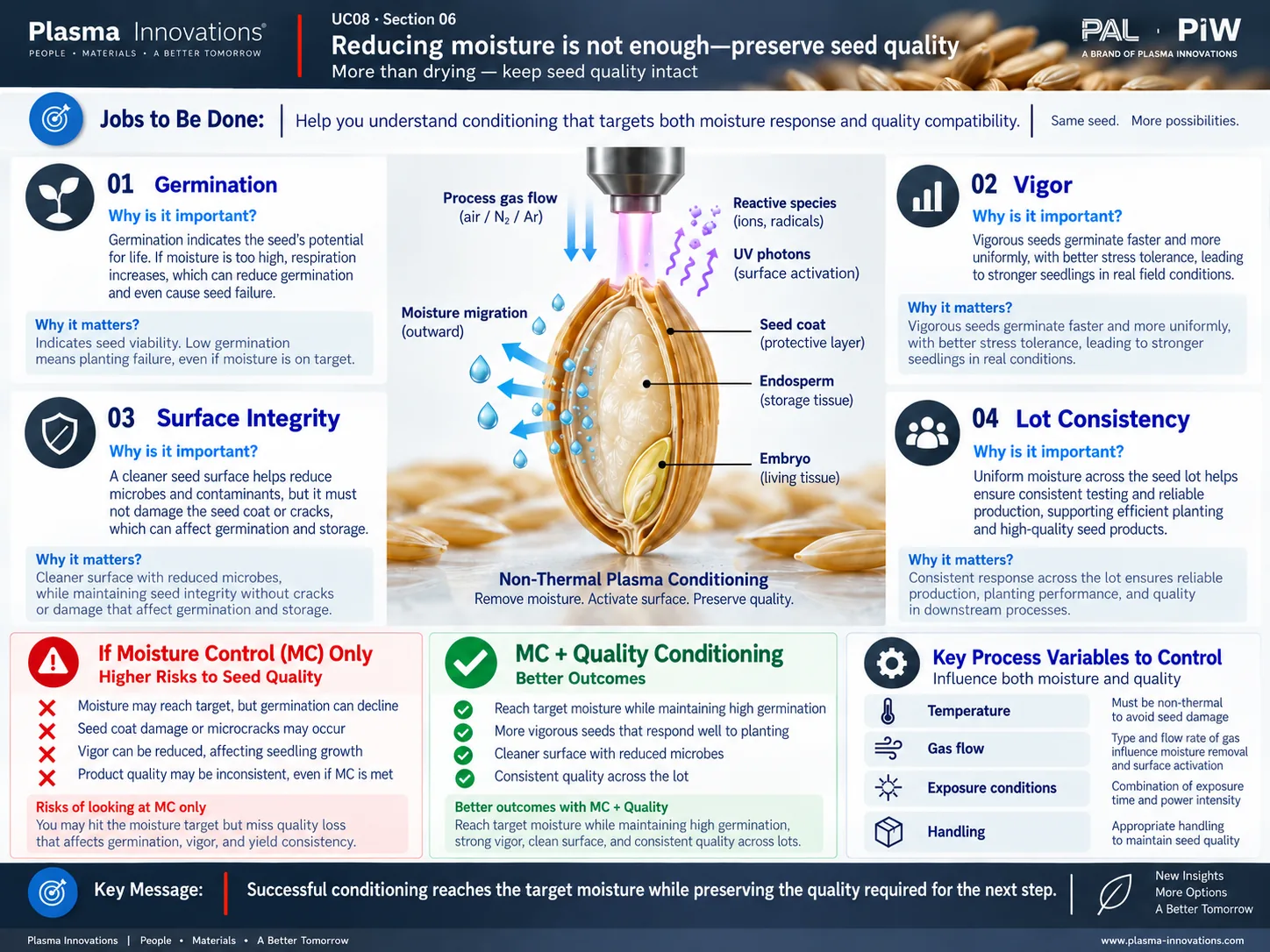
In Rongsangchaicharean et al. [2], major measured constituents such as carbohydrate, fat and protein did not change markedly under the studied conditions, supporting joint assessment of moisture and quality.
Reach the moisture target while keeping quality within specification.
Apply this to your lotAsk ·Must the seeds germinate well, remain in storage or meet other product requirements?
Next step ·Measure MC alongside germination, vigor and product-specific metrics.
Key messageSuccessful conditioning reaches target moisture while preserving what the next task requires.
Do treated seeds stay within the required range?
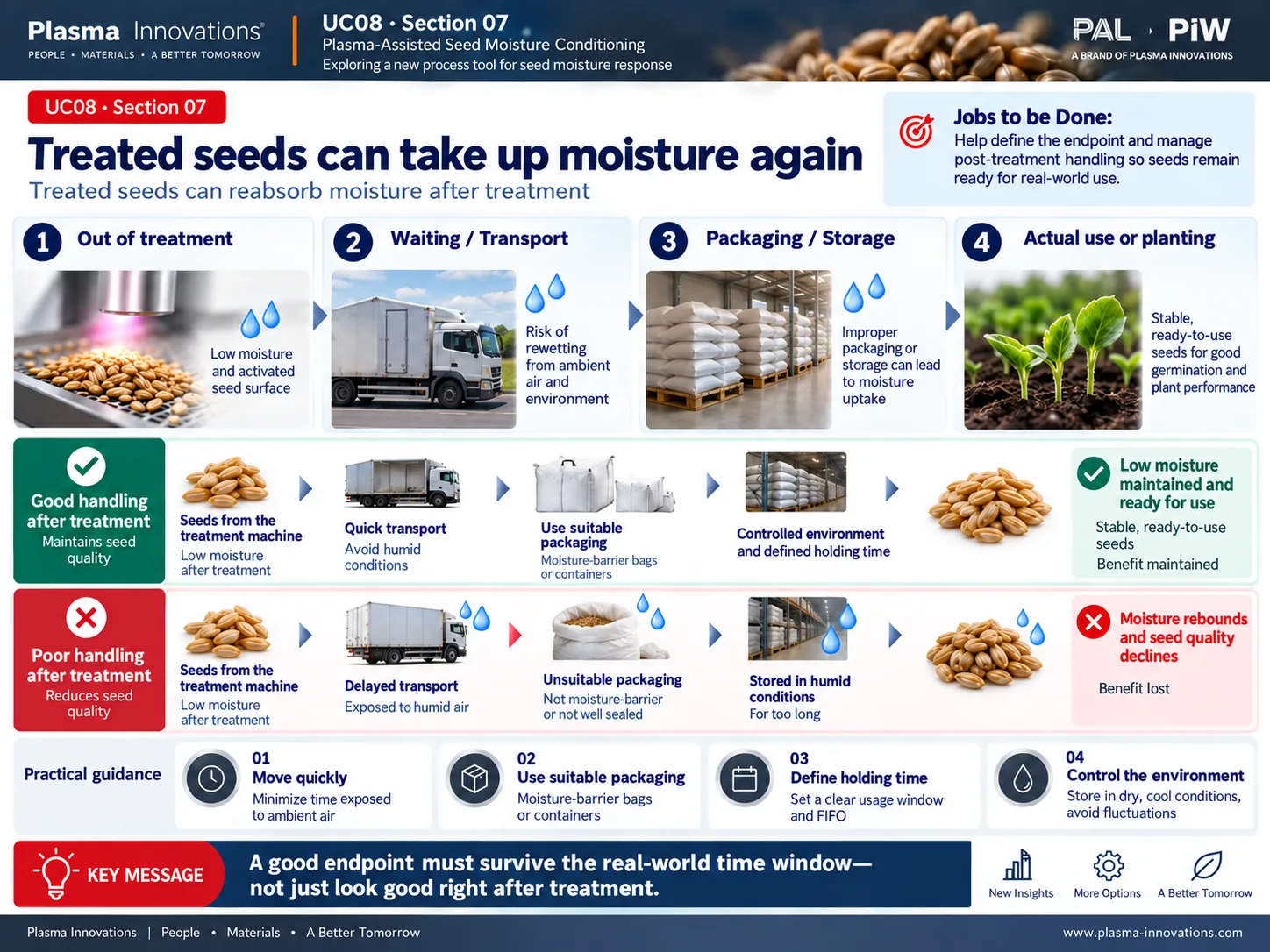
Follow performance through to the time of use
The result at the machine exit is only the beginning: waiting, transport, packaging and storage can change moisture again.
Include measurements after handling and during storage to check whether seeds still meet moisture and quality criteria when needed.
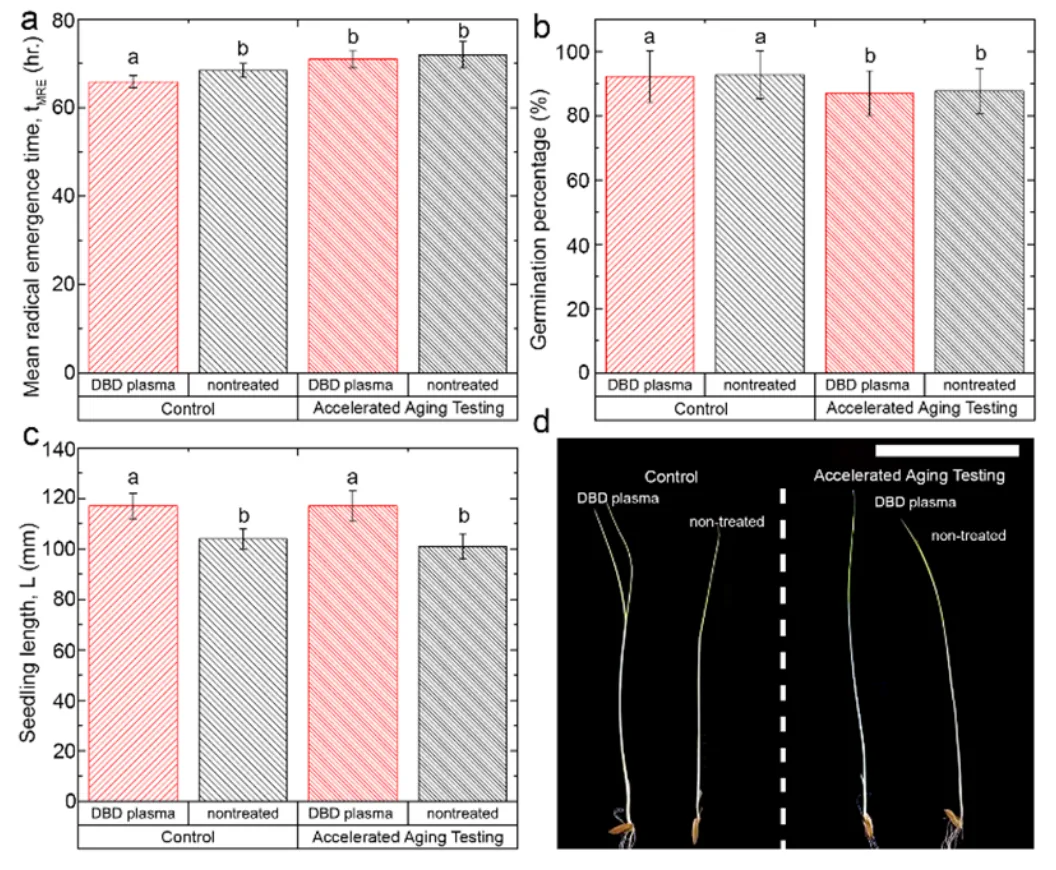
Rongsangchaicharean et al. [2] shows that germination and seedling length do not respond identically before and after accelerated aging. Use moisture and seed quality together as lot-release criteria.
Track through packaging, storage and actual use.
Apply this to your lotAsk ·Does moisture change again after waiting, packaging or transport?
Next step ·Add measurements after handling and during storage under realistic conditions.
Key messageA useful result should remain within the required range when seeds are packaged, stored or used.
How can a laboratory result become a worthwhile production step?
Assess outcomes, cost, time and quality before scaling
When a trial is promising, assess the energy, gas, time and seed handling required by the practical process against its outcome.
Include gas supply, fans, controls, seed transfer and downtime to capture total process cost and capacity.
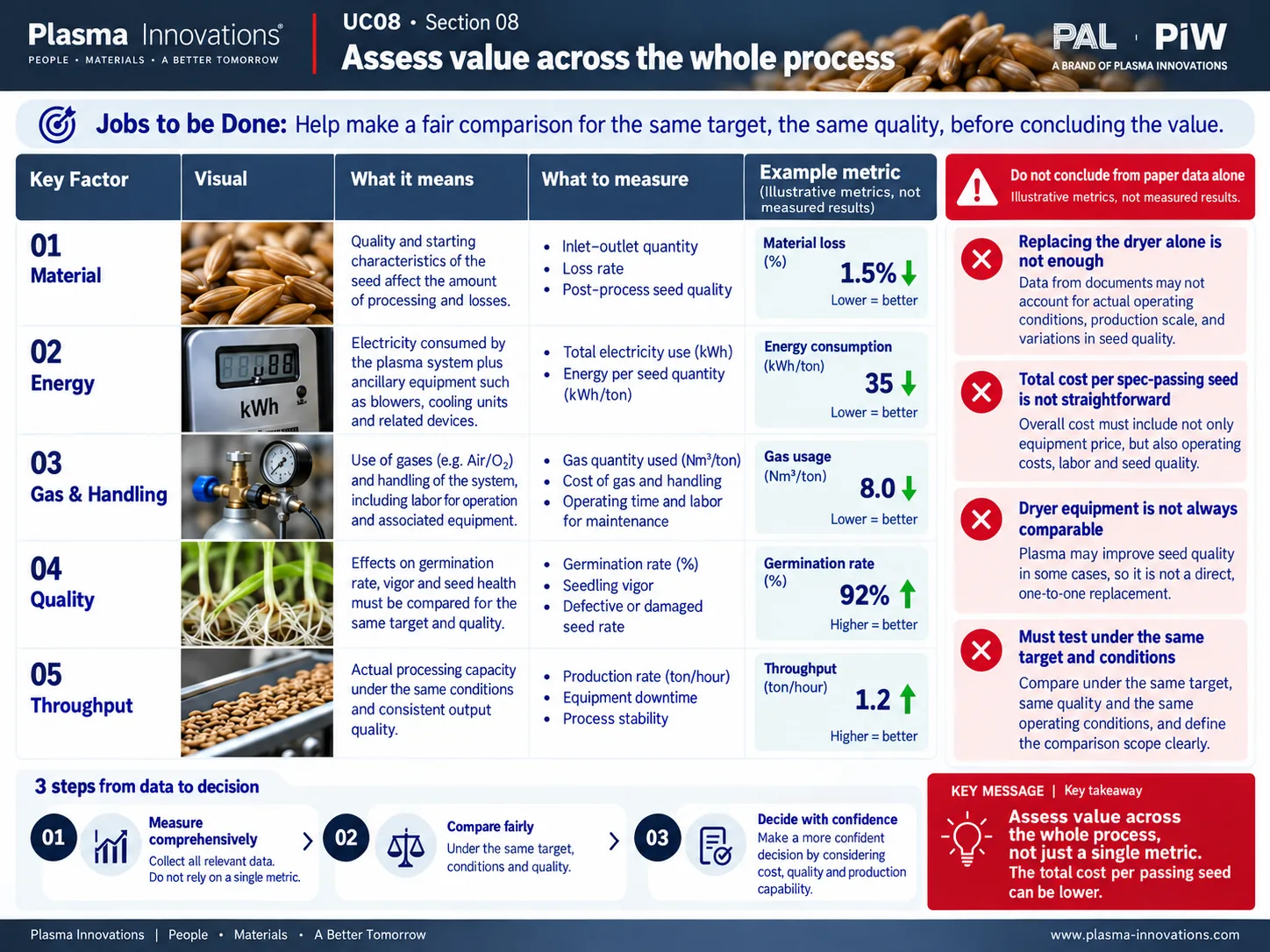
If moisture reaches target but resource use increases without a meaningful benefit, refine the conditions or choose another application point.
Assess value across the whole system.
Apply this to your lotAsk ·How much additional gas, energy, time and labor are required?
Next step ·Record total cost and compare passing quality for the same task.
Key messageEvaluate system-wide outcomes, cost, time and quality together.
Where could cold plasma help in your process?
Choose a trial around the practical bottleneck
The right application depends on the actual needs of seed producers, storage operators, drying-system developers and process R&D teams.
Choose the key constraint—moisture, consistency, quality or storage time—and design the trial to answer that question directly.
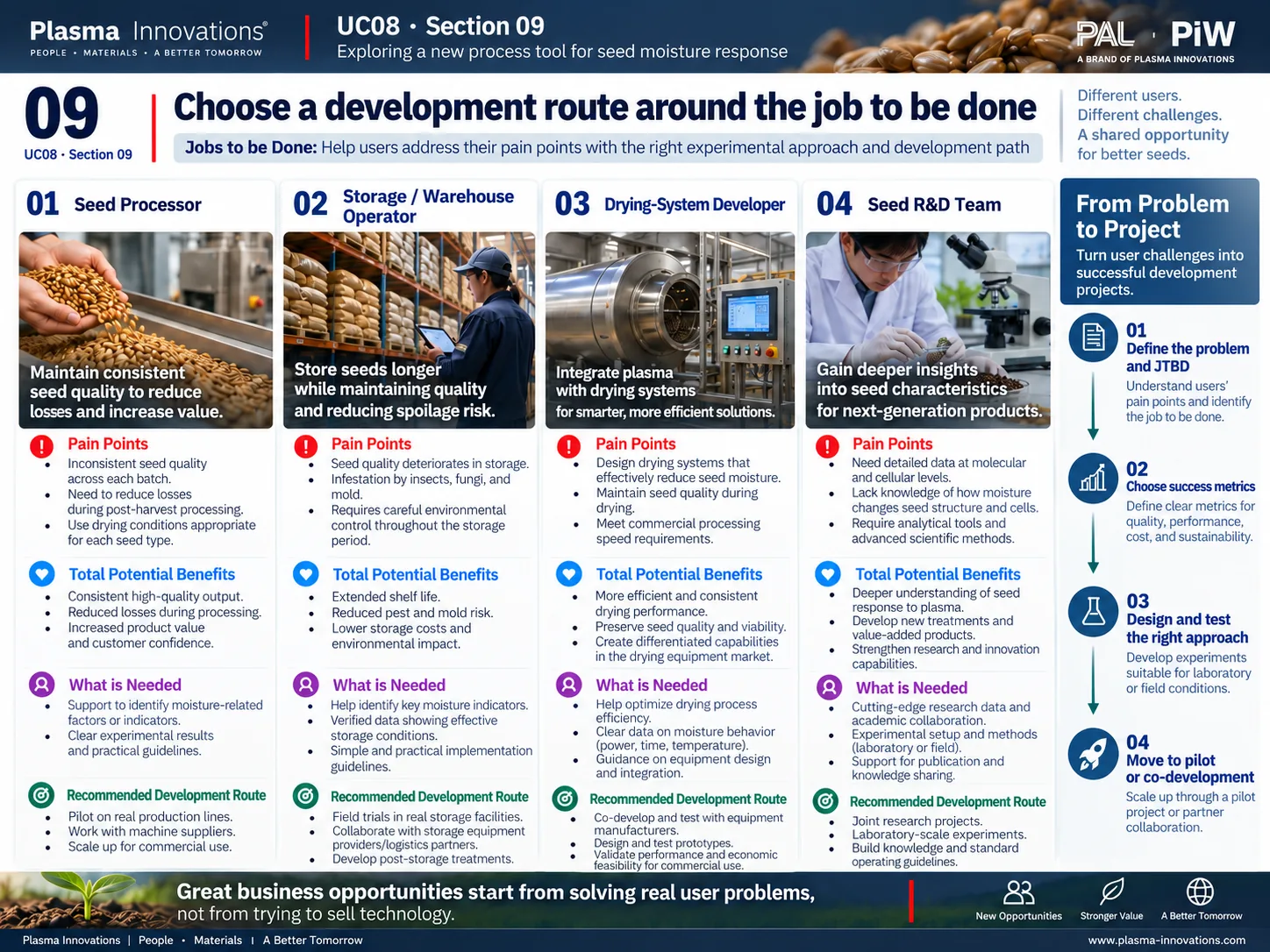
Select one priority problem and design the trial around it.
Apply this to your lotAsk ·Is the main constraint moisture, consistency, quality or storage?
Next step ·Choose one priority question for a feasibility test.
Key messageA useful project starts with a real user problem.
Test an actual lot, assess the result and refine before scaling
Begin with a small controlled comparison of moisture and quality. Find suitable conditions, then move toward a scale that represents the practical process.
As work expands, fit seed handling, monitoring, cleaning and gas systems to actual site constraints.
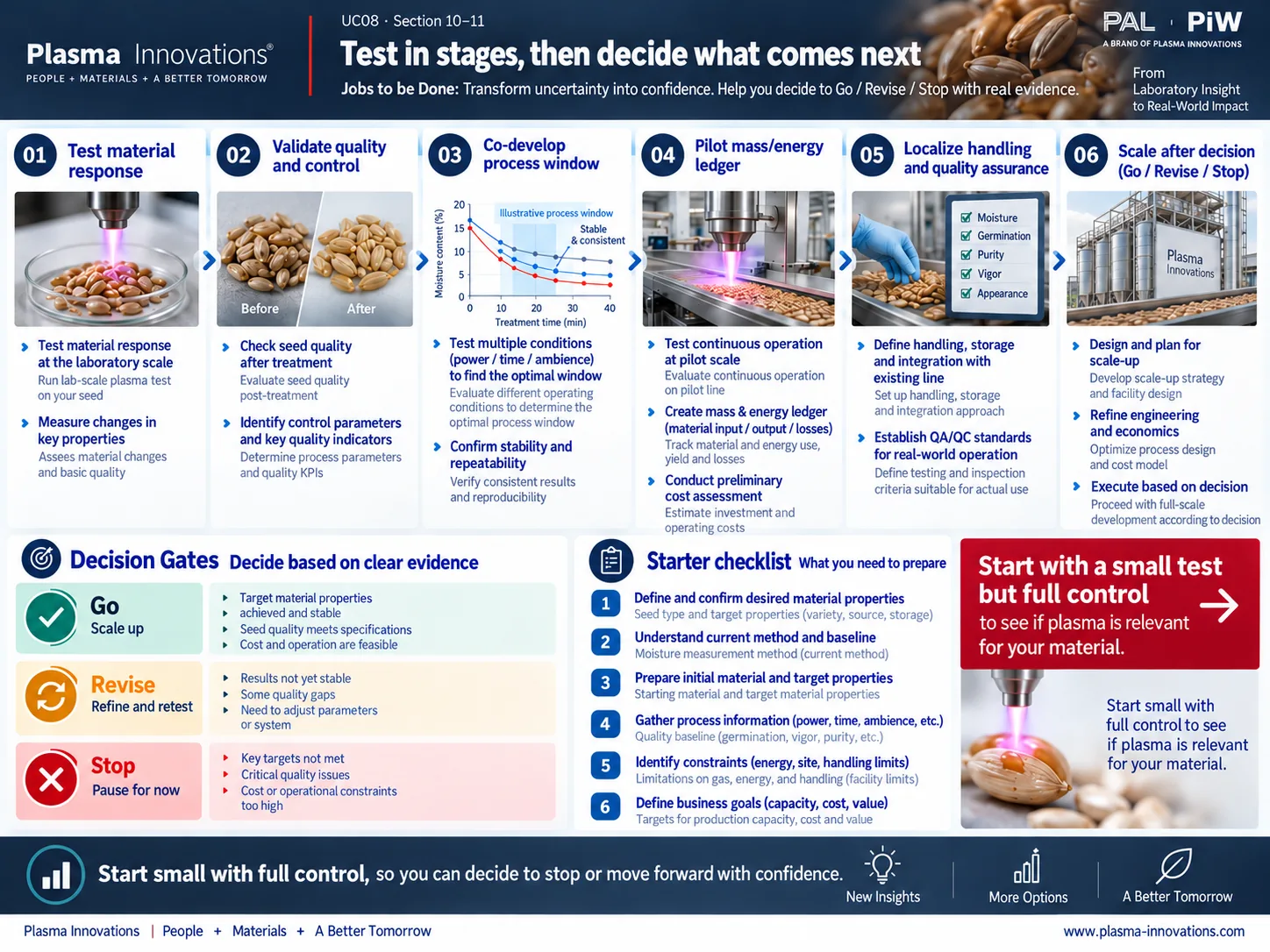
Proceed when moisture is on target and quality and resource use are acceptable. Refine inconsistent results; stop routes that add no useful difference from the current method.
Start small → Assess → Refine → Scale
Apply this to your lotAsk ·What result means Go, Revise or Stop?
Next step ·Define MC, quality and cost criteria before testing.
Key messageStart small and measure clearly to identify what to refine or scale.
Start with your seeds and a trial that answers your question
Bring an actual lot, target and constraints to design a focused trial
Actual lot → Trial → Results → Next step
Provide actual lot information and the desired outcome so the trial can answer one important question clearly.
Compare cold plasma with your current method, assessing moisture, quality and resources before deciding whether to refine or scale.
Once the difference is clear and quality meets specification, integrate the selected route into the existing process.
Apply this to your lotAsk ·Do you have representative seeds and lot information for testing?
Next step ·Share the lot, target and constraints to define the trial together.
Key messageBring the lot → Set the target → Test → Measure → Choose the next step
Start with your actual seed lot
Bring an actual lot, target and constraints to design a trial that answers one question clearly. Contact the Plasma Innovations team at [email protected] to compare cold plasma with your current method on moisture, quality and resources before deciding to refine or scale.
Email the research team[email protected]See other cold plasma use cases →What to prepare
- Seed species and lot
- Starting moisture, target moisture and measurement method
- Quality to preserve, such as germination and vigor
- The seed's next step: storage, processing or sowing
- Your current drying method and its constraints
References
- Srisonphan S. (2018). Tuning surface wettability through hot-carrier-initiated impact ionization in cold plasma. ACS Applied Materials & Interfaces, 10, 11297–11304. doi:10.1021/acsami.7b19495
- Rongsangchaicharean T., et al. (2022). Effect of dielectric barrier discharge plasma on rice (Oryza sativa L.) seed hydration and hygroscopicity. Journal of Physics D: Applied Physics, 55, 365201. doi:10.1088/1361-6463/ac791d
- CDC/NIOSH Pocket Guide — Ozone. Background for gas-management and installation planning
- IRRI Rice Knowledge Bank — How to ensure seed quality. Background on seed-lot quality, germination versus establishment, vigor and moisture