

Cold Plasma / UC04
Use case UC04 · Seed priming
More usable seedlings. Ready sooner. Ready together.
The real goal of seed preparation is enough usable seedlings, on time. The team's research primed rice, lettuce and cabbage seeds with dry and water-immersed plasma treatments. This article helps you choose the right measures and design a trial with your own lot.
Research by Assoc. Prof. Dr. Siwapon Srisonphan and the Plasma Innovations team, Department of Electrical Engineering, Kasetsart University
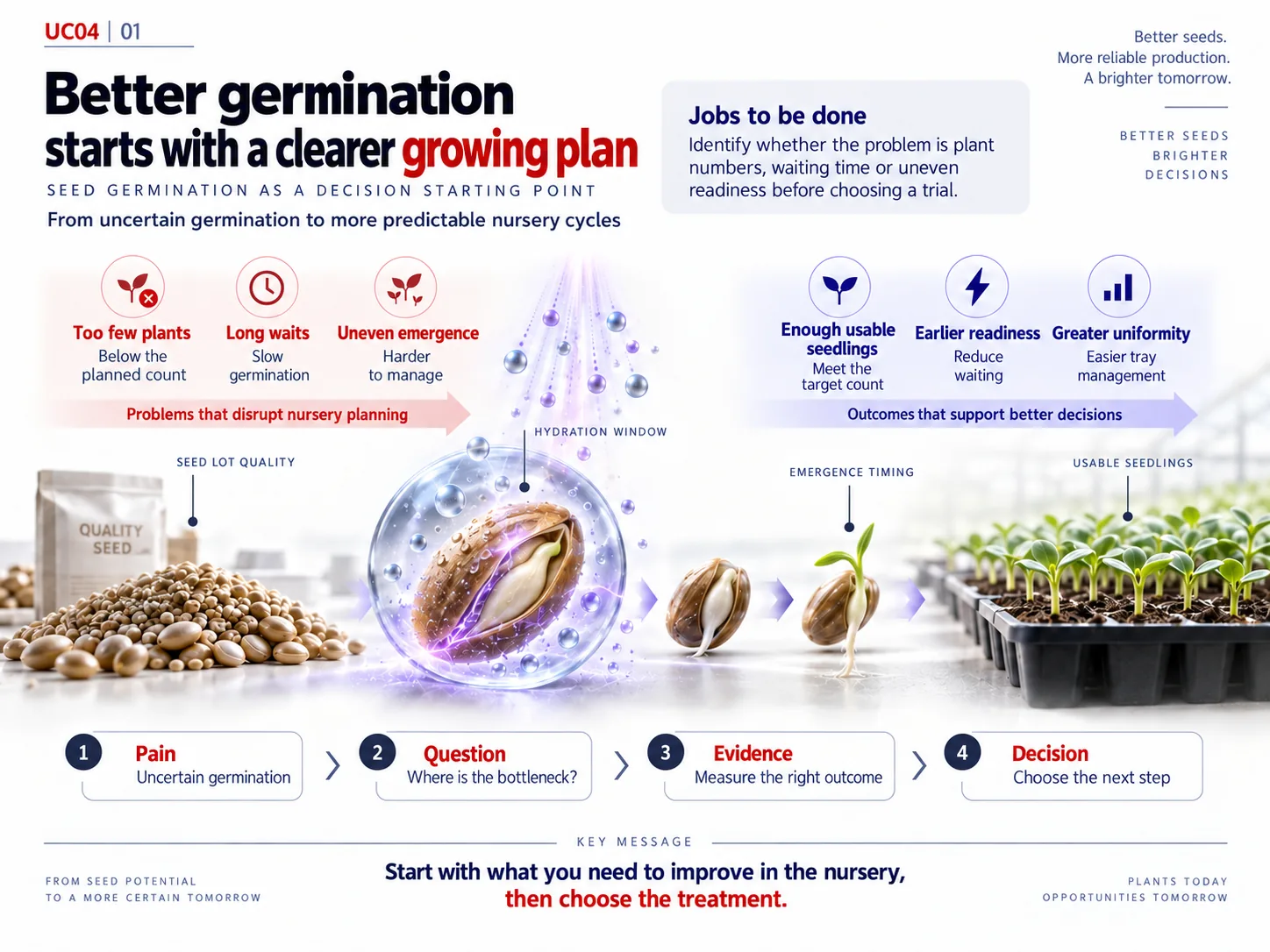
3 questionsEnough plants? Ready sooner? Ready together?
3 cropsRice, lettuce and cabbage in the team's cited research
1 lotStart with one problem and one actual lot, compared with your current seed preparation
Figures in this article are laboratory results under the conditions of the cited studies. Results with your own lot or growing system need to be tested.
Where does your nursery process get stuck?
Some lots germinate incompletely, slowly or unevenly. These problems directly affect the number of usable seedlings, transplanting schedules and the labor needed to repair trays
Nurseries / CEA Enough usable seedlings, ready on time
Reduce oversowing, tray repair, waiting for slower plants and uncertainty in nursery cycles
Seed producers Know which lots respond
Identify promising crops and lots before investing in wider use
OEM / R&D Build evidence before developing the system
Find a suitable treatment range and assess its practical value before developing equipment for the application
01 · PROBLEM Too few plants / Long waits / Uneven readiness
02 · PROGRESS More usable seedlings, ready together
03 · EVIDENCE Identify responsive lots worth developing further
04 · DECISION Decide: Adjust · Repeat · Scale
Uncertain germination makes nursery schedules uncertain
The practical goal is enough usable seedlings, ready on time and with consistent qualityStart with the lot's problem and choose measurements that let the trial answer what to do next
Too few plants
Empty tray cells mean oversowing or tray repair, using more seeds and labor
Long waits
Slower-than-expected emergence can delay transplanting or delivery
Uneven readiness
Plants in one tray reach different stages, making lots harder to manage and readiness dates harder to plan
For nurseries and production planners, the key question is how many usable plants this lot will deliver, and when. Incomplete germination calls for more oversowing; slow germination can delay the schedule; and emergence spread across several days can leave plants in the same tray at different stages
Before choosing a seed treatment, distinguish incomplete, slow and uneven germination. Each problem calls for a different measurement. The goal is a nursery cycle that is easier to plan and manage
Where the problem adds cost
- Extra seeds for oversowing
- Labor for tray repair, resowing and sorting
- Greenhouse space occupied for longer
- Less reliable transplanting and delivery schedules
Existing approaches, and questions to resolve
- Higher-grade seed may help, at an additional cost
- Hydropriming / osmopriming are important comparators; include preparation time and the interval before sowing
- Oversowing manages an immediate risk but uses more seeds and labor
- Compare coatings and other treatments against the method you actually use
The improvement you should be able to see
From uncertainty about the bottleneck to knowing whether to focus on plant numbers, timing or uniformity
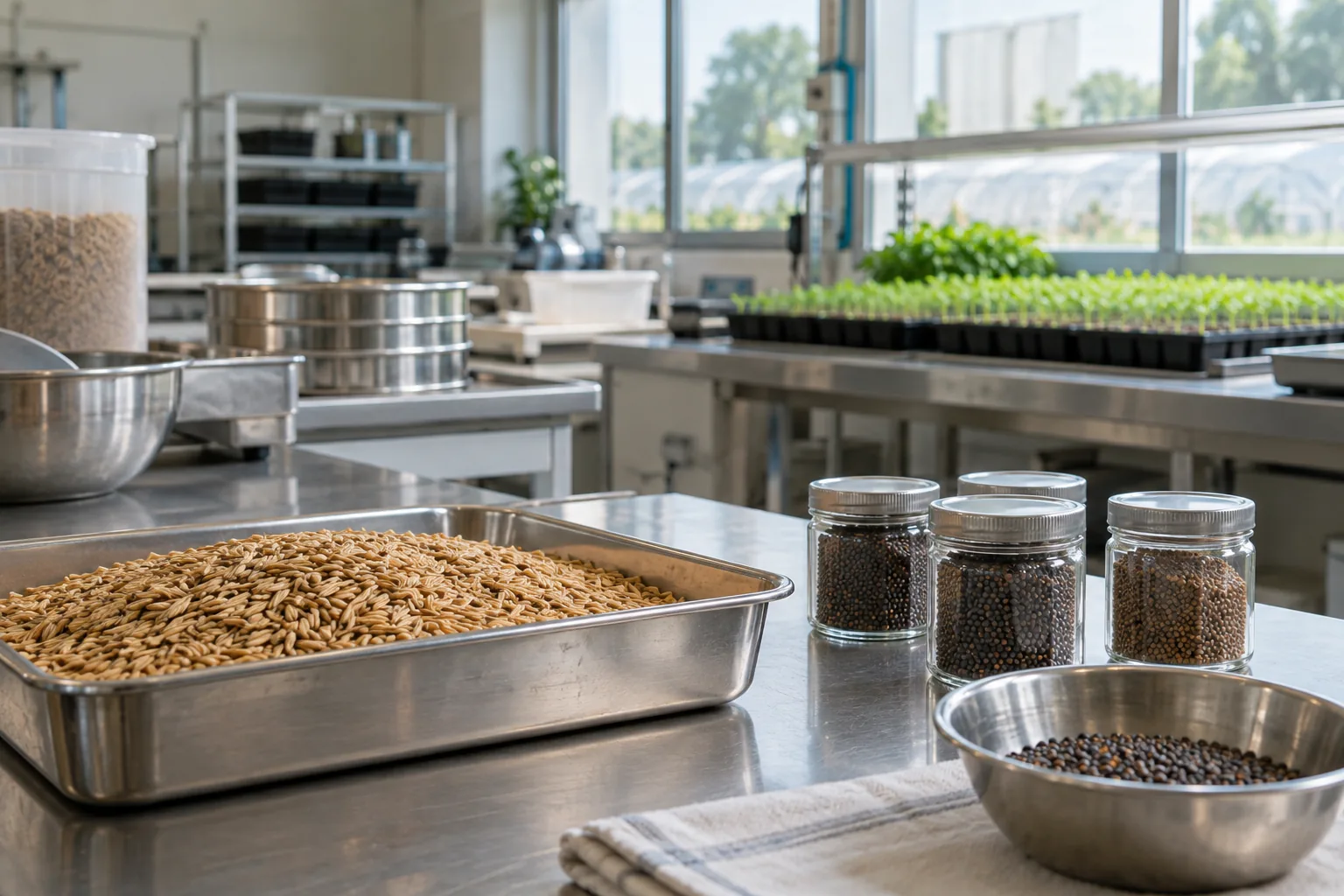
In the nursery, follow germination through to the number of seedlings ready for the next stage at the required time. This connects experimental results to practical performance
Key messageStart with the lot's problem and nursery schedule, then choose the measurements that will determine success
Germination matters when it delivers usable seedlings at the time you need them
The practical benefit to assess is having acceptable seedlings within the required time window. Earlier laboratory germination may help nursery planning, but operational value must be demonstrated in real trays: successfully established cells, the spread of readiness times and performance after transplanting
Assess both levels together: how the seeds respond and whether tray readiness improves. A laboratory gain only meets the practical need if it translates into a useful change in the nursery
Connect seed measurements to nursery decisions
Number germinated Number of usable plants
Follow through to normal seedlings and filled tray cells
Speed Are seedlings ready sooner?
Measure the target readiness day; MGT is not the total production time
Uniformity Are seedlings ready together?
Measure the spread of readiness times and sorting or tray-repair work in the pilot
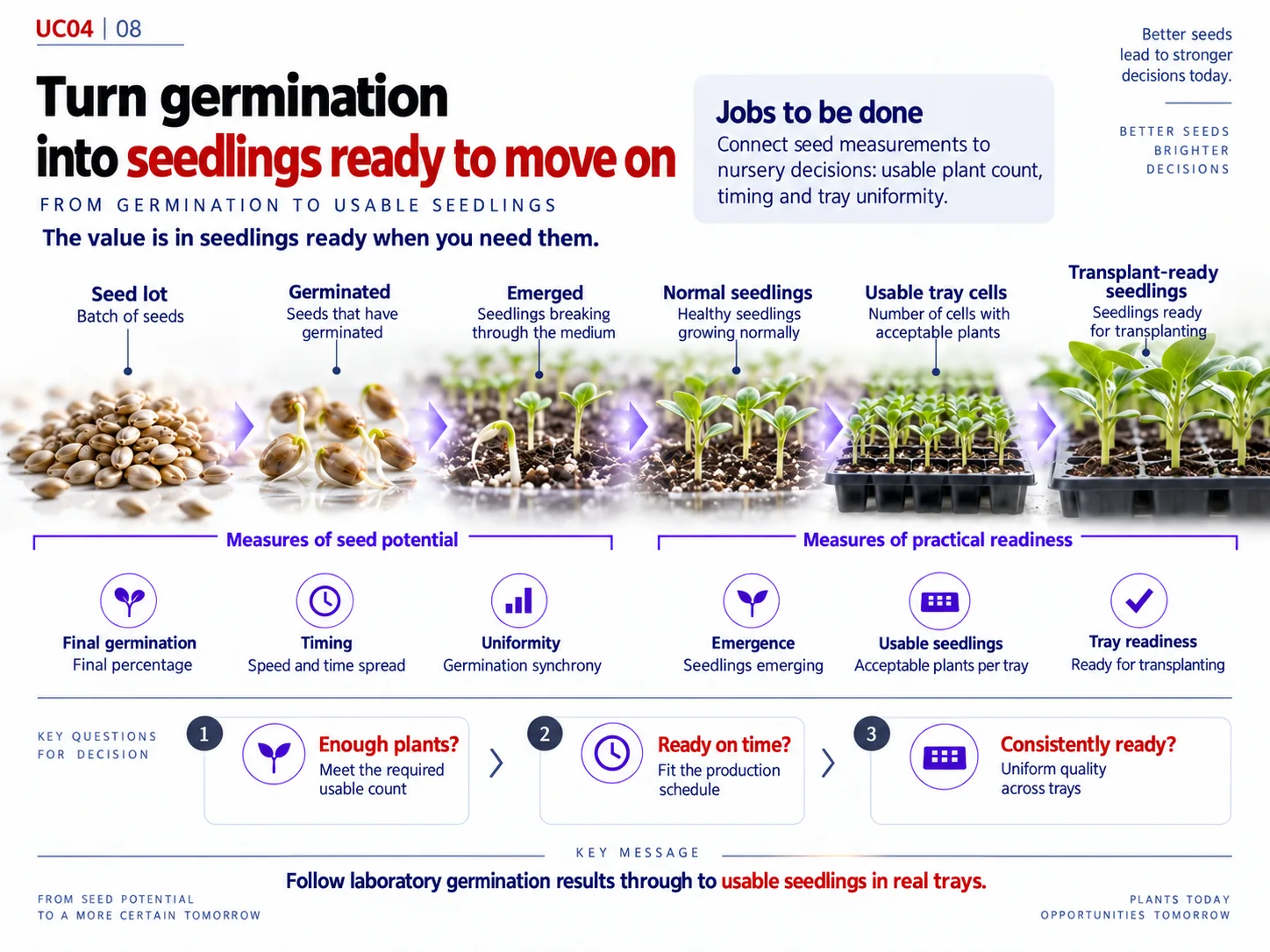
The outcome your operation needs to see
From a higher germination percentage to enough usable seedlings, ready on time and consistently ready for the next stage
To assess reductions in sorting, tray repair or cycle time, collect data from real nursery trays alongside germination measurements
Key messageFollow the germination percentage through to how many usable seedlings the lot produces and when they are ready
Green Oak lettuce shows the potential for faster, more uniform germination
The Green Oak study compared several seed-preparation methods. Its results indicate that plasma-assisted immersed priming can accelerate germination and concentrate it within a narrower time window
These findings provide a starting point for nursery-tray trials to assess how much earlier and more uniformly seedlings become ready
The next step is a trial in your growing system
Assess whether seedlings are ready sooner and more consistently, and how much tray repair or waiting is reduced
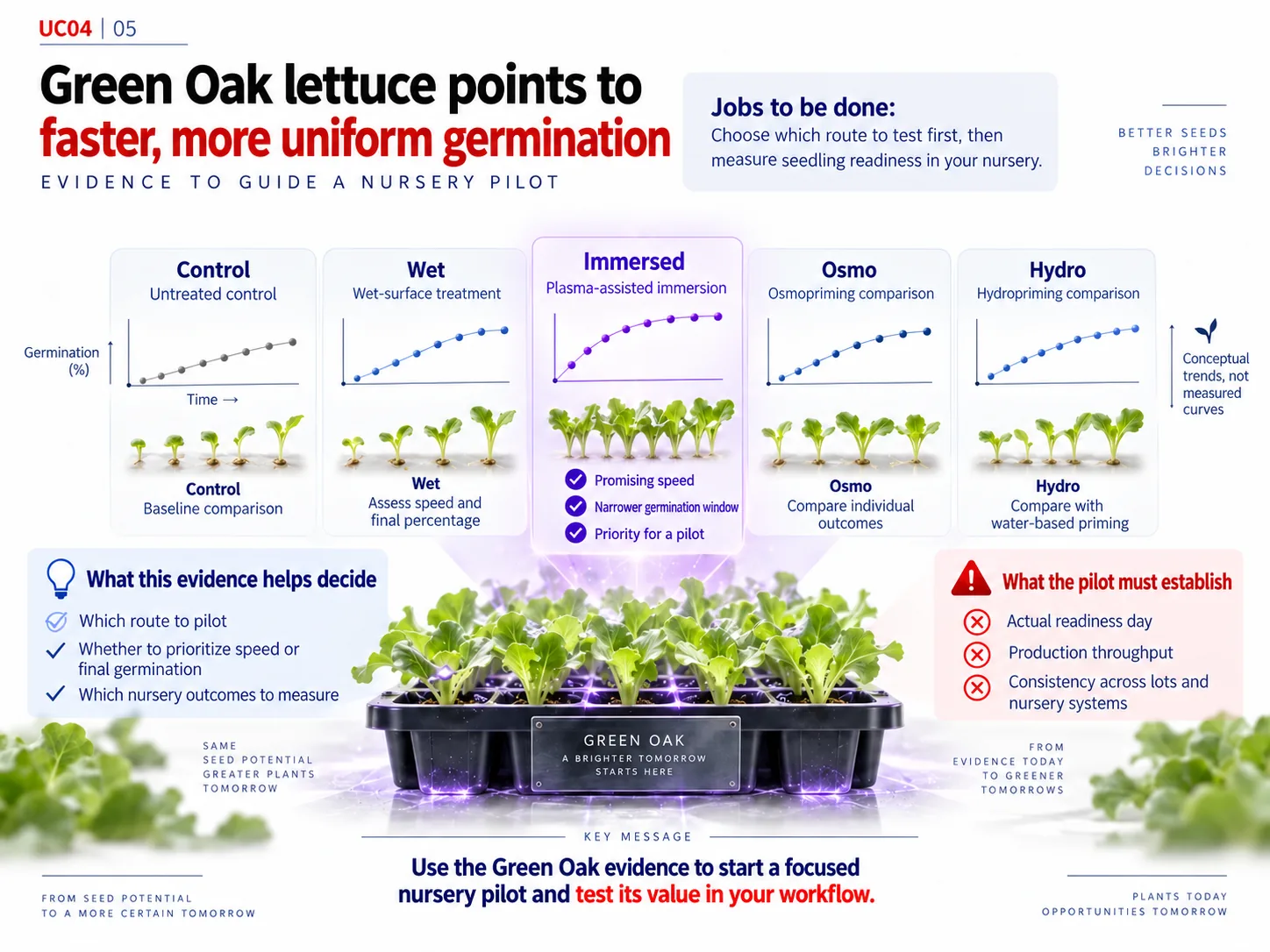
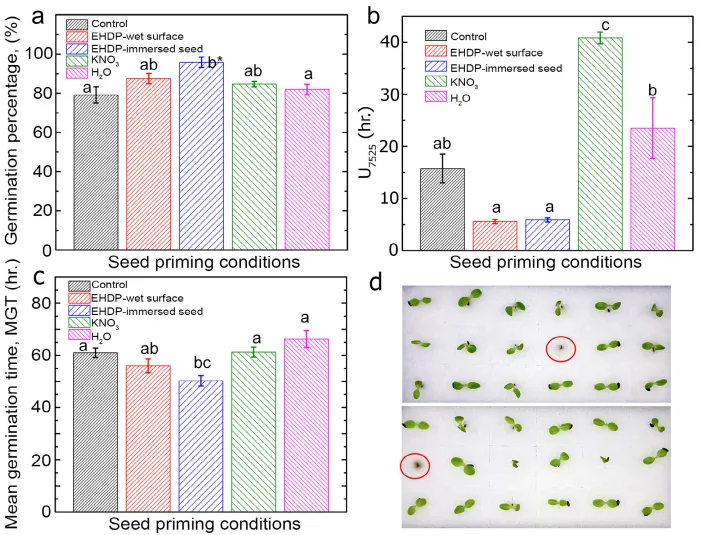
This graph compares several seed-preparation methods and shows the direction of changes in germination speed and uniformity
Key messageThe Green Oak results provide a useful starting point for a trial in an actual nursery system
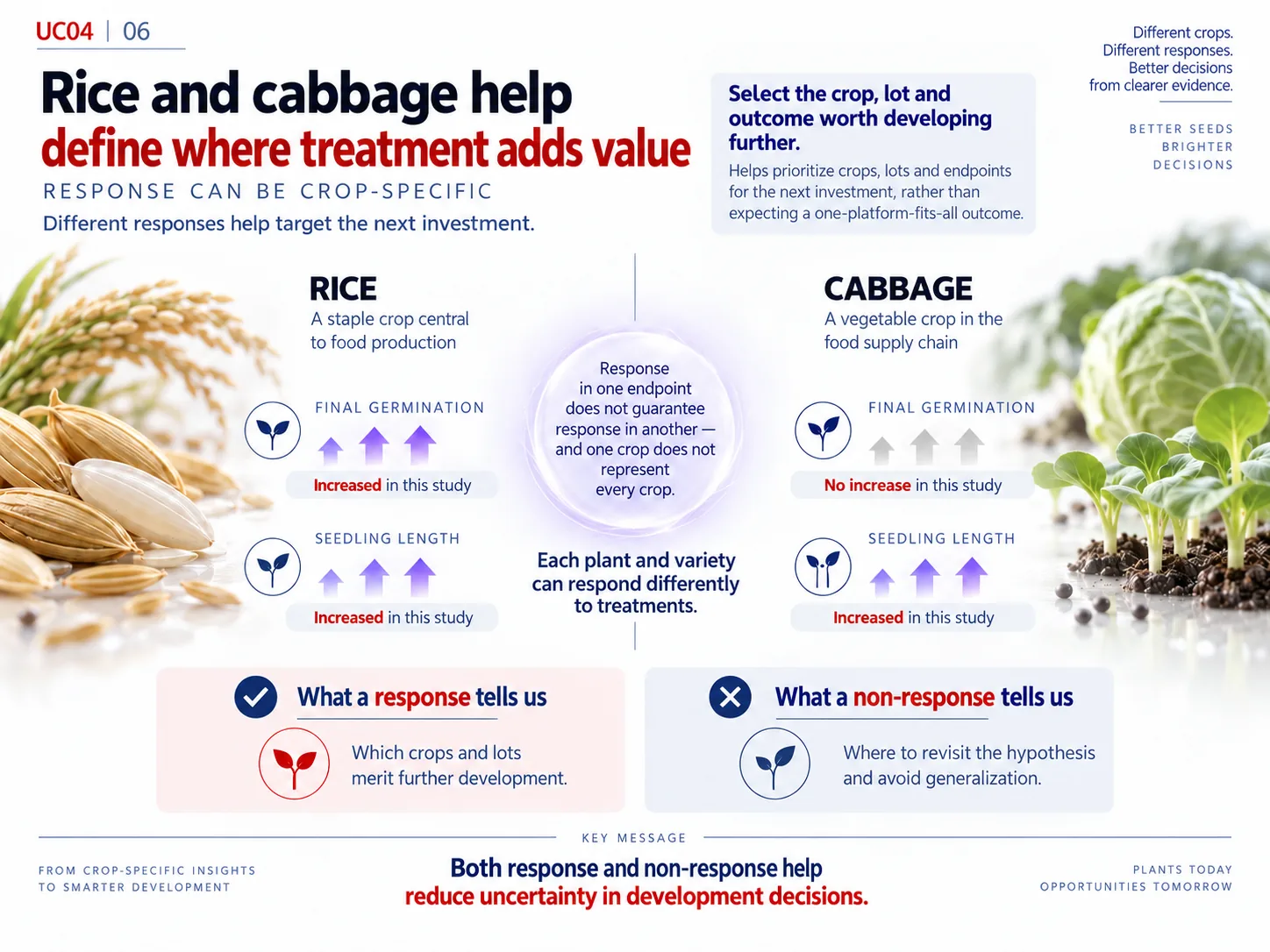
Different crops respond differently: test your lot before scaling
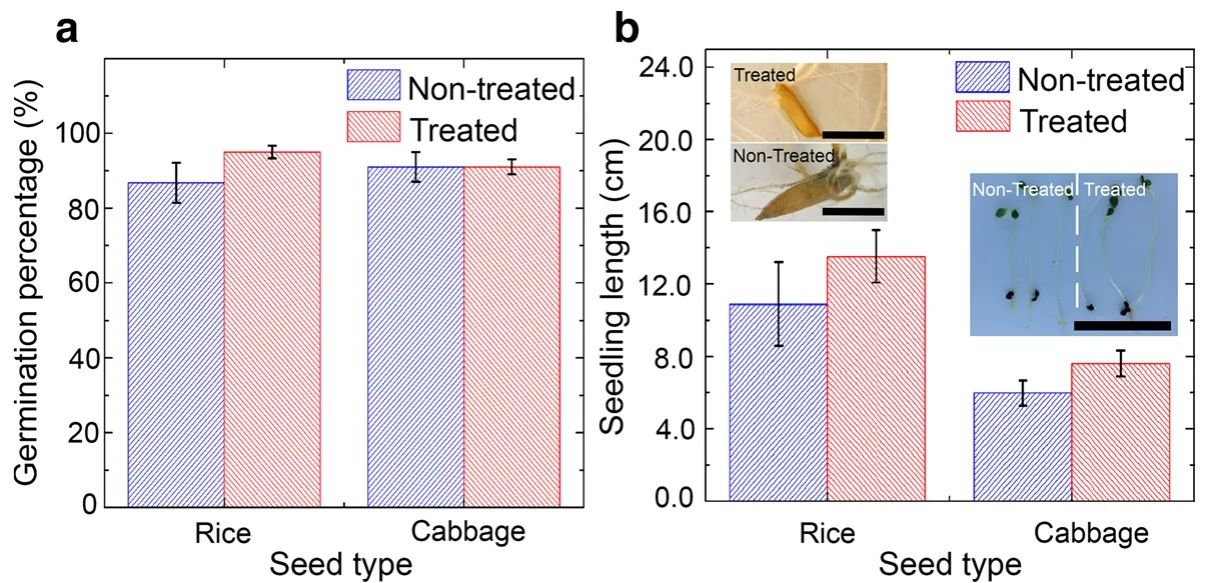
Srisonphan et al. [5] examined rice and cabbage in the same study, showing that the same outcome can respond differently between crops. Final germination increased in rice but not in cabbage, while seedling length responded in both
Read both panels together to distinguish seedling length from final germination. Khamsen et al. [1] provides rice germination evidence in a different context. The studies should not be pooled into one platform-wide performance figure, and citations of an earlier study are not additional replications
Identifying responsive crops and lots early helps focus development and avoid investment in conditions that add no practical value
Key messageBoth responsive lots and lots showing no difference help identify worthwhile next steps sooner
Treat today. When will you sow?
Rongsangchaicharean et al. [3] distinguishes germination speed from final percentage: MRET responded before accelerated aging, while final germination did not differ significantly between treated and untreated seeds. Some responses changed after aging
When developing priming or dry treatment, define when the seeds will be used. Immediate sowing, a waiting period and storage for sale require different validation plans
Immediate use
Treat → Sow
For immediate use, assess whether seedlings become ready sooner and more uniformly
A waiting period
Treat → Wait / Transport / Store → Sow
Test the waiting interval, packaging and seed quality under conditions close to actual use
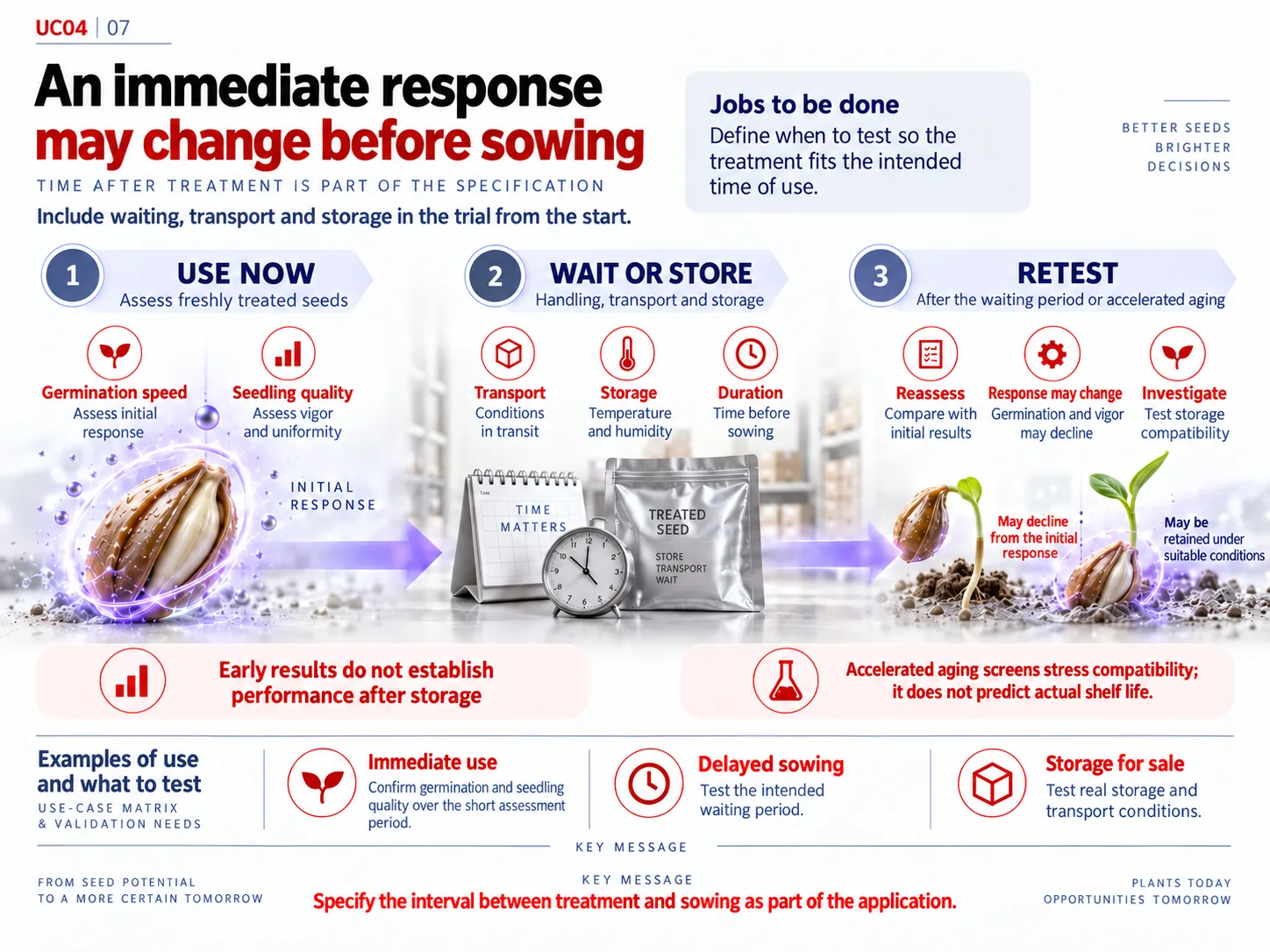
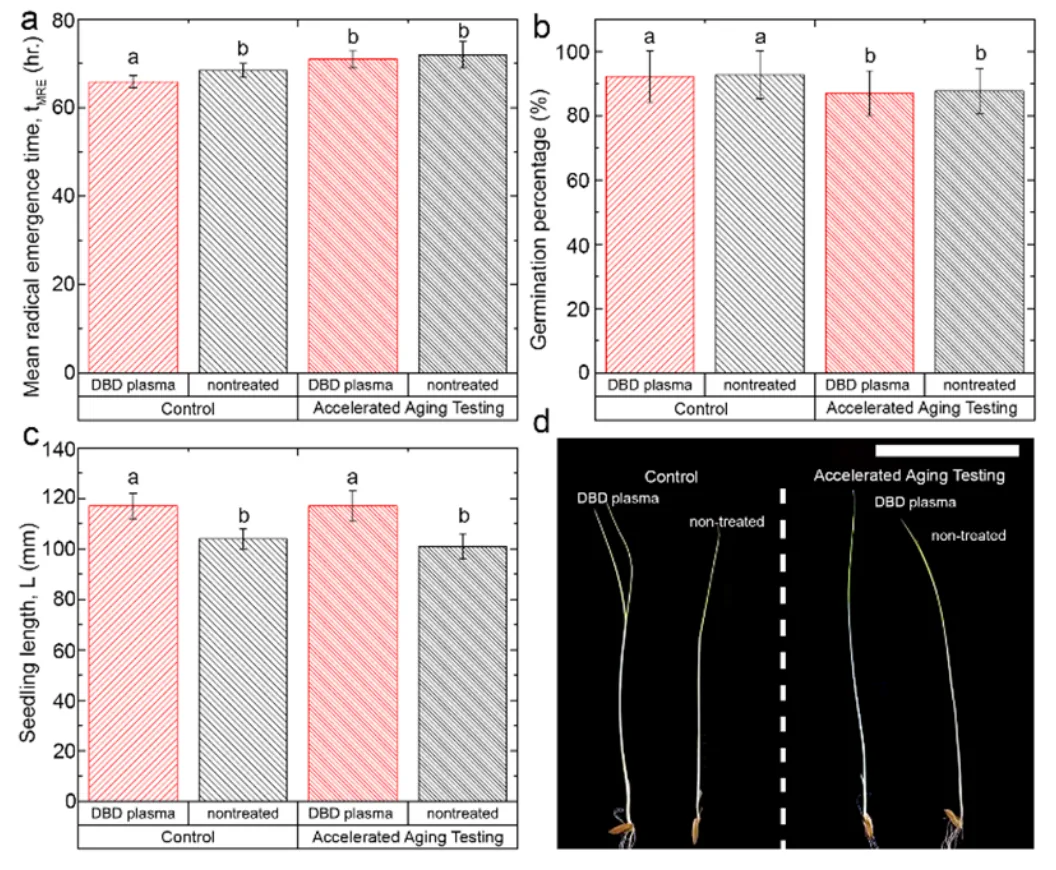
Accelerated aging is a stress test for treatment compatibility with seed quality; it does not establish an actual storage life in months. If the workflow includes a delay after treatment, test the intended waiting intervals and packaging with both treated and untreated controls
Key messageSpecify the interval between treatment and sowing as part of the application
Choose a treatment route that fits your existing process
Dry plasma treatment exposes seeds to a discharge before hydration and sowing. Plasma-assisted immersed priming combines seeds, water and discharge within seed preparation. The two routes have different handling steps and comparators, even though both target germination performance
Start with the current workflow. Seed treatment before storage or transport requires delayed-use testing. A process that already includes soaking before sowing calls for matched water handling and conventional priming comparators
Route A
Dry seed treatment
A route to assess when no soaking step is in place, or when intervening before sowing or storage with limited additional water handling
Route B
Water-based preparation
A route to assess when hydration or priming is already part of the process, using hydropriming, osmopriming or the current method as a fair comparator
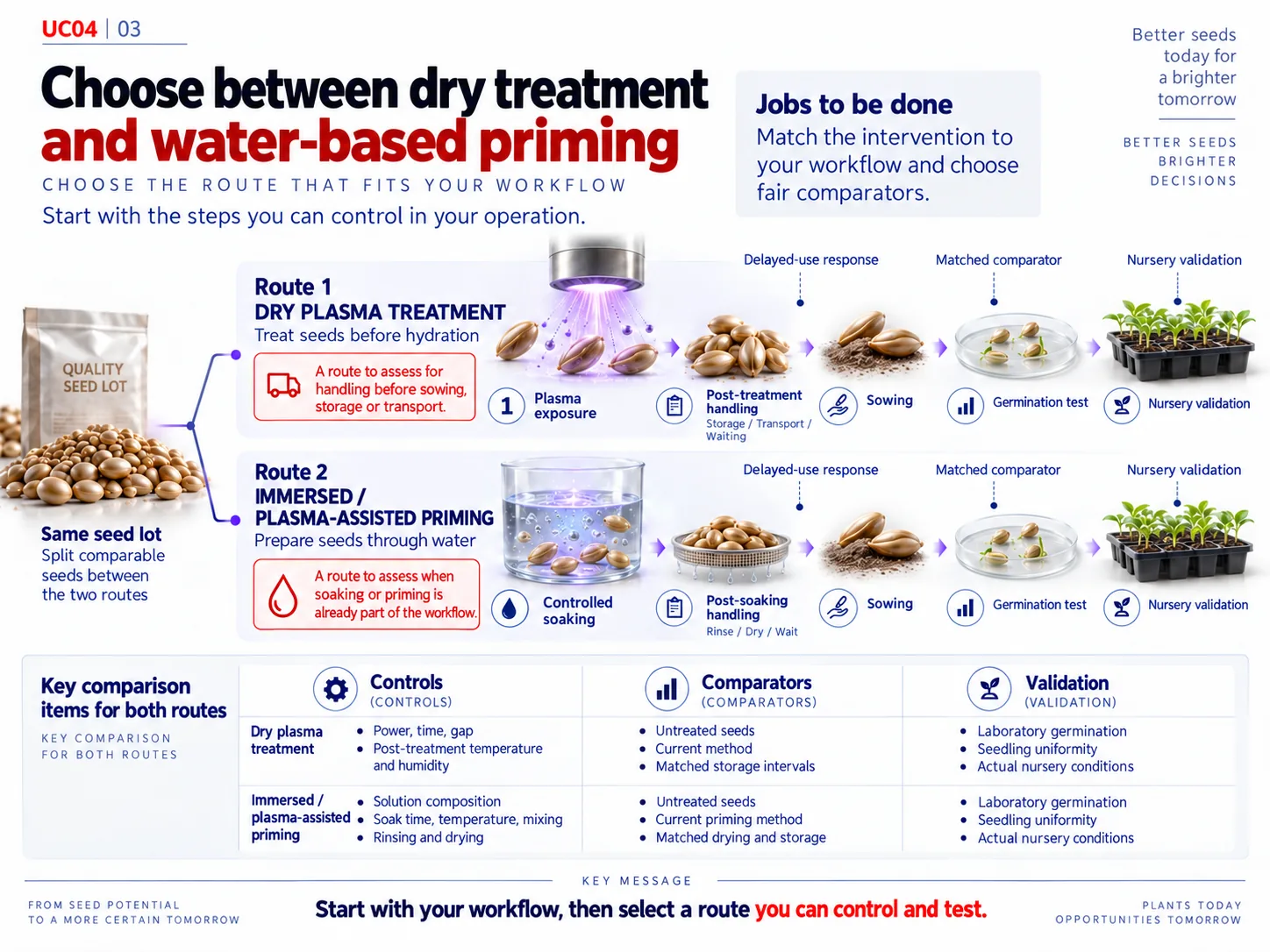
- 01 Lot & baseline
- 02 Choose a dry / immersed route
- 03 Control handling
- 04 Germination test
- 05 Nursery validation
Plasma Innovations can use this evidence to define lot-specific feasibility studies, distinguishing plasma-treated seeds, activated water and their combined use in each experimental design. This supports collaboration with both seed-preparation teams and nursery-system developers
Key messageMatch the intervention to the process steps the user can control
How can you build on a promising result?
Different teams value different outcomes. Connect the problems of seed producers, nurseries, system developers and R&D teams to the evidence each needs for its decisions
| User / Problem | Plasma fits / potential value | What to validate | Partner / Possible path |
|---|---|---|---|
| Seed producer / Variable germination between lots | Before lot release / Develop a lot-specific response | Final%, speed, normal seedlings, delayed use | Seed laboratory + Producer / Feasibility → Treatment service |
| Nursery / Uneven seedling readiness | Before sowing / Consistent readiness | Time distribution, emergence, usable seedlings | Nursery + integrator / pilot → process integration |
| Nursery-system developer / Seed preparation | Seed preparation module / repeatability | Multiple lots, handling, capacity and quality | OEM + seed specialist / co-development |
| Breeder / Genotype-specific response | Screening / Select conditions worth studying | Species × lot × environment interaction | University + Breeder / Research partnership |
Nurseries / CEA
Plan nursery cycles more reliably
Aim for enough usable seedlings with a narrower readiness window
Follow through to: filled cells, readiness window, re-sowing / variability
Seed producers
Select responsive lots for further development
Identify lots that respond while retaining the required quality
Follow through to: lot response, delayed use, quality, repeatability
System developers
Add a seed-preparation step that creates practical value
Once results are repeatable, develop integration with the actual system
Follow through to: workflow fit, handling, traceability, repeatability
Breeding / R&D
A system for screening crop and lot responses
Screen species, cultivars and lots systematically before choosing a development route
Follow through to: response limits and decision rules
Choose one primary question per pilot and assign responsibility for quality assessment at the start. If the seed seller and nursery use different criteria, agree on both before judging success
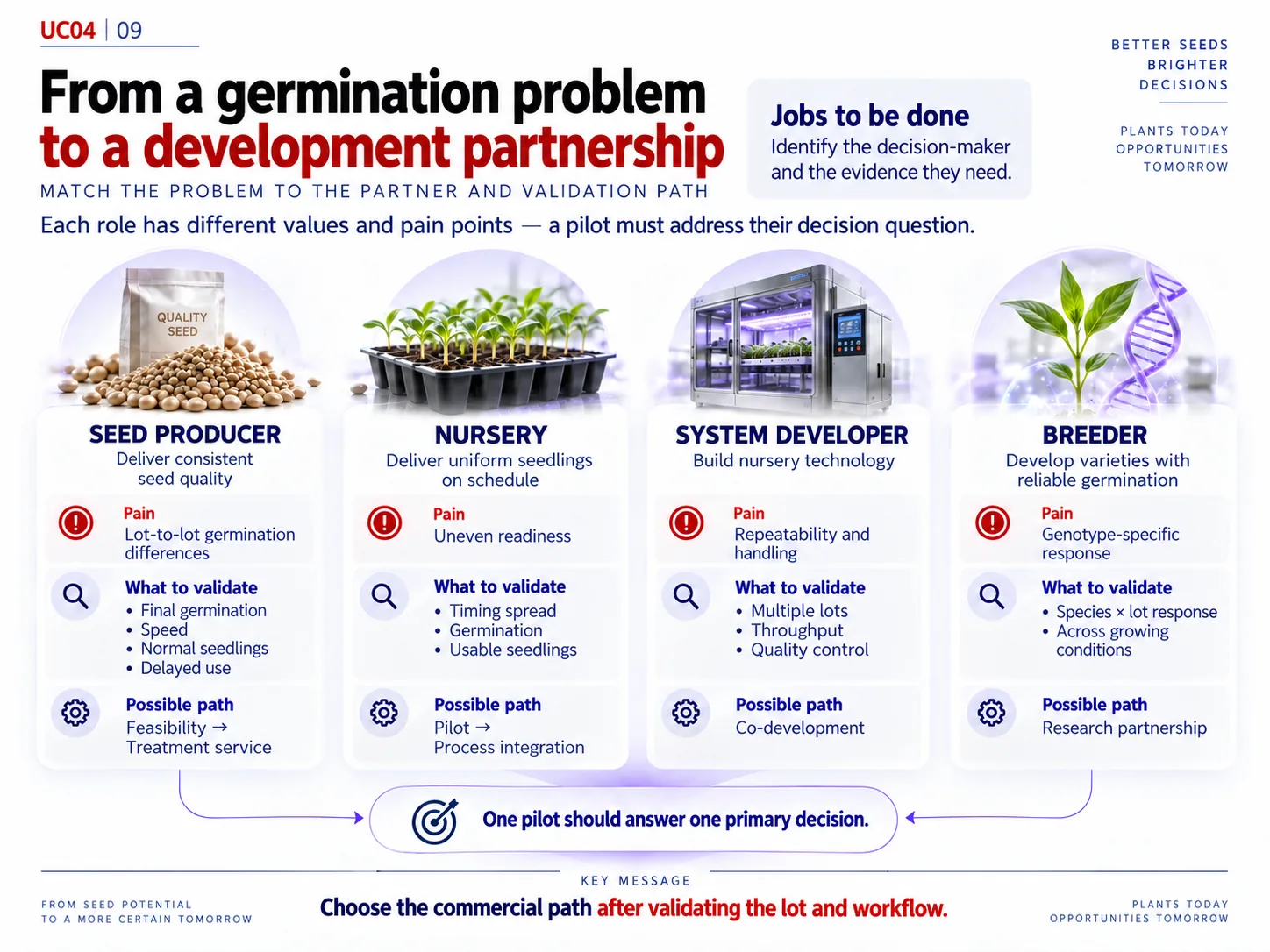
Key messageOnce results are clear for the lot and workflow, choose the appropriate delivery model
A useful trial ends with a clear next-step decision
Design a trial that answers the question
Start with a documented lot and baseline. Agree on the sowing method, germination definition, counting intervals and normal-seedling criteria. Compare the selected intervention with the current process, using replicates and distributing sample positions to reduce growing-condition effects
Next, test repeatability across lots and operating cycles, including waiting periods after treatment. One promising sample result can justify further study, but an operating range for practical use requires repeated evidence
Start small, with a question the trial can answer: One primary problem + One lot + A clear current method + Measurements agreed before starting So the trial produces a decision, with a defined scope and endpoint
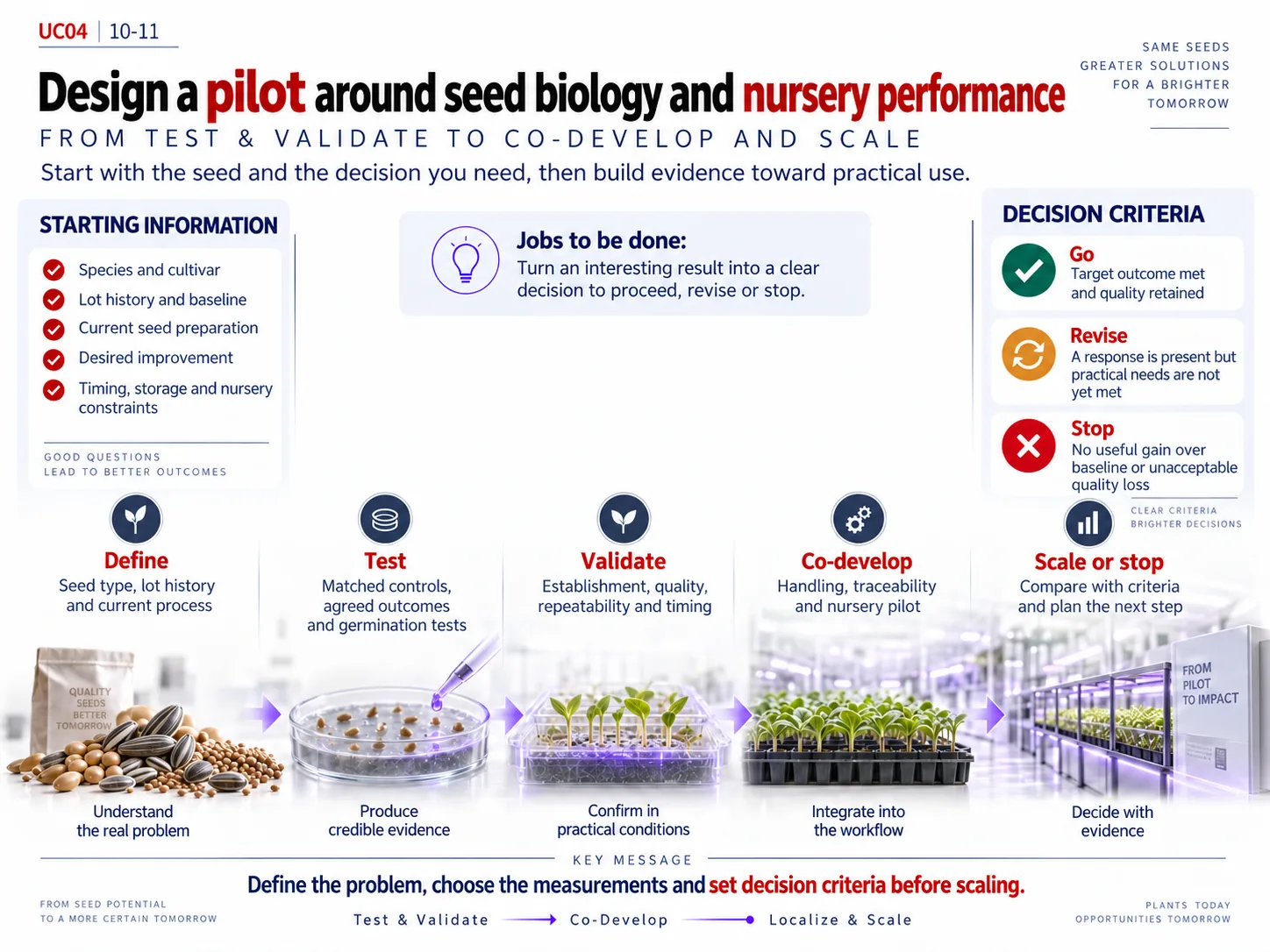
- 01 Test: matched controls
- 02 Validate: germination + quality
- 03 Co-develop: handling window
- 04 Pilot: repeat lots
- 05 Scale: evidence-based decision
Integration requires seed handling, traceability, cleaning and gas management to be considered with the system developer. Increasing throughput must preserve clear treatment groups and the ability to track seed quality
Key messageA useful pilot has decision criteria from the start and tracks quality throughout the workflow
Compare your actual lot first, then decide the next step
Start with seed species and cultivar, lot history, baseline germination, the current preparation method and the desired improvement. Include constraints involving waiting time, storage, seed coating or the sowing system
Design a small trial with a primary outcome and the quality criteria that must be retained. Develop toward practical use once the results are repeatable
Describe the main problem
Too few plants / Long waits / Uneven readiness, together with the cultivar, lot history and current seed-preparation method
Provide samples for comparison with your current method
Agree on the comparators, measurements and quality criteria
Receive evidence for the next decision
A clear recommendation on whether to repeat, adjust conditions or expand the trial
Once results are clear, decide whether to repeat, adjust or expand. Then choose a model that fits the operation, such as a trial service, process co-development or integration into production
Key messageTest → Confirm repeatability → Co-develop → Scale, with lot quality guiding the next step
A lot that germinates incompletely, slowly or unevenly? Send us the lot details and current preparation method to design a focused, small-scale trial for your operation Discuss your seed-priming trial with Plasma Innovations
Match the numbers to the problem: more, faster and more uniform
Final germination percentage is the proportion of seeds germinating within the test window. Mean germination time (MGT) summarizes germination timing, while uniformity describes the spread of germination times within a group. Improvement in one does not establish improvement in the other two
A count on one day may show one group ahead, while both groups reach similar final germination. Measurements over time distinguish earlier germination from an increase in the final number germinated, helping identify the benefit relevant to the user
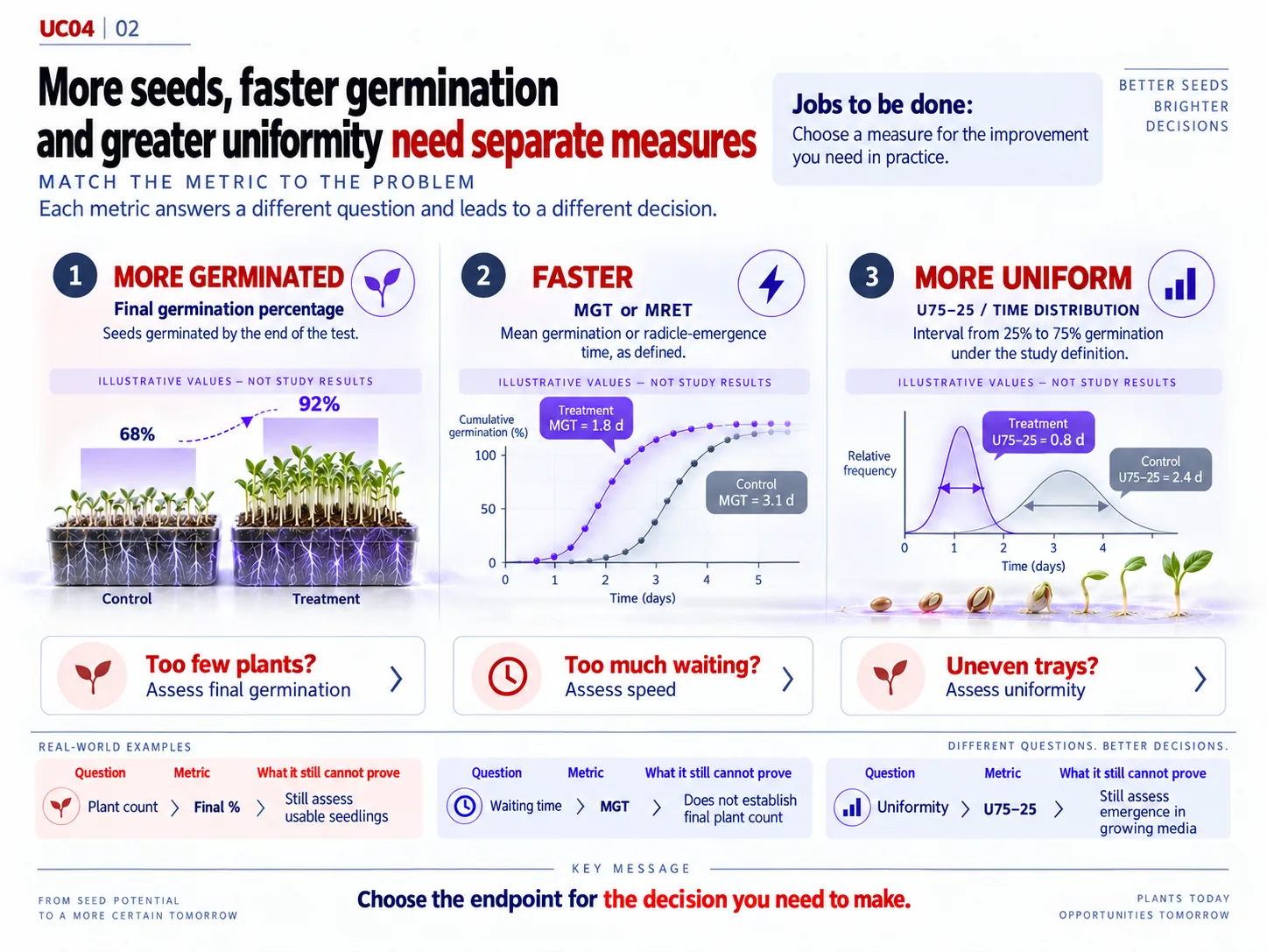
| Question | Measurement | What to assess in practice |
|---|---|---|
| Do more seeds germinate? | Final germination % | Normal seedlings and emergence in the growing medium |
| Do seeds germinate sooner? | MGT or MRET, as defined in the study | Total time to usable seedling readiness |
| Do seeds germinate more uniformly? | U75–25 / time distribution | Tray uniformity and reduced sorting work |
In Tephiruk et al. [4], U75–25 is the interval between 25% and 75% germination of viable seeds, as defined by the authors. A shorter interval means germination is concentrated within a narrower window. Rongsangchaicharean et al. [3] uses MRET, based on radicle emergence, so its definition must be reviewed before comparing it with MGT
Key messageAlign each outcome's name, denominator, time window and counting criteria
Use mechanisms to design a more focused experiment
Changes in surface wettability describe how a water droplet interacts with the seed. Germination also depends on internal water uptake, seed condition and the growing environment. The bulk-hydration evidence in Rongsangchaicharean et al. [3] reinforces why apparent contact angle alone cannot predict germination
For water-based routes, reactive oxygen and nitrogen species (RONS) contribute to the chemical explanation. Hormonal, gene-expression and signaling mechanisms remain interpretations unless directly measured in the cited study
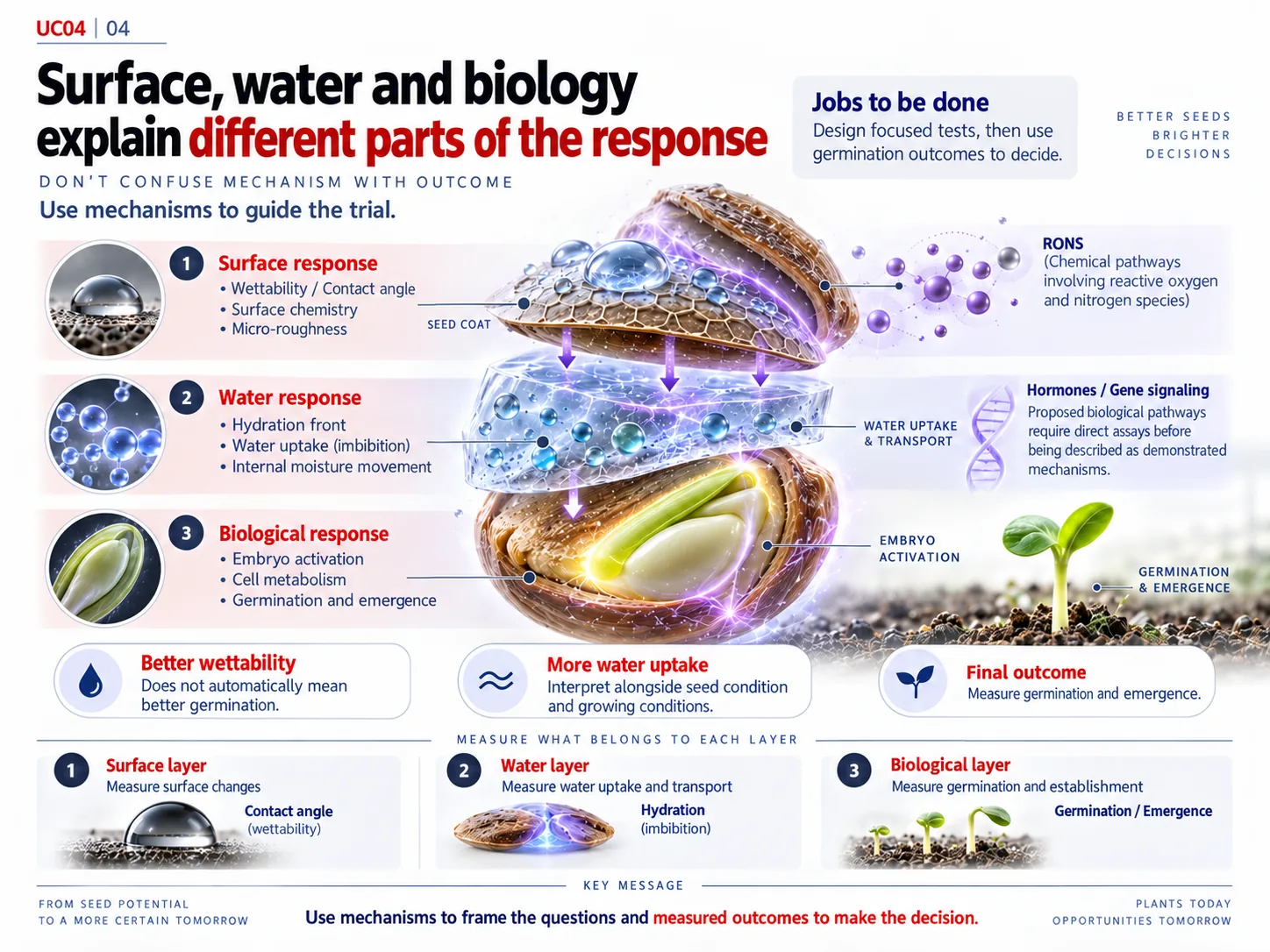
Include untreated and handling controls, along with the priming method the user currently applies. Match the time and conditions experienced by the seeds. Unequal water exposure between plasma and control groups can make the treatment's contribution difficult to isolate
Key messageUse mechanisms to frame the experimental questions and germination results to guide the decision
Start a trial with your lot
Compare your actual lot with your current method first, then decide the next step. Contact the Plasma Innovations team at [email protected] to design a small trial with a primary outcome and the quality criteria that must be kept.
Email the research team[email protected]See other cold plasma use cases →What to prepare
- Main problem: too few plants, long waits or uneven readiness
- Species, cultivar and lot history
- Baseline germination and current seed preparation method
- Constraints on waiting time, storage, seed coating or the sowing system
References
- Khamsen N., Onwimol D., Teerakawanich N., Dechanupaprittha S., Kanokbannakorn W., Hongesombut K., Srisonphan S. (2016). Rice (Oryza sativa L.) seed sterilization and germination enhancement via atmospheric hybrid nonthermal discharge plasma. ACS Applied Materials & Interfaces, 8, 19268–19275. doi:10.1021/acsami.6b04555
- Srisonphan S. (2018). Tuning surface wettability through hot-carrier-initiated impact ionization in cold plasma. ACS Applied Materials & Interfaces, 10, 11297–11304. doi:10.1021/acsami.7b19495
- Rongsangchaicharean T., et al. (2022). Effect of dielectric barrier discharge plasma on rice (Oryza sativa L.) seed hydration and hygroscopicity. Journal of Physics D: Applied Physics, 55, 365201. doi:10.1088/1361-6463/ac791d
- N. Tephiruk, K. Ruangwong, S. Suwannarat, W. Kanokbannakorn, and S. Srisonphan, "Electrohydraulic discharge induced gas-liquid interface plasma for seed priming in hydroponics," IEEE Access, vol. 11, pp. 124634–124642, 2023, doi: 10.1109/ACCESS.2023.3329811.
- Srisonphan S., Ruangwong K., Thammaniphit C. (2020). Localized electric field enhanced streamer cold plasma interaction on biological curved surfaces and its shadow effect. Plasma Chemistry and Plasma Processing, 40, 1253–1265. doi:10.1007/s11090-020-10098-8
- Molina R., et al. (2018). Influence of irrigation conditions in the germination of plasma treated Nasturtium seeds. Scientific Reports, 8, 16442. doi:10.1038/s41598-018-34801-0
- CDC/NIOSH Pocket Guide — Ozone
- Cornell University CEA — Hydroponic Lettuce Handbook (2013)
- IRRI Rice Knowledge Bank — How to ensure seed quality