Solar Greenhouse Innovations for Elevating High-Value Agriculture in Thailand: Lessons from the Tanba Regional Social Systems Research Foundation
By Dr. Wuttipong Panitsetthakorn
TIBD Co., Ltd.
In an era where the world faces challenges such as Climate Change, Food Security, and the Energy Transition, integrating solar power generation technology with agricultural infrastructure known as Agrivoltaics has become a crucial global strategy. However, applying this technology in a tropical, highly humid region like Thailand requires profound knowledge and advanced innovations that transcend the limitations of conventional solar panels.
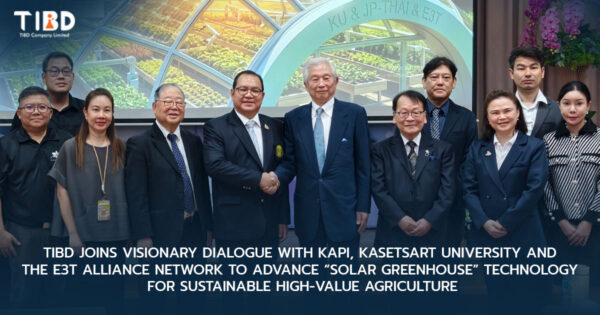
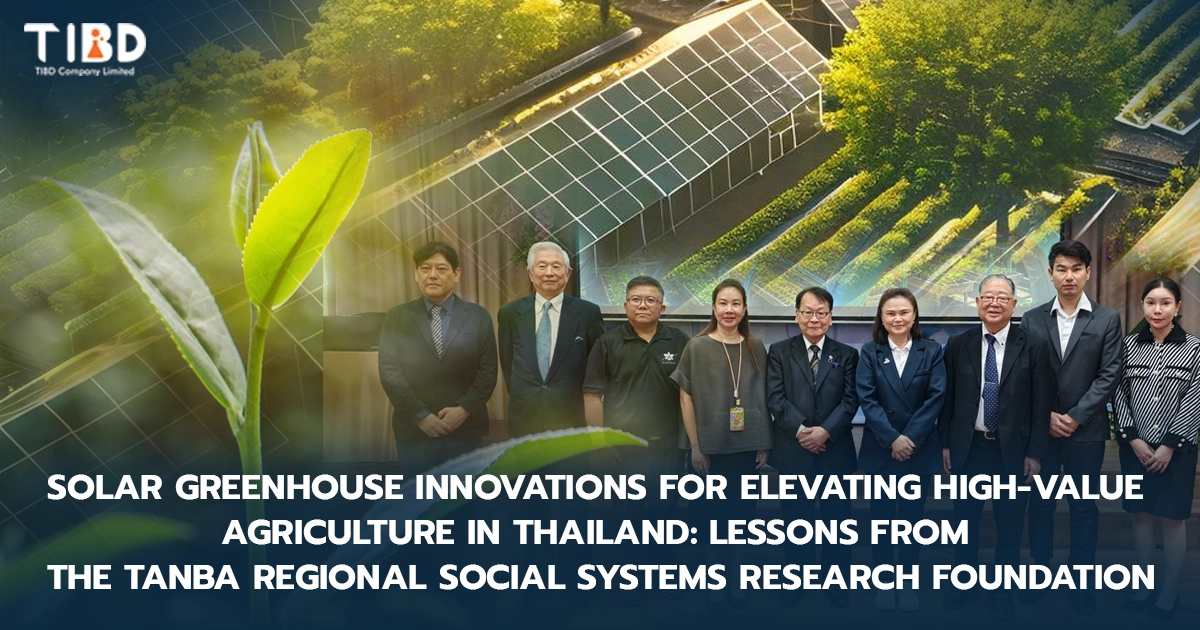
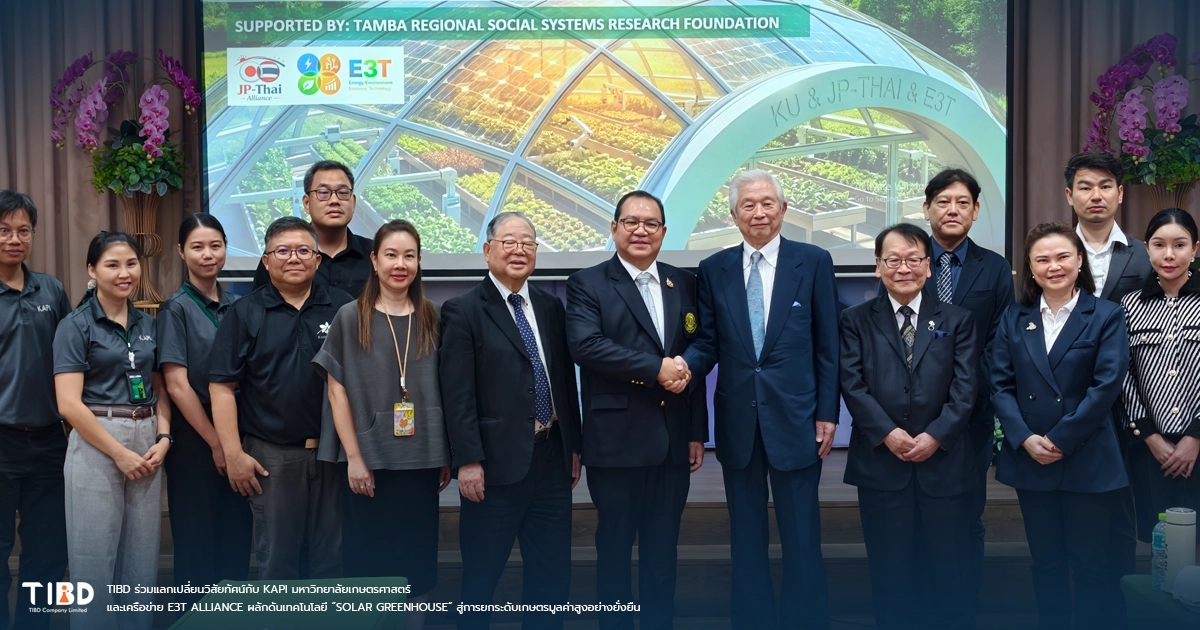
As the President and Founder of TIBD Co., Ltd., I am committed to delivering sustainable innovations and business solutions to enhance the competitiveness of Thai industries. Recently, TIBD had a significant opportunity to engage in visionary discussions with leading business executives and researchers from Japan, led by Mr. Koshiro Ikehata (Chairman), Mr. Kimio Miyamoto (Executive Officer), and Mr. Tadashi Sato (Vice Representative) of the Tanba Matcha Project Development Committee under the Tanba Regional Social System Research Foundation.
This meeting was not merely a business networking event, but a profound exchange of knowledge regarding the development of High-Value Crops, particularly the Matcha green tea industry. It is well known that Japanese farmers possess world-class expertise in controlled-environment agriculture, specifically in “light and shade management” to stimulate tea plants to produce the amino acids responsible for umami flavor. This deep understanding of Plant Physiology is the key when integrating advanced technologies like the Solar Greenhouse into national-level projects such as the E3T Solar Greenhouse.

The Challenge of Agrivoltaics in Tropical Climates
Thailand’s climate poses extreme challenges for Controlled-Environment Agriculture. With ambient temperatures frequently exceeding 35 degrees Celsius, severe UV Index levels, and relative humidity often surpassing 80% during the monsoon season, superficial installations of solar cell systems often result in economic losses rather than profits. We can divide the evolution of this technology into three tiers, which illustrates why Japanese innovation is the true solution.
Tier 1: Conventional c-Si Panels
The use of traditional crystalline silicon (Crystalline Silicon) solar panels—commonly seen on residential or factory roofs—installed on agricultural greenhouses causes two major physical crises:
- Complete Spectral Blockage: These panels are 100% opaque, completely blocking the Photosynthetically Active Radiation (PAR) within the 400 to 700-nanometer wavelength range. Consequently, farmers are forced to grow only shade-tolerant plants, which are typically low-value. It is impossible to cultivate high-value economic crops such as strawberries, tomatoes, or premium-grade tea.
- Severe Thermal Load: The dark materials of conventional solar panels act as solar radiation absorbers, converting unused energy into accumulated heat and directly emitting Thermal Radiation to the area below. This turns the greenhouse into a massive oven, forcing operators to consume massive amounts of electrical power on Active Cooling Systems just to keep the plants alive.
Tier 2: Semi-Transparent & Checkerboard Systems
To solve the shading problem, the industry attempted to develop partially transparent Amorphous Silicon panels or install opaque panels with spaced gaps (Checkerboard). However, these methods still have critical blind spots:
- Non-Selective Transmission: The light filtration of older materials is non-selective, meaning it simultaneously reduces the intensity of red and blue light, which are the primary food sources for plants.
- Spatial Heterogeneity: Spaced installations create an environment with stark contrasts between light and shadow, causing plants to suffer from an inability to adapt rapidly (Phototoxic Stress). This results in uneven crop growth, degraded quality, and severe difficulties in standardizing the harvest.
Leaping into the Future: Tier 3 Japanese Advanced Wavelength-Selective Technologies
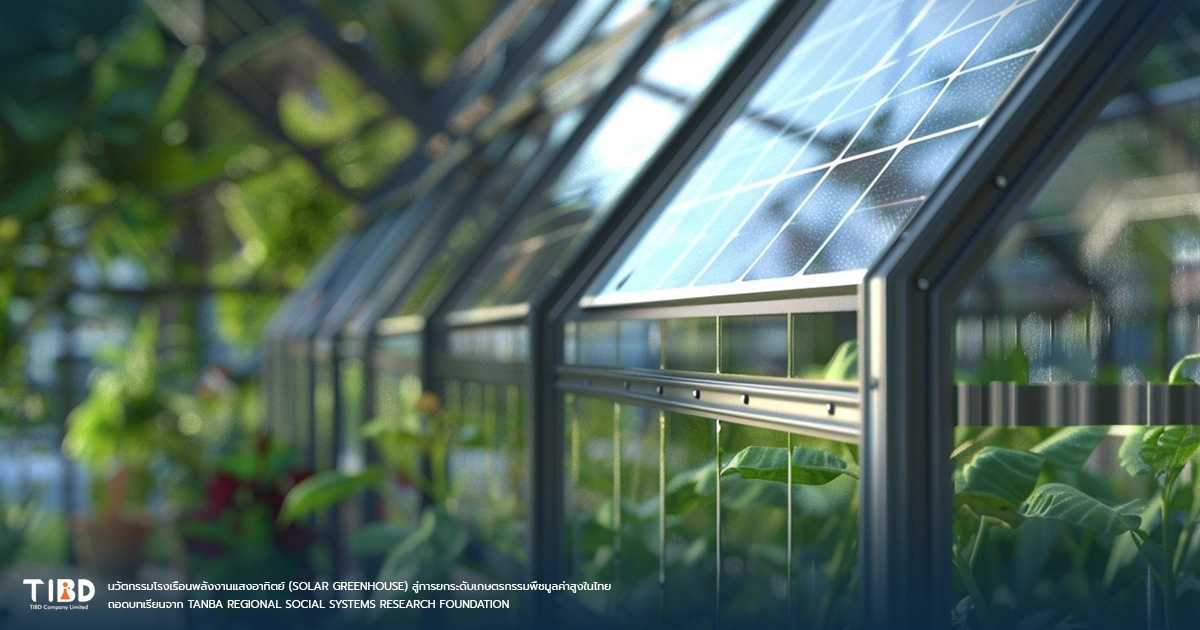
To completely shatter engineering and biological limitations, a consortium of leading businesses and research institutes in Japan pioneered the development of new-generation solar cell technologies. These are not just power-generating devices; they serve as “smart optical and thermal filters.” These technologies are the core components that TIBD recognizes for their potential to revolutionize Thai agriculture.
- Wavelength-Selective Organic Solar Cells (OSCs)
The innovation of Green-Light Wavelength-Selective Organic Solar Cells (GLWS-OSCs) is precisely engineered at the molecular level. Special polymer materials selectively absorb light in the “green-light region” (500–600 nanometers)—a wavelength range that most plants reflect and utilize inefficiently—to convert into electrical energy.
Simultaneously, these smart solar films allow “blue and red light” to fully penetrate the structure to the canopy below. These two light wavelengths correspond perfectly with the peak light absorption of Chlorophyll a and Chlorophyll b in plant leaves. This innovation is scientifically proven to enhance the Photosynthetic Rate of economic crops such as tomatoes, bell peppers, and strawberries significantly higher than cultivating them under any previous types of solar panels, perfectly answering the needs of holistic cultivation.
- Thermal Management & Radiative Cooling
Thailand’s greatest challenge is heat. The sunlight that hits the surface contains up to 49% Near-Infrared (NIR) radiation, which plants cannot utilize but is the primary cause of heat accumulation in greenhouses. Perovskite Solar Cells (PSCs) technology and advanced polymer films from Japan integrate nanoparticles capable of reflecting this NIR thermal radiation.
The most astonishing advancement is Passive Radiative Cooling technology. The materials are engineered to emit heat back into space through the Atmospheric Transparency Window at wavelengths of 8-13 micrometers. The engineering result is that these films can reduce the internal air temperature of the greenhouse by 4 to 5 degrees Celsius compared to standard plastic covers. This passive temperature reduction helps cut the Operational Expenditure (OPEX) of cooling systems by up to 20%, a figure that makes a massive business difference.
- Structural Dynamics & CAPEX Compression
A major hurdle preventing Agrivoltaics projects from scaling up is the Capital Expenditure (CAPEX). Glass-encased silicon solar panels are extremely heavy, necessitating the use of heavy-duty Venlo Glasshouse steel structures, which have exceptionally high construction costs.
In contrast, Tier 3 Perovskite (PSC) and Organic (OSC) films are manufactured using Roll-to-Roll Inkjet Printing processes on highly flexible substrates. This makes them up to 80% lighter than traditional glass panels. These ultra-thin innovations can be directly attached to plastic greenhouses, polycarbonate structures, or Hoop Houses using industrial adhesives, entirely eliminating the need for roof penetrations or heavy steel supports. This massive reduction in dead load allows investors to significantly compress structural CAPEX, accelerating the project’s break-even point.

Synergizing National Drivers: The “Triple Helix” Model and a Major Step with Kasetsart University
Discussions with the Tanba group crystallized TIBD Co., Ltd.’s perspective that merely importing superior technology into the country is insufficient for long-term sustainability. We must establish a deep-rooted “Innovation Ecosystem.” Therefore, TIBD is pushing forward with the Triple Helix Model, marked by an essential collaboration with Thailand’s premier agricultural academic institution, Kasetsart University.
Preparing to sign a Memorandum of Understanding (MOU) for the E3T Solar Greenhouse project with Kasetsart University opens a new dimension in commercial R&D. This integrates top-tier expertise from three primary sectors within the university:
- Kasetsart Agricultural and Agro-Industrial Product Improvement Institute (KAPI)
- Faculty of Agriculture
- Faculty of Fisheries
Fusing the specialized expertise of Kasetsart University, materials science technologies from the Japanese network (Tanba Group), and capital management along with commercial strategies by TIBD will create a powerful synergy, truly transforming Thailand’s agricultural industry into the 5.0 era.
High-Yield ROI & Economic Viability
From an economic and investment standpoint, the E3T Solar Greenhouse project, driven by this advanced technology, will completely shift the traditional paradigm of agriculture:
- Dual-Use Revenue: Applying wavelength-selective technology enables farmers to cultivate premium economic crops (e.g., high-grade matcha, vertical strawberries, or medical herbs), which yield a production value exponentially higher than typical field crops. The revenue from agricultural produce will become the primary cash flow of the project.
- Utility Green Tariff (UGT): Supported by the new regulations from Thailand’s energy regulatory body promoting green electricity purchasing rates, the greenhouse’s ability to generate electricity for self-consumption to lower business utility bills (Avoided Cost) or sell Carbon Credits will cause the project’s Internal Rate of Return (IRR) to increase exponentially.
A New Dimension for Thai Agriculture and TIBD as the Leader of Change
I firmly affirm that the future of Thai agriculture is no longer limited to traditional land expansion, but relies on applying advanced engineering innovations to create climate-resilient production systems that meet global market demands.
Integrating high-value crop management knowledge from the Tanba Regional Social System Research Foundation with materials science technology from Japan, through the professional management of TIBD Co., Ltd., is the path that will lead Thailand’s agricultural and energy industries to become the leader in Southeast Asia.
This article is recorded as an academic and business online record, serving as a benchmark for those interested in advanced technologies. If any organization, government agency, or investor sees the opportunity in developing Agrivoltaics / Solar Greenhouse systems, conducting project feasibility assessments, or establishing strategic partnerships for sustainable growth, TIBD is ready to be your most trusted consultant and business partner. Let us join together to build a future of economic prosperity alongside the sustainability of natural resources.
References / Academic References
- Campana, P. E., et al. (2021). Building Integrated Photovoltaic (BIPV) in Southeast Asian Countries: Review of Effects and Challenges. Sustainability, 13(23), 12952. https://doi.org/10.3390/su132312952
- Fukuda, K., & Someya, T. (2023). Green-light wavelength-selective organic solar cells for agrivoltaics: dependence of wavelength on photosynthetic rate. Faraday Discussions, 250, 100-115. https://pubs.rsc.org/en/content/articlelanding/2024/fd/d3fd00141e
- International Energy Agency (IEA-PVPS). (2025). Dual Land Use for Agriculture and Solar Power: Agrivoltaics. IEA Photovoltaic Power Systems Programme (Task 13 Report).
- Park, S., et al. (2023). Ultraviolet-Resistant Flexible Perovskite Solar Cells with Enhanced Efficiency Through Attachable Nanophotonic Downshifting and Light Trapping. Advanced Energy Materials. https://doi.org/10.1002/aenm.202301111
- Sonneveld, P. J., Swinkels, G. L. A. M., & Bot, G. P. A. (2011). Solar Energy Delivering Greenhouse with an Integrated NIR filter and a Solar Cooling System. Acta Horticulturae, 893, 255-262. https://doi.org/10.17660/ActaHortic.2011.893.26
- Yin, X., et al. (2024). Crop Performance and Photochemical Processes Under a UV-to-Red Spectral Shifting Greenhouse: A Study on Aubergine and Strawberry. Agriculture, 15(6), 569. https://www.mdpi.com/2077-0472/15/6/569