

Cold Plasma / UC09
Use case UC09 · PAW in early cultivation
Uneven seedlings? Start by testing the water
Change the water at one point, then measure how seedling establishment and uniformity respond. Sunflower studies show that PAW can produce measurable differences in early growth. The next step is to test it with your own water, crop and growing system.
Research by Assoc. Prof. Dr. Siwapon Srisonphan and the Plasma Innovations team, Department of Electrical Engineering, Kasetsart University
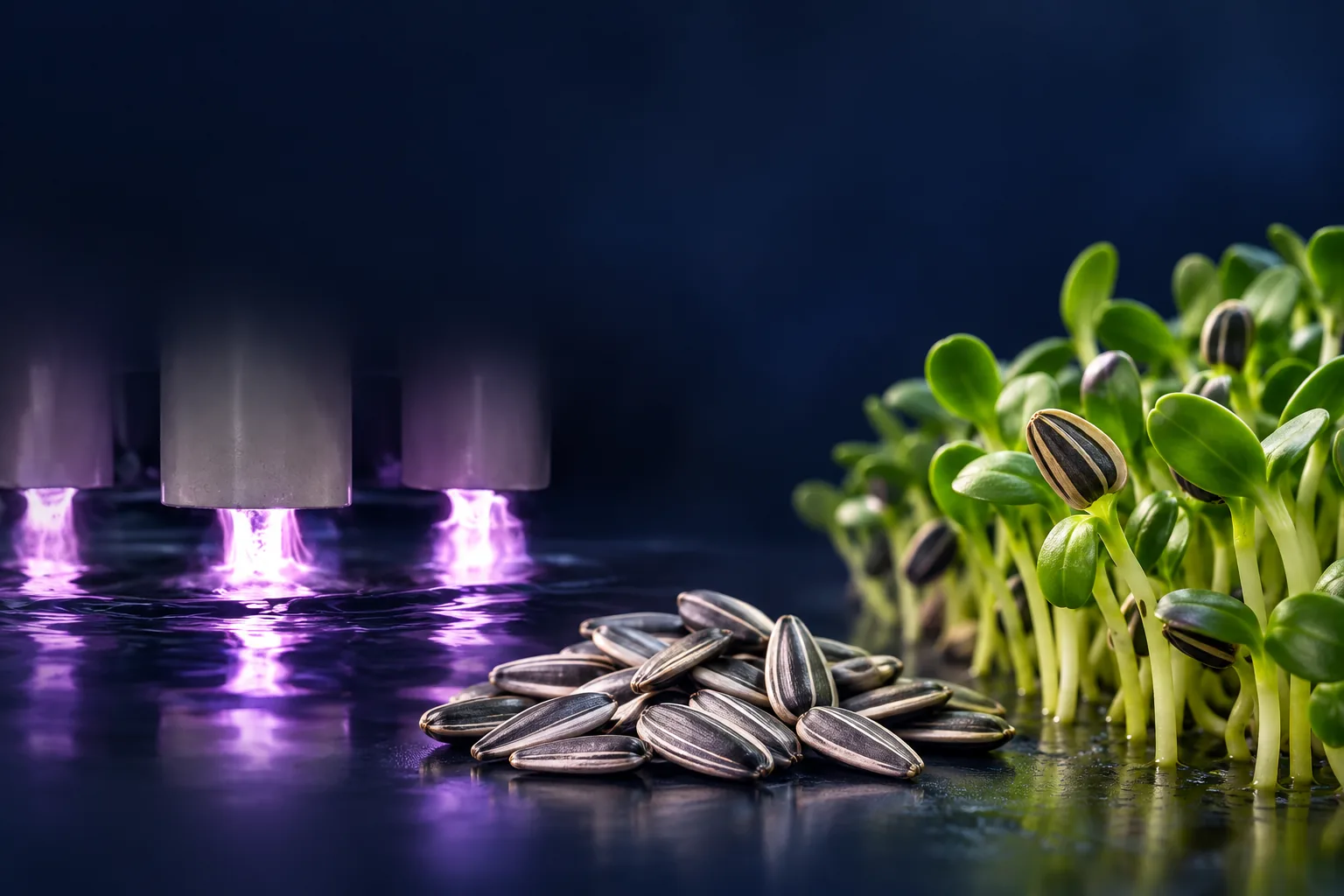
4 groupsDI water, PAW, DBD+DI and DBD+PAW separate water, seed and combined effects
H2O2 · NO3−Measured in PAW and compared with DI water
1 changeChange only the water, then compare seedlings with your current water
Figures in this article are laboratory results under the conditions of the cited studies. Results with your own lot or growing system need to be tested.
Seeds have germinated—why are the seedlings still uneven?
Growers need more seedlings that establish well, develop consistently and are ready for use.
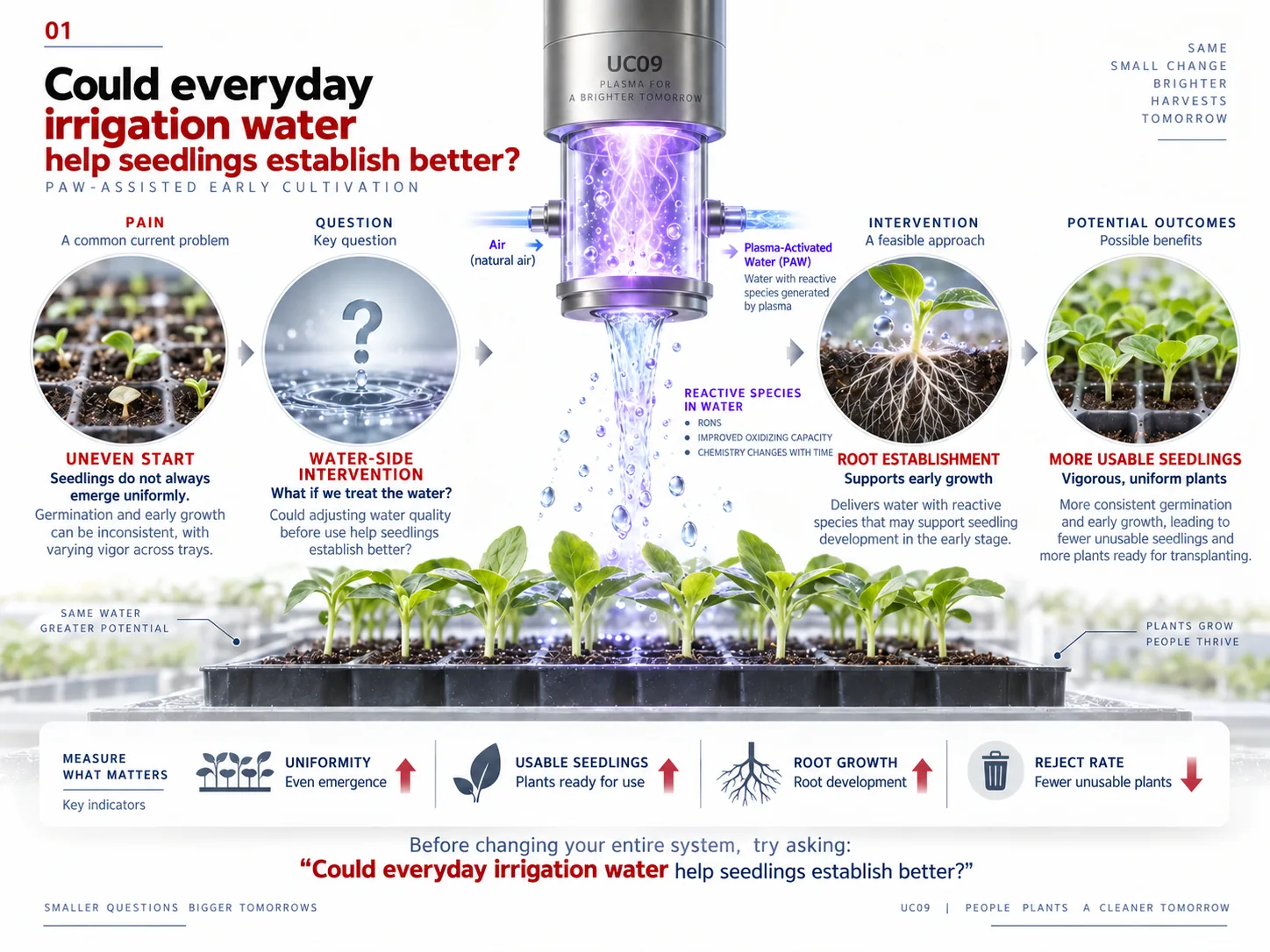
Develop the water route around the plant's early needs
Trays, greenhouses and controlled environment agriculture (CEA) let growers observe the relationship between water, substrate and early development closely. Consistent water quality is therefore both a cultivation issue and a process-control issue.
PAW allows water properties to be adjusted before application. Sunflower studies illustrate PAW-only outcomes as well as comparisons separating seed and water treatments.
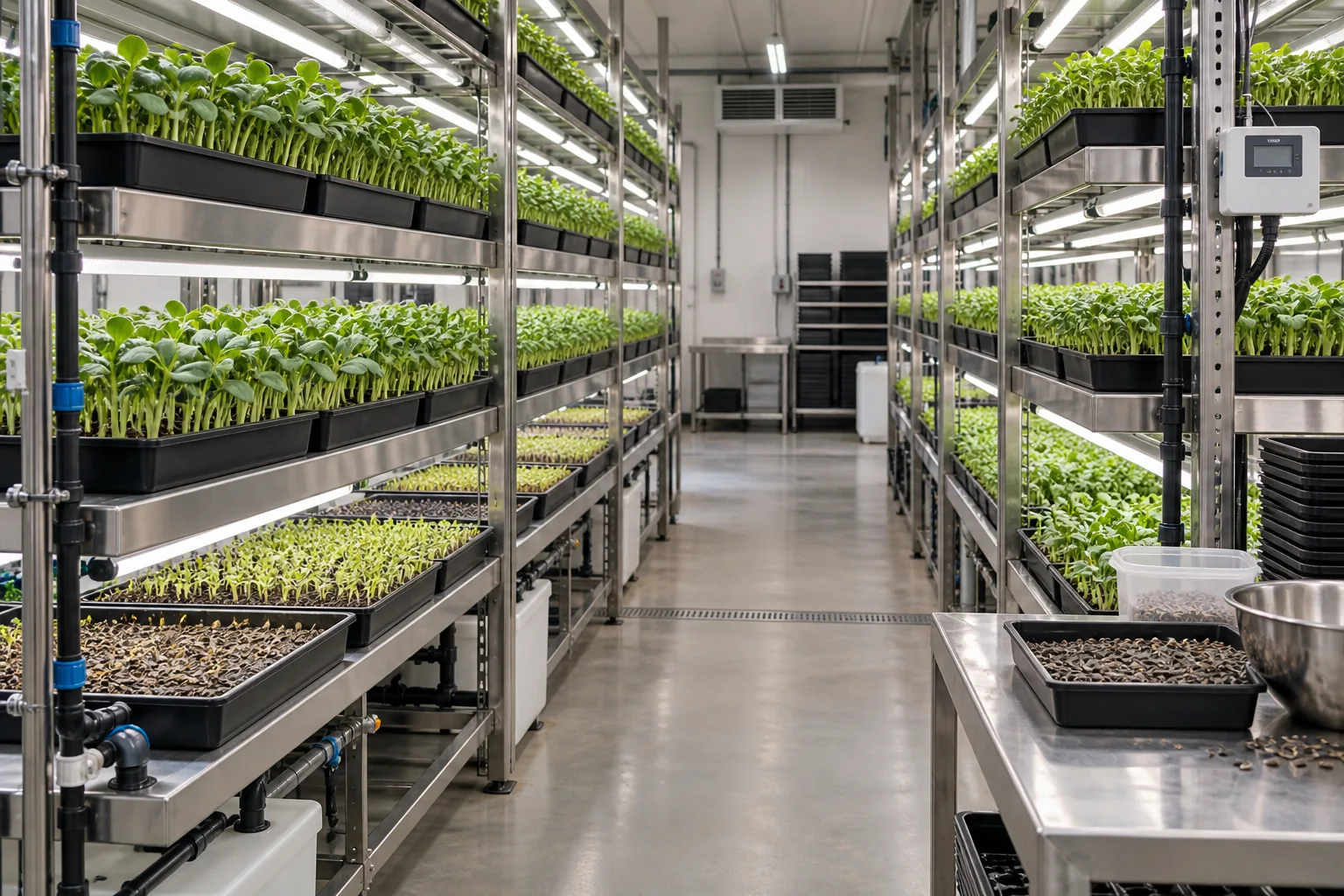
Start by adding a measurable water-side control point, then test whether characterized water improves establishment. The approach can be explored in nurseries, CEA and other crops.
Growers, water-system developers and collaborating partners
Sunflower growers and early-cultivation developers connect most directly with our evidence. Other nursery and CEA growers may find the approach relevant where seedling consistency or water handling is a clear trial question.
Irrigation and water-treatment developers integrate preparation, storage, delivery and quality checks. Cultivation specialists and laboratories help connect measured chemistry with actual plant responses.
Who needs to work together from water to seedlings? Give water operators and cultivation teams shared criteria
- Growers Crop acceptance criteria · Workflow and output data
- Water-system operators Preparation and delivery · Materials / handling
- Laboratories Chemistry and response · Controls / interpretation
- Technology team Repeatable preparation · Maintenance / delivery model
Connect water and cultivation teams from the start. Agree desired outcomes and measurable variables before developing a practical delivery model.
What mattersStart with characterized water, then demonstrate value for the crop and the process. PAW value depends on connecting water management with cultivation outcomes.
Where can PAW fit without complicating the system?
Start at a point you can control and compare within the existing process
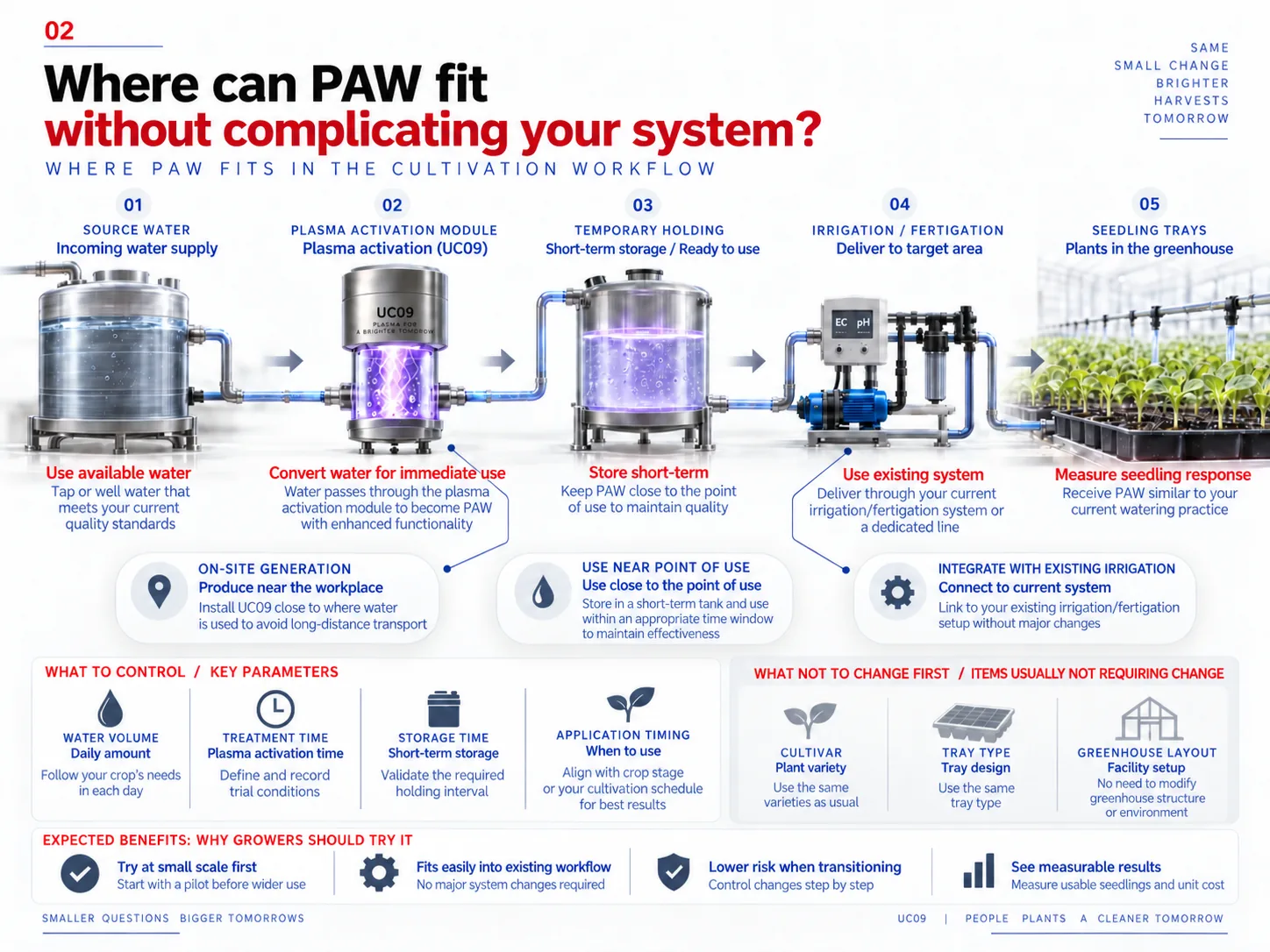
UC09 begins with source water, plasma preparation and quality checks, followed by delivery to the crop. This isolates the water-side response without changing seed preparation at the same time.
Change only the water first and compare with the current method. If seed treatment is later added, include groups that separate each contribution.
The water route from source to seedling Separate water treatment from direct seed treatment to identify each contribution
- 01 Source water Check source-water quality · Record nutrient inputs
- 02 Prepare PAW Define the trial scope · Agree treatment conditions
- 03 Characterize pH / EC / relevant analytes · Check quality after preparation
- 04 Hold and deliver Record handling and water age · Check at the point of use
- 05 Cultivate Crop / substrate / controls · Track the early response
- 06 Validate value Usable output / variation · Water / energy / cost
Batch preparation and treatment near the delivery point are possible integration concepts to test. A vessel-scale result does not determine how to connect PAW to a farm's nutrient tank or recirculating loop.
What mattersIdentify the water-side contribution before combining it with a more complex workflow.
What should you know before using PAW?
PAW describes how water was prepared; point-of-use measurements describe what the plant receives
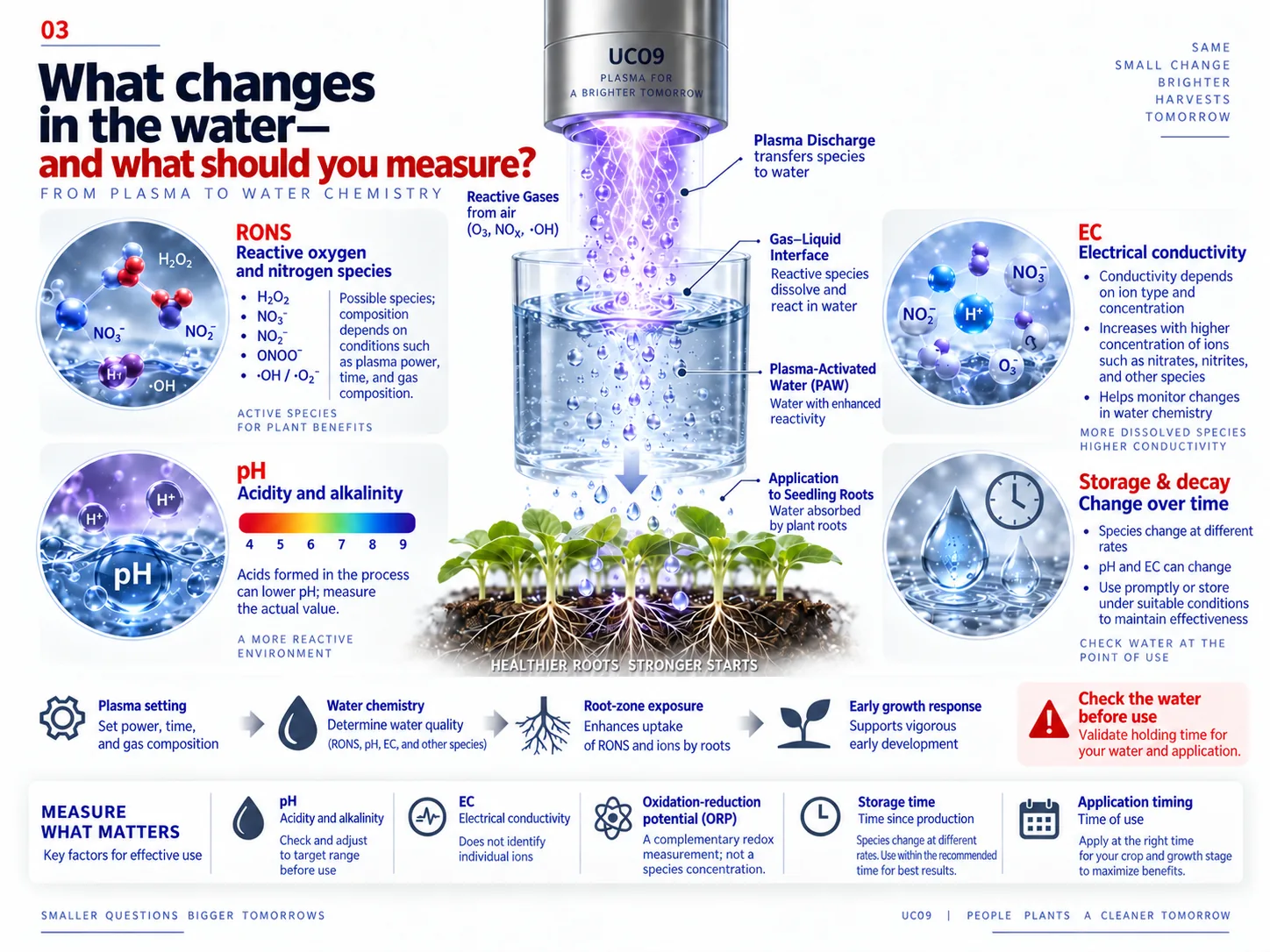
Describe PAW with measurements
Plasma interaction can change water composition and properties. Identify the properties of the water actually delivered to the plants.
Reactive oxygen and nitrogen species (RONS) provide a useful framework, but species shown in a mechanism diagram were not necessarily all measured. For each study, identify what was tested, in which water and at what time.
The practical questions are: what are the properties of ready-to-use water, and how do seedlings respond? Measure both water and plants.
Start with the source water, then check again at use
Tap, groundwater, DI water and nutrient solutions start differently. Use the actual source water and measure before and after treatment to establish what changed.
Select pH, conductivity and relevant species such as nitrate or hydrogen peroxide according to the hypothesis, using methods suited to the sample matrix. Equal EC does not establish identical composition.
Start with source water and check again at use Choose measurements around the hypothesis and actual water
- Source / matrix DI / supply / nutrient water · Record the relevant baseline
- Bulk properties pH / electrical conductivity · Use a matrix-appropriate method
- Relevant chemistry For example, NO₃⁻ and H₂O₂ · These do not represent every RONS
- At point of use Time / Container / Mixing · Check the water that actually reaches the plant
Record measurements after preparation and before use so cultivation results link to actual exposure. This checklist supports specification development; it is not a universal set of recommended values.
What mattersPAW describes the preparation route; characterization describes what reaches the plant. The water specification must describe what is delivered to plants.
What changes after plasma treatment?
Read measured water properties alongside seedling outcomes
Srisonphan et al. [2] pairs PAW preparation images with hydrogen peroxide and nitrate measurements against DI water, establishing differences in those measured variables before comparing cultivation outcomes.
Hydrogen peroxide and nitrate measurements distinguish PAW from the comparator water and help connect preparation with plant responses.
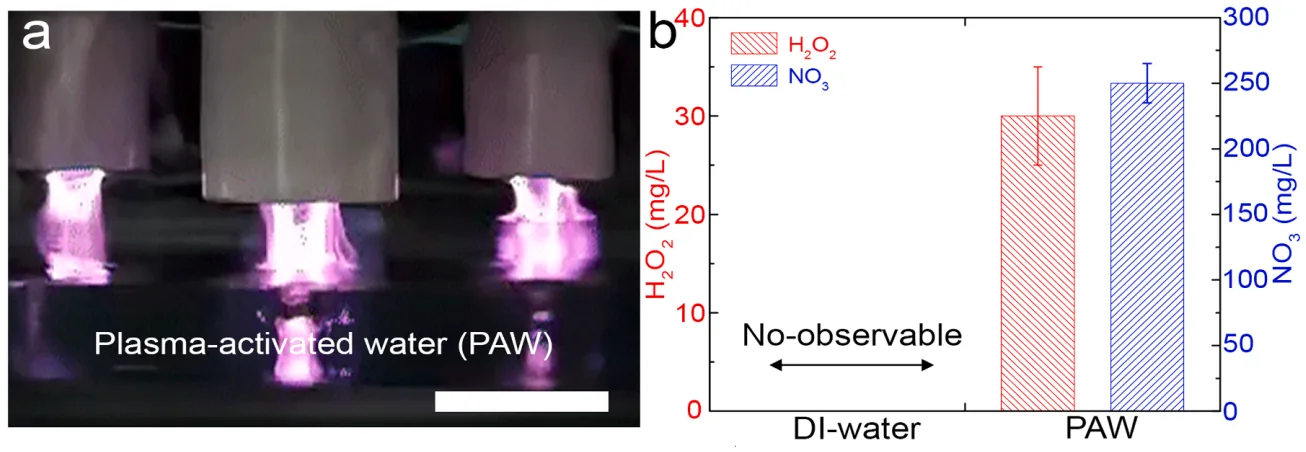
Water chemistry describes the change in the water; seedling measurements show how much that change matters for cultivation.
What mattersMeasured chemistry characterizes the water but does not identify every active cause.
Does changing only the water change seedling outcomes?
Sunflower trials help isolate the water-side PAW response
Tephiruk et al. [1] compared DI water with PAW in sunflower cultivation, changing primarily the water to examine early-growth responses more directly.
Graphs and seedling images show length and weight differences between DI-water and PAW groups, demonstrating a measurable early response to the water change.
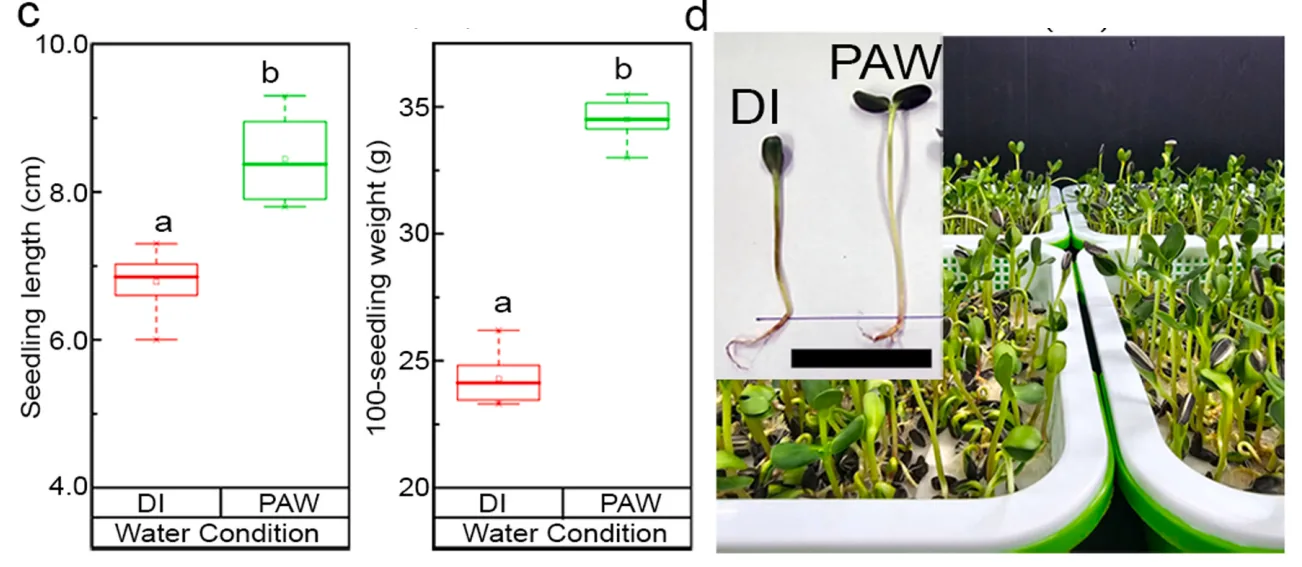
These early results are a starting point. Next, test their effect on usable seedlings, uniformity and output per tray in the grower's system.
What mattersPAW-only evidence supports a water-side trial; production value remains to be tested.
If both seeds and water change, how do you know what helped?
Separate the groups to identify water, seed and combined effects
Srisonphan et al. [2] compares DI, PAW, DBD+DI and DBD+PAW. This distinguishes water-only, seed-only and combined treatment. A combined result should not be attributed to PAW alone.
The four groups show how seed treatment, water treatment and their combination differ, helping select the route to develop next.
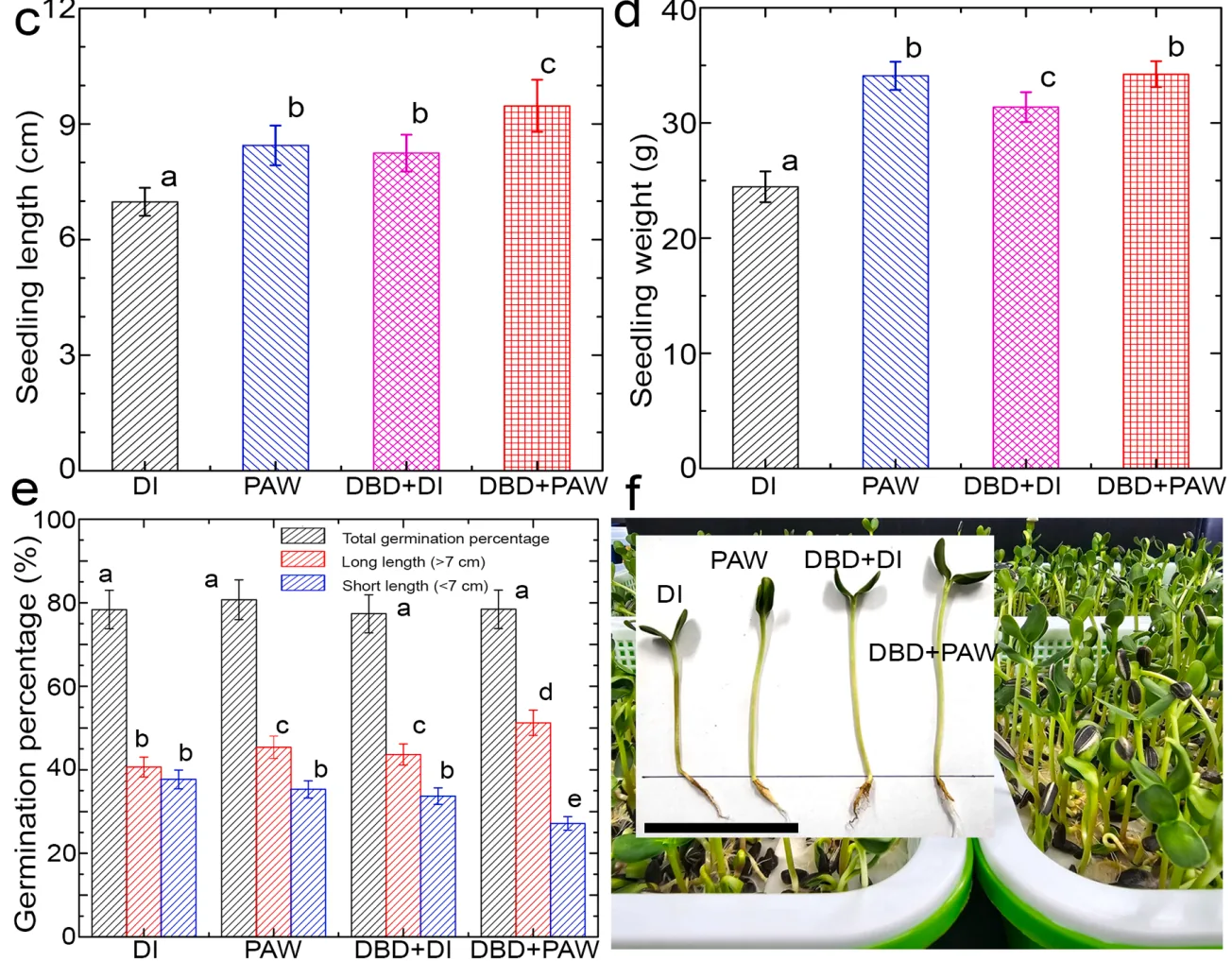
Projects using both interventions should retain this comparison and define outcomes in advance. For UC09 directly, PAW versus control is the primary comparison; combined treatment should be reported separately.
What mattersWater-only, seed-only and combined treatments answer different questions.
What in PAW might contribute to the seedling response?
Connect changes in water with changes in plants
Water properties may affect nutrient availability, signaling and plant responses, offering hypotheses linking chemistry with early growth.
Nitrate and hydrogen peroxide describe part of how PAW differs from the source water. Read them alongside plant outcomes.
From water properties to seedling responses Separate measured findings from mechanistic hypotheses
- Measured in the water Species actually measured · Match units and sampling time
- Possible contributors Nutrition / signalling · or stress, depending on conditions
- Observed seedling outcomes Length / biomass / quality · Use controls to identify contributions
External PAW studies illustrate the value of mock-chemistry comparisons and species-specific responses. In cultivation, use these lessons to design controls and check compatibility with microbial inputs used by the grower.
What mattersUse mechanisms to frame testable questions, then use results to judge value.
Is the prepared water still the same when it reaches the plant?
Does the water stay the same before it reaches the plant?
If water is held, mixed or delivered through a system, check it again at use
Maintain the required properties along the delivery route
Water may encounter containers, holding, mixing and delivery systems before reaching plants. Define the timing and handling route the application requires, then measure water properties across that interval.
Check again after holding, mixing or delivery to confirm that plants receive the water intended for the trial.
After preparation → After holding → At use Water properties must remain suitable throughout the required route
- After preparation Baseline PAW chemistry · Record the starting time
- After handling Container / Holding / Mixing · Check changes
- At crop contact Point-of-use water specification · Link with biological response
Scale-up requires more than volume: it must repeatedly deliver the specified water without disrupting cultivation. Define continue, adjust or stop criteria when properties move outside the validated range.
Design controls to identify what creates the difference
At minimum, include control water relevant to the user's workflow with comparable handling. Changing water, nutrients and seed preparation simultaneously obscures PAW's contribution.
To separate chemistry from process effects, consider matched-pH, nutrient-matched or mock-solution controls according to the hypothesis and practical scope. Each group should serve a clear decision.
Comparisons that clarify the result Choose controls around the project's hypothesis
- Water baseline Current water + Comparable handling · Isolate the PAW contribution
- Chemistry controls Matched / Mock controls as needed · EC does not describe all components
- Factorial comparison DI / PAW / seed-only / combined · When two interventions are used
- Crop response Replication / common endpoint · Do not combine maxima from different groups
Use randomization, replication and consistent outcome definitions, such as length, fresh/dry biomass and usable seedlings. Distinguish published research metrics from newly collected production metrics.
What mattersValidate the delivered water, not only the freshly activated water. Good controls make trial results useful for system design and project planning.
Which applications are suitable starting points?
Which applications suit PAW trials?
Start with a clear problem, measurable response and direct user value
Each growing system has different needs. Start with the outcome the user wants to improve and choose a practical PAW intervention point, whether in a nursery, CEA or another crop.
The table links user needs with possible PAW entry points, metrics and evidence required before scaling.
| User and problem | PAW entry point | Desired value | What must be demonstrated | Possible development route |
|---|---|---|---|---|
| Sunflower growers · Seedlings vary between cycles | Prepare and check PAW near the point of use during early cultivation. | More consistent seedlings and more plants ready for use | Point-of-use water quality + Early growth + Usable or saleable plants + Cost | Feasibility test → Pilot trial · With growers and plant laboratories |
| Nurseries / CEA · Need establishment that meets specification | Test only the water route before changing the current nutrient formulation. | More consistent, controllable early establishment | Crop and substrate compatibility + Nutrient control + Readiness criteria | Co-development → Application-specific solution · With growers and crop specialists |
| Water / Irrigation integrators · Need controllable water quality | Connect PAW generation → Quality checks → Point-of-use delivery. | Repeatable water preparation with clear acceptance criteria | Batch consistency + Holding time + Material compatibility + Water and energy cost | Integration trial → Near-use preparation or connection to the existing system · With integrators and quality-control staff |
Choose the route around actual user priorities. If storage or transport substantially changes PAW, consider near-use generation. If integrating with existing irrigation, involve system and water-quality teams from the trial stage.
What mattersDevelop the delivery model around demonstrated crop value and delivery requirements.
How can a trial show whether PAW is worthwhile in your system?
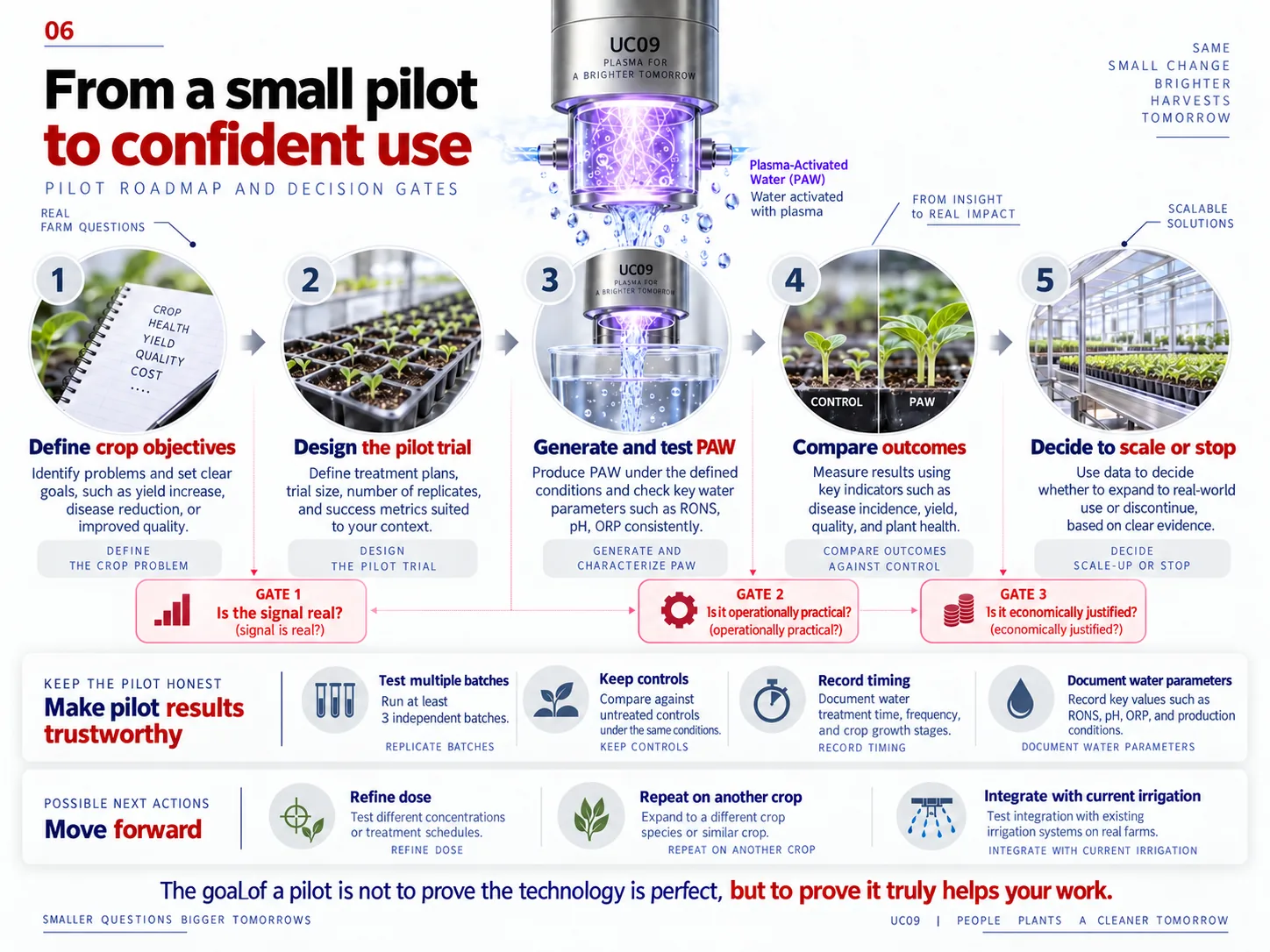
Define the crop, lot, substrate, water and growth stage. Select a few primary decision outcomes, such as usable plants or saleable mass per tray, with length, biomass and water properties supporting interpretation.
Alongside growth, track consistency between cycles, rejection rate, water, energy and unit cost so the decision reflects actual use.
PAW trial metrics Assess water quality, crop response and cost per usable output
| Dimension | What to track | Decision-supporting evidence |
|---|---|---|
| Water quality at the point of use | Specified values and consistency between cycles | Holding time + Compatibility with solutions and system materials |
| Plant response | Length, root development, biomass and quality | Clearly defined primary outcomes + Appropriate controls |
| Usable production output | Ready-to-use plant count or saleable mass | Between-cycle variation + Rejection rate |
| Delivery cost | Water, energy, time and labor | Cost per usable plant or unit of output |
Agree acceptance criteria and repeat across days or lots. When the effect is clear, refine conditions, repeat and move toward practical scale.
What mattersA pilot should demonstrate water quality, plant outcomes and cost per usable output.
If results are promising, how can PAW fit the existing system?
Start with water volume, timing, delivery points and the quality to preserve
Make preparation fit a system the user can operate
After a promising trial, evaluate volumes, timing, delivery points and water quality along the full route to design an appropriate integration.
Integration includes wetted materials, cleaning, batch checks and operator workload. Assess electrical and gas safety for the actual configuration and site requirements with the responsible specialists.
For recirculation or nutrient-solution integration, retest point-of-use water and plant responses to select a suitable connection method.
Let project evidence determine the delivery approach
Begin with actual water and crops at small scale. Once effects repeat, move closer to the producer's operating conditions.
Use validated conditions to design preparation, outlets, quality checks and maintenance around the site.
The practical model should match water volume, holding time, delivery points and usage frequency so the design serves the grower's needs.
What mattersUseful scale-up repeatedly delivers the required quality in the real workflow. Preserve value from preparation through to use.
Start a PAW project with your current water and crop
Share system details → Test → Refine → Repeat → Scale
Start with the crop and stage, current water and nutrients, substrate, delivery system, recurring problem and production metric. Design the trial around that question.
When water and crop results are clear, refine and repeat, then design integration at a suitable scale.
Test → Refine → Repeat → Scale From a water question to a verifiable early-cultivation application
- Test with a working system The problem to solve: Source water + crop stage · Define the required output · Small-scale trial: Characterize + controls · Isolate the water-side response · Assess usable outcomes: Point-of-use QC · Usable output / compatibility
- Refine together Adjust conditions: Grower + water partner · Specification / handling · Integrate with the current system: Repeatability / delivery · Energy / water / cost
- Move toward practical use Choose the operating model: Prepare water near use · An operating model suited to the system
Start with a simple question: “If we change only the water, how much do your seedlings improve?” Use that answer to design the next step for the real system.
What mattersCharacterize the water → Validate the crop → Build the delivery pathway.
Test PAW with your water and crop
Share your water, crop, delivery system and recurring problem. We will help design a small trial to find out whether PAW makes a meaningful difference to your operation.
Test PAW with your water and crop
Send your water, crop, delivery system and recurring problems to the Plasma Innovations team at [email protected]. We will help design a small trial to see whether PAW makes a meaningful difference to your operation.
Email the research team[email protected]See other cold plasma use cases →What to prepare
- Crop and growth stage of interest
- Current water and nutrients
- Growing medium and water delivery system
- Recurring problems
- Decision metrics, such as usable seedlings per tray
References
- Tephiruk N., Homkanchan S., Puttha J., Suwannarat S., Teerakawanich N., Kanokbannakorn W., Srisonphan S. (2025). CO2 reduction and seedling growth enhancement using dual-function gliding arc plasma system. Journal of Environmental Chemical Engineering, 13(5), 117567. doi:10.1016/j.jece.2025.117567
- Srisonphan S., Tephiruk N., Homkanchan S., Puttha J., Suwannarat S., Teerakawanich N. (2025). Synergistic DBD plasma and plasma-activated water enhance sunflower seed surface wettability and germination. Results in Engineering, 26, 105434. doi:10.1016/j.rineng.2025.105434
- CDC/NIOSH Pocket Guide to Chemical Hazards — Ozone